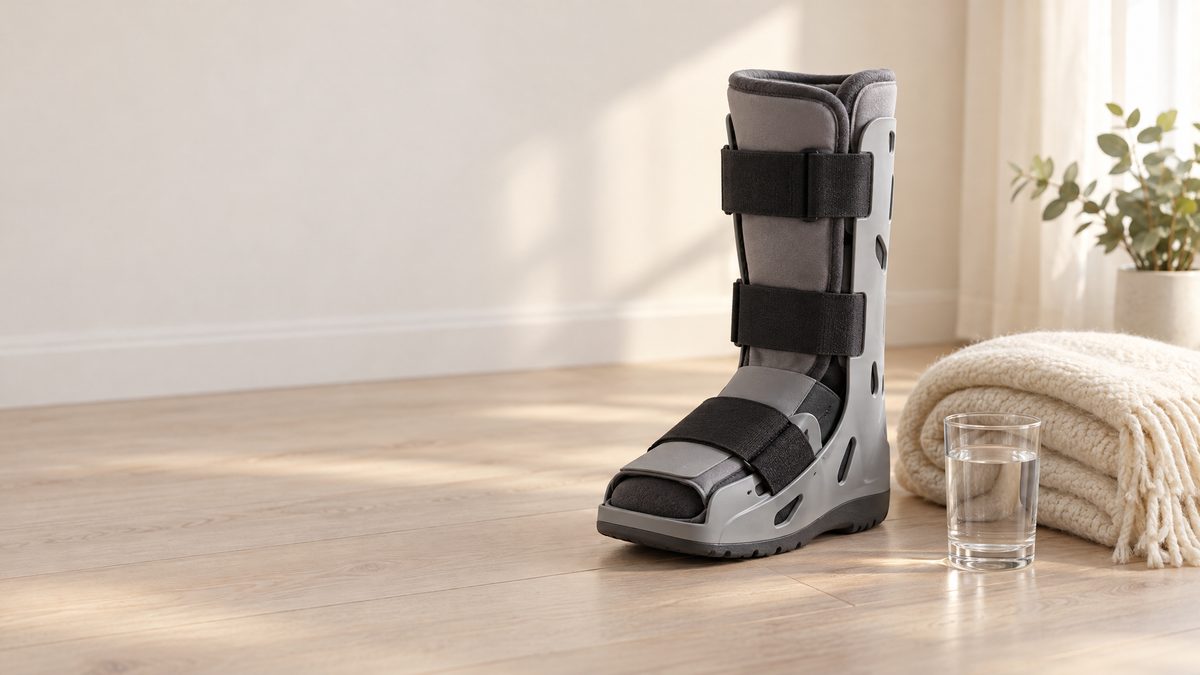
Minor Ankle Fracture Recovery Time: Stable and Hairline Breaks
About six weeks for the bone, a few months for the swelling, and usually no surgery. Here is what makes a break stable, and what each week looks like.
A minor ankle fracture, meaning a stable or hairline break where the ankle joint has not shifted, usually heals in about 6 weeks without surgery. Most people walk on it in a boot from the start, are back in normal shoes by 4 to 6 weeks, and have some swelling for 3 to 6 months.
ASG Foot & Ankle patient education. Updated October 18, 2026. General information, not a diagnosis.
The short answer
Avulsion chip off the fibula tip: treated much like a bad sprain, with the bone healed in about 6 weeks and the boot off by 6 weeks. Stable fibula fracture (a Weber A or stable Weber B): about 6 weeks for the bone, walking in a boot from the start. Swelling: 3 to 6 months, sometimes up to a year. Running and jumping: not before 6 weeks, and up to 3 months in some clinics. Inner ankle pain, a shifted joint, or numbness means it may not be minor.
Get It Seen Promptly If
- •The ankle is at an odd angle, bone is showing, or there is a deep cut
- •Your toes are blue, white, cold or numb
- •Severe pain, or pain in the boot that keeps climbing despite elevation and pain relief
- •Calf pain or swelling, which can be a blood clot. With chest pain or breathlessness, call 911
- •A fever, or feeling hot, cold and shivery
- •You have diabetes, neuropathy or poor circulation, where pain is not a reliable guide
What Makes an Ankle Fracture "Stable"?
The word that matters most on your X-ray report is stable. The talus, the top bone of the foot, sits in a socket between the tibia (your inner ankle bump) and the fibula (your outer ankle bump), held centered by ligaments on both sides.
A fracture is stable when the talus stays centered, even with your weight on it. It is unstable when bone or ligament has failed on both sides, so the talus can slide and heal out of line, which is why those fractures are usually fixed with surgery. The American Academy of Orthopaedic Surgeons notes that many isolated outer ankle fractures are stable enough to walk on. Most minor ones are one of three kinds:
Avulsion (chip) fracture
A ligament pulls a fleck of bone off the fibula tip: essentially a sprain with bone attached, treated much like one.
Weber A fracture
A break low on the fibula, below the ankle joint. The ligaments binding the leg bones together are untouched, so it is reliably stable.
Stable Weber B fracture
A slanted break at the level of the joint. Many heal in a boot, but some come with torn inner ligaments, so this type often gets a repeat X-ray.
A break higher up, above the joint (a Weber C), often comes with torn ligaments between the two leg bones and generally needs surgery. That path is covered in our full ankle fracture recovery timeline.
What Does "Hairline" Mean?
A thin crack where the pieces have not moved apart, which doctors call nondisplaced. It heals on the same timeline as any stable fibula fracture, about 6 weeks. But hairline describes the crack, not the joint: a hairline fibula crack with torn inner ligaments can still be unstable. A crack that built up gradually, with no twist or fall, is more likely a stress fracture, which heals on a different schedule.
Why a Second X-Ray in the First Two Weeks?
A fracture that looks stable on day one usually stays that way, but NHS fracture clinics describe a small chance that it moves. An X-ray taken while you stand on the ankle shows whether the joint stays centered under load, the real test of stability.
So for a Weber B, many clinics repeat the X-ray standing at around 2 weeks. Still centered: carry on in the boot. Shifted: it is treated as unstable and surgery is usually discussed. A Weber A is often not followed up routinely; you are asked to call if still struggling at 6 weeks.
Avulsion Chip vs Stable Fracture vs Unstable Fracture
| Feature | Avulsion chip | Stable fibula fracture | Unstable fracture |
|---|---|---|---|
| What it is | A fleck of bone pulled off the fibula tip by a ligament | One crack in the fibula, joint centered (Weber A, stable Weber B) | Joint shifted or able to shift: both sides broken, or one side plus torn inner ligaments |
| Treatment | Like a sprain; walk as comfort allows | Boot or supportive shoe; walk as comfort allows | Usually plate and screws; weight often limited for weeks |
| Boot | For comfort; off by 6 weeks | About 4 to 6 weeks (Weber A); around 6 weeks (Weber B) | Set by the surgeon |
| Repeat X-ray | Often none routinely | Standing X-ray at about 2 weeks for a Weber B | Several, to check alignment and healing |
| Bone healing | About 6 weeks | About 6 weeks | At least 6 weeks early, 10 to 12 weeks complete |
| Swelling | Mild, 3 to 6 months | 3 to 6 months, sometimes up to a year | Many months |
| Running and jumping | Some clinics advise 3 months | From about 6 weeks; sport often 8 to 12 weeks | Months; set by the surgeon |
Clinic leaflets differ by a few weeks, so follow your own. For the unstable column, the ankle fracture recovery timeline covers surgery and the months after it.
Stable Ankle Fracture Recovery, Week by Week
The typical course for a stable fracture or chip. Where your clinic differs, follow your clinic.
Boot On, Foot Up
- Walk as comfort allows in the boot, with crutches early on if they help
- Ankle raised above hip level, plus wrapped ice for 15 to 20 minutes every 2 to 3 hours
- Ankle pumps and toe wiggles from day one, which help circulation and lower the risk of a clot
Walking in the Boot
- Boot on for walking; for a Weber A or chip it can come off at rest and at night, while some clinics keep a Weber B boot on day and night at first
- A repeat standing X-ray at around 2 weeks, if your clinic does one
- If you smoke, stop or cut down: smoking slows healing, and these two weeks matter most
Easing Off
- Wear the boot a little less each day, as your clinic allows
- Add gentle calf and ankle stretches
- Swelling that builds by evening is expected
Out of the Boot
- Wean out of the boot indoors first, in a supportive sneaker, then outside
- Most stable fractures are out of the boot by about 6 weeks, and the bone has usually knitted
- A weak, wobbly ankle at first is normal
Strength and Balance
- Heel raises, band exercises and single-leg balance work
- Running and jumping from about 6 weeks after a Weber A; some clinics say 3 months after a chip
- Sport often returns around 8 to 12 weeks, once brisk walking is pain free
The Long Tail
- End-of-day swelling for 3 to 6 months, sometimes up to a year
- A firm bump of new bone may form and slowly remodel over 12 to 18 months
- Still bad pain or swelling at 12 weeks? Have it rechecked
Walking, Driving, Work and Sport
Walking
From the first days, in the boot, as comfort allows, unless you were told to keep weight off the foot.
Driving
Once out of the boot, walking comfortably, and able to do an emergency stop without pain or hesitation, often a few weeks after the boot comes off. The AAOS gives 9 to 12 weeks for right ankle fractures in general. Never drive in a boot on your pedal foot.
Work
Desk work once the pain settles and you can keep the foot raised. Standing and lifting jobs take longer.
Sport
Often 8 to 12 weeks, building up gradually once the ankle moves fully.
The emergency stop test, and why the left ankle in an automatic is different, are in driving after a foot or ankle injury.
Making the Six Weeks Go Well
Worth doing
- Walking as much as is comfortable, if your clinic allows it
- A long sock in the boot, and a supportive shoe on the other foot
- The ankle on pillows above heart level at night
- Ankle and toe exercises several times a day
- Over-the-counter acetaminophen as the label directs, if it is safe for you
Worth avoiding
- Impact activity before your clinic's timeline allows it
- Ice directly on the skin, or at all with neuropathy or poor circulation
- Ditching the boot outdoors before you manage indoors
- Pushing through sharp pain during exercises
- Skipping the repeat X-ray because it feels better
Some fracture clinics ask you to avoid ibuprofen and similar anti-inflammatories for the first couple of weeks after a fracture, so ask yours. Check with a doctor or pharmacist first if you have kidney, liver, stomach or heart problems, are pregnant, or take a blood thinner.
Signs It Might Not Be a Minor Fracture
Each of these suggests more than a single stable crack.
Inner ankle pain or bruising too
Alongside an outer break, this can mean torn inner ligaments (a bimalleolar equivalent), which can let the ankle bone shift.
Both ankle bones broken
A bimalleolar fracture breaks the ring around the joint on both sides, and most need surgery.
A shifted joint
A foot at an odd angle, or an ankle bone off center on the X-ray, is unstable from the start.
Numbness, or a cold or pale foot
Possible pressure on nerves or blood vessels: emergency care.
Skin under threat
A wound near the break, or skin stretched tight and pale over a bony point, needs same-day care.
Pain higher up the leg
Tenderness toward the knee can mean a higher fibula fracture or torn ligaments between the leg bones.
Pain above the joint points toward a high ankle sprain, which takes noticeably longer.
Swelling That Lasts for Months
The bone heals at around 6 weeks, yet the ankle can still puff up by evening at 3 months. NHS fracture clinic leaflets put ordinary pain and swelling at 3 to 6 months, and one says swelling can last up to a year without anything being wrong. Raise the leg when resting, and keep walking and exercising.
Not normal: swelling with calf pain, warmth or tightness, which needs a same-day check for a blood clot; spreading redness or a fever; or swelling that keeps getting worse rather than better.
When It Is Not Healing on Schedule
Fracture clinics use similar check-in points. Get back in touch if:
- At 6 weeks you have significant pain and swelling, or cannot get out of the boot
- At 8 weeks you are still in the boot
- At 12 weeks you still have bad pain or swelling
- At any time the pain worsens, the boot rubs or feels loose, or the foot feels numb or burning
A stall can mean a cartilage or tendon injury the first X-ray missed; our ankle sprain guide covers these. With diabetes or neuropathy, check the skin under the boot daily and report any redness early.
Needed plates and screws, or broke both sides? Every fracture pattern, month by month. Ankle Fracture Recovery Timeline →
X-ray came back clear? Rolled Ankle Recovery Time →
Told it is a partial ligament tear? Grade 2 Ankle Sprain Recovery →
Ligament torn completely? The grade 3 timeline, and when surgery comes up. Grade 3 Ankle Sprain Recovery Time →
A crack that built up without an injury? Stress Fracture in the Foot: Healing Time →
Right ankle in the boot? Why driving in a boot is not the answer. Driving After Foot or Ankle Injury →
Frequently Asked Questions
How long does a minor ankle fracture take to heal?
Usually about 6 weeks for the bone. Most people walk in a boot from the start and are in normal shoes by 4 to 6 weeks, but stiffness and evening swelling commonly last 3 to 6 months, sometimes up to a year. Running and jumping usually wait at least 6 weeks, and sport often returns at 8 to 12 weeks. Your clinic's plan takes priority.
How long does a broken ankle take to heal without surgery?
If the fracture is stable, about 6 weeks for the bone; NHS guidance gives 6 to 8 weeks for broken ankles generally. Stable usually means a single break of the fibula, the outer ankle bone, with the joint still centered. Full recovery takes longer: the American Academy of Orthopaedic Surgeons says most people return to normal activities within 3 to 4 months of an ankle fracture.
How long does a hairline fracture in the ankle take to heal?
About 6 weeks for the bone, with mild aching and swelling for 3 to 6 months, like other stable fibula fractures. Hairline means the pieces have not moved apart, but it does not guarantee the ankle is stable: pain or bruising on the inner ankle can signal torn ligaments there, so mention it. A crack with no twist or fall behind it may be a stress fracture.
How long are you in a boot for an avulsion fracture of the ankle?
Usually up to about 6 weeks, worn for standing and walking, mainly for comfort. The chip off the fibula tip is treated much like a sprain and heals in about 6 weeks, with mild pain and swelling for 3 to 6 months. One NHS clinic advises no running or jumping for 3 months. Still needing the boot at 8 weeks is a reason to be rechecked.
How long does a chipped bone in the ankle take to recover?
Most are avulsion fractures, a ligament pulling a small piece off the outer ankle, and they recover like a moderate sprain: about 6 weeks for the fragment, with swelling settling over 3 to 6 months. A chip from the joint surface of the ankle bone is a different injury, so deep aching, catching or locking, or no clear improvement by 6 weeks, deserves another look.
Can I walk on a stable ankle fracture?
Usually yes, in a boot or supportive shoe, as much as is comfortable, with crutches early on if they help. The American Academy of Orthopaedic Surgeons notes that many isolated outer ankle fractures are stable enough to bear weight. If you were told to keep weight off the foot, follow that, because loading some fractures too early can make the pieces shift.
Sources and further reading
- AAOS OrthoInfo: Ankle fractures (broken ankle)
- NHS: Broken ankle
- University Hospitals Sussex NHS: Weber A fracture
- Northern Lincolnshire and Goole NHS: Minimally displaced Weber B ankle fracture
- Royal Berkshire NHS: Discharge advice following a Weber B ankle fracture
- Whittington Health NHS: Lateral ankle avulsion fracture
General patient education. Your examination and individual treatment instructions take priority.
See a Podiatrist Near You
ASG Foot & Ankle has offices in Homewood, South Chicago Heights and Mokena. Our board-certified podiatrists accept most insurance. Find the office closest to you:
Told It Is a Minor Fracture? Make Sure It Is Stable.
A careful look in the first two weeks separates a fracture that heals quietly in a boot from one that needs a different plan. ASG Foot & Ankle offers examination, X-rays, boot fitting and a clear weaning plan in Homewood, South Chicago Heights and Mokena.