Bone Bruise in the Foot: Healing Time, Symptoms and When It's Something More
How long a bruised heel, midfoot or forefoot bone takes, why it can hurt for weeks after a normal X-ray, and how to tell it from a stress reaction or a fracture.
A bone bruise is an injury inside the bone: small blood vessels tear, and blood and fluid leak into and around the bone, without a full break. In the foot it usually follows a hard landing on the heel, something heavy dropped on the top of the foot, or a rolled ankle, and it often hurts more, and for longer, than people expect from "just a bruise."
Below: how long it takes, stage by stage, how it differs from a stress reaction and a broken bone, whether you can walk on it, and the signs that it is something more.
ASG Foot & Ankle patient education. Updated October 27, 2026. General information, not a diagnosis.
The short answer
A bone bruise in the foot usually takes about 1 to 2 months to heal, with day-to-day pain often easing by around 6 weeks. Larger bruises, and those that reach a joint surface or dent the outer surface of the bone, can take 3 to 5 months to stop hurting. It does not show on X-ray; MRI is the scan that shows it, and the bruise often stays visible there for about 3 months or longer, after you already feel better. Most heal with a break from impact, ice, elevation and a supportive shoe.
Get It Seen Promptly If
A bone bruise is diagnosed only once a fracture has been ruled out. Get the foot examined, and usually X-rayed, if:
- •You could not take four steps right after the injury, or still cannot
- •The bony bump halfway along the outer edge of the foot, or the bump on the inner side of the midfoot, is tender to press
- •The foot or a toe looks out of shape
- •The pain has not started to improve within a few days, or is getting worse
- •Swelling, numbness or tingling is getting worse, the foot turns purple, or you have a fever
- •The pain built up gradually with no injury and is worse with each walk or run
- •You have diabetes or neuropathy and the foot is swollen and warm, even if it hardly hurts
After a serious fall or a car accident with sharp, intense bone pain, go to the emergency room.
What Is a Bone Bruise? Bone Contusion Explained
Bone is not solid all the way through. Inside is a mesh of thin struts called trabeculae, with marrow between them. In a bone bruise, also called a bone contusion, only some of those struts are damaged and blood and fluid collect in and around the bone. That is why it is sometimes called a microfracture. In a fracture, the bone breaks through. Bone bruises come in three types, named for where the bleeding sits:
Subperiosteal (periosteal)
Blood collects beneath the periosteum, the thin membrane of blood vessels and nerves wrapped around most bones.
Intraosseous
Bleeding and swelling inside the bone itself, in the marrow. This is what an MRI shows as bone marrow edema.
Subchondral
Bleeding and swelling in a joint, between the cartilage and the bone beneath it. In the foot and ankle, often the talus after a rolled ankle.
Bone bruise symptoms
- A dull, throbbing ache that feels deeper than a skin bruise, often worse with certain movements or with standing
- Tenderness over the bone, and swelling of the surrounding area
- Bruising or color change of the skin over the area
- Sometimes a hard lump, or swelling and stiffness in a nearby joint
The pain is usually more severe, and lasts longer, than with a soft-tissue bruise. Most bone bruises heal without problems. Rarely, a very large one can cut off the blood flow to part of the bone, so that part of it dies (avascular necrosis), one reason a bruise that is not improving deserves a second look.
Where Bone Bruises Happen in the Foot
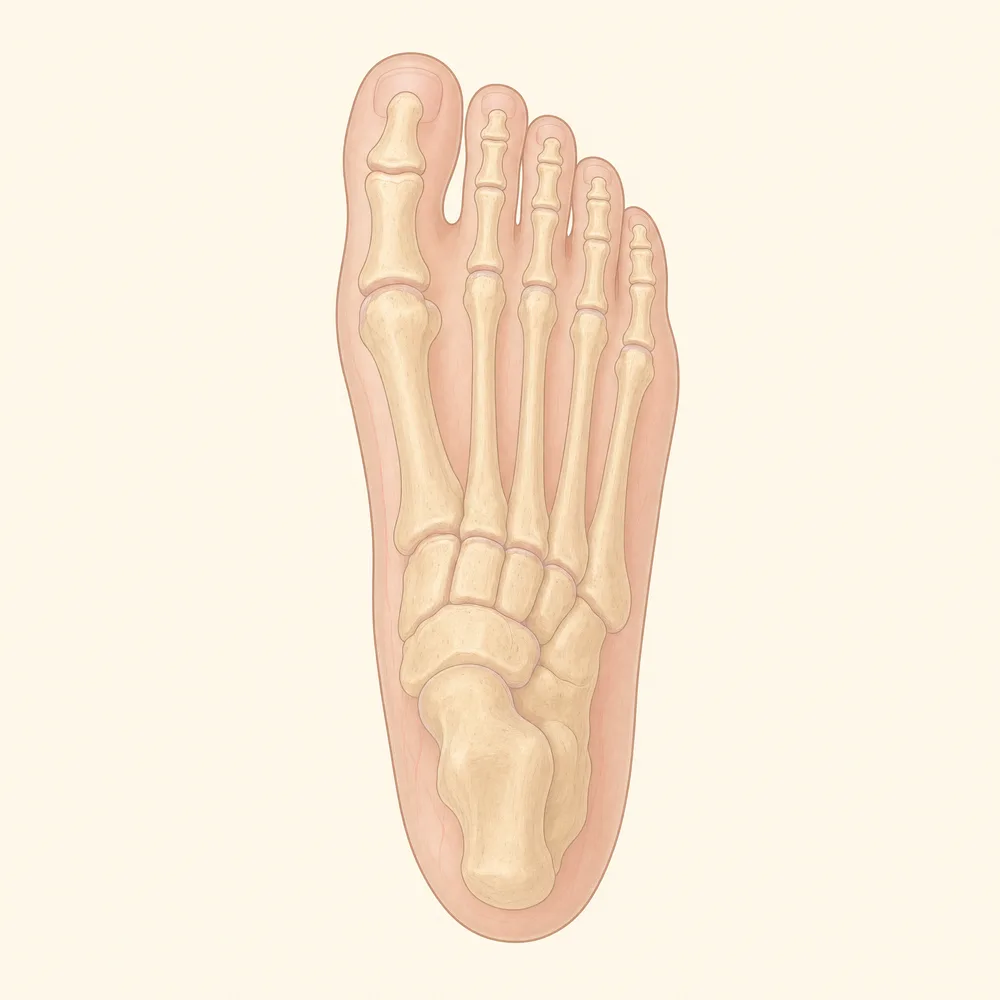
Where it hurts, and how it started, says a lot about what you are dealing with:
 Illustration
| Where | Usual cause | What to know |
|---|---|---|
| Heel (calcaneus) | A hard landing on the heel, such as a fall or a jump from a height | The heel bone is mostly spongy bone, where bone stress injuries heal more slowly than in the metatarsals. Marrow edema here can also come from overuse where the Achilles tendon or plantar fascia attaches. |
| Top of the foot (midfoot and metatarsals) | Something heavy dropped on it, being stepped on, or kicking something hard | The same kind of blow can break a metatarsal, so one sharply tender spot needs an X-ray. Pain on top of the foot that built up with no injury points toward a stress fracture instead. |
| Ball of the foot (metatarsal heads) | Repeated impact on the forefoot, as in running and jumping sports | Without a single injury, it is less likely to be a bruise and more likely an early bone stress injury. Metatarsal stress injuries are among the most common in runners. |
| Ankle bones (talus) after a rolled ankle | Rolling or twisting the ankle | In one foot and ankle study, about 4 in 10 bone bruises were in the talus, and sprains were the most common cause. They usually settle with treatment of the sprain itself. |
Bone bruise in the heel
A deep ache in the heel bone after a hard landing, worse with standing and walking. The heel was one of the three most common bone bruise sites around the foot and ankle in the study above. Heel pain that started with no landing or fall has other common causes, covered in the plantar fasciitis healing timeline.
Bone bruise on top of the foot
Tender, swollen and often discolored over the midfoot or the metatarsals after something landed on it. A heavy blow can break a metatarsal too, so if pressing one spot on the bone is sharply painful, read broken foot recovery time and get an X-ray.
Hurt a toe? A bone bruise in the big toe or a smaller toe follows the toe timeline in bruised toe healing time. After a rolled ankle, the bone bruise usually heals alongside the sprain, so the ankle sprain recovery timeline is the one to follow.
How Long Does a Bone Bruise Take to Heal?
Most bone bruises slowly heal over 1 to 2 months. How long yours takes depends on its size and type, which bone is involved, and whether anything else was injured at the same time. The best foot-specific numbers come from a study of 76 people whose bone bruises around the foot and ankle were seen on MRI, which measured how long the pain lasted with non-surgical treatment:
Most bone bruises
1 to 2 months
Slow, steady improvement. Much of the day-to-day pain often settles by about 6 weeks.
Bruise inside the bone, seen on MRI
About 12 weeks
Average time until pain settled in one foot and ankle study, for a diffuse bruise in the marrow.
Bruise reaching the joint surface
About 14 to 15 weeks
Bruises that extend up to the cartilage of a joint took longer to stop hurting.
Outer bone surface dented
About 21 weeks
Roughly 5 months, when the normal contour of the bone surface was disrupted or depressed.
Those study patients had injuries bad enough to need an MRI, many from ankle sprains and traffic accidents, so they represent the slower end. Many bone bruises, especially smaller ones that never need a scan, settle within the 1 to 2 month range.
Why the MRI lags behind how you feel
Feeling better and the bone looking normal on a scan are not the same thing. In imaging research, symptoms from bone marrow edema after injury or overuse usually improve by about 6 weeks, while the edema itself usually takes around 3 months to clear, sometimes longer. After an ankle sprain, bone bruises can stay visible on MRI for 6 to 12 months, and a review found no evidence that they need treatment beyond care of the sprain. So recovery is judged by how the foot feels and works, not by waiting for a clean scan.
Bone Bruise Foot Healing Time, Stage by Stage
The usual course once a fracture has been ruled out. If you were told to keep weight off the foot, your own plan comes first.
Calm It Down
- Stop running, jumping and anything that pounds the sore spot
- Ice wrapped in a cloth for about 15 minutes at a time, several times a day, never directly on the skin
- Raise the foot above the level of your heart when you sit or lie down
- A supportive, stiff-soled shoe; crutches, a brace or a boot if walking makes you limp
- Get an X-ray if any of the warning signs above apply
Turning a Corner
- Pain should start to improve within a few days; if it has not, get it checked
- Walk as comfort allows: no more pain during, after, or the next morning
- Cycling or swimming can keep you fit if they do not hurt
- Do not take pain relievers for more than 10 days in a row without talking to a clinician
Steady Improvement
- The deep, throbbing ache fades and the tender area shrinks
- Longer walks become comfortable; still no running or jumping
- In imaging research, symptoms of bone marrow edema from injury or overuse usually improve by about 6 weeks
Most Bruises Settled
- Most bone bruises heal over 1 to 2 months
- Once daily activities have been pain-free for 5 days in a row, a gradual return to running can start
- Build up the amount of running before the speed
The Bigger Bruises
- Large bruises, those reaching a joint, and those that dent the bone surface can take about 12 to 21 weeks
- On MRI, marrow edema usually clears in about 3 months, and sometimes takes longer
- Still clearly painful, or worse, at this stage: get re-examined rather than waiting longer
Bone Bruise vs Stress Reaction vs Stress Fracture vs Broken Bone
These four sit on a spectrum of bone damage, and they can feel alike. The biggest clue is how it started:
| Injury | How it starts | X-ray and MRI | Typical recovery |
|---|---|---|---|
| Bone bruise | One clear injury: a fall, a hard landing, a twist or a blow. Hurts from the start, then slowly eases. | X-ray normal. MRI: bright marrow edema, no fracture line. | About 1 to 2 months; larger ones 3 to 5 months |
| Stress reaction | No single injury. Builds over days to weeks with repeated load, often after a jump in activity. | X-ray usually normal. MRI: edema at the bone surface first, then in the marrow, with no fracture line. | About 6 weeks back to sport for the mildest MRI grade; about 10 to 12 weeks for higher grades |
| Stress fracture | The same build-up, further along. Often one spot on the bone is sharply tender. | X-ray often normal at first. MRI: a fracture line with edema around it. | About 14 weeks back to sport on average in one review; slow-healing sites take longer |
| Broken bone | One injury, usually with immediate, sharp pain at one spot and trouble walking; may look out of shape. | X-ray usually shows the break. | Metatarsal: weight bearing in about 6 to 8 weeks, sometimes longer |
Bone bruise vs stress reaction
Both show bright marrow on MRI with no fracture line, so the story decides. A bruise has a moment you can point to. A stress reaction is overload: edema starts along the bone surface and, if the load continues, spreads into the marrow and can become a fracture.
Bone bruise vs stress fracture
A stress fracture is a crack from repetitive load, often after a sudden increase in activity, and may not show on the first X-ray. MRI shows a line across the bone. It needs a stricter plan than a bruise.
Pain that crept up over weeks with no injury belongs in stress fracture foot healing time, which covers the slow-healing locations. If an X-ray found a break, see broken foot recovery time, and for the bone along the outer edge of the foot, fifth metatarsal fracture recovery.
How a Bone Bruise Is Diagnosed: X-ray and MRI
Diagnosis starts with how the injury happened and an examination of exactly where the bone is tender. An X-ray cannot show a bone bruise, but it is often taken to rule out a fracture, which needs different treatment. An MRI can confirm a bone bruise. It is usually ordered only if the foot is not improving, and a bone bruise can be diagnosed and treated without one once a fracture has been ruled out.
Bone marrow edema in the foot: what the report means
If your MRI report says bone marrow edema, it means extra fluid in the bone: a sensitive sign that something is going on, but not a diagnosis by itself. In the foot and ankle, the same appearance can come from:
- A bone bruise after an injury, often in a pattern that shows how the foot was twisted or struck
- A stress reaction or stress fracture from overload
- Overuse where the Achilles tendon or plantar fascia attaches to the heel
- Cartilage wear, inflammation, or loss of blood supply to part of a bone
- A foot that was recently immobilized, such as in a cast
- Charcot foot, when it comes with soft-tissue swelling in someone with neuropathy
It can also appear in physically active people with no symptoms at all. That is why your history, and where you are actually tender, matter as much as the scan.
Can You Walk on a Bone Bruise?
Usually, for everyday walking, once a fracture has been ruled out and as long as it does not make things worse. A useful rule from bone stress injury care: the amount of walking is right if it causes no extra pain during, after, or the next day. Some foot bone bruises do need weight kept off them for a while, and your clinician will say how long.
Usually fine
- Short walks around the house and to the car in a supportive, stiff-soled shoe
- A mild ache that settles quickly when you sit down
- Cycling or swimming, if they are pain-free
Cut back, and ask about crutches or a boot, if
- You are limping
- The foot aches more that evening or the next morning
Can You Make a Bone Bruise Worse?
Yes. A bruised bone has damaged internal struts, and continuing to use or stress it before it heals can deepen the damage until it cracks or breaks. The usual culprits are running or jumping on it too soon, and long days on your feet before it has settled.
Signs it is heading the wrong way:
- •Pain that is worse this week than last, rather than slowly better
- •A broad ache narrowing to one spot on the bone that is sharply tender
- •New or increasing swelling, numbness or tingling
Any of these is a reason to be re-examined, and possibly re-imaged, rather than waiting it out.
What Helps a Bone Bruise Heal
There is no shortcut: bone repairs at its own pace. The job is to keep it calm and stop re-injuring it.
Rest from impact
Avoid intense activity and anything that pounds the bruised spot while it heals. Gentle movement is fine.
Ice
Wrapped in a cloth, about 15 minutes at a time, several times a day in the first days. Skip it on a foot you cannot feel well.
Elevation and compression
The foot above heart level, and an elastic bandage that is snug but never tight enough to cause numbness or color change.
Support
A stiff-soled shoe, and if needed a brace, boot or crutches. Some foot bone bruises need weight kept off them for a while.
Pain relief, briefly
Acetaminophen or an anti-inflammatory as the label allows. Some anti-inflammatories may slow bone healing, so ask before using them for more than a few days.
Food and habits
Enough calcium, vitamin D and protein, and no smoking: smoking can delay healing.
Do not take pain relievers for more than 10 days in a row without talking to a clinician, and check before taking anti-inflammatories if you have heart disease, high blood pressure, kidney or liver disease, or a history of stomach ulcers or bleeding. Once the pain allows, physical therapy can help restore strength and range of motion, especially after a bruise near a joint.
Returning to Running and Sport
Return to sport can take weeks or months. We found no studies of returning to running after a foot bone bruise, so the most useful guide is the plan used for low-risk metatarsal bone stress injuries in runners, which follows symptoms rather than the calendar. Start when all of these are true:
- 1Daily activities have been pain-free for 5 days in a row, including walking at your normal pace without a limp.
- 2Pressing on the bruised spot gives no more than mild tenderness.
- 3Your clinician agrees, particularly if the bruise was large, reached a joint, or was in the heel.
Start short
Walk-run intervals on flat, even ground, with rest days between sessions at first.
Distance before speed
Build the amount of running first. Sprints, hills and jumping come last.
The next-day test
No pain during the run, after it, or the next day. If there is, drop back a step.
For comparison, in a review of 560 bone stress injuries, those with the mildest MRI grade took about 6 weeks on average to return to sport, and more than 90% of athletes got back. Spongy-bone sites such as the heel healed more slowly than the metatarsals, so a heel bruise may need extra patience.
Diabetes, Neuropathy and a "Bone Bruise"
If nerve damage has dulled the feeling in your feet, a foot that seems bruised needs more caution. Bone marrow edema with soft-tissue swelling in someone with neuropathy can be the first sign of Charcot foot, where the bones of the foot weaken, fracture and can collapse. An international expert group notes that:
- •Onset often follows an injury that was minor
- •The foot is typically markedly swollen and warm, often red, with only mild pain
- •The affected foot is usually several degrees warmer than the other one
- •X-rays can still be normal when MRI already shows changes
- •It can be mistaken for an infection, a blood clot or gout, and keeping weight off the foot is the most important first treatment
With diabetes or neuropathy, do not walk off a swollen, warm foot as a bruise, and skip ice on a foot you cannot feel well. Get seen promptly. More in Charcot foot recovery and diabetic foot care.
Pain built up over weeks, with no single injury? Stress Fracture Healing Time →
The X-ray showed a break? The metatarsal recovery, week by week. Broken Foot Recovery Time →
Twisted the midfoot, and the ligaments hurt more than the bone? Foot Sprain Recovery Time →
Stubbed or crushed a toe? Bruised, jammed or broken, side by side. Bruised Toe Healing Time →
Frequently Asked Questions
How long does a bone bruise take to heal?
Most bone bruises slowly heal over about 1 to 2 months, and the worst of the pain usually settles before that. Larger ones take longer: in one study of bone bruises around the foot and ankle, pain lasted about 12 weeks on average when the bruise stayed inside the bone, and about 21 weeks when the outer surface of the bone was dented. The bruise can stay visible on MRI for months after you feel fine.
Can you walk on a bone bruise in your foot?
Usually, for everyday walking, as long as it does not make the pain worse. Wear a supportive, stiff-soled shoe and let pain guide you: walking that hurts during, afterward, or the next morning is too much, so cut back and ask about crutches or a boot. Some foot and leg bone bruises need weight kept off them for a time, so follow any instructions you were given, and hold off running and jumping.
Can you make a bone bruise worse?
Yes. A bruised bone has damaged internal struts but is not broken, and continuing to stress it before it heals can deepen the damage until it cracks or breaks. Pushing through pain with running, jumping or long days on your feet is the usual way this happens. Pain that is getting worse instead of better, or one spot becoming sharply tender, is a reason to be re-examined.
What is the difference between a bone bruise and a stress fracture?
A bone bruise follows one clear injury, such as a fall, a hard landing, a twist or something dropped on the foot. A stress reaction or stress fracture builds up over days to weeks from repeated load, often after a jump in activity, with no single injury. On MRI both show fluid in the bone marrow, but a stress fracture also shows a fracture line. X-rays are often normal early in both.
What is bone marrow edema in the foot?
It is the MRI term for extra fluid inside a bone, seen as a bright patch on fluid-sensitive scan sequences. A bone bruise is one cause, but the same look can come from a stress reaction, a fracture, overuse where a tendon attaches, joint wear, or, in someone with neuropathy, early Charcot foot. It can even appear in active people with no symptoms, so it is a clue to be matched with your story and examination.
How long does a bone bruise on the heel take to heal?
There is little heel-specific research, so the general range applies: about 1 to 2 months for most bone bruises, and longer for a large one. The heel bone is mostly spongy bone, and in a review of bone stress injuries, spongy-bone sites including the heel took longer to heal than the metatarsals. A heel that is not improving after a few days, or that you cannot stand on, should be checked for a fracture.
Why didn't my bone bruise show up on an X-ray?
Because a bone bruise damages only some of the bone's internal struts and leaves blood and fluid inside it, without a break for the X-ray to show. The X-ray is still worth having, because it rules out a fracture, which is treated differently. MRI is the scan that shows a bone bruise, but it is usually only needed if the foot is not improving as expected.
Sources and further reading
- Cleveland Clinic: Bone bruise (bone contusion)
- Cedars-Sinai: Bone bruise
- AAOS OrthoInfo: Toe and forefoot fractures
- MedlinePlus: Metatarsal fracture (acute), aftercare
- American Family Physician: Diagnosis and management of common foot fractures (2016)
- Szaro P et al. Traumatic and non-traumatic bone marrow edema in ankle MRI: a pictorial essay. Insights into Imaging (2020)
- Kim HJ, Lee KB. Improvement of pain according to MRI classification in bone contusion around foot and ankle. J Korean Foot Ankle Soc (2019)
- Longo UG et al. Bone bruises associated with acute ankle ligament injury: do they need treatment? Knee Surg Sports Traumatol Arthrosc (2013)
- Hoenig T et al. Does MRI grading correlate with return to sports after bone stress injuries? Am J Sports Med (2022)
- Warden SJ et al. Optimal load for managing low-risk tibial and metatarsal bone stress injuries in runners. JOSPT (2021)
- Rogers LC et al. The Charcot foot in diabetes. Diabetes Care (2011)
General patient education. Your examination and individual treatment instructions take priority.
See a Podiatrist Near You
ASG Foot & Ankle has offices in Homewood, South Chicago Heights and Mokena. Our board-certified podiatrists accept most insurance. Find the office closest to you:
Bruised, Stressed or Broken? Find Out
ASG Foot & Ankle can examine and X-ray the foot, rule out a fracture, arrange an MRI when a bone bruise or stress reaction is not settling, and plan your return to walking and running, with extra care when diabetes or neuropathy is part of the picture.