5th Metatarsal Fracture Recovery Time: Avulsion vs Jones Fracture
Why two breaks so close together heal so differently, and when a screw is worth it.
5th metatarsal fracture recovery time ranges from about a month to several months, and what decides it is exactly where on the bone the break sits. The fifth metatarsal is the long bone along the outer edge of your foot, and breaks near its base fall into three zones that heal very differently: an avulsion fracture at the bony bump, a Jones fracture just beyond it, and a stress fracture a little further along the shaft.
For broken bones elsewhere in the foot, see our broken foot recovery time guide.
ASG Foot & Ankle patient education. Updated October 23, 2026. General information, not a diagnosis.
The short answer
5th metatarsal fracture recovery time is usually 4 to 8 weeks for an avulsion fracture at the bony bump on the outer foot (zone 1), which you can normally walk on in a boot from the start. A Jones fracture just beyond the bump (zone 2) usually takes 6 to 12 weeks and often means time off the foot, because the blood supply there is poor. A stress fracture a little further along (zone 3) can take 3 months or more, so a screw is often offered, especially to athletes, who are back to sport about 8 to 10 weeks after surgery on average. Aching and swelling can linger for 3 to 6 months.
Get It Seen Promptly If
Go to the emergency room if:
- •The foot is out of shape, or there is a wound over the break or bone showing
- •The foot or toes are numb, tingling, pale, purple or cold
- •You have calf pain and swelling in one leg with shortness of breath or chest pain (call 911)
Get an X-ray within a few days if:
- •You could not take four steps right after the injury, and still cannot
- •The bony bump halfway along the outer foot, or the bone in front of it, is sharply tender
- •An outer-foot ache that built up with running or sport keeps getting worse
- •You have diabetes or neuropathy and have hurt your foot at all, and today if it turns warm, red and swollen
- •Pain, swelling, numbness or tingling is getting worse in a cast or boot, or you develop a fever
Broken Bone on the Outside of the Foot: Is It the 5th Metatarsal?
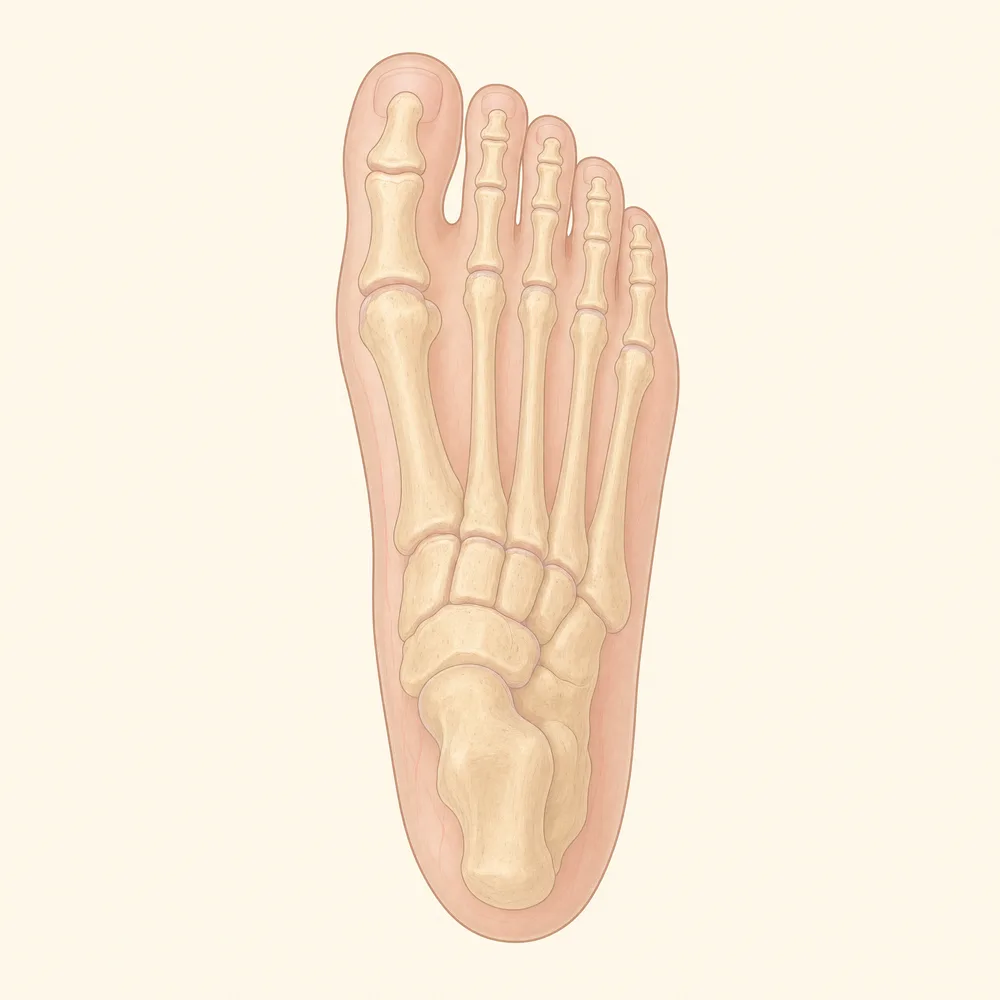
The fifth metatarsal runs from the base of your little toe back to a bony bump about halfway along the outer edge of the foot. It is the most commonly broken metatarsal, about two in three metatarsal fractures in one series, and it most often breaks near the base.
 Illustration
Where it hurts
Pain, swelling, bruising and tenderness on the outer midfoot, and difficulty walking.
How it started
A rolled ankle. Avulsion fractures are often overlooked because they come with a sprain.
The press test
Sharp pain when you press the bony bump halfway along the outer foot, or just in front of it.
No single injury
An outer-foot ache that crept up with running and keeps worsening suggests a stress fracture.
Who needs an X-ray. Clinicians use the Ottawa foot rules: midfoot pain plus bone tenderness at the base of the fifth metatarsal or the navicular on the inner arch, or being unable to take four steps both right after the injury and when examined. The rules catch about 99% of ankle and midfoot fractures. A Jones or stress fracture sometimes does not show on the first X-ray, so more imaging may be needed if pain persists.
It is not a broken pinky toe. A "pinky toe metatarsal fracture" usually means this bone, but the little toe has its own small bones. A toe fracture is buddy taped; a fifth metatarsal fracture is not. If the tenderness is in the toe itself, see broken pinky toe healing time.
It often comes with a rolled ankle. The inward roll that sprains the ankle can pull the bump off, so press along the outer foot after any rolled ankle. The ankle side of that injury has its own ankle sprain recovery timeline. If the X-ray is clear but the outer midfoot still hurts, it may be a foot sprain.
Jones Fracture vs Avulsion Fracture: The Three Zones
Breaks at the base of the fifth metatarsal are sorted into three zones by how far forward they sit. In one series, 93% were zone 1, 4% zone 2 and 3% zone 3. Some doctors call any zone 2 or 3 break a Jones fracture, so ask which zone yours is in.
| Zone | Where | How it happens | Usual treatment | Weight bearing | Typical healing time | Nonunion risk |
|---|---|---|---|---|---|---|
| Zone 1: avulsion (pseudo-Jones) | The bony bump at the base of the bone | Rolling the ankle; a tendon and a band of the plantar fascia pull a flake of bone off | Removable boot or stiff-soled shoe, mainly for comfort | As comfort allows, from day one | 4 to 8 weeks; 3 to 6 months to feel normal | Very low, about 0.5 to 1% |
| Zone 2: Jones fracture | Just beyond the bump, level with the joint between the 4th and 5th metatarsals | A sudden inward force on the forefoot while up on the toes, such as an awkward pivot | Cast or boot; a screw for athletes and displaced breaks | Traditionally none for 6 to 8 weeks; some clinics allow a boot | 6 to 12 weeks, sometimes longer | Significant: in athletes, about 71% healed without surgery versus 97% with a screw |
| Zone 3: proximal shaft stress fracture | The first stretch of shaft beyond the Jones zone | Repeated stress, often after weeks of outer-foot aching | Surgery often advised; otherwise a non-weight-bearing cast or boot | None for at least 6 weeks without surgery | 3 months or more; casting can run up to 20 weeks | High, the main reason a screw is advised |
A break further along the shaft is a separate injury, usually treated without surgery when it has not shifted much. Stress fractures in the other metatarsals are covered in stress fracture foot healing time.
Why a Jones Fracture Heals Slowly
Blood supply and load. Studies tracing the arteries inside the bone found two supplies that meet right where Jones fractures happen:
The bump (zone 1)
Fed by many small vessels entering from all sides. A break here keeps a rich blood supply and heals reliably.
The shaft
Fed mainly by one nutrient artery that enters the bone and runs lengthways inside it.
The junction (zones 2 and 3)
Where the two supplies meet and barely overlap, a watershed. A break here cuts across its own supply, so delayed healing and nonunion are common.
Mechanics add to it. The fifth metatarsal has the thinnest outer wall of the metatarsals, and the tendons and ligaments at its base funnel stress through that junction. A heel that tilts inward loads the outer edge even more: in one series, about 9 in 10 Jones fracture patients had this alignment, against roughly 1 in 4 people generally. None of this applies at the bump, which is why a pseudo-Jones fracture can be walked on early.
Can You Walk on a Broken 5th Metatarsal?
Often yes, but it changes with the zone, so let the X-ray decide, not how it feels.
Avulsion fracture (zone 1)
Usually yes, from the startWalk as comfort allows in a boot or stiff-soled shoe, on the heel at first. One NHS leaflet notes the boot is for comfort, not healing, and that early weight bearing helps. In studies, a removable boot or hard-soled shoe did as well as a cast.
Jones fracture (zone 2)
Often not, at firstThe traditional plan is no weight in a below-knee cast for 6 to 8 weeks. Some UK clinics instead allow walking in a boot, with a specialist review at 6 weeks. Follow the plan you were given.
Stress fracture (zone 3)
Usually notWithout surgery, expect no weight on the foot for at least 6 weeks, sometimes much longer.
Being able to walk does not prove the bone is intact, and walking on an untreated fracture can make it worse, so keep weight off it until it has been X-rayed.
Two tips for the boot
- •Even up your legs. Wear a firm-soled shoe on the other foot, ideally matching the boot sole height, to spare your other joints.
- •Diabetes? Ask about a specialist diabetic boot, and check the skin under it every day.
Avulsion vs Jones Fracture Recovery, Week by Week
Based on an NHS fracture clinic plan (avulsion) and the traditional non-surgical plan in American Family Physician (Jones). Your own plan takes priority.
| Time since injury | Avulsion fracture (zone 1) | Jones fracture (zone 2), no surgery |
|---|---|---|
| First 3 days | Rest with the foot above hip level for 24 to 72 hours; cold pack up to 15 minutes every few hours. Walk as comfort allows, heel first. | A splint, no weight on the foot, crutches. Review within 3 to 5 days. |
| Weeks 1 to 3 | Boot whenever you walk, crutches if needed; boot off at night and at rest. Ankle and toe exercises 3 to 4 times a day. | A non-weight-bearing below-knee cast. An X-ray at about 1 week checks nothing has shifted. |
| Weeks 3 to 6 | Wean out of the boot, around the house first, and drop the crutches. Boot for long walks. | Still in the cast, no weight on the foot. |
| Weeks 6 to 8 | The bone has usually knitted by about 6 weeks. Daily activity, guided by pain. | X-ray. If healing, weight is built up with physical therapy. If not, about 4 more weeks without weight. |
| Weeks 8 to 12 | Normal activity, guided by pain. Long walks can still bring aching and swelling. | Rebuilding walking. No healing on an X-ray at 10 to 12 weeks means a surgery discussion. |
| 3 to 6 months | Swelling and aching fade. Still significant pain at 12 weeks? Get reviewed. | Sport typically around 3 to 4 months without surgery. Mild aching can last 3 to 6 months. |
Exercises from the start (avulsion)
Three to four times a day, 10 of each: point the foot up and down, circle it both ways, and spread the toes. Early movement limits stiffness and lowers the risk of a blood clot.
The boot route for a Jones fracture
Some UK clinics use a walking boot with weight as comfort allows for 6 weeks, then a specialist review, weaning out of the boot between weeks 6 and 12.
5th Metatarsal Fracture Surgery: When a Screw Is Offered
Most fifth metatarsal fractures heal without an operation. When surgery is needed, it is usually a single screw passed down the inside of the bone through a small incision. The screw usually stays in for good.
When surgery is usually offered
Athletes and very active people
Family medicine guidance says surgery should be strongly considered for a Jones fracture, because it gets people back sooner.
A displaced break
A Jones fracture shifted more than 2 mm, or an avulsion shifted more than 3 mm or carrying more than 60% of the joint surface.
No healing by about 12 weeks
Still not bridged on X-ray after about 12 weeks of non-surgical care.
Zone 3 stress fractures
A 2021 systematic review recommends treating these primarily with surgery.
Avulsion fractures rarely need it: a 2021 review found that displacement and joint involvement did not worsen outcomes when they were treated with early walking.
What the evidence shows
- In a randomized trial of acute Jones fractures, 8 of 18 (44%) treated in a cast failed: 5 never healed, 1 healed very slowly and 2 broke again. Only 1 of 19 failed after a screw. Median healing was 7.5 weeks against 14.5, and return to sport 8 weeks against 15.
- In a 2021 analysis of 646 Jones fractures in athletes, 98.8% returned to play after a screw, on average at 9.6 weeks, against 71.6% at 13.1 weeks without surgery.
Recovery after screw fixation
| When | What usually happens |
|---|---|
| Weeks 0 to 2 | Splint or boot, foot raised. In published series, walking in a boot often started within 7 to 14 days; your surgeon's protocol comes first. |
| Weeks 2 to 6 | More weight in the boot as your surgeon allows. |
| Weeks 6 to 10 | The bone typically bridges on X-ray around 7.5 to 8 weeks. |
| Weeks 8 to 12 | Return to sport, on average about 8 to 10 weeks in athletes, once healing is confirmed. |
| Afterwards | Orthotic inserts if your heel tilts inward. |
A screw is not a guarantee: refractures happened in about 1 in 10 athletes overall in that analysis, so surgeons pace the return and check alignment. In one series, correcting an inward-tilting heel with orthotic inserts was followed by no refractures. For getting back behind the wheel, see driving after foot surgery.
Nonunion and Refracture: Signs It Is Not Healing
A nonunion is a fracture that has stopped trying to heal. A refracture is a fresh break through a fracture that had healed, or seemed to. Both are mainly zone 2 and 3 problems. Get it checked if you notice:
- Pain at the same spot that is no better, or worse, 6 weeks after the injury
- Struggling to wean out of the boot by about 6 weeks with an avulsion fracture
- Significant pain and swelling still there at 12 weeks
- Pain that settles with rest but returns as soon as you walk further
- Sharp pain at the old spot after getting back to sport, which can mean a refracture
What happens next. An X-ray, sometimes a CT scan, shows whether the bone has bridged. Options include more time in a cast or boot, a bone stimulator (used most for Jones fractures), and surgery, which a true nonunion often needs. Stopping smoking and checking vitamin D help at any stage.
Getting Back to Walking, Work and Sport
| Milestone | Avulsion (zone 1) | Jones or zone 3, no surgery | After a screw |
|---|---|---|---|
| Walking without a boot | Usually by 3 to 6 weeks | Weight built up after 6 to 8 weeks off the foot, longer for zone 3 | Walking in a boot often within 1 to 2 weeks |
| Back to work | In one trial, 11 days with early walking versus 28 with immobilization | Depends on whether you may bear weight; a seated role helps | Depends on the job and your surgeon's plan |
| Sport | Normal activity, guided by pain, from about 6 to 12 weeks | Usually not before 12 weeks; about 13 to 15 weeks on average in athletes | About 8 to 10 weeks on average in athletes |
Returning to running and sport safely
- Wait for the go-ahead, usually after an X-ray confirms healing. Going back too soon risks re-injury.
- Alternate activity days with rest days, and stop if pain at the fracture site returns.
- After a stress fracture, fix the cause: training jumps, worn-out shoes, low vitamin D, or alignment.
What Can Slow Healing
Smoking
It prolongs fracture healing and, in extreme cases, can stop it.
Diabetes and obesity
Both are linked with worse outcomes after these fractures.
A heel that tilts inward
Often with a high arch; it overloads the outer foot.
Low vitamin D or bone density
Including in athletes who under-eat for their training.
Diabetes or neuropathy: with reduced feeling, a broken bone can be walked on without much pain, making it worse. A warm, red, swollen foot can be Charcot foot and needs to be seen straight away. See Charcot foot recovery and on our diabetic foot care page.
Only the little toe hurts? Toe fractures heal differently. Broken Pinky Toe Healing Time →
Rolled your ankle? The usual way this fracture happens. Rolled Ankle Recovery Time →
Aching built up with running? Stress fractures in the other foot bones. Stress Fracture Foot Healing Time →
X-ray clear but the midfoot still hurts? Foot Sprain Recovery Time →
Frequently Asked Questions
How long does a 5th metatarsal fracture take to heal?
It depends on the zone. An avulsion fracture at the bony bump usually knits in about 4 to 8 weeks, with most people out of the boot by 3 to 6 weeks. A Jones fracture just beyond the bump usually takes 6 to 12 weeks. A stress fracture of the upper shaft can take 3 months or more without surgery. Aching and swelling often linger for 3 to 6 months.
Can you walk on a broken 5th metatarsal?
Often, but it depends on the type. With an avulsion fracture, you can usually walk as comfort allows in a boot or stiff-soled shoe from the start. With a Jones fracture, the traditional plan is no weight for 6 to 8 weeks, though some clinics allow walking in a boot. A shaft stress fracture usually needs at least 6 weeks off the foot.
What is the difference between a Jones fracture and an avulsion fracture?
Location and blood supply. An avulsion fracture is a flake pulled off the bony bump at the base of the bone, usually when the ankle rolls, and it heals reliably. A Jones fracture sits slightly further forward, where two blood supplies barely overlap, so it heals more slowly and more often needs time off the foot or a screw.
What is a pseudo-Jones fracture?
Another name for an avulsion fracture of the fifth metatarsal base, also called a zone 1 fracture. It sits just behind a true Jones fracture and the names are easily mixed up, but it behaves very differently: a boot or stiff shoe with walking as comfort allows is the usual treatment, and only about 1 in 100 or fewer fail to heal.
Do you need surgery for a Jones fracture?
Not always, but a cast fails often: in a randomized trial, 8 of 18 cast-treated fractures failed, against 1 of 19 fixed with a screw. Surgery is usually recommended for athletes and very active people, displaced fractures, and fractures not healed after about 12 weeks. Athletes return to sport about 8 to 10 weeks after screw fixation on average.
Is a broken pinky toe the same as a 5th metatarsal fracture?
No. The pinky toe has its own small bones, and a simple toe fracture is usually buddy taped. The fifth metatarsal is the long bone behind the toe, along the outer edge of the foot. Tenderness on the outer midfoot, rather than in the toe itself, needs an X-ray, because a fifth metatarsal fracture is not treated with tape.
How do I know if my 5th metatarsal fracture is not healing?
Warning signs are pain at the same spot that is no better at 6 weeks, struggling to get out of the boot, pain that returns as soon as you walk further, or significant pain and swelling at 12 weeks. An X-ray, sometimes a CT scan, shows whether the bone has bridged. Options include longer protection, a bone stimulator, or surgery.
Sources and further reading
- AAOS OrthoInfo: Toe and forefoot fractures
- AAOS OrthoInfo: Stress fractures of the foot and ankle
- American Family Physician: Diagnosis and management of common foot fractures (2016)
- ACFAS FootHealthFacts: Fractures of the fifth metatarsal
- East Sussex Healthcare NHS Trust: Fracture of the base of the 5th metatarsal (avulsion)
- York and Scarborough Teaching Hospitals NHS Foundation Trust: Base of 5th metatarsal fracture (Jones)
- Bowes J, Buckley R. Fifth metatarsal fractures and current treatment. World J Orthop (2016)
- Herterich V et al. Fifth metatarsal fracture: a systematic review of the treatment of fractures of the base of the fifth metatarsal bone. Dtsch Arztebl Int (2021)
- Mologne TS et al. Early screw fixation versus casting in the treatment of acute Jones fractures. Am J Sports Med (2005)
- Attia AK et al. Return to play and fracture union after the surgical management of Jones fractures in athletes. Am J Sports Med (2021)
General patient education. Your examination and individual treatment instructions take priority.
See a Podiatrist Near You
ASG Foot & Ankle has offices in Homewood, South Chicago Heights and Mokena. Our board-certified podiatrists accept most insurance. Find the office closest to you:
Outer Foot Pain After a Rolled Ankle?
A fifth metatarsal fracture is easy to mistake for a sprain, and the zone decides the plan. ASG Foot & Ankle can X-ray the foot, tell you which zone it is, fit the right boot or shoe, and follow the healing with you, including when surgery is worth discussing.