
Broken Foot Recovery Time: Metatarsal Fractures, Week by Week
How long the bone takes, how long the boot stays on, when you can walk on it, and the signs that mean your foot needs more than a boot.
Broken foot recovery time depends mostly on which bone broke and whether it stayed in line. For the most common kind, a crack through one of the long metatarsal bones that has not shifted, the bone usually heals in about 6 to 8 weeks, mostly in a walking boot or stiff-soled shoe, and most people are back to normal daily life by about 3 months.
Below: the recovery week by week, broken versus sprained, walking on it, and why the swelling outlasts the fracture.
ASG Foot & Ankle patient education. Updated October 23, 2026. General information, not a diagnosis.
The short answer
Broken foot recovery time for a simple metatarsal fracture that has stayed in line is about 6 to 8 weeks for the bone to heal, usually in a walking boot or stiff-soled shoe for 4 to 6 weeks, putting weight on it as pain allows once your clinician says you can. Most people are back to everyday activities, and often sport, by about 3 months, while aching and end-of-day swelling can last 3 to 6 months. Breaks that are out of line, involve several metatarsals or the first metatarsal, or affect the midfoot or heel take longer and sometimes need surgery.
Get It Seen Urgently If
Go to an emergency room or urgent care the same day if:
- •Bone is showing, or there is a cut or wound over the injured area
- •The foot or a toe looks deformed or out of place
- •The foot or toes are cold, pale, blue or purple, or numb or tingling
- •Pain, swelling, numbness or tingling is getting worse rather than better, or you have a fever
- •You cannot take four steps on it, or there is bruising on the sole of the foot
- •You have diabetes or neuropathy and the foot is swollen and warm, even if it hardly hurts
With diabetes or neuropathy, have any foot injury checked promptly. Reduced feeling can hide a fracture.
Which Bones a "Broken Foot" Usually Means
The front of the foot has five long metatarsals and 14 small toe bones, with the midfoot bones and the heel behind them. Toe fractures are the most common foot fractures, but a "broken foot" usually means a metatarsal: about 35% of foot fractures. About 80% of metatarsal fractures are not displaced, or only minimally, which is why most heal without surgery. The fifth metatarsal, on the outer edge, breaks most often, followed by the third.
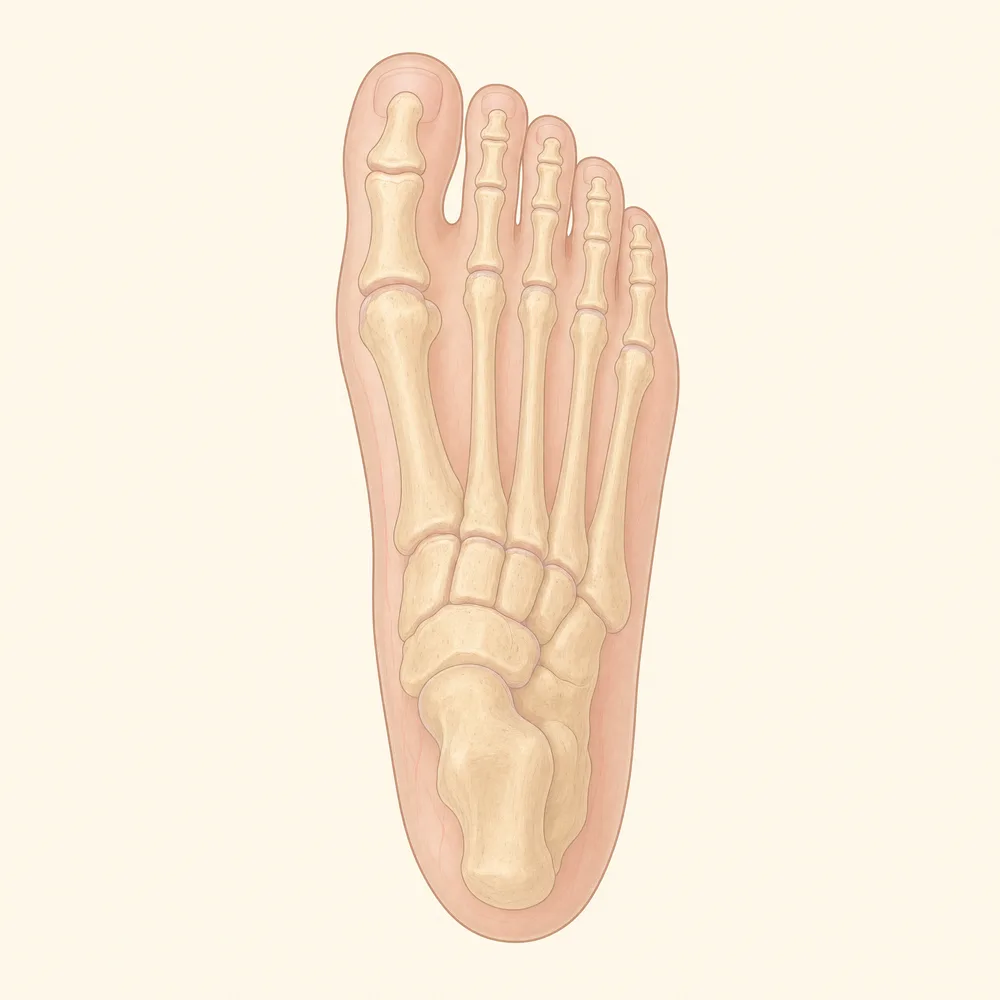 Illustration
| Bone | What usually happens | Typical healing |
|---|---|---|
| Toes | Stubbed, kicked into something hard, or crushed by a dropped object | About 4 to 6 weeks |
| 2nd to 4th metatarsals | A break across the shaft from a direct blow or a twist | About 6 to 8 weeks; normal life by about 3 months |
| 5th metatarsal | Most often at the base, when the foot rolls inward | Depends on exactly where it breaks; see below |
| 1st metatarsal | The largest metatarsal, behind the big toe; less forgiving if out of line | Often referred to a surgeon unless perfectly in line |
| Midfoot (Lisfranc) | Anything from a simple twist and fall to a car crash; easily mistaken for a sprain | 6 to 8 weeks with no weight, then months; 6 months to a year to resume everything in some people |
| Heel (calcaneus) | Usually a fall from a height or a car crash | Weeks with no weight; normal activities 3 to 4 months at the earliest, 1 to 2 years after a severe fracture |
Hurt a toe? See the broken toe healing timeline or the broken pinky toe guide. Pain that built up over weeks with no single injury is more likely a stress fracture, and pain at the ankle bones belongs in the ankle fracture recovery timeline.
Broken Foot Symptoms: Is It Broken or Sprained?
Pain, swelling, bruising and difficulty walking happen with both, so there is no reliable way to be sure at home. An examination, and often an X-ray, decides. These clues push toward a break:
| What you notice | What it can point to |
|---|---|
| One spot on a bone is sharply tender when pressed | Points toward a fracture rather than a general soft-tissue ache. |
| A tender bump about halfway along the outer edge of the foot | The base of the fifth metatarsal, an Ottawa X-ray trigger and the most common place to break a metatarsal. |
| A tender bony bump on the inner side of the midfoot | The navicular, the other Ottawa X-ray trigger in the midfoot. |
| Bruising on the sole, especially under the arch | Highly suggestive of a Lisfranc (midfoot) injury, which is easily mistaken for a sprain. |
| A toe or part of the foot that looks out of shape | A displaced break or a dislocation. Get it seen the same day. |
When an X-ray is needed: the Ottawa foot rules
Emergency clinicians use a tested checklist. For pain in the midfoot, a foot X-ray is needed if any one of these is true:
- 1Bone tenderness at the base of the fifth metatarsal, the bump about halfway along the outer edge of the foot.
- 2Bone tenderness at the navicular, the bump on the inner side of the midfoot.
- 3You could not take four steps, both right after the injury and when examined.
Used properly, the rules pick up about 99% of fractures, though many people who meet them turn out to have a sprain. They rely on feeling pain, so they cannot reassure you if neuropathy has dulled your feet, and they cover only the midfoot.
If it turns out to be ligaments rather than bone, see foot sprain recovery time, which also covers the midfoot warning signs.
Metatarsal Fracture Recovery Time, Week by Week
The usual course for the commonest broken foot: a closed break across one metatarsal that has stayed in line. If you were told to keep weight off the foot, or had surgery, your own plan comes first.
Protect, Raise, Get Checked
- A walking boot, stiff-soled shoe or splint, with crutches if you need them
- The foot raised above hip level as much as you can; ice wrapped in a cloth for about 20 minutes at a time, never on a numb foot
- A follow-up visit within about 3 to 5 days is common
Walking as Pain Allows
- If your clinician has said you can, walk in the boot as comfort allows; walking on the heel can be easier at first
- A repeat X-ray at about 1 week checks that the bone has not shifted
- Gentle ankle movements up and down several times a day, which also help circulation
Building Up
- Walking further, and leaning less on the crutches
- From about 2 weeks, slow heel raises with your weight on both feet, if they do not increase the pain
The Bone Knits
- The boot is usually worn for at least 4 weeks, often about 6, then many people move into a rigid-soled shoe
- A second X-ray at around 4 to 6 weeks in many clinics
- By about 6 weeks the break is typically no longer tender
Out of the Boot
- Most metatarsal fractures have healed enough for weight bearing by 6 to 8 weeks
- Wean out of the boot around the house first, and drop the crutches once you can walk without limping
- Add balance work: stand on the injured foot, holding on, building up to 30 seconds
Back to Normal Life
- Ordinary day-to-day activities should be manageable
- Long walks and hard physical work can still bring on aching and swelling
- A return to sport usually takes up to about 3 months
The Last of the Swelling
- Mild aching and evening swelling are common and keep fading
When it is not on schedule
Get back in touch if the foot is not clearly improving by about 8 weeks, or at any point if pain increases, swelling looks abnormal, or you struggle to move the foot. And if you smoke, the weeks in the boot are a good time to stop: smoking slows fracture healing and in extreme cases can stop it altogether.
Walking Boot for a Broken Foot: How Long?
For a simple metatarsal shaft fracture, the boot usually stays on for at least 4 weeks and often about 6, then a week or two of weaning into a supportive, stiff-soled shoe, around the house first. A boot then a rigid-soled shoe gives better function than a cast, with no difference in healing time or pain. It can usually come off at night and when resting. Other injuries differ:
| Injury | Usual protection | Weight on the foot |
|---|---|---|
| Simple shaft fracture, 2nd to 4th metatarsal | Boot or stiff-soled shoe, about 4 to 6 weeks | As pain allows, once cleared |
| Small chip off the base of the 5th metatarsal | Boot or stiff-soled shoe for a short spell | As pain allows |
| Jones fracture (5th metatarsal) | Non-weight-bearing cast for 6 to 8 weeks, or surgery | None at first |
| Lisfranc (midfoot) injury without surgery | Non-weight-bearing cast or boot for 6 to 8 weeks | None at first |
| Heel bone fracture without surgery | Cast, splint or brace for 6 to 8 weeks or longer | None until the bone has healed |
You are usually ready to wean when your clinician agrees, you walk in the boot without limping, and pressing on the break no longer gives sharp pain. Get in touch sooner if the boot rubs, feels loose, or the foot goes numb inside it.
Can You Walk on a Broken Foot?
Often, yes, once you know what you have broken. For many simple metatarsal fractures, guidance favors walking as pain allows in a boot or stiff-soled shoe, and NHS leaflets note that early weight bearing helps symptoms settle faster. Walk as normally as you can: heel down, roll forward, push off through the toes, with crutches to take some weight if needed.
Walking does not rule out a break
Many metatarsal fractures are even treated with walking, so being able to walk proves little. That is why the Ottawa rules ask for an X-ray when the base of the fifth metatarsal or the navicular is tender, even if you can walk.
Some breaks need no weight at first
Jones fractures, breaks near the base of the first to fourth metatarsals, Lisfranc injuries and heel fractures are usually kept off the ground at first, sometimes for 6 to 8 weeks or more. A Lisfranc injury should never be walked off as a sprain.
Sharp pain while walking is a reason to stop, not push through. With neuropathy, the absence of pain tells you little, so follow the weight-bearing plan you were given.
The Fifth Metatarsal: The Most Common Break
The bone along the outer edge of the foot is the metatarsal broken most often, usually at its base when the foot rolls inward, which is why it is so often mistaken for a sprained ankle. Exactly where it breaks changes the plan: a small chip pulled off the base usually heals in a boot or stiff shoe in about 4 to 8 weeks, while a Jones fracture, a little further along, has a poor blood supply, heals more slowly, and may need weeks off the foot or surgery.
The full breakdown is in fifth metatarsal fracture recovery.
When a Broken Foot Needs Surgery
Most do not. Surgery is not usually needed for a metatarsal fracture. A surgeon is usually involved when there is:
An open fracture
Bone through the skin, or a wound over the break. Treated urgently because of the infection risk.
Several metatarsals broken
Especially if the foot is deformed or unstable. Bones shift more easily when more than one is broken.
The first metatarsal out of line
The largest metatarsal is less forgiving of a shift than the others, so any displacement usually means referral.
A lesser metatarsal clearly shifted
Displaced 3 mm or more, or tilted more than 10 degrees up or down. Sideways shifts usually heal well as they are.
A break into a joint, or a dislocation
Including breaks near the head or base of the bone with any shift, and fracture-dislocations.
Position lost during treatment
What the follow-up X-rays look for. A break that slips in the first weeks may need fixing.
Unstable Lisfranc injuries are usually fixed too, and athletes with a Jones fracture are often offered early surgery to shorten the return to sport. Pins, or plates and screws, hold the bones while they heal, followed by a cast for about 6 to 8 weeks.
Swelling That Lasts for Months
The bone can be healed by 6 to 8 weeks, yet the foot may stay swollen for several months, making shoes tight. NHS fracture clinics put pain and swelling at 3 to 6 months, often worst at the end of the day.
What helps
- Raising the foot above hip level in the evening
- Keeping the ankle and toes moving, and walking regularly
- Roomy lace-up or strap shoes that adjust to the swelling
Not normal: call your clinician
- Swelling, pain, numbness or tingling in the leg, ankle or foot that is getting worse
- A leg or foot that turns purple, or a fever
- A hot, red, swollen foot when you have diabetes or neuropathy
Swelling in both feet, or swelling without an injury, has other causes, covered in swollen feet and ankles.
Getting Back to Work, Driving and Sport
A desk job
Usually once you are comfortable, ideally with the foot raised on a stool under the desk.
A job on your feet
Standing, lifting and walking jobs may need light duties or a phased return until the bone has healed, at least 6 to 8 weeks for a simple metatarsal fracture.
Driving
Not in the boot. NHS fracture clinic advice is to wait until you are out of it and can do an emergency stop comfortably. Check with your insurer too.
Sport
Usually up to about 3 months. Build up gradually, and stop and get checked if pain keeps coming back: going back too early risks injuring it again.
The emergency stop test, and what changes when the break is in your left foot, are in when you can drive after a foot injury or surgery.
Diabetes, Neuropathy and a Broken Foot
When nerve damage has dulled the feeling in your feet, a broken bone can hurt far less than it should, so it is easy to keep walking on it. A fracture can then tip into Charcot foot, where inflammation leads to further fractures, dislocations and, if missed, collapse of the midfoot. An international expert task force notes that:
- •Onset often follows an injury that was minor
- •An acute foot or ankle fracture in someone with neuropathy is considered active Charcot
- •The foot is typically markedly swollen and warm, often red, with much less pain than expected
- •Early X-rays can look normal, and it can be mistaken for an infection, a blood clot or gout
Do not ice a foot you cannot feel well, check the skin inside the boot daily for rubbing or blisters, and get seen without delay if the foot becomes swollen and warmer than the other one. More in Charcot foot recovery and diabetic foot care.
Broke the bone on the outer edge of the foot? Avulsion versus Jones. Fifth Metatarsal Fracture Recovery →
Pain built up over weeks, with no single injury? Stress Fracture Healing Time →
X-ray clear, but the foot still hurts? Foot Sprain Recovery Time →
Broke the big toe instead? Broken Big Toe Healing Time →
Frequently Asked Questions
How long does a broken foot take to heal?
It depends on the bone. A simple metatarsal fracture that has stayed in line, the usual broken foot, heals enough to walk on in about 6 to 8 weeks, and most people are back to everyday activities by about 3 months. Broken toes usually take 4 to 6 weeks. Midfoot (Lisfranc) injuries and heel fractures take months, and a severe heel fracture can take 1 to 2 years.
Can you walk on a broken foot?
Often, once it has been checked. Many simple metatarsal fractures are treated with walking as pain allows in a boot or stiff-soled shoe. Being able to walk does not rule out a break, though. Jones fractures, Lisfranc injuries and heel fractures usually need no weight at first, so do not try to walk it off before you know which one you have.
How do I know if my foot is broken or sprained?
You cannot be sure without an examination, and often an X-ray, because both cause pain, swelling, bruising and trouble walking. A break is more likely if one spot on a bone is sharply tender, especially the bump halfway along the outer edge or the inner midfoot, if you could not take four steps, if the foot looks out of shape, or if there is bruising on the sole.
How long do you wear a walking boot for a broken foot?
For a simple metatarsal fracture, usually about 4 to 6 weeks, then a week or two of weaning into a supportive, stiff-soled shoe, around the house first. The boot can often come off in bed and when resting, unless you were told otherwise. A Jones fracture or a Lisfranc injury may instead need a non-weight-bearing cast or boot for 6 to 8 weeks.
How long does a broken metatarsal take to heal?
Usually about 6 to 8 weeks for the bone. Many clinics repeat the X-ray at about 1 week, to check nothing has shifted, and again at 4 to 6 weeks. The break is typically no longer tender, with new bone showing on X-ray, by about 6 weeks. Aching and swelling often linger for 3 to 6 months. Breaks that need surgery, and Jones fractures, usually take longer.
Is it normal for a broken foot to still be swollen after 3 months?
Usually, yes. The foot can stay swollen for several months after the bone has healed, often worst at the end of the day, and NHS fracture clinics describe pain and swelling lasting 3 to 6 months. It should keep slowly improving. Swelling that is getting worse, with more pain, numbness or a purple color, or a hot, swollen foot if you have neuropathy, needs prompt review.
Sources and further reading
- American Family Physician: Diagnosis and management of common foot fractures (2016)
- American Family Physician: Diagnosis and management of metatarsal fractures (2007)
- AAOS OrthoInfo: Toe and forefoot fractures
- AAOS OrthoInfo: Lisfranc (midfoot) injury
- AAOS OrthoInfo: Calcaneus (heel bone) fractures
- MedlinePlus: Metatarsal fracture (acute), aftercare
- Leeds Teaching Hospitals NHS Trust: Metatarsal fracture, fracture clinic advice
- Wirral Community Health and Care NHS Foundation Trust: Metatarsal fracture
- East Sussex Healthcare NHS Trust: Fracture of the mid-shaft of the 5th metatarsal (2025)
- Rogers LC et al. The Charcot foot in diabetes. Diabetes Care (2011)
General patient education. Your examination and individual treatment instructions take priority.
See a Podiatrist Near You
ASG Foot & Ankle has offices in Homewood, South Chicago Heights and Mokena. Our board-certified podiatrists accept most insurance. Find the office closest to you:
Hurt Your Foot and Not Sure It Is Broken?
ASG Foot & Ankle can examine and X-ray the foot, tell a fracture from a sprain, fit a walking boot or stiff-soled shoe, and follow the healing with repeat X-rays, with extra care when diabetes or neuropathy is part of the picture.