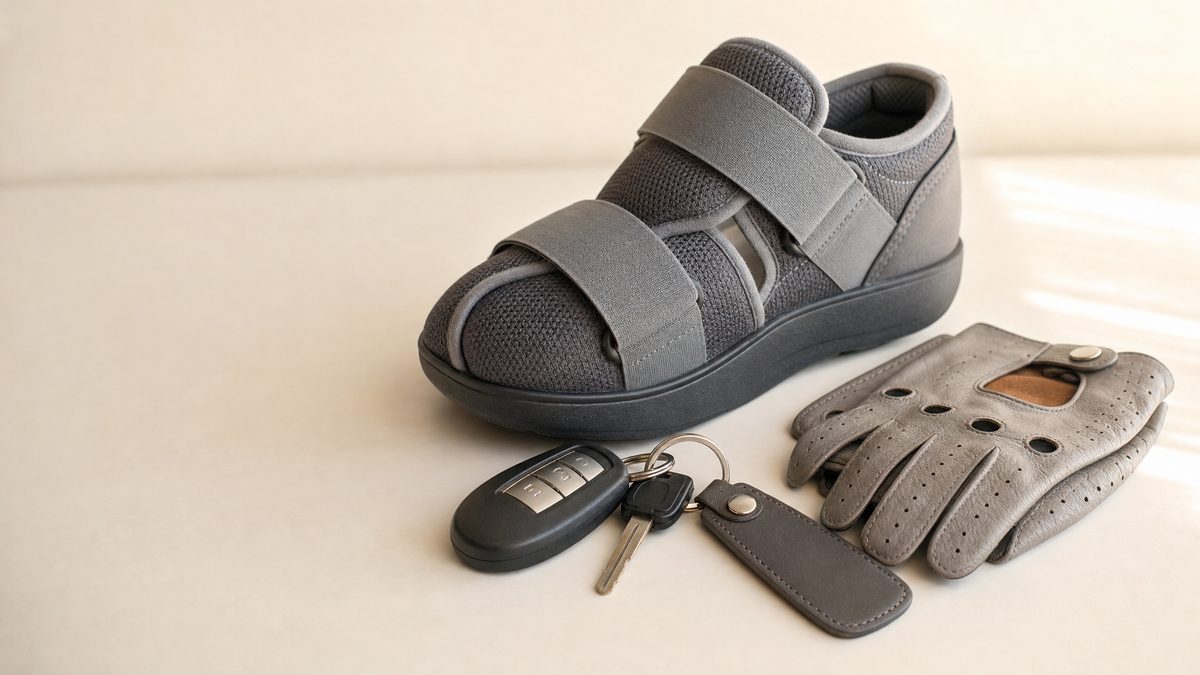
When Can I Drive After Foot Surgery?
Which foot, which gearbox, and one question that settles it: could you stamp on the brake right now without flinching?
Driving is the question patients ask about most after foot surgery and the one they get the vaguest answers to. Part of that is genuine: the timeline depends on which foot, what was done, what you drive, and how you are healing. But part of it is that clinicians are wary of giving a blanket clearance over the phone, because fitness to drive is a functional judgement rather than a date on a calendar.
The useful thing is that the underlying standard is simple and you can check it yourself. Everything below, the procedure timelines, the boot problem, the insurance question, comes back to whether you could perform an emergency stop, at full force, without hesitating.
Medically reviewed by Dr. Timothy Horak and Julia Shauger, board-certified podiatric specialists serving Homewood, South Chicago Heights & Mokena. Last reviewed August 2026. Your own surgeon's instruction always takes precedence over general guidance.
The short answer
Left foot in an automatic: often 1 to 2 weeks, once off opioids. Right foot: 2 to 4 weeks for simple forefoot work, 6 to 8 weeks after bunion surgery, 8 weeks or considerably more after hindfoot, ankle, or fusion surgery. Do not drive with a boot or cast on your pedal foot, and taking it off for the drive is not a fix. The test is an emergency stop at full force with no hesitation, and it is worth confirming your insurer's position too.
Do Not Drive Yet If Any of These Are True
- •You are still taking opioid pain medication, or anything that makes you drowsy
- •The pedal foot is in a boot, cast, or post operative shoe
- •You cannot press the brake at full force without pain or hesitation
- •You cannot move quickly and repeatedly between accelerator and brake
- •You are still non weight bearing, or need crutches to reach the car
- •Your surgeon has not cleared you, or you have not asked yet
Sitting in a parked car on your own driveway and pressing the pedals hard, several times, is a genuinely useful rehearsal and it is what many surgeons suggest.
Typical Timelines
Usually the Quickest
- Often 1 to 2 weeks, once off opioid pain medication
- You still need to get in and out of the car safely and unaided
- A boot on the left foot is frequently acceptable, but confirm it
- Sitting with the leg down for a long drive will swell it; plan stops
Toe and Nail Surgery
- Right foot, roughly 2 to 4 weeks depending on the procedure and dressing
- You must be out of the post operative shoe and into a normal one
- Braking loads the ball of the foot directly, which is the limiting factor
- Toenail procedures are often at the short end of this range
Bone Work in the Forefoot
- Right foot, commonly 6 to 8 weeks; some minimally invasive cases earlier
- Fixation in the bone is being loaded every time you brake firmly
- Left foot in an automatic is often 1 to 2 weeks
- Get the clearance at your follow up and have it documented
Fractures, Fusions, Reconstruction
- Right foot, 8 weeks at the earliest and often considerably longer
- Ankle motion controls pedal modulation, and it returns slowly
- Non weight bearing periods push everything back by definition
- Reconstructions and fusions are frequently 3 months or more
These are typical ranges from surgical practice, not permissions. Two people having the same operation can be weeks apart, and the variable that matters is function rather than time elapsed.
Why the Boot Is the Sticking Point
People reasonably assume that if they can walk in a boot, they can drive in one. The problem is that braking is not walking. It requires a fast, forceful, finely graded movement at the ankle, and a boot is specifically designed to prevent exactly that movement.
Add three centimetres of sole thickness and the geometry of the footwell changes as well. The boot sits closer to the pedals than a shoe, it can catch on the pedal edge or the floor mat, and in a hurried movement it can end up in the wrong place entirely. Braking studies consistently find slower reaction times and lower peak force with an immobilised ankle, and the effect is large enough to matter at speed.
Taking the boot off for the drive removes the obstruction and creates a different problem. The bone or repair that the boot was protecting now takes the full load of a hard brake application, and the foot is unprotected in a collision. If the boot is on your right foot and you drive an automatic, the honest answer for those weeks is lifts, deliveries, and a bit of planning, which is a nuisance rather than a disaster.
Completely tore the ligament? What a grade 3 tear means, the week-by-week timeline, and when surgery comes up. Grade 3 Ankle Sprain Recovery Time →
Having bunion surgery? The full recovery timeline, week by week. Bunion Surgery Recovery Timeline →
Ankle fracture? When weight bearing starts drives everything else. Ankle Fracture Recovery Timeline →
Hammertoe or pin in the toe? Hammertoe Surgery Recovery →
Frequently Asked Questions
When can I drive after foot surgery?
The answer turns almost entirely on which foot was operated on. If it was the left foot and you drive an automatic, many people are cleared within one to two weeks, once they are off strong pain medication and can get in and out of the car safely. If it was the right foot, or you drive a manual, the timeline is governed by when you can operate the pedals properly, and the usual ranges are roughly two to four weeks after a simple forefoot procedure in a stiff soled shoe, six to eight weeks after bunion surgery, eight weeks or more after hindfoot or ankle surgery, and longer again after fusions or reconstructions. Those are typical figures rather than permissions. The actual test is functional and it is described below, and your surgeon's specific instruction always overrides a general timeline because they know what was done to the bone.
Can I drive in a walking boot or cast?
You should not drive with a boot or cast on the foot you use for the pedals, and this is one of the clearest points in the whole subject. A boot changes the geometry of your ankle, adds several centimetres of sole thickness, restricts the fine ankle movement that pedal control depends on, and can catch on the pedal or the floor. Studies measuring braking performance consistently show significantly worse reaction and force in a boot compared with a normal shoe, and the risk of the boot itself becoming an obstruction is real. Driving with the boot removed for the journey is not the workaround it looks like. The foot is unprotected, it is usually weak and painful, and if the boot was prescribed for a healing bone, an emergency stop through it is exactly the load it was meant to avoid. A boot on the left foot in an automatic is a different situation and is often acceptable, but it is worth confirming with your surgeon.
What is the actual test for being ready to drive?
The standard clinicians use is whether you can perform an emergency stop safely and without hesitation. Break that into parts you can genuinely check: you are off opioid pain medication entirely, you can get into the driver's seat and position the foot without help, you can move the foot between accelerator and brake quickly and repeatedly without pain, you can press the brake hard with full force, and you would not flinch or hesitate if you had to do it right now. Practising in a stationary car on a driveway is a reasonable and commonly recommended way to check, pressing the pedals firmly and repeatedly before you ever move. If there is any hesitation in that last item, you are not ready, regardless of how many weeks it has been. A driver who instinctively protects a sore foot will brake late, and that hesitation is measured in car lengths.
Will my insurance cover me if I drive too soon?
This is the part patients are most often unaware of, and it is worth taking seriously. Motor insurers generally expect you to be medically fit to drive, and driving against medical advice or before you are physically capable of controlling the vehicle can jeopardise cover in the event of a claim. A collision in that situation may also raise questions about liability. Policies and state rules vary, so the sensible steps are to ask your surgeon to document that you are cleared to drive, and to check your own policy wording or ask your insurer directly, which costs one phone call. It is also worth knowing that clinicians will usually decline to give a blanket clearance over the phone. They are being careful rather than unhelpful: fitness to drive is assessed on function, and the person best placed to judge whether you can stamp on a brake pedal is the person who can watch you do it.
Can I use my left foot to drive if my right foot is in a boot?
It is a bad idea in an ordinary car, and it is the single most common workaround people ask about. Left foot braking in a vehicle set up for right foot control means reaching across, which changes your seating position and body angle, and it removes the years of automatic muscle memory that makes emergency braking fast. Studies of untrained left foot braking show slower and less accurate performance, and in a genuine emergency you are relying on a movement you have never practised at speed. There are legitimate versions of this: vehicles can be professionally fitted with a left foot accelerator or hand controls, and specialist assessment centres exist to advise and certify this for people with longer term needs. For a six week recovery, arranging lifts, deliveries, and rides is almost always the better answer than retraining a reflex you will abandon in a month.
How long after bunion surgery can I drive?
For right foot bunion surgery, most surgeons expect somewhere around six to eight weeks, and some minimally invasive procedures allow earlier. The delay exists because bunion surgery cuts and fixes bone at the base of the big toe, and the big toe joint is loaded directly when you press a brake pedal, so pressing hard both hurts and stresses the fixation. It also matters that most patients are in a post operative shoe or boot for several weeks, and driving in one is not appropriate. For left foot bunion surgery in an automatic, many people drive at around one to two weeks, once off opioids and able to get in the car comfortably. The functional test still applies in both cases: full force on the brake, no hesitation, no pain that would make you hold back. Ask at your two week or six week follow up and get the clearance recorded.
See a Podiatrist Near You
ASG Foot & Ankle has offices in Homewood, South Chicago Heights and Mokena. Our board-certified podiatrists accept most insurance. Find the office closest to you:
Planning Foot Surgery? Ask About the Practicalities.
ASG Foot & Ankle walks patients through the whole recovery before the date is booked: time off work, driving, weight bearing, and what to arrange at home. Across Homewood, South Chicago Heights, and Mokena.