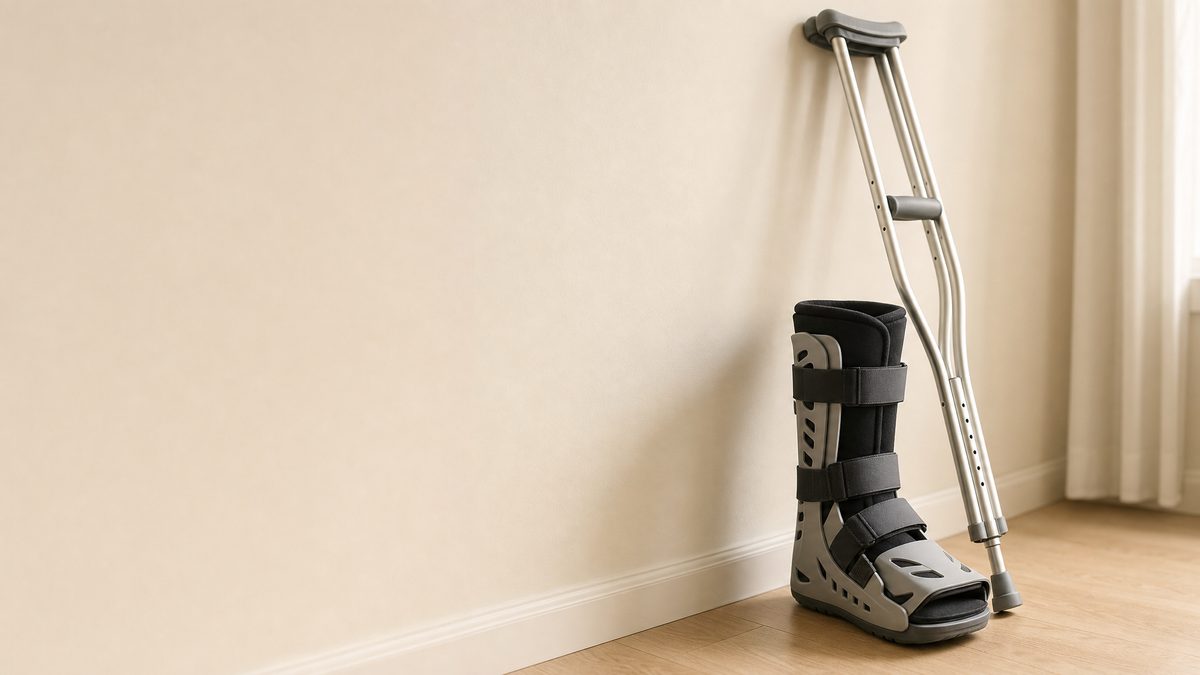
Ankle Fracture Recovery: The Month-by-Month Timeline
The cast comes off at six weeks, and that is the halfway point, not the finish line. Here is what actually happens month by month, with or without surgery.
A broken ankle has two recoveries, and almost everyone is only told about the first one. The first is the bone: six to eight weeks in a cast or boot while the fracture knits, with or without plates and screws holding it. The second is everything the immobilization cost you while that happened: a stiff joint, a shrunken calf, gone balance reflexes, and an ankle that swells every evening for months. The second recovery is longer than the first, it is the one that decides how you walk, and it is the one this page is mostly about.
The timeline below covers both, whether you were treated in a boot or with surgery, plus the weight-bearing progression, the hardware questions, and the short list of things that are genuinely urgent along the way.
Medically reviewed by Dr. Timothy Horak and Julia Shauger, board-certified podiatric specialists serving Homewood, South Chicago Heights & Mokena. Last reviewed August 2026.
The short answer
Bone heals in 6 to 8 weeks. Weight-bearing starts anywhere from right away to 6 weeks depending on the fracture pattern. Walking without a limp returns around 3 to 4 months, impact and sport at 4 to 6 months, and evening swelling can run up to a year. The weeks right after the cast comes off are the hardest part, and the rehab you do then decides the result.
Get Help Promptly If You Notice
- •Sudden calf swelling or calf pain in the injured leg, or new shortness of breath (possible blood clot, this is same-day or emergency care)
- •Pain inside the cast that escalates relentlessly despite elevation and medication
- •Toes turning pale, blue, or cold, or numbness and tingling that will not ease with elevation
- •Spreading redness, warmth, drainage, or fever after surgery
- •A crack, pop, or new deformity after a stumble on the healing leg
- •The cast or boot cracking, softening, or rubbing a raw spot
- •Swelling that had settled and then clearly increases with redness or warmth
The Recovery, Stage by Stage
Protect and Elevate
- Splint or cast, or surgery in the first days once swelling allows; elevation is the main job
- Swelling control is not comfort care, it protects the skin and speeds everything after
- Non-weight-bearing for most patterns; crutches, walker, or a knee scooter
- Wiggle the toes constantly and move the knee and hip; the rest of the leg should not hibernate
Bone Knitting
- Cast or boot continues; stitches out around 2 weeks if surgery was done
- Stable fractures may begin protected weight-bearing in the boot on your surgeon's schedule
- Pain fades to a dull ache; itching inside the cast means skin healing, not trouble
- The calf visibly shrinks; this is expected and fully recoverable
Out of the Cast, Into the Work
- X-rays confirm healing; the boot comes off or weight-bearing advances
- The ankle is stiff, weak, and swells by evening; this is the expected low point, not a setback
- Physical therapy or a disciplined home program starts now and matters enormously
- Boot weans off over 1 to 2 weeks as the limp improves
Learning to Walk Again
- Gait normalizes; most people shed the limp somewhere in month 3
- Calf strength, single-leg balance, and stair confidence rebuild week by week
- Evening swelling continues; compression socks earn their keep
- Driving typically returns once you can brake hard without hesitation (right ankle)
Return to Impact
- Jogging, then running, then sport-specific movement, in that order
- Single-leg heel raises near-symmetric is the practical green light for impact
- Uneven ground and fatigue are the re-injury zones; build exposure gradually
- Aching after big days is common and fades; sharp joint-line pain is worth reporting
The Long Tail
- Intermittent swelling with long days tapers off across this window
- Stiffness in deep squat or full point may linger; usually minor and painless
- Hardware questions get settled now if anything is prominent or rubbing
- Persistent significant pain at 6 months deserves evaluation, not resignation
Your Fracture Pattern Sets Your Schedule
"Broken ankle" covers everything from a hairline crack to a joint in three pieces, which is why your instructions may look nothing like your neighbor's.
| Fracture | Typical treatment | Weight-bearing | Back to normal walking |
|---|---|---|---|
| Stable single malleolus | Boot, no surgery | Often early, in the boot | ~2 to 3 months |
| Displaced or unstable | Surgery (plate and screws) | Protected ~4 to 6 weeks | ~3 to 4 months |
| Bimalleolar / trimalleolar | Surgery, nearly always | Protected ~6 weeks | ~4 to 6 months |
| With syndesmosis injury | Surgery plus a stabilizing screw or button | Protected, often longer | Add ~4 to 6 weeks to everything |
| Avulsion fleck (ligament pull-off) | Treated like a bad sprain | Usually early | ~1 to 2 months |
One distinction worth understanding: an avulsion fleck, where a ligament pulled off a fleck of bone, behaves like the sprain it really is. A true fracture through the weight-bearing structure behaves like the table above. The X-ray report language can make both sound similar, and they are not.
The Hardest Part Comes After the Cast
Nobody warns people about this properly. Coming out of the cast feels like it should be the victory moment, and instead the ankle you get back is stiff, thin, untrustworthy, and swollen by dinner. The first two weeks after immobilization ends are reliably the emotional low point of the whole recovery, precisely because expectations and reality cross there.
It is also the highest-leverage moment. Range-of-motion work, progressive calf strengthening, and balance drills started now translate directly into how soon the limp disappears. The joint is remodeling and the soft tissue is still adaptable; the same work started three months later fights established stiffness instead of preventing it.
The single most useful benchmark: single-leg heel raises. When the injured side can do them nearly as well as the other side, walking looks normal and impact activity is close. Until then, the limp is a strength problem, not a healing problem.
Where should I be today? Enter the date of the fracture or surgery
Enter the date and get what is normal for today, what is next, and what to watch for.
Completely tore the ligament? What a grade 3 tear means, the week-by-week timeline, and when surgery comes up. Grade 3 Ankle Sprain Recovery Time →
Pain above the ankle, not below the bony bump? That is a high ankle sprain, and it runs two to three times longer. High Ankle Sprain Recovery Timeline →
Was it a sprain rather than a break? Ligament injuries run a different course, including the re-sprain trap. Ankle Sprain Recovery: Grade 1, 2 and 3 →
Broke a toe instead? Toe fractures follow their own, much more walkable timeline. Broken Toe Healing: Week-by-Week →
Foot pain that built up without an injury? It might be a stress fracture, which behaves differently again. Stress Fracture in the Foot: Healing Time →
Frequently Asked Questions
How long does a broken ankle take to heal?
The bone itself knits in roughly 6 to 8 weeks, and that number is the source of most of the disappointment around this injury, because it is only the first phase. After weeks of immobilization the ankle is stiff, the calf has visibly shrunk, and the joint swells with use, so walking normally usually returns around 3 to 4 months, and comfortable return to impact activity or sport more like 4 to 6 months. Intermittent swelling with long days commonly persists up to a year. A stable fracture treated in a boot runs the same broad timeline as a surgically fixed one; what differs is mainly how soon weight is allowed through the leg, which your surgeon or podiatrist sets based on the fracture pattern.
When can I walk after an ankle fracture?
It depends almost entirely on the fracture pattern, which is why two people with 'a broken ankle' get completely different instructions. A stable, well-aligned fracture of one malleolus is often allowed to bear weight in a boot early, sometimes within the first couple of weeks. An unstable fracture involving both sides of the ankle, or one that needed plates and screws, is typically protected from weight for around 4 to 6 weeks before a gradual progression begins. The progression itself is standard: partial weight in the boot, advancing as tolerated, then boot weaning over a week or two, then a regular shoe. Do not improvise your own schedule in either direction; loading too early can shift a healing fracture, and staying off it longer than instructed feeds the stiffness that becomes the second half of your recovery problem.
Why is walking still hard after my cast or boot came off?
Because immobilization, the thing that let the bone heal, quietly costs you everything else: ankle range of motion, calf muscle mass, balance reflexes, and the skin and tendon glide around the joint. The first two weeks out of a cast or boot are reliably the low point of morale in this recovery. The ankle feels tight and unreliable, it swells by evening, and a limp is universal. This is the phase where physical therapy, or at minimum a disciplined home program of range-of-motion, calf strengthening, and balance work, changes the outcome. The people who do the boring exercises get their gait back in weeks; the people who wait for it to loosen up on its own limp for months, and some of that stiffness can become permanent.
Will the plates and screws in my ankle need to come out?
Usually not. Modern ankle hardware is designed to stay in for life, and most people keep it without ever noticing it. Removal becomes a conversation in a few situations: hardware that sits prominently under thin skin at the ankle and rubs in shoes or boots, screws placed across the syndesmosis (the joint between the two leg bones) which some surgeons remove routinely and others leave, confirmed irritation of a tendon or nerve by a plate edge, or infection. Elective removal is typically not considered until the bone is solidly healed, generally 6 to 12 months after fixation. Cold sensitivity and a dull ache in weather changes are commonly attributed to hardware but usually persist after removal, so they are a weak reason on their own.
How long does swelling last after a broken ankle?
Far longer than anyone expects: intermittent swelling for 6 to 12 months is ordinary after a significant ankle fracture. The ankle is the lowest joint that does mechanical work all day, the injury and any surgery disrupt the veins and lymphatics that drain it, and scar tissue drains poorly for months. The typical pattern is a reasonable morning ankle that thickens through the day, worse after long standing, flights, or the first attempts at real exercise. Compression socks, elevation at the end of the day, and calf-pump exercises genuinely help. The version that is not normal: sudden one-sided swelling with calf pain, especially in the weeks of reduced mobility, which raises the question of a blood clot and deserves same-day attention, or swelling with increasing redness and warmth around an incision, which suggests infection.
Will my ankle ever be the same after a fracture?
For most simple, well-aligned fractures, functionally yes: walking, work, and sport all return, and many people eventually forget which ankle it was. Honest caveats exist. A few degrees of stiffness, particularly in deep squatting or pointing the toes, is common and usually unimportant. Fractures that involved the joint surface, healed with any step or gap in the cartilage, or came with significant ligament injury carry a real long-term risk of post-traumatic arthritis, which can show up years later as activity-related aching and stiffness. That is not a reason for despair, it is a reason for follow-through: restoring full calf strength and balance, managing body weight, and getting persistent pain evaluated early rather than assuming it is just how the ankle is now. An ankle that still hurts significantly at 6 months deserves a look, not resignation.
Wondering when you can drive?
Which foot, which gearbox, and the emergency stop test that actually settles it.
Driving After Foot Surgery →Achilles sore for months, no pop?
Rest feels right and makes it worse. Why a degenerating tendon needs load, not time off.
Achilles Tendonitis Recovery →See a Podiatrist Near You
ASG Foot & Ankle has offices in Homewood, South Chicago Heights and Mokena. Our board-certified podiatrists accept most insurance. Find the office closest to you:
Recovering From an Ankle Injury?
From fracture evaluation and X-rays through boot fitting, weight-bearing progression, and rehab guidance, our board-certified podiatrists manage ankle injuries across our Homewood, South Chicago Heights, and Mokena clinics.