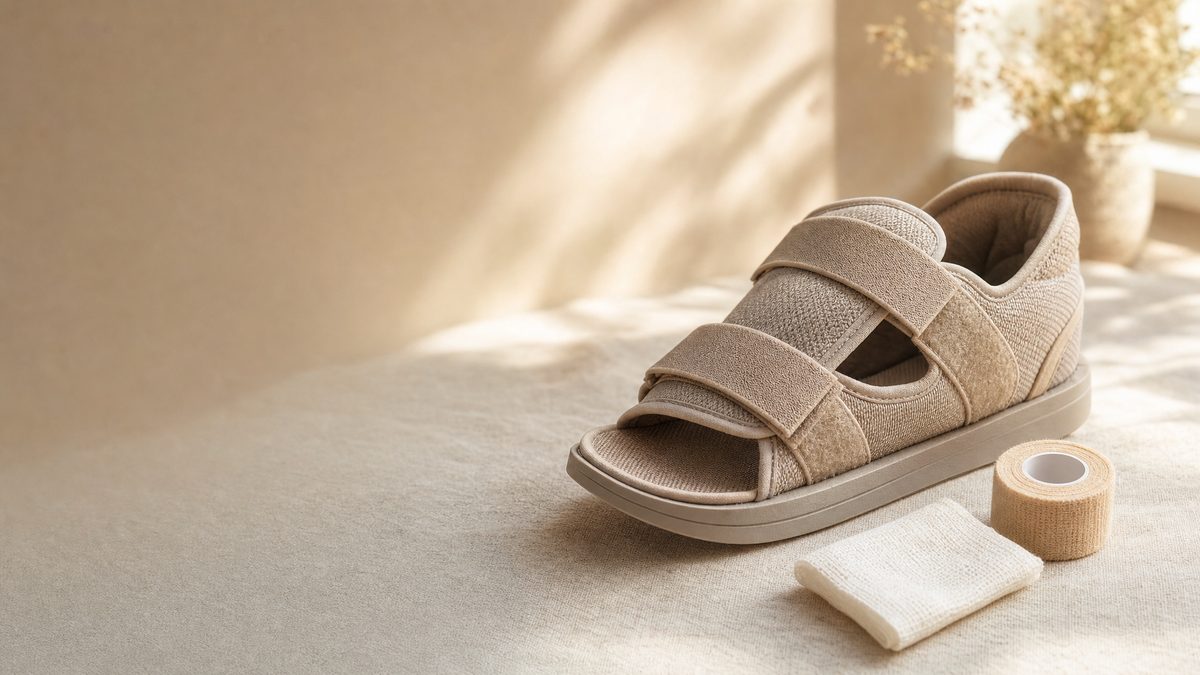
Broken Toe Healing Time: The Week-by-Week Timeline
The bone knits in about a month. The swelling can run for four. That gap is what makes people think something has gone wrong when it usually has not.
Almost everyone who breaks a toe asks the same two questions, and they are not the ones you would expect. The first is whether it even needs treating, because the folklore says there is nothing anyone can do for a broken toe. The second arrives about six weeks later: why does it still hurt and look swollen if it was supposed to be healed by now?
Both questions have real answers. Some broken toes genuinely do fine with a stiff shoe and patience, and some heal badly for the rest of your life if nobody looks at them in the first week. And the bone knitting is only the halfway point of the recovery you actually feel. This guide from the podiatrists at ASG Foot & Ankle walks the healing week by week, separates the fractures that need attention from the ones that do not, and explains what the long tail of swelling means.
Medically reviewed by Dr. Timothy Horak and Julia Shauger, board-certified podiatric specialists serving Homewood, South Chicago Heights & Mokena. Last reviewed August 2026.
The short answer
A fractured smaller toe unites in 4 to 6 weeks. A broken big toe takes 6 to 8 weeks because it carries far more load. Swelling routinely lasts 2 to 4 months and occasional aching can persist up to a year, both of which are normal rather than signs of a problem. The single highest-value thing you can do is get into a stiff-soled shoe, and the single most important thing to check early is whether the toe is pointing straight.
Which Broken Toes Actually Need Seeing
Most people can manage a simple crack in a middle toe at home. These situations change the outcome and should be examined, ideally within the first few days while anything out of position can still be corrected easily:
- •The big toe. It takes roughly 40% of your weight at push-off and far more often needs proper immobilization or fixation
- •A crooked, rotated, or overlapping toe. Displaced fractures heal in whatever position you leave them
- •Any break in the skin. That makes it an open fracture and a genuine infection risk
- •Blood collected under the nail that is painful and under pressure, or a nail bed injury
- •Numbness, a cold or dusky toe, or pain wildly out of proportion to the injury
- •Pain in the middle of the foot, not the toe, or an inability to bear weight at all
- •Diabetes, neuropathy, or poor circulation. Have any toe injury looked at, because the warning signals you would normally rely on are not working
The Healing, Stage by Stage
Swelling and Bruising Peak
- Swelling typically peaks around 48 to 72 hours, not immediately after the injury
- Bruising often spreads to neighboring toes and the sole, which looks alarming and is normal
- Elevate above heart level as much as possible; this does more than anything else this week
- Ice 15 to 20 minutes at a time, never directly on skin, and get into a stiff-soled shoe
Early Callus Forms
- The body lays down soft callus bridging the fracture; it is not yet strong
- Pain shifts from constant throbbing to activity-related, which is the first real milestone
- Bruising drifts downward and turns green then yellow as it resorbs
- This is the window where people feel better, abandon the stiff shoe, and set themselves back
Hard Callus and Union
- Soft callus mineralizes into hard callus; the fracture becomes mechanically stable
- Most people can walk in a normal wide, stiff shoe with markedly less pain
- Morning stiffness in the toe joint is common and is soft tissue, not bone
- Swelling is still clearly present and the toe still looks bigger than its opposite
Bone Healed, Toe Not Yet Normal
- The smaller toes are usually united by now; the big toe often needs 6 to 8 weeks
- Gentle range-of-motion work matters here to stop the joint stiffening permanently
- Return to walking distance and low-impact exercise is usually reasonable
- Expect discomfort in tight or pointed shoes for a good while yet
Swelling Slowly Resolves
- Residual swelling is the longest-running visible sign and can persist 2 to 4 months
- Typically worse by evening and after long days standing, better after a night's rest
- Running and impact sport usually return in this window if pain allows
- A toe that is still visibly swollen at 8 weeks is normal; one that is hot and red is not
The Long Tail
- Occasional aching in cold weather or after heavy days can persist up to a year
- Some permanent thickening at the fracture site is common and harmless
- Fractures that involved the joint surface carry a longer-term stiffness or arthritis risk
- Pain that is not steadily improving by this stage should be re-imaged rather than waited out
Where should I be today? Enter the date you broke it
Enter the date and get what is normal for today, what is next, and what to watch for.
Which Toe You Broke Changes Everything
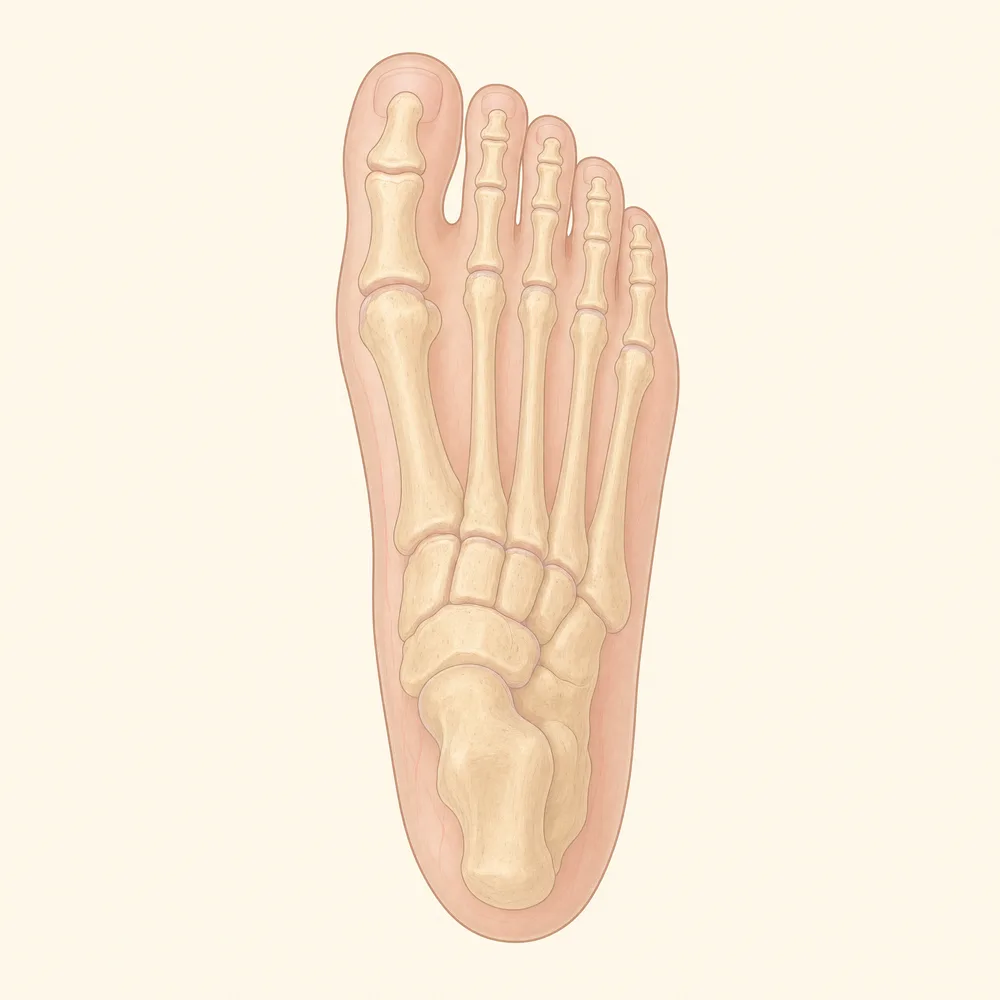 Illustration
"Broken toe" covers injuries with genuinely different timelines and different consequences for getting it wrong. This is the part the folklore misses.
| Location | Union time | Typical treatment | Why it matters |
|---|---|---|---|
| Big toe (hallux) | 6 to 8 weeks | Boot, sometimes fixation | Carries ~40% of body weight at push-off; poor healing changes your gait |
| 2nd to 4th toes | 4 to 6 weeks | Buddy tape + stiff shoe | The forgiving ones; neighbors act as a natural splint |
| 5th (little) toe | 4 to 6 weeks | Buddy tape + wide shoe | Most commonly broken of all; shoe width is the whole battle |
| Joint surface involved | 6+ weeks | Assessment, sometimes surgery | Carries a real long-term stiffness and arthritis risk |
| Metatarsal (midfoot) | 6 to 12 weeks | Walking boot, sometimes surgery | Not a toe fracture at all; the fifth metatarsal base heals badly on its own |
That last row is worth reading twice. A fracture at the base of the fifth metatarsal, on the outer edge of the midfoot, is often mistaken for a broken little toe. One version of it, a Jones fracture, sits in a zone with a genuinely poor blood supply and has a meaningful rate of failing to unite without proper immobilization or surgery. If your pain is in the middle of your foot rather than the toe, that needs an X-ray, not buddy tape.
Why a Stiff Sole Beats Almost Everything Else
If you take one practical thing from this page, take this. The reason a broken toe hurts so much when you walk is not the weight going through it. It is that your toe joints bend roughly 30 to 40 degrees at the end of every single step, and that bend passes directly through the fracture line.
What helps
- A post-operative or fracture shoe with a rigid, flat sole
- A hiking boot or work boot with a stiff shank
- Anything wide enough that nothing presses the toe sideways
- Elevation, genuinely above heart level, in the first week
What makes it worse
- Soft running shoes that flex easily at the forefoot
- Going barefoot on hard floors, which maximizes toe bend
- Flip-flops, which make you grip with your toes to hold them on
- Abandoning the stiff shoe at week two because it feels better
Buddy Taping: Useful, But Not for Every Toe
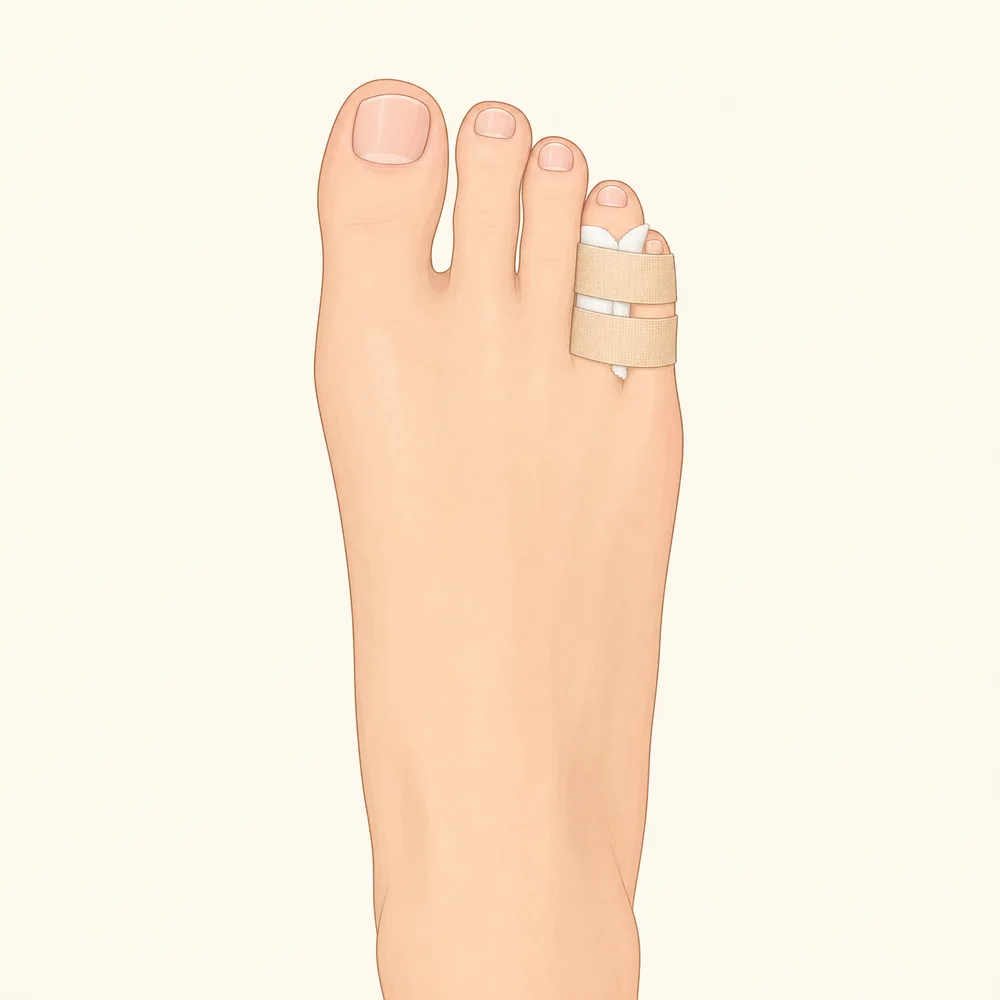 Illustration
Strapping the broken toe to its neighbor turns the healthy toe into a splint. For a simple, straight fracture of the second, third, or fourth toe it works well and is broadly what we would do anyway. Three cautions matter:
- •Always put gauze or felt between the toes. Skin-on-skin under tape stays damp and macerates within days
- •Never tape a toe that is crooked or rotated. You will lock in the deformity
- •If you have diabetes, neuropathy, or poor circulation, do not do this unsupervised. Tape pressure causes skin breakdown, and the people it happens to are exactly the ones who cannot feel it starting
Re-tape daily rather than leaving one strapping on for a week, and check the skin between the toes every time you do.
"It Has Been Six Weeks and It Still Hurts"
This is the most common message we get about toe fractures, and the honest answer is that six weeks is when the bone is done, not when you are. The joint capsule, the small ligaments, and the soft tissue around the fracture remodel for months afterward, and residual swelling keeps the toe stiff and tender at the end of a long day.
The reassuring pattern is trending in the right direction: better in the morning, worse by evening, and noticeably better this month than last. The pattern that deserves another look is pain that is unchanged from week one, pain that is getting worse, pain sharp enough to stop you weight bearing, or new redness and warmth in the toe.
Those can mean a fracture that has not united, a second injury missed at the time, a fracture running into the joint surface, or infection. All four are far easier to deal with at eight weeks than at eight months.
Broke the big toe specifically? It carries your push-off, so it is protected and timed differently. Broken Big Toe Healing Time →
Broke the little toe? How long to buddy tape it, and the outer-foot pain that means it is the metatarsal instead. Broken Pinky Toe Healing Time →
Not sure it is broken at all? Bruised, jammed and broken toes compared side by side, with how long each takes. Bruised Toe Healing Time →
Did the nail go black after the injury? Blood under the nail from trauma behaves differently from other causes of dark nails. Why Toenails Turn Black →
Was the ankle involved too? Rolling the foot often injures both, and the ankle has its own timeline. Ankle Sprain Recovery Timeline →
Broke the ankle itself? Ankle fractures follow a longer plan with a weight-bearing progression of their own. Ankle Fracture Recovery Timeline →
Foot pain that built up with no injury moment? That pattern points to a stress fracture, which hides from early X-rays. Stress Fracture in the Foot →
Diabetic with a foot injury? Any trauma changes the risk picture substantially. Diabetic Foot Care →
Frequently Asked Questions
How long does a broken toe take to heal?
The bone itself typically knits in 4 to 6 weeks for one of the four smaller toes, and 6 to 8 weeks for the big toe, which carries far more load. But that is the bone healing, not the toe feeling normal. Swelling commonly persists for 2 to 4 months, stiffness in the joint can last a similar stretch, and mild aching with weather changes or long days on your feet can continue for up to a year. This gap between bone-healed and feels-healed is the single most common source of worry we hear, and in most cases it is entirely normal rather than a sign that something went wrong.
Do you really need to see a doctor for a broken toe?
For a straightforward crack in one of the middle three toes with the toe still pointing the right way, often no, and the treatment would be much the same at home. But several situations genuinely change the outcome and should be seen. A broken big toe carries roughly 40 percent of your body weight during push-off and is far more likely to need proper immobilization or fixation. A toe that looks crooked, rotated, or overlaps its neighbor is displaced and needs to be reduced before it heals in that position permanently. Any break in the skin over the fracture makes it an open fracture with real infection risk. Blood collected under the nail, numbness, or a fracture that involves the joint surface all warrant imaging. And if you have diabetes or neuropathy, any toe injury should be assessed, because the usual pain signals that tell you something is wrong are not reliable.
Can you walk on a broken toe?
Usually yes, and being able to walk does not mean it is not broken, which is a myth that delays a lot of care. Most people with a fractured smaller toe can bear weight from the beginning, though it will be uncomfortable and you will naturally shift weight to the outside of the foot. The important part is what you walk in. A stiff-soled shoe or a post-operative shoe stops the toe joints from bending through the fracture with every step, which is what actually causes pain and slows healing. A soft running shoe with a flexible forefoot lets the toe flex repeatedly and is much worse. A broken big toe is different and often needs a period of protected or limited weight bearing.
Should I buddy tape a broken toe?
Buddy taping, meaning strapping the injured toe to the one beside it, works well for simple non-displaced fractures of the second, third, and fourth toes, where the neighboring toe acts as a natural splint. It is not universally appropriate. Do not buddy tape if the toe is visibly crooked or rotated, because you will hold it in the wrong position while it heals. Do not buddy tape a broken big toe, which needs more support than a neighbor can provide. And do not buddy tape if you have diabetes, neuropathy, or poor circulation without being shown how, because tape pressure and trapped moisture between toes cause skin breakdown in exactly the people who will not feel it happening. Always place gauze or felt between the toes and re-tape daily rather than leaving it on.
Why does my broken toe still hurt after 6 weeks?
In most cases this is the normal tail of the recovery rather than a problem. At six weeks the bone has usually united but the surrounding soft tissue, joint capsule, and small ligaments are still remodeling, and residual swelling makes the toe stiff and tender at the end of the day. That pattern, better in the morning and worse after activity, gradually fading over months, is expected. What is not expected is pain that is unchanged from week one, pain sharp enough to stop you weight bearing, worsening rather than improving pain, or new redness and warmth. Those raise the possibility of a fracture that has not united, a missed additional injury, damage to the joint surface, or infection, and they deserve a repeat examination and imaging.
What is the difference between a broken toe and a broken metatarsal?
The toes are the small bones beyond the ball of the foot, while the metatarsals are the five long bones running through the midfoot behind them. People often describe both as a broken toe, but the management differs substantially. Metatarsal fractures usually take longer, frequently require a walking boot rather than a stiff shoe, and one specific injury, a fracture at the base of the fifth metatarsal known as a Jones fracture, has a genuinely poor blood supply and a meaningful rate of failing to heal without proper immobilization or surgery. If your pain sits in the middle of the foot rather than in the toe itself, or if you cannot bear weight at all, it should be imaged rather than treated as a broken toe.
See a Podiatrist Near You
ASG Foot & Ankle has offices in Homewood, South Chicago Heights and Mokena. Our board-certified podiatrists accept most insurance. Find the office closest to you:
Not Sure If It Is Healing Right?
A crooked toe, a fracture into the joint, or a metatarsal injury mistaken for a broken toe are all far easier to fix early than late. Our board-certified podiatrists can image it, tell you exactly what you are dealing with, and get you into the right shoe or boot the same visit.