
I Stubbed My Toe and It Still Hurts After a Week: Is It Broken?
What is normal at one, two, three and six weeks, how to tell broken from bruised at home, and when an X-ray is worth it.
If you stubbed your toe and it still hurts after a week, that is common, and on its own it does not mean the toe is broken. The test is whether it is clearly better than it was on day two. Pain and swelling should have started to ease by about day 5, and most of the early soreness and bruising fades within 2 weeks, even when a small bone is cracked.
Toe fractures are the most common fractures in the foot, and stubbing is one of the most common causes, so the worry is reasonable. This guide covers what still hurting means at each point and a practical broken-or-bruised checklist. For the bruise color stages, see bruised toe healing time.
ASG Foot & Ankle patient education. Updated October 23, 2026. General information, not a diagnosis.
The short answer
A stubbed toe that still hurts after a week is normal if it is steadily improving: pain and swelling should start easing by day 5, and the early soreness and bruising usually fade within 2 weeks. A broken small toe takes 4 to 6 weeks to heal, with an ache that can last 3 to 6 months. Get it checked if it is not easing by day 5, still makes you limp at 3 weeks, or still hurts to walk on at 6 weeks, and the same day if it looks crooked, it is the big toe, there is a wound, or you have diabetes or neuropathy.
Get It Seen Promptly If
Same day for the first four; a prompt appointment for the rest:
- •The toe is crooked, rotated, at an odd angle, or bone is showing
- •You think the big toe is broken
- •There is a cut or wound near the injury, or bleeding from around the nail
- •The toe or foot is numb or tingling, or the toe is pale, blue, or cold
- •Pain and swelling have not started to ease 5 days after the injury, or are getting worse
- •The worst pain is in the middle or outer edge of the foot, or you cannot take four steps
- •Red streaks, spreading redness, fever, or chills
- •You have diabetes, neuropathy, or poor circulation, even if it does not hurt much
- •It is a child's toe: the NHS advises against treating it at home
How Long Does a Stubbed Toe Take to Heal? Week by Week
A stubbed toe is usually bruised, sprained at a joint, or broken. On day one they can look the same; their timelines separate over the following weeks, so "it still hurts" means something different at each point.
The Worst of It
Normal
- Throbbing, swelling, and a limp
- Purple color, often by the next day
Worth a look
- A crooked toe, or you cannot take four steps
- Throbbing blood under the nail: drainage works best within 24 to 48 hours
It Should Be Turning
Normal
- Pain and swelling starting to ease
- Soreness in shoes and by evening
Worth a look
- No easing at all by day 5
- Pain getting worse, new redness, or fever
Sore, Not Sharp
Normal
- Early pain, swelling, and bruising fading, even with a small fracture
- Some stiffness at push-off
Worth a look
- One spot on the bone as sharply sore as in week one
The Real Checkpoint
Normal
- A mild ache after a long day
- A fracture still tender: it is only partway healed
Worth a look
- Still limping, or pain with every step
- Pinpoint bone pain or swelling that is not going down
The Bone Knitting
Normal
- A small-toe fracture finishing its 4 to 6 weeks
- Evening swelling after activity
Worth a look
- Still hurts to walk on at 6 weeks
- The toe looks more crooked than before
The Long Tail
Normal
- After a fracture, ache, stiffness, and swelling for 3 to 6 months
Worth a look
- Sharp pain with ordinary walking
- A joint that stays stiff and swollen
If it turns out to be broken, the bone-healing stages are in the broken toe healing timeline.
Why Does My Stubbed Toe Still Hurt After a Week?
Because a week is early. Even with a broken toe, the initial pain and swelling are expected to improve over the first week, not vanish, and the toe bends at the end of every step. The bruise may also look worse than on day one as it spreads and changes color, so judge by pain and walking, not color. Compare today with day two:
Clearly better
On track, whether it is a bruise, a mild sprain, or a simple small-toe fracture. Keep protecting it.
About the same
Past the NHS 5-day mark for pain that has not started to ease. Worth an exam, often an X-ray.
Worse
More pain or swelling, new redness, numbness, or a more bent toe. Get it seen promptly.
One thing that keeps a stubbed toe sore is bending: soft sneakers, flip-flops, and bare feet all let it flex through the injury. A wide, flat, stiff-soled shoe, plus buddy taping for a small toe, is the standard fix.
Stubbed Toe Still Hurts After 3 Weeks
The early pain, swelling, and bruising typically last up to about two weeks, even after a break. A mild ache after a long day at three weeks is fine. A toe that still makes you limp usually has one of these behind it:
- A small fracture still knitting. Broken toes take 4 to 6 weeks to heal, so a hairline break is about halfway there. One sharply tender spot on the bone is the usual clue.
- A bone bruise. Blood trapped under the bone surface, felt as a deep, dull ache. It does not show on X-ray, only on MRI or similar scans. Most last a few weeks; severe ones can take months.
- A sprained or jammed joint. The stub strained the ligaments around a toe joint rather than the bone. See sprained toe healing time.
- Something behind the toe. A metatarsal injury, or a stress fracture, which may not show on an early X-ray and often becomes visible several weeks later.
None is an emergency, but an exam and usually an X-ray are reasonable now. A confirmed small-toe fracture is typically managed with buddy taping and a rigid-sole shoe for 4 to 6 weeks in total.
Still hurting at 4 to 6 weeks? After a fracture, comfortable walking in normal shoes can take 6 to 8 weeks, and some ache and swelling can last 3 to 6 months. But if it still hurts to walk on at 6 weeks, the NHS advises seeing a doctor.
How Do I Know if My Toe Is Broken or Just Bruised?
Only an X-ray can say for certain. These checks tell you which way it leans. The more that point toward a fracture, the more worthwhile the X-ray.
- 1Does it line up with the same toe on your other foot? The nails should face the same way. A toe that angles off, is twisted, or overlaps its neighbor is likely a displaced fracture and needs to be seen the same day.
- 2Is one spot on the bone sharply sore? Press gently along the toe with a fingertip. Pain focused on one point of the bone points toward a fracture; general soreness is less telling.
- 3Did you hear or feel a crack? A sound at impact is a listed sign of a toe fracture. No sound does not rule one out.
- 4Where did the bruise go? With a fracture, bruising often shows the next day and may spread into nearby parts of the foot.
- 5Is it better on day 5 than on day 2? The NHS advises seeing a doctor if pain and swelling have not started to ease 5 days after the injury.
- 6Can you take four steps? Walking does not prove the toe is intact. But being unable to take four steps right after the injury and still now, with pain in the middle of the foot, is one of the rules doctors use for a foot X-ray.
- 7Is the worst pain behind the toe? Tenderness at the base of the fifth metatarsal, the bump halfway along the outer edge of the foot, or over the inner midfoot is a different injury that needs imaging.
- 8Is it the big toe? It plays a bigger part in balance and carrying weight, and the NHS sends a suspected broken big toe to emergency care.
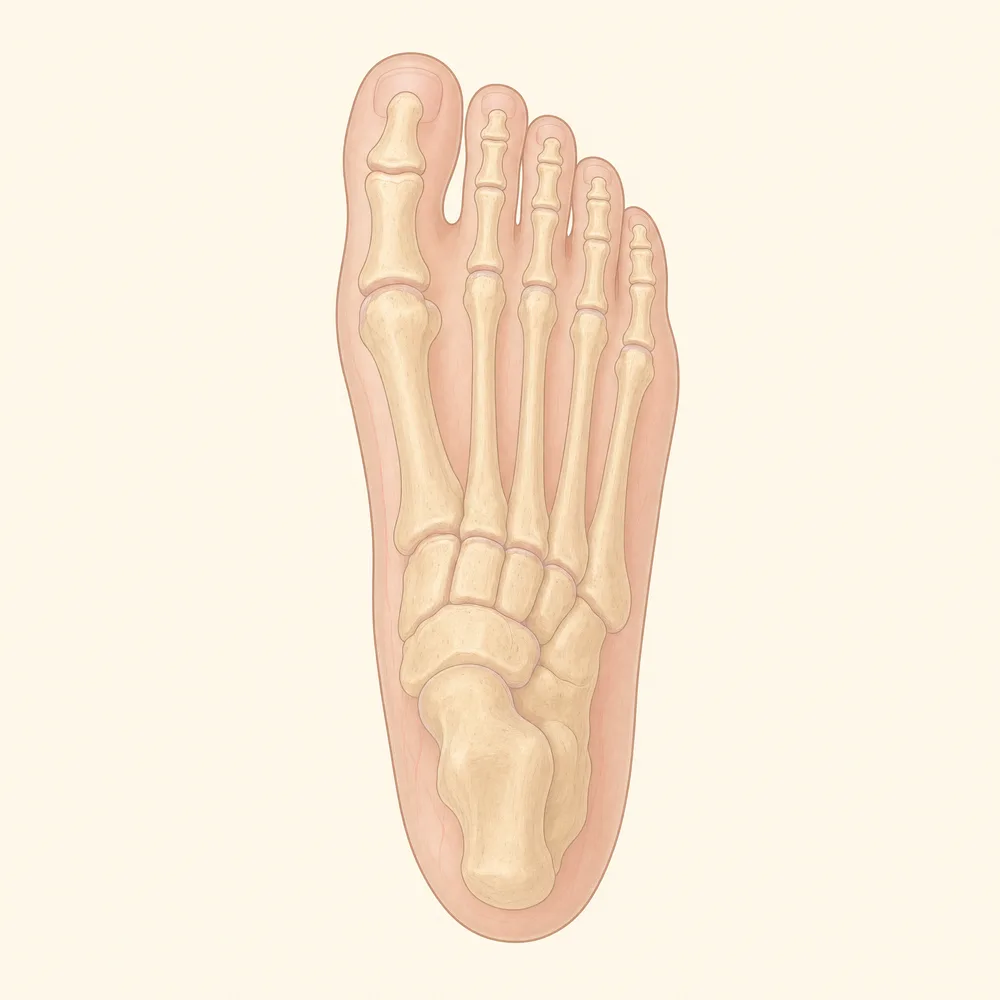 Illustration
The reassuring part
For one of the four smaller toes that lines up straight, the NHS notes treatment is usually the same whether it is broken or bruised. In one review of 339 toe fractures, 95% were displaced less than 2 millimeters, and all were managed without surgery with good outcomes. Knowing for sure mostly changes how long you plan for.
Does a broken toe always bruise?
Not always visibly, and not always straight away. Fracture bruising often appears the next day, is harder to see on brown and black skin, and a stress fracture can swell without bruising. A toe that is not purple has not been cleared.
Stubbed Toe Turned Purple? What the Bruising Means
If you stubbed or hit your toe and it turned purple, blood has leaked from small vessels under the skin. A hard knock can do that with or without a fracture, so stubbed toe bruising alone does not settle the question. It leans toward a break when the bruise spreads into the foot, you felt a crack, the toe looks crooked, or one spot on the bone stays sharply sore. The color stages as it fades are in bruised toe healing time.
One pattern is not a bruise at all: a whole toe that turns pale, gray, or dusky, feels cold, or goes numb. That is a blood supply or nerve problem and needs to be seen the same day. See toe turning black.
Purple or black under the nail
That is usually blood trapped under the nail, a subungual hematoma, and the pressure can be very painful. A clinician can release it through a tiny opening in the nail, which works best within 24 to 48 hours. Not every one needs draining, and it should never be done at home with a heated paperclip, which risks infection. The dark patch grows out with the nail. Why toenails turn black covers the rest.
I Stubbed My Pinky Toe and It Still Hurts
The little toe sits on the outer edge of the foot, so it is the one that catches table legs. It follows the same timeline as the other small toes.
- •Check the angle. A pinky that sticks out, tucks under the fourth toe, or has its nail facing a different way needs to be seen early.
- •Check behind it. Pain along the outer edge of the foot can be a fifth metatarsal fracture, the most common metatarsal fracture, and tenderness at its base is an X-ray criterion.
- •Tape it to the fourth toe with gauze between them: how to buddy tape a toe.
- •Go wider. A wider than usual shoe keeps the side of the shoe off it.
If it is broken, see broken pinky toe healing time.
When Is an X-Ray Worth It?
When the answer would change the plan. For a straight small toe that is improving, it often would not, at least at first.
| Situation | X-ray? | Why |
|---|---|---|
| Crooked, rotated, or overlapping toe | Yes, same day | It may need setting before it heals that way |
| Suspected broken big toe | Yes, same day | It carries the most load |
| Wound near the injury, or bone showing | Yes, same day | An open fracture can let bacteria into the bone |
| Midfoot pain with tenderness at the base of the fifth metatarsal or inner midfoot, or unable to take four steps | Yes | The Ottawa foot rules doctors use |
| Not easing 5 days after the injury | Often | The NHS threshold for seeing a doctor |
| Still limping or pinpoint bone pain at 3 weeks | Reasonable | Confirms the injury and the timeline |
| Still hurts to walk on at 6 weeks | Yes, with an exam | The NHS advises seeing a doctor |
| Diabetes, neuropathy, or poor circulation | Low threshold | Reduced feeling can hide the injury |
| Straight small toe, better every day | Often not at first | Treatment is usually the same either way |
An X-ray cannot show a bone bruise, and an early one can miss a stress fracture. A normal X-ray with a toe that is still not improving deserves a follow-up visit.
Home Care While It Heals
The same basics suit a bruise and a simple small-toe fracture:
- 1Ice, wrapped. Up to 20 minutes every few hours for the first few days, never directly on the skin. Take care, or skip it, with diabetes or reduced feeling in the foot.
- 2Raise it while it is swollen, and avoid long periods of standing or walking for the first few days.
- 3A wide, flat, stiff-soled shoe. It stops the toe bending with every step. Avoid tight or pointed shoes, flimsy sneakers, and bare feet.
- 4Buddy tape a small toe to its neighbor with gauze between them, for 2 to 3 weeks. Not the big toe, and not a crooked toe.
- 5Pain relief if safe for you. Ibuprofen, naproxen, or acetaminophen as directed. Ask first if you have heart, kidney, or liver disease, high blood pressure, or a history of stomach ulcers or bleeding.
- 6Build back gradually. Walk a little more each day. After a break, skip soccer, rugby, hockey, and similar sports for about 6 weeks, or until the pain eases.
When a Stubbed Toe Needs More Than Time
Diabetes or neuropathy
About half of people with diabetes have some nerve damage, so an injury can be worse than it feels. Bones also heal more slowly with diabetes or smoking. Have any toe injury checked.
A crooked toe
A fracture left out of line can heal that way. Deformity, arthritis, and chronic pain are the listed results of a poorly treated toe fracture.
An open wound
A cut or bleeding from around the nail over a possible fracture may be an open fracture, which can let bacteria into the bone.
Numbness, or a pale or cold toe
Signs of nerve or blood supply trouble, not a bruise. The NHS lists tingling or numbness after a toe injury as a reason for emergency care.
The big toe joint
Big toe injuries cause more lasting trouble, and a fracture into a joint can lead to arthritis. A broken big toe often needs a walking boot for 2 to 3 weeks first.
Getting worse
A sudden increase in pain or swelling, red streaks, fever or chills, or a toe that looks more bent all need a prompt review.
Hurt the big toe? See broken big toe healing time, or turf toe recovery if it was bent sharply upward. With diabetes, see diabetic foot and wound care.
Bruise colors, and bruised vs jammed vs broken? Bruised Toe Healing Time →
X-ray showed a break? Broken Toe Healing Timeline →
Jammed rather than bruised? Sprained Toe Healing Time →
Need to tape it? How to Buddy Tape a Toe →
Foot pain that built up without a clear injury? Stress Fracture in the Foot →
Frequently Asked Questions
How long does a stubbed toe take to heal?
It depends on what the stub did. The early pain, swelling and bruising usually settle within a few days to 2 weeks, even with a small fracture. A broken small toe takes about 4 to 6 weeks to heal, and some ache or swelling can last 3 to 6 months. Get it checked if it has not started to ease by day 5, or still hurts to walk on at 6 weeks.
Why does my stubbed toe still hurt after 3 weeks?
By 3 weeks the early pain and swelling should be behind you, so a toe that still makes you limp is worth checking. The likeliest causes are a small fracture still knitting, which takes 4 to 6 weeks; a bone bruise, which does not show on X-ray and can last weeks to months; or a sprained toe joint. An exam, often with an X-ray, gives you a real timeline.
Does a broken toe always bruise?
Not always visibly on day one. Bruising from a broken toe often appears the next day, it is harder to see on brown and black skin, and a stress fracture can swell without bruising at all. A toe that is not purple is not cleared, and a very purple toe is not proof of a break. Alignment, one sharply sore spot on the bone, and the pain trend tell you more.
I stubbed my toe and it turned purple. Is it broken?
Not necessarily. Purple is blood leaked from small vessels under the skin, which a hard stub can cause with or without a fracture. It leans toward a break if the bruise spreads into the foot, you felt a crack, the toe looks crooked, or one spot on the bone stays sharply sore. A toe that turns pale, gray or cold, or goes numb, needs same-day care.
I stubbed my pinky toe and it still hurts. Is it broken?
It may be, but a simple, straight break of the little toe is treated much like a bad bruise: tape it to the fourth toe with gauze between them and wear a wide, stiff-soled shoe. Get it checked if it sticks out sideways or tucks under its neighbor, or if the pain is along the outer edge of the foot behind the toe, which can be a fifth metatarsal fracture.
Should I get an X-ray for a stubbed toe?
Not always. For a straight small toe that improves every day, the NHS notes treatment is usually the same whether it is broken or bruised. An X-ray is worth having for the big toe, a crooked toe, an open wound, pain in the middle or outer edge of the foot, a toe not easing by day 5 or still making you limp at 3 weeks, and anyone with diabetes or neuropathy.
Sources and further reading
- NHS: Broken toe
- MedlinePlus: Broken toe, self-care
- American Family Physician: Diagnosis and management of common foot fractures (2016)
- AAOS OrthoInfo: Toe and forefoot fractures
- ACFAS FootHealthFacts: Toe and metatarsal fractures (broken toes)
- Cleveland Clinic: Broken toe
- Cleveland Clinic: Bone bruise
- Cleveland Clinic: Nail trephination
- Royal United Hospitals Bath NHS Foundation Trust: Advice after breaking your toe
- CDC: Diabetes and your feet
General patient education. Your examination and individual treatment instructions take priority.
See a Podiatrist Near You
ASG Foot & Ankle has offices in Homewood, South Chicago Heights and Mokena. Our board-certified podiatrists accept most insurance. Find the office closest to you:
Stubbed Toe Not Getting Better?
A toe that is not easing by day 5, still makes you limp at 3 weeks, or looks out of line is worth a proper look. ASG Foot & Ankle can examine and X-ray it, tell you whether it is bruised, sprained, or broken, and set you up with the right shoe and a realistic timeline.