
Bruised Toe Healing Time: Bruised, Jammed or Broken?
One to two weeks for a bruise, longer for a jam, four to six for a break. The trick is knowing which one you stubbed.
A bruised toe usually takes 1 to 2 weeks to heal: the worst soreness settles within a few days and the discoloration fades over about two weeks. A badly bruised toe, where the bone itself took the hit, can stay tender for 3 to 4 weeks, and a jammed toe, which is really a sprained joint, often stays stiff for a month or more after the pain has gone.
The harder question is the one behind the search: is it actually bruised, or is it broken? A stubbed toe that turns purple, swells, and hurts to walk on fits both, and being able to walk on it does not settle the matter. This guide from the podiatrists at ASG Foot & Ankle compares the three injuries side by side, walks through the bruise color timeline, lists the signs that point to a fracture, and explains the honest truth that for many small toes the treatment is the same either way, and for which toes it is not.
Medically reviewed by Dr. Timothy Horak and Julia Shauger, board-certified podiatric specialists serving Homewood, South Chicago Heights & Mokena. Last reviewed September 2026.
The short answer
Bruised toe: sore for a few days, mostly healed in 1 to 2 weeks. Badly bruised (the bone took the hit): 3 to 4 weeks. Jammed toe (a sprained joint): 1 to 3 weeks, with stiffness that can last a month or more. Broken toe: 4 to 6 weeks for a small toe, 6 to 8 for the big toe, with swelling that outlasts the bone. The most useful sign is the trend: a bruise is a little better every day from day two or three. A toe that is worse on day three than on day one, looks crooked, or will not let you walk properly deserves an X-ray.
Get It Seen Promptly If
Most stubbed toes are bruises that settle on their own. These features change the picture and mean the toe should be examined, ideally within the first few days:
- •The toe looks crooked, rotated, sticks out sideways, or overlaps its neighbor
- •You cannot take four steps in a row, or the pain is in the ball or outer edge of the foot rather than the toe
- •Blood under the nail covers a large part of it, or throbs badly in the first two days
- •Any cut or break in the skin near the injury, including around the nail. A child who stubbed the big toe and is bleeding from the base of the nail needs same-day care, because this can be an open fracture through the growth plate
- •Numbness or tingling, or the whole toe turning white, blue gray, or black, or feeling cold compared with the others
- •Redness, warmth, or swelling that spreads after the first few days, or a fever
- •You have diabetes, neuropathy, or poor circulation. Have any toe injury looked at, even one that does not hurt much, because pain is not a reliable guide
A whole toe that darkens without a clear injury is a different problem from a bruise. Here is how to tell the difference.
Bruised, Jammed or Broken? Side by Side
The three injuries often start with the same moment, a bare foot catching a table leg or a doorframe, and they can look alike on day one. They differ in what was damaged, where it hurts, and how the pain behaves over the next few days.
| Feature | Bruised toe | Jammed toe | Broken toe |
|---|---|---|---|
| What happened | Small blood vessels burst in the skin and soft tissue, sometimes the bone surface; bone and joint intact | Toe driven straight into something, compressing a joint and spraining its capsule and ligaments | A crack or break in one of the small toe bones |
| Typical signs | Tender over a broad area; a little better each day from day 2 or 3 | Pain and swelling centered on one knuckle; bending the toe hurts most; feels stiff | One sharply tender spot on the bone; maybe a snap at impact; may look crooked; can worsen over 2 to 3 days |
| Bruise pattern | Where it was struck; surfaces over hours to a day | Often mild, around the joint | Often within hours; can spread to neighboring toes, the sole, or the side of the foot |
| Walking | Possible with a mild limp | Possible, but push off hurts | Often possible for a small toe, painfully; a big toe or metatarsal break may not allow it |
| Healing time | Days to 2 weeks; badly bruised 3 to 4 weeks | 1 to 3 weeks; stiffness often 4 to 6 weeks | 4 to 6 weeks small toe, 6 to 8 big toe; swelling for months |
| Needs an X-ray? | Rarely, unless it is not improving by about 2 weeks | If the joint looks bent, it is the big toe, or it is still swollen past a month | Big toe, crooked toe, midfoot pain, open wound, or large blood under the nail; simple small-toe cracks are often treated the same regardless |
One myth deserves retiring here: "if you can walk on it, it is not broken." Most people with a fractured second, third, fourth, or little toe can walk on it from the first day, with a limp and by shifting weight to the outside of the foot. Walking tells you the injury is probably not severe. It does not tell you whether the bone is intact.
How Fast Does a Broken Toe Bruise?
Usually within a few hours. A broken bone bleeds from its own interior as well as from the torn tissue around it, so a fracture tends to produce more blood, sooner, than a simple bruise. Many broken toes are visibly purple the same evening.
The catch is that timing is not reliable in either direction. A fracture deep in the toe or near its base can take 24 to 48 hours for the color to reach the surface, so a toe that looks normal on the night of the injury is not cleared. And a hard stub with no fracture can go dark within the hour, especially in people who take aspirin or a blood thinner, who bruise faster and larger from any injury.
Spread and behavior tell you more than speed. Bruising that reaches the neighboring toes, the sole, or the side of the foot within the first day or two suggests more bleeding than a surface bruise usually produces. Some color also migrates slowly over several days as the blood moves through the tissue, which on its own is not a sign of a break. The pattern to take seriously is early, wide bruising together with pain that is still getting worse on day two or three.
Six Signs It Is More Than a Bruise
None of these proves a fracture on its own, and an X-ray is the only way to be sure. Two or more together make a break considerably more likely.
A snap or crack at impact
Feeling or hearing something give at the moment of the stub is one of the more reliable pointers toward a fracture. Bruises do not crack.
A crooked or rotated toe
Compare it with the same toe on the other foot. A toe that points a different way, sticks out sideways, or overlaps its neighbor is displaced and needs setting early.
One pinpoint tender spot
A bruise is sore over a broad area. A fracture usually has one spot on the bone that is sharply painful when pressed with a fingertip.
Bruising that spreads early
Color reaching the neighboring toes, the sole, or the side of the foot within a day or two suggests bleeding from bone, not just skin.
Worse on day 2 or 3, not better
Every injury is sore at 48 hours as swelling peaks. A bruise then starts easing by day 3 to 5. Pain still climbing after that points to a break.
You cannot walk on it properly
If you cannot take four steps in a row, or the pain sits further back in the ball or outer edge of the foot, it needs imaging.
The Bruise Color Timeline
A toe bruise changes color as the body breaks down the trapped blood. The timings below are approximate. Color varies with the depth of the bruise, skin tone, age, and medications, and doctors do not rely on color to date an injury precisely. What matters is the direction of travel: darker to lighter, and less sore as it goes.
Red, Then Purple
- Fresh blood under the skin looks red or reddish purple, and a deep bruise may not show at all for the first day
- Swelling builds and usually peaks around 48 to 72 hours, so day two often feels worse than day one
- This is the window for ice, elevation, and a stiff shoe, and the window for draining blood trapped under the nail
- A fracture often shows color within hours, but a deep one can take a day or two to surface
Dark Purple and Blue
- The trapped blood loses its oxygen and darkens to purple, blue, or nearly black
- A plain bruise should start to ease by day 3 to 5: less throbbing and easier walking
- The color may creep toward the tip or underside of the toe as the blood moves through the tissue
- Pain that is still climbing at this point is the clearest early hint of a fracture
Green
- The body breaks the blood down into biliverdin, the pigment that turns a bruise green
- Most simple bruises are only sore with pressure or tight shoes by now
- Walking in normal, roomy shoes is usually comfortable
- Green edges with a purple center is normal; the edges clear first
Yellow and Brown
- Biliverdin becomes yellow bilirubin, and iron left behind from the blood leaves a brownish stain
- A simple bruised toe is close to healed; a badly bruised one still aches after a long day
- The stain can linger for a week or more after the pain has gone
- A jammed toe may still be stiff and puffy at the joint even though the color is gone
Fading, or Not
- Bruises on the feet fade more slowly than on the arms, because the foot sits below the heart and drains slowly
- A badly bruised toe can stay tender at 3 to 4 weeks, but it should still be trending better
- Blood under the nail does not fade; it grows out with the nail over months
- Still painful to walk on at 3 weeks? That is the point where an X-ray is worth having
The Honest Part: Many Broken Small Toes Are Treated Like a Bad Bruise
If you stubbed one of the middle three toes or the little toe, it is pointing straight, and you can walk on it, the treatment for a hairline fracture and for a bad bruise is largely the same: buddy tape, a stiff-soled shoe, elevation, and time. The X-ray would tell you which one it is and how long to plan for, but it often would not change what you do this week. That is why a simple, straight small-toe injury is often managed without an X-ray at first.
Where the X-ray genuinely changes the plan:
- •The big toe. It takes far more load at push off, its fractures more often run into the joint, and some need a boot or fixation
- •A crooked, rotated, or overlapping toe. It needs to be set straight in the first days, before it heals in that position
- •Pain behind the toe. Tenderness in the ball of the foot or along its outer edge can be a metatarsal fracture, which heals on a different and sometimes much longer schedule
- •A large blood collection under the nail, or a crush. These can hide a fracture of the bone tip underneath
- •A jammed joint that stays swollen. A small chip off the joint surface can mimic a sprain and carries a longer stiffness risk
- •Diabetes, neuropathy, or poor circulation, or any toe that is not clearly improving by two weeks
If it does turn out to be broken, the week-by-week recovery is in our broken toe healing timeline.
Pinky Toe or Big Toe? It Changes the Timeline
The stubbed pinky toe
The little toe sits on the outer edge of the foot, which is why it is the one that catches furniture and the one most often broken. A bruised pinky toe is usually much better within a week and normal in about two. A fractured one knits in 4 to 6 weeks.
Watch for a pinky that sticks outward or tucks under the fourth toe, and for pain on the outer edge of the foot behind it, which can be a fifth metatarsal injury rather than a toe injury. Shoe width is most of the battle.
Broken Pinky Toe Healing Time →The stubbed or jammed big toe
A bruised big toe follows a similar timeline, but it feels slower because you push off through it with every step. Do not buddy tape it; a stiff sole does far more. The threshold for an X-ray is lower here, and a fracture takes 6 to 8 weeks.
If the big toe was bent sharply upward rather than stubbed straight on, the injury is to the joint underneath, known as turf toe, which has its own longer recovery.
Broken Big Toe Healing Time →Jammed Toe: A Sprain, Not a Bruise
A jammed toe is what happens when the toe is driven straight into something: a bedpost in the dark, a wall, a stair edge, the ground on a mistimed kick. Rather than bruising the surface, the force travels along the toe and compresses one of its joints, stretching or partly tearing the capsule and small ligaments that hold the knuckle together. It is a sprain, and it behaves like one.
The pain and swelling center on one knuckle, bending the toe is what hurts most, and bruising is often mild. Most jammed toes settle in 1 to 3 weeks. The stiffness and puffiness around the joint commonly run 4 to 6 weeks, sometimes longer, which is normal ligament healing rather than a sign that something was missed. Once the first few days have passed, gentle bending of the toe through a comfortable range helps stop that stiffness setting in.
Two things change the plan. A jammed toe that looks bent or out of place at the joint may be dislocated and should be seen the same day, not pulled straight at home. And a jammed toe still swollen and stiff past a month deserves an X-ray, because a small chip fracture at the edge of the joint can feel exactly like a sprain.
Stubbed Your Toe and It Turned Black?
When a stubbed toe turns black under the nail, it is almost always a subungual hematoma: blood from the nail bed trapped between the nail and the bone. The nail is rigid, so the blood has nowhere to go, which is why these can throb far out of proportion to the size of the injury and why the pain often peaks the first night.
- In the first 48 hours, drainage helps. A podiatrist makes a tiny opening in the nail with a sterile instrument, a procedure called trephination. The blood escapes and the pressure pain usually eases within minutes. It works best while the blood is still liquid, roughly the first 24 to 48 hours. After that the blood has clotted, drainage achieves less, and the pain is usually settling anyway.
- A large one needs an X-ray first. When blood covers a large part of the nail, or the toe was crushed rather than stubbed, there is a real chance of a fracture of the bone tip and a cut in the nail bed underneath. That changes the treatment, so it is imaged before anything else.
- Do not drain it at home. The heated paperclip method risks burns and infection, and in someone with diabetes or poor circulation an infected toe is a serious problem.
- The nail may come off. Blood that lifts the nail can loosen it over the following weeks. Keep a loose nail trimmed, covered, and in place rather than pulling it, since it protects the bed while the new one grows. A new big toenail takes about 12 to 18 months to grow in fully; the smaller toenails are quicker.
A dark nail you cannot explain is different. Blood from an injury grows out toward the tip as the nail grows. A dark streak or patch that appeared without a clear injury, does not move forward over a couple of months, or spreads into the skin around the nail should be examined, because occasionally it is not blood at all. The causes of a black toenail are covered in detail in our separate guide.
And if the whole toe, not just the nail, has turned black, dusky, or cold, that is a circulation question rather than a bruise and needs to be seen the same day.
Home Care: The First 48 Hours and After
The first two days are about limiting bleeding and swelling. After that, the job is protecting the toe from bending with every step while it settles.
- 1Rest. Keep walking to the essentials for a day or two. Short trips around the house are fine.
- 2Ice. 15 to 20 minutes at a time, every 2 to 3 hours while awake, over a thin towel and never directly on the skin. Skip the ice if you have neuropathy or poor circulation, where cold injury can happen without you feeling it.
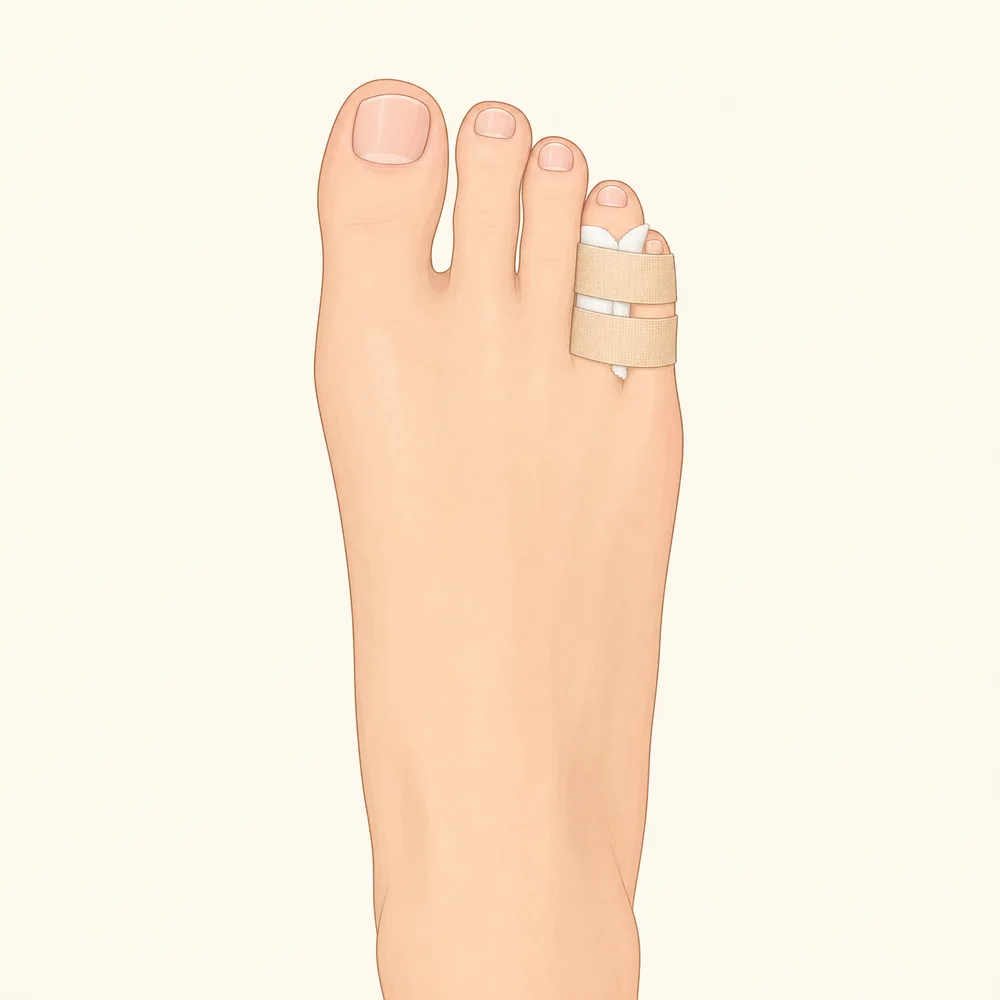
- 3Compression, lightly. For a small toe, buddy taping to its neighbor gives support. Never wrap a single toe tightly, which can cut off its circulation.
- 4Elevation. Toes genuinely above the level of the heart, on pillows, whenever you are sitting or lying. For swelling in the foot this does more than anything else.
- 5Pain relief. Over-the-counter acetaminophen, or an anti-inflammatory such as ibuprofen or naproxen, taken as the label directs if they are safe for you. Check with your doctor or pharmacist first if you have kidney disease, stomach ulcers, or heart disease, are pregnant, or take a blood thinner.
 Illustration
Worth doing
- A stiff-soled shoe, so the toe is not bent through the injury at the end of every step
- A roomy toe box, or an open-toe shoe with a firm sole if the nail is sore
- Buddy tape for a small toe, gauze between, changed daily with a skin check
- Evening elevation for the first week
- Gentle toe bending and wiggling once the first 48 hours pass, to limit stiffness
Worth avoiding
- Heat, hot soaks, and alcohol in the first 48 hours, which increase bleeding and swelling
- Soft, flexible sneakers and flip-flops, which let the toe bend or make you grip
- Going barefoot on hard floors
- Pulling on a jammed or crooked toe to straighten it yourself
- Running or kicking sports while push off still hurts
A reasonable test for getting back to running: brisk walking in a normal shoe is pain free, and you can rise onto your toes and hop on that foot without a sharp twinge. For most bruised toes that is somewhere in the second week. For a badly bruised or jammed toe, give it longer.
"I Stubbed My Toe and It Still Hurts"
After one week, some soreness is normal, especially with walking, in shoes, and by the end of the day. The question is whether it is clearly better than it was on day two. If it is, carry on.
After two weeks, a simple bruise is mostly settled. A badly bruised or jammed toe can still ache with long days and tight shoes, and that is within the normal range as long as each week is better than the last.
After three weeks, a plain bruise should be close to done. A toe that still hurts to walk on, still swells, or has one sharply tender spot on the bone is more likely to be a small fracture, a bone bruise, or a sprained joint. None of those is an emergency, but an X-ray at this point is reasonable and often changes the plan, usually to a stiffer shoe and a clearer timeline. Pain that is getting worse rather than better, new redness and warmth, or a wound near the nail should be seen sooner.
Just a spot, dot or streak, not the whole nail? Most are a small bruise that grows out; here is the ruler-and-photo test and the signs that are not. Black Spot Under Toenail →
Turned out to be broken? The week-by-week healing, and why the swelling outlasts the bone by months. Broken Toe Healing Timeline →
Was it the big toe? It carries the most load and has the longest recovery of any toe. Broken Big Toe Healing Time →
Caught the little toe on the furniture? The most commonly broken toe, and the one where shoe width matters most. Broken Pinky Toe Healing Time →
Nail went black after the stub? Trauma, fungus, pressure, and the rare cause worth ruling out. Why Toenails Turn Black →
Whole toe darkening, not just the nail? That is a circulation question until proven otherwise. Toe Turning Black →
Big toe bent back rather than stubbed? Turf Toe Recovery →
Frequently Asked Questions
How long does a bruised toe take to heal?
Most bruised toes heal in 1 to 2 weeks. The sharp soreness usually eases within 3 to 5 days, walking feels close to normal by the end of the first week, and the discoloration works through purple, green, and yellow before fading at around two weeks. A badly bruised toe, where the bone underneath took the force, can stay tender for 3 to 4 weeks. Bruises on the foot also tend to linger a little longer than bruises elsewhere, because the foot sits below the heart and drains more slowly. If a bruised toe is still clearly painful to walk on at two weeks, or is not improving at all after the first few days, an X-ray is worth having to rule out a fracture.
How long does a badly bruised toe take to heal?
Typically 3 to 4 weeks, and occasionally longer. A bad bruise usually means the bone itself was bruised, not just the skin and soft tissue over it. Bleeding and swelling inside the bone take longer to settle than a surface bruise, so the toe can ache with walking, in tight shoes, or at the end of the day well after the color has faded. A true bone bruise, which only shows up on an MRI, can take a couple of months to feel completely normal. The key is the trend: a badly bruised toe should be a little better each week. One that is as painful at two weeks as on day two, looks crooked, or still will not let you walk properly should be X-rayed, because a small fracture is the injury most often mistaken for a bad bruise.
How long does a jammed toe take to heal?
Most jammed toes settle in 1 to 3 weeks. A jammed toe happens when the toe is driven straight into something, like a bedpost, a wall, or a stair edge, and the force compresses one of the toe joints and sprains the capsule and small ligaments around it. The pain and swelling sit on one knuckle and bending the toe hurts most. Stiffness and a slightly puffy joint commonly outlast the pain, often for 4 to 6 weeks, and that is normal ligament healing. A jammed big toe deserves more care than a small one because it takes so much load at push off, and if the big toe was bent sharply upward rather than jammed straight on, that is turf toe, which has its own longer timeline. A jammed toe that looks bent at the joint, or is still swollen and stiff past a month, should be X-rayed, because a small chip fracture at the joint can behave exactly like a sprain.
How fast does a broken toe bruise?
Usually within a few hours, because a broken bone bleeds from the inside as well as from the torn soft tissue around it. But the timing is not reliable in either direction. A fracture deep in the toe or near its base can take 24 to 48 hours for the bruise to surface, and a hard stub with no fracture at all can go purple within the hour. What matters more than speed is spread and behavior. Bruising that reaches the neighboring toes, the sole, or the side of the foot within the first day or two suggests more bleeding than a simple bruise usually produces. Pain that is worse on day 2 or 3 and not starting to ease by day 4 or 5, a toe that looks crooked, and a snap or crack felt at impact all point toward a fracture as well.
How can I tell if my toe is bruised or broken?
You often cannot be certain without an X-ray, but a few features lean strongly one way. A bruise tends to be tender over a broad area, lets you walk with a mild limp, and feels a little better each day from day two or three onward. A fracture tends to have one precise spot on the bone that is sharply sore when pressed, may have come with a snap you felt or heard, often bruises quickly and widely, can look crooked or rotated compared with the same toe on the other foot, and hurts more on day two or three rather than less. Being able to walk does not rule out a fracture, since most people with a broken small toe can still walk on it. The X-ray matters most for the big toe, a toe that looks out of line, pain further back in the foot, a large blood collection under the nail, and anyone with diabetes, neuropathy, or poor circulation.
I stubbed my toe and it turned black. What does that mean?
If it is the nail that turned black, it is almost always blood trapped under the nail, called a subungual hematoma, and it can throb intensely because the blood has nowhere to go. Within roughly the first 48 hours, while the blood is still liquid, a podiatrist can release it through a tiny opening in the nail, which is quick and usually brings relief within minutes. After that the blood clots and drainage helps less, though the pain is usually easing by then. A collection covering a large part of the nail, or one from a crush, should be X-rayed first because it can hide a fracture of the bone tip underneath. The nail may loosen and come off over the following weeks, and a new big toenail takes about 12 to 18 months to grow in fully. If the whole toe, rather than the nail, has turned black, dusky, or cold, that is not a bruise pattern and it needs to be seen the same day.
How long does a stubbed pinky toe take to heal?
A stubbed pinky toe that is only bruised usually feels much better within a week and is back to normal in about 2 weeks. The little toe is the one most often caught on furniture and also the one most often broken, and a fracture there takes 4 to 6 weeks to knit, with swelling that can last longer. A simple, straight fracture of the little toe is treated almost the same way as a bad bruise: buddy tape it to the fourth toe with gauze between them and wear a shoe wide enough that nothing presses on it from the side. The exceptions are a pinky toe that sits at an odd angle, sticks out sideways, or overlaps its neighbor, which needs to be straightened early, and pain on the outer edge of the foot behind the toe, which can be a fifth metatarsal fracture rather than a toe injury.
Why does my stubbed toe still hurt after a week, or after three weeks?
At one week, some soreness is normal, especially with walking, in shoes, and at the end of the day. A simple bruise should be clearly better than it was on day two, even if it is not gone. At three weeks the picture changes. A plain bruise should be close to settled by then, so a toe that still hurts to walk on, still swells, or has one sharply tender spot on the bone is more likely to be a small fracture, a bone bruise, or a sprained joint than an ordinary bruise. None of those is an emergency, but an X-ray at that point is reasonable and often changes the plan, usually to a stiffer shoe and a clearer timeline. Pain that is getting worse rather than better, new redness and warmth, or a wound near the nail should be seen sooner.
See a Podiatrist Near You
ASG Foot & Ankle has offices in Homewood, South Chicago Heights and Mokena. Our board-certified podiatrists accept most insurance. Find the office closest to you:
Bruised or Broken? Find Out in One Visit
A stubbed toe that is not settling, looks crooked, or has blood throbbing under the nail is worth a proper look. Our board-certified podiatrists can X-ray it, tell you whether it is bruised, sprained, or broken, relieve a painful nail when drainage will help, and get you into the right shoe with a realistic timeline.