Turf Toe: Days, Weeks, or a Season
A sprained big toe sounds trivial until you count how many times a day you push off through it. The grade decides everything.
Turf toe is a sprain of the joint at the base of the big toe, caused by the toe being forced upward past its normal range while body weight drives through it. The structure that gets injured is the plantar plate, a thick fibrous pad on the underside of the joint that stabilises it and houses the two sesamoid bones.
It has a reputation for lingering, and the reason is mechanical rather than mysterious. That joint takes a large share of your body weight every time you push off, which is thousands of times a day, so healing tissue keeps getting tested. The treatment that works is therefore not rest in the usual sense, it is preventing the toe from bending, which is why a rigid sole ends up mattering more than anything else you do.
Medically reviewed by Dr. Timothy Horak and Julia Shauger, board-certified podiatric specialists serving Homewood, South Chicago Heights & Mokena. Last reviewed August 2026.
The short answer
Grade 1 is days to two weeks, grade 2 is two to eight weeks, grade 3 is six to ten weeks minimum and sometimes surgical. The treatment in every grade is to stop the toe bending upward: a rigid sole, a carbon plate, taping, and a boot for the higher grades. Returning to sport before you can push off pain free is the single thing that turns a short injury into a chronic one.
Get It Imaged Rather Than Waiting If
- •You cannot bear weight on the foot, or cannot push off at all
- •There is significant swelling and bruising on the underside of the joint
- •The big toe looks out of alignment compared with the other foot
- •You felt a pop at the moment of injury
- •There is a single exquisitely tender point on one small bone under the ball of the toe
- •It is not improving at all after two weeks of protection
A high grade plantar plate tear treated as a minor sprain is the classic path to a permanently stiff, painful big toe joint.
The Three Grades
Stretched, Not Torn
- Localised soreness, minimal swelling, little or no bruising
- You can usually still walk and often still play
- Taping plus a stiff soled shoe; ice and relative rest
- Typical recovery: a few days to about two weeks
Partial Tear
- More diffuse tenderness, visible swelling, bruising underneath is common
- Push off hurts, and the toe does not want to bend upward
- Walking boot early, then a rigid insert; graded return over weeks
- Typical recovery: 2 to 8 weeks before sport
Complete Tear
- Severe pain, marked swelling and bruising, unable to push off at all
- The toe may look subtly out of position, or the sesamoids may have shifted
- Imaging is warranted; some cases need surgical repair
- Typical recovery: 6 to 10 weeks minimum, often considerably longer
What Else Hurts in the Same Place
| Condition | How it starts | Distinguishing feature |
|---|---|---|
| Turf toe | One sudden event, toe bent upward | Pain across the joint, often bruising underneath |
| Sesamoiditis or fracture | Gradual, repetitive loading | One pinpoint sore spot on a small bone under the joint |
| Hallux rigidus | Slow, over years | Stiffness and a bony ridge on top; worse bending up |
| Gout | Overnight, no injury | Red, hot, exquisitely painful, often wakes you |
| Stress fracture | Gradual, after a training increase | Pain with impact that eases with rest, then returns sooner |
The Rigid Sole Does Most of the Work
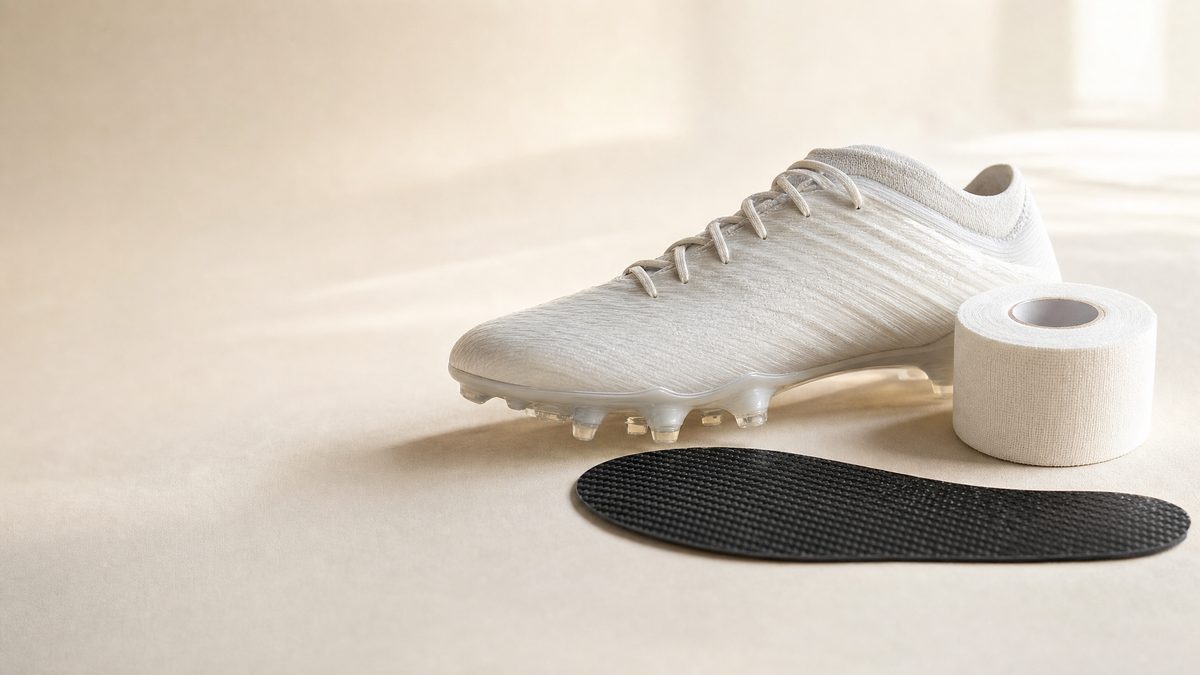
Every element of turf toe management is really the same idea repeated: stop that joint from bending upward while the plantar plate heals. Tape does it, a boot does it, and a carbon fibre plate in the shoe does it in a form you can wear to work and eventually back to sport.
This is why the injury behaves so differently for two people with the same grade. Someone who spends eight weeks in flexible trainers is loading the healing tissue thousands of times a day, and their grade 2 sprain acts like a grade 3. Someone with a rigid plate is not, and theirs settles roughly on schedule.
Worth knowing when the protection comes off: the plate usually stays in the shoe for a long stretch after the toe stops hurting, particularly in cutting sports. The tissue that hurts is not the same as the tissue that is strong, and the gap between those two dates is where re injuries live.
Broke the big toe specifically? It carries your push-off, so it is protected and timed differently. Broken Big Toe Healing Time →
Not sure it is broken at all? Bruised, jammed and broken toes compared side by side, with how long each takes. Bruised Toe Healing Time →
Pain above the ankle, not below the bony bump? That is a high ankle sprain, and it runs two to three times longer. High Ankle Sprain Recovery Timeline →
Pinpoint pain on a small bone under the joint? That is more likely a stress fracture pattern. Stress Fracture in the Foot: Healing Time →
Red, hot, and it woke you at 3am with no injury? Gout Attack Timeline: How Long It Lasts →
Toe stiff and painful for years, not days? Big Toe Pain: Causes and Relief →
Frequently Asked Questions
How long does turf toe take to heal?
It depends entirely on the grade, and the range is wide. A grade 1 sprain, where the plantar plate is stretched but intact, typically settles in a few days to two weeks with taping and a stiff soled shoe, and many athletes keep playing through it. A grade 2 partial tear runs roughly two to eight weeks, usually with a period in a walking boot and a slower return to cutting and sprinting. A grade 3 complete tear is a serious injury: expect a minimum of six to ten weeks before sport, frequently longer, and in some cases surgery. The complicating factor across all grades is that this joint is used constantly. You push off through the big toe every step, so it does not get the natural rest that an upper limb injury would, which is why turf toe has a reputation for dragging on well past the point everyone expected.
What actually is turf toe?
It is a sprain of the joint at the base of the big toe, specifically an injury to the plantar plate and surrounding capsule and ligaments on the underside of that joint. The mechanism is hyperextension: the toe is forced upward beyond its normal range, usually with the heel raised and body weight driving through it, which is exactly what happens when a foot is planted and the body keeps travelling forward. It got its name from American football on artificial turf, where the combination of a hard unyielding surface and flexible shoes made it common, but it happens in soccer, basketball, dance, gymnastics, wrestling, and in ordinary life from a bad step off a curb. Anatomically the plantar plate is a thick fibrous structure that stabilises the joint and houses the two sesamoid bones, and injuring it destabilises a joint that transmits a large share of your body weight at push off.
Should I wear a boot for turf toe?
For grade 2 and 3 injuries, usually yes, at least for the early weeks, because the goal is to stop the toe from bending upward while the tissue repairs. For grade 1 injuries a boot is generally unnecessary and a stiff soled shoe with taping does the job. Whatever the grade, the single most useful piece of equipment is a rigid sole, because bending at the joint is what pulls on the healing tissue. That principle continues long after any boot comes off: a carbon fibre insert or a rigid full length plate in the shoe protects the joint during return to activity and is often used for months in athletes. Taping the toe to limit upward bend is the other mainstay, and it is worth having it demonstrated properly rather than copying a video, since tape applied without controlling the right direction of movement does very little.
How do I know if it is turf toe or a sesamoid injury?
The two overlap and often occur together, which is why an examination is worth having rather than self diagnosing. The useful distinctions are mechanism and location. Turf toe usually starts with a single identifiable event, the toe bending sharply upward, and the pain is felt across the joint, often on the underside and sometimes with bruising there. Sesamoid problems, meaning sesamoiditis or a sesamoid fracture, more often build gradually with repetitive loading, and the tenderness localises very precisely to one of the two small bones under the ball of the big toe, so a fingertip finds a single exquisitely sore point rather than a diffusely sore joint. Both cause pain on push off and both are aggravated by bending the toe upward. X-rays help, and MRI is used when the picture is unclear or the injury is not settling, because a missed high grade plantar plate tear treated as a minor sprain is the scenario that produces long term problems.
Can turf toe cause permanent damage?
It can, and this is the reason a big toe sprain deserves more respect than it usually gets. The main long term risks are stiffness and loss of upward bend at the joint, ongoing pain with push off, and hallux rigidus, which is arthritis of that joint, developing years later. There can also be a drift of the big toe out of alignment if the stabilising structures healed poorly. The strongest predictor of a bad outcome is returning to full activity too early on a grade 2 or 3 injury, because the plantar plate heals with the toe positioned and loaded, and repeated re injury during that window produces the chronic version. The reassuring counterpart is that properly managed turf toe, protected with a rigid sole and rehabilitated in stages, usually returns to full function without lasting consequences.
When can I go back to sport after turf toe?
The criteria matter more than the calendar. Before returning to cutting and sprinting sports you want full pain free weight bearing in normal walking, the ability to rise onto the ball of the foot and push off without pain, a comparable range of upward toe bend to the other side or at least enough for your sport, no swelling response after activity, and the ability to jog, then cut, then sprint in graded steps without a next day flare. Rushing any of those is how a two week problem becomes a three month one. Most athletes return with a rigid carbon plate in the shoe and the toe taped for a considerable period after they feel fine, and that protection is not optional caution, it is what keeps a healing plantar plate from being re tested at full load before it can take it.
See a Podiatrist Near You
ASG Foot & Ankle has offices in Homewood, South Chicago Heights and Mokena. Our board-certified podiatrists accept most insurance. Find the office closest to you:
Big Toe Injury That Is Not Settling?
ASG Foot & Ankle grades the injury, images it when the picture is unclear, fits the right rigid protection, and plans a staged return to sport, across Homewood, South Chicago Heights, and Mokena.