Broken Big Toe Healing Time: How Long, and Can You Walk on It?
Six to eight weeks for the bone. Around three months before it pushes off like it used to. And unlike the smaller toes, it cannot simply be taped to its neighbor.
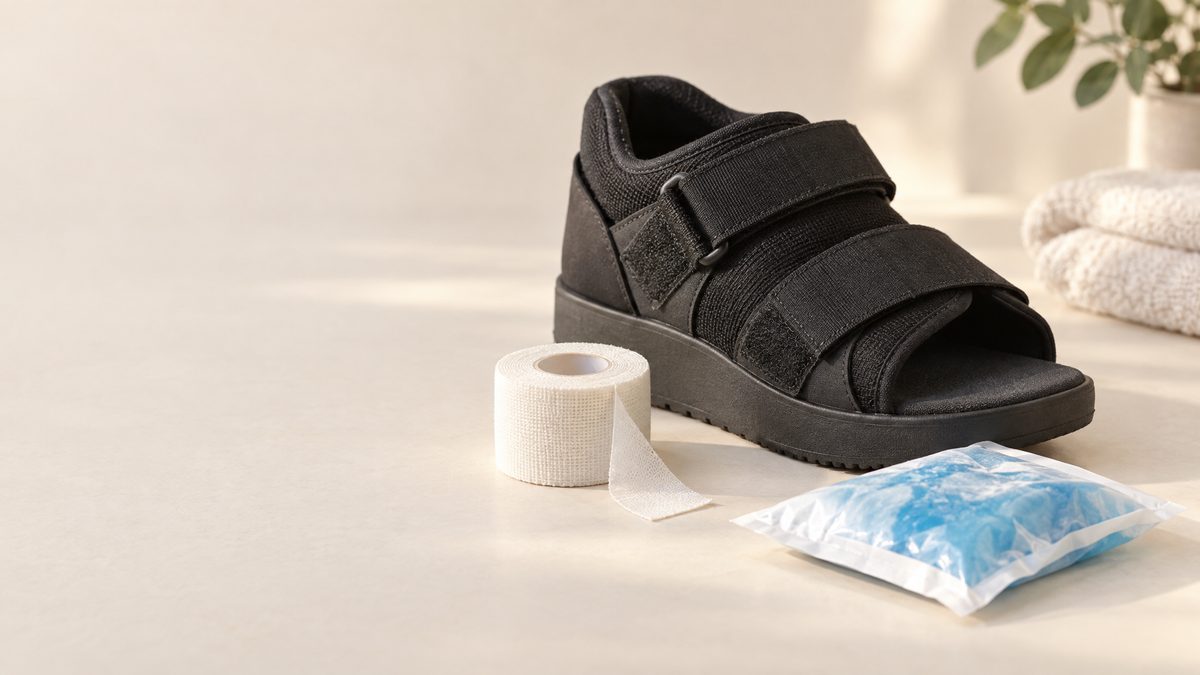
A broken big toe usually takes 6 to 8 weeks for the bone to heal, and roughly 3 months before it will push off, run, and fit into normal shoes without complaint. Most people can walk on it from the start, but in a rigid-soled post-op shoe or a walking boot rather than a regular sneaker, and breaks that shift out of place or run into a joint take longer and sometimes need surgery.
The big toe is not just a larger version of the other four. It does most of the pushing when you walk, it has two bones and two joints rather than three bones, it sits in front of two small bones called the sesamoids, and the toe next to it is too small to splint it. Those differences change the healing time, the footwear, and the long-term risk. This guide from the podiatrists at ASG Foot & Ankle covers healing time by fracture type, how to walk on it safely, how to tell it from a sprain or turf toe, and when it needs a specialist. If it is one of the smaller toes you broke, our broken toe healing timeline is the better guide.
Medically reviewed by Dr. Timothy Horak and Julia Shauger, board-certified podiatric specialists serving Homewood, South Chicago Heights & Mokena. Last reviewed September 2026.
The short answer
Tip of the toe (under the nail): 4 to 6 weeks. Hairline or non-displaced break: 6 to 8 weeks for the bone, about 2 to 3 months to run. Into a joint, displaced, or fixed surgically: 6 to 10 weeks for the bone and 4 to 6 months back to full sport. Walk on it in a rigid post-op shoe or boot, not a sneaker and not with buddy tape alone. Expect swelling for 3 to 4 months or more, and get an X-ray, because the position of the break, not how much it hurts, decides the treatment.
Get It Seen the Same Day If
Most big toe fractures are managed without surgery, but a few features change the plan and are time sensitive. Any of these means an examination and X-rays today or tomorrow, not after a week of seeing how it goes:
- •A wound over the toe, or bone visible, which makes it an open fracture with real infection risk
- •The nail is torn, lifted out of its fold at the base, or blood is oozing from under its edges
- •The toe is visibly bent, or the nail points in a different direction from your other big toenail
- •The toe is numb, pale, blue, or cold compared with the other foot
- •You cannot put any weight on the foot, or the worst pain is in the middle of the foot rather than the toe
- •A child or teenager with an injury at the base of the nail, where a growth plate fracture can hide under a torn nail bed
- •Days later: spreading redness, heat, pus, or a fever
- •You have diabetes, neuropathy, or poor circulation, where pain is not a reliable guide and small wounds escalate quickly
Why the Big Toe Is Different
 Illustration
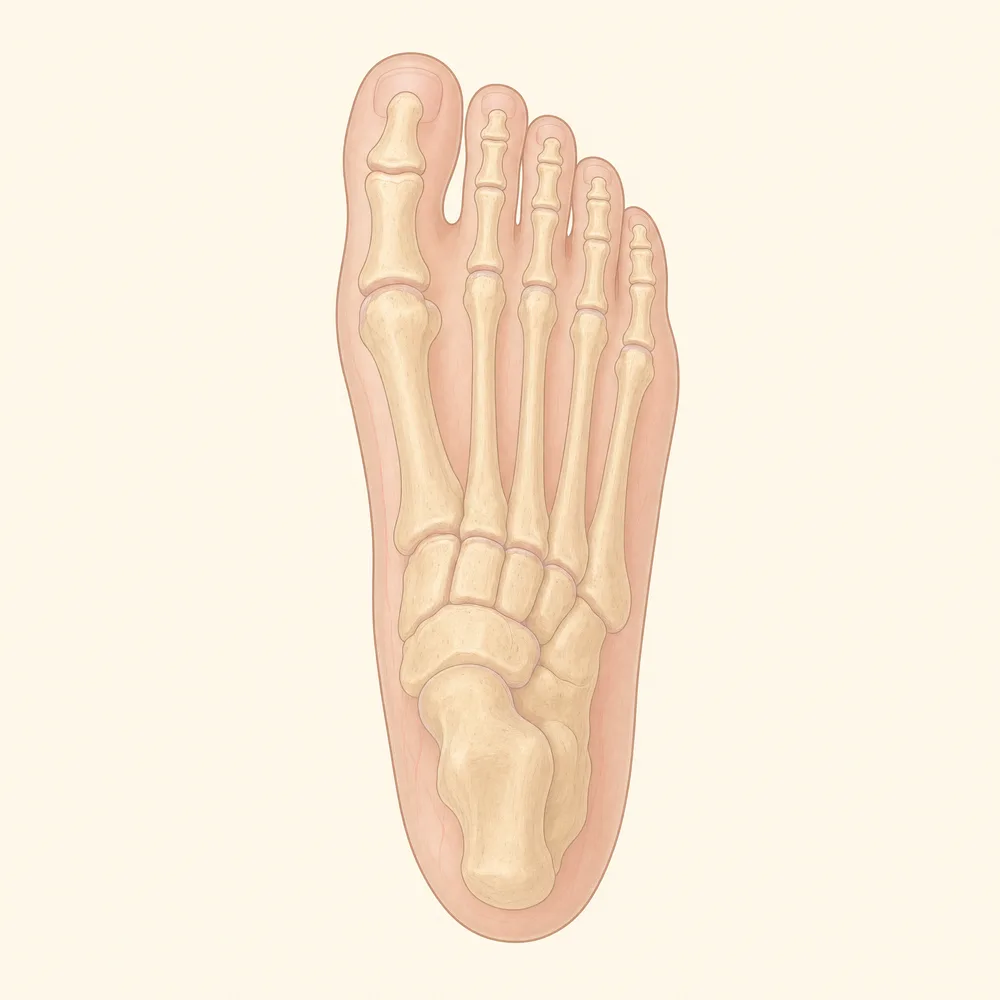
Most of what you read about broken toes is written for the four smaller ones, which are forgiving. The big toe (the hallux) is built and loaded differently, and four of those differences explain everything else on this page.
It does the pushing
At the end of every step the big toe presses into the ground and carries roughly 40 percent of the push-off load. A small toe fracture changes your walk a little. A big toe fracture changes how the whole forefoot is loaded, and people limp onto the outer edge of the foot, which brings its own soreness.
Two bones, two joints
A short bone under the nail (the distal phalanx) and a longer, thicker one at the base (the proximal phalanx). Between them is the small interphalangeal (IP) joint. At the base is the big toe joint (the MTP joint), which bends around 60 degrees on every step. A break that enters either joint is a different injury from one straight across the bone.
The sesamoids underneath
Two pea-sized bones sit under the ball of the foot beneath the big toe joint, inside the tendon that pulls the toe down. They take much of the pressure at push-off, they can break too, and they are easy to confuse with a toe fracture. Pain on the underside of the ball rather than in the toe itself points there.
No neighbor to splint it
The smaller toes can be buddy taped to each other because they are similar in size. The second toe is too small and flexible to hold the big toe still, which is why a broken big toe needs a rigid sole or a boot doing the splinting instead.
Healing Time by Type of Big Toe Fracture
"Broken big toe" covers a crack in the tip that heals quietly in a month and a joint fracture that decides whether you have a stiff toe at 60. The X-ray tells us which one you have. These are typical ranges for healthy adults; smoking, poorly controlled diabetes, and going back to flexible shoes too early all push them longer.
| Type | What it is | Bone healing | Usual protection | Running |
|---|---|---|---|---|
| Tip (tuft) fracture | Crack or crush of the bone under the nail, often from a dropped object | 4 to 6 weeks | Post-op shoe for 2 to 4 weeks; care of any blood under the nail | 6 to 8 weeks |
| Hairline or non-displaced | A crack across the bone that has not shifted | 6 to 8 weeks | Post-op shoe or boot for 4 to 6 weeks, then a stiff shoe | 8 to 12 weeks |
| Avulsion (chip) | A small flake pulled off a joint edge by a ligament or the joint capsule | 4 to 6 weeks | Stiff shoe or boot, managed much like a bad sprain | 6 to 12 weeks; longer if the underside of the joint is involved |
| Into a joint (intra-articular) | A break that reaches the IP joint or the big toe joint surface | 6 to 10 weeks | Boot, sometimes crutches; surgery for a large or stepped fragment | 3 to 4 months |
| Displaced or rotated | The bone ends have shifted, angled, or twisted | 6 to 10 weeks after setting or fixation | Set under a numbing block; pins or screws if it will not hold | 3 to 4 months; 4 to 6 for cutting sports |
| Open fracture | A wound over the break, including a torn nail bed | As for the fracture type | Same-day cleaning, antibiotics, and repair | As for the fracture type, once the wound has healed |
Two thresholds decide most of the treatment. If a break reaches a joint and involves more than roughly a quarter of the joint surface, or leaves a step in it of more than a millimeter or two, the fragment usually needs to be put back and held. And if the toe is rotated, even slightly, it will not correct itself as it heals. Both are judged on X-rays taken from at least three angles, and the side view of the big toe often has to be taken on its own so the other toes do not overlap it.
What Happens Week by Week
This is the typical course for a non-displaced break of the big toe. Tip fractures run a little faster; joint fractures and surgically fixed breaks run slower, and the later stages stretch the most.
Swelling Peaks, Get the X-Ray
- Swelling peaks around 48 to 72 hours and often spreads from the toe into the ball of the foot
- Bruising tracks to the base of the toe, the web space, and the sole; blood under the nail is common after a crush
- Elevate above heart level, ice through a cloth for 15 to 20 minutes at a time, and stop wearing flexible shoes
- This is the week to find out whether it is displaced or in a joint, while it can still be set easily
Protected Walking
- Walk flat-footed in a post-op shoe or boot with short steps, lifting the whole foot rather than rolling through the toe
- Throbbing at rest fades and the pain becomes tied to standing and walking, which is the first real milestone
- Fractures that were set or pinned are usually X-rayed again around now to confirm nothing has slipped
- Evening swelling is expected; swelling that is worse each morning than the one before is not
Early Callus, Not Yet Strong
- Soft callus bridges the fracture and holds the position, but it will not take a hard push-off yet
- Walking in the protective shoe gets much easier, and this is exactly when people abandon it too early
- If cleared, gentle bending of the big toe joint by hand starts now so the joint does not stiffen
- Pinned fractures usually have the pins removed in the office somewhere around week 4 to 6
Union and the Move Back to Shoes
- Most breaks across the shaft of the big toe show bridging bone on X-ray in this window
- Wean from the post-op shoe or boot into a roomy, stiff-soled shoe, often with a rigid insole
- Rising onto the toes and the push-off part of each step still ache and feel stiff
- Stationary cycling and swimming usually become possible, once any wound or pin site has closed
Loading the Push-Off
- Normal walking returns, though the toe is still thicker than the other one and swells after long days
- Easy running for simple fractures often returns around week 8 to 12; joint fractures closer to month 3 to 4
- Calf raises, toe range of motion, and balance work are what make the difference now
- Stiffness at the big toe joint that is not improving month to month deserves a recheck
The Long Tail
- Kicking, sprinting, jumping, and deep toe-bent positions such as lunges and kneeling come back last
- Occasional aching with weather changes or heavy days can persist for up to a year
- A nail damaged by the injury may still be growing out; a new big toenail takes 12 to 18 months
- New stiffness, a bump on top of the joint, or pain at push-off months later suggests early joint wear
Can You Walk on a Broken Big Toe?
Usually yes, and the old line that "if you can walk on it, it is not broken" is wrong. What hurts, and what disturbs the healing bone, is not the weight itself. It is the big toe joint bending upward at the end of each step while the toe presses into the floor. Take that bend away and most people can walk surprisingly well. Which level of protection you need depends on the fracture:
Post-op (fracture) shoe
A flat, rigid sole with an open, strapped top that fits over the swelling. The standard for stable tip and hairline fractures. Walk flat-footed with shorter steps, landing on the heel and lifting the whole foot. Worn for every step, including at home, typically for 3 to 6 weeks.
Walking boot
Taller and more rigid, it removes the push-off completely. Used when the post-op shoe is still too painful, when the break reaches a joint, or when a sesamoid or midfoot injury came along with it. Commonly 4 to 6 weeks, then a stiff shoe.
Crutches, heel only
For breaks that were displaced and set, pinned, or screwed, or that are unstable. Weight goes through the heel only, or not at all, for roughly the first 2 to 6 weeks depending on the fracture. This protects the position that was just restored.
Buddy taping on its own is not enough for the big toe. It can be added for comfort inside the shoe or boot, with gauze between the toes and fresh tape each day, but the rigid sole is doing the real work. The reasons, and how taping is done properly for the smaller toes, are in our general broken toe guide.
Worth doing
- Wearing the protective shoe or boot for every step, including the trip to the bathroom at night
- Elevating the foot above heart level for most of the first 3 to 5 days
- Keeping the ankle, knee, and hip moving so the rest of the leg does not stiffen
- Graduating to a roomy, stiff-soled shoe with a rigid insole, not straight to sneakers
- Stopping smoking and nicotine while it heals, since both slow bone healing
Worth avoiding
- Soft sneakers, flip-flops, and barefoot walking on hard floors
- Pushing off the toe or rising onto it to test whether it is healed
- Relying on buddy tape alone
- Draining blood under the nail at home with a heated pin or drill bit
- Driving with a boot on the right foot
What a Broken Big Toe Looks and Feels Like
A broken big toe usually announces itself with a sharp pain at the moment of injury, throbbing within minutes, a toe that is visibly swollen within hours, and bruising that spreads to the base of the toe and the ball of the foot over the next day or two. The problem is that a bad sprain, or a turf toe, can look almost identical. These are the features that help tell them apart.
| Feature | Broken big toe | Sprained (jammed) big toe | Turf toe |
|---|---|---|---|
| How it happened | Stubbed hard, kicked something, or something heavy dropped on it | Stubbed or jammed, often bent sideways | Toe forced upward while pushing off a planted forefoot, usually in sport |
| Where it hurts | Pinpoint, over one spot on the bone | Around the joint, on its sides | Under the ball of the foot at the big toe joint |
| Swelling and bruising | Whole toe, often into the ball of the foot; blood under the nail after a crush | Around the joint, usually less | Around the joint, bruising often on the underside |
| The telling movement | Gently pressing the tip back toward the foot hurts at the break | Bending the toe sideways hurts; the bone itself is not tender | Bending the toe upward hurts most |
| Nail direction | May be rotated compared with the other big toenail | Normal | Normal |
| First step | X-ray, then post-op shoe or boot | Stiff shoe, taping, X-ray if bone tender | Rigid sole or boot; imaging for anything beyond mild |
These overlap more than a table can show, and they can happen together: a forced upward bend can pull a flake of bone off the base of the toe, which is a turf toe and a fracture at once. If the pain is mostly under the ball of the foot, read our turf toe recovery guide as well. For the big toe, an X-ray is worth it even when you suspect a sprain, because a hairline crack and a displaced joint fracture can look the same from the outside and need different treatment.
Blood Under the Nail Changes the Plan
The bone at the tip of the big toe sits directly under the nail bed with very little in between. So a crush that breaks the tip usually bleeds under the nail (a subungual hematoma), and sometimes tears the nail bed itself. When the nail bed is torn over a fracture, the break is effectively connected to the outside, and it is managed as an open fracture: cleaned, often with the nail lifted and the nail bed repaired, and usually covered with antibiotics.
Signs the nail bed may be torn: the nail has lifted out of its fold at the base, the nail plate is cracked or loose, blood is oozing from under the nail edges, or there is a cut at the skin fold around the nail. A tense, throbbing pool of blood under an intact nail can be released in the office through a small sterile hole, which relieves the pressure almost immediately. Over a fracture this is done under clean conditions, and some clinicians add antibiotics for the same reason.
Please do not drain it at home with a heated paper clip or a drill bit. That is the step that can turn a closed fracture into an open, contaminated one. The nail may still come off in the following weeks, and a new big toenail takes 12 to 18 months to grow in fully.
In children and teenagers, a stubbed big toe with blood at the base of the nail deserves the same urgency. The growth plate near the tip of the toe can break with the nail bed torn over it, an injury that looks minor and behaves like an open fracture.
When It Needs Surgery
Most broken big toes never see an operating room. The ones that do are the breaks where the position, not the pain, is the problem: displaced fractures that will not stay put, rotated toes, joint fractures above the quarter-of-the-surface threshold, dislocations that came with the break, and open fractures. The usual options:
- •Closed reduction. The toe is numbed with an injection at its base and the bone is gently pulled back into line, then splinted and protected. No incision, and often all that is needed
- •Pinning. If the bone will not hold its position, thin wires are passed through the skin to hold it. They are usually pulled in the office at around 4 to 6 weeks
- •Screw fixation. A larger joint fragment is put back and held with one or two small screws, restoring a smooth joint surface
- •Washout and nail bed repair. For open fractures, the wound is cleaned, the nail bed repaired, and antibiotics given, with the bone treated by one of the methods above
After pinning or fixation, expect heel-only or protected weight bearing in a post-op shoe or boot for roughly 2 to 6 weeks, a stiff shoe from about week 6 to 8, and running around month 3 to 4. The goal of the operation is not a quicker return. It is a big toe joint that still bends properly and does not wear out early.
Getting Back to Running and Sport
Running is where a big toe fracture is tested hardest, because the toe joint bends further and takes more load with every stride than it does in walking. For a simple non-displaced break, easy running usually returns around 8 to 12 weeks. After a joint fracture or surgery, plan on about 3 to 4 months for running and 4 to 6 months for cutting, jumping, and kicking sports. The calendar is a guide; these checks are the green light:
1. Brisk walking
30 minutes in ordinary shoes with no limp and no pain afterward or the next morning.
2. Single-leg heel raises
15 to 20 rises onto the toes on the injured foot alone, pain free, with the heel rising as high as the other side.
3. Toe range of motion
The big toe bends upward close to as far as the other one, and the end of that bend is not sharply painful.
4. The hop test
10 hops on the injured foot without pain. Then start with short, easy runs on flat ground every other day.
A carbon fiber plate or a stiff insole in the running shoe, sometimes with an extension under the big toe (a Morton's extension), is a sensible way to limit how far the joint bends for the first few months back. Sprinting, hill work, kicking sports, martial arts, dance, and anything done up on the toes come back last.
The Long-Term Risk: A Stiff Big Toe
Most big toe fractures heal and are forgotten. The ones that are not tend to be the breaks that reached the big toe joint. Cartilage that was cracked, or healed with a step in it, wears faster, and months or years later the joint can develop post-traumatic hallux rigidus: a stiff, arthritic big toe joint with a bony ridge on top and pain every time you push off.
Watch for stiffness that stops improving after 3 to 6 months, pain on top of the joint when you rise onto your toes, a bump forming over the joint, or shoes rubbing a spot they never used to. Early joint wear responds well to stiff-soled or rocker-bottom shoes, a rigid insert, and sometimes an injection. More advanced cases are treated by removing the bone spurs (a cheilectomy) or, for a worn-out joint, fusing it.
Less common late problems include a toe that healed angled toward the second toe and rubs it, a nail that grows back ridged or split after a nail bed tear, and, rarely, a break that never fully unites. The best protection against all of them is getting the alignment right in the first week or two, which is the strongest argument for an X-ray early rather than a wait-and-see approach.
Broke the little toe? How long to buddy tape it, and the outer-foot pain that means it is the metatarsal instead. Broken Pinky Toe Healing Time →
Not sure it is broken at all? Bruised, jammed and broken toes compared side by side, with how long each takes. Bruised Toe Healing Time →
Broke one of the smaller toes? They heal faster, can be buddy taped, and follow a different timeline. Broken Toe Healing Timeline →
Toe bent upward, pain under the ball of the foot? That is the classic turf toe pattern. Turf Toe Recovery Time →
Nail went black after the injury? What blood under the nail means and how long the nail takes to recover. Why Toenails Turn Black →
Pain under the big toe joint that built up with no injury? That points to a stress fracture or a sesamoid problem. Stress Fracture in the Foot →
Red, hot big toe and no injury at all? That is far more likely to be gout than a fracture. Gout in the Big Toe →
Right foot in a boot? The emergency-stop standard and when it is safe to drive again. Driving After a Foot or Ankle Injury →
Big toe joint stiff and sore months or years after the break? Foot and Ankle Arthritis →
Frequently Asked Questions
How long does a broken big toe take to heal?
The bone usually knits in about 6 to 8 weeks, but it depends a great deal on where it broke. A crack in the tip of the toe, under the nail, often unites in 4 to 6 weeks. A break across the longer bone at the base of the toe usually takes 6 to 8 weeks. A fracture that runs into a joint, or one that shifted and had to be set or fixed surgically, commonly takes 6 to 10 weeks to unite and considerably longer to loosen up. Feeling normal takes longer than the bone: most people walk comfortably in ordinary shoes by about 8 to 10 weeks, run at around 2 to 3 months, and still notice some swelling and stiffness at the end of long days for 3 to 6 months.
Can you walk on a broken big toe?
Most people can, and being able to walk on it does not mean it is not broken. The real question is how you walk on it. Every normal step ends with the big toe joint bending upward around 60 degrees while the toe presses down into the ground, and that bend and pressure go straight through the fracture. A rigid-soled post-operative shoe or a walking boot takes the bend away so you can walk flat-footed while the bone heals. A soft sneaker, or going barefoot, puts it back on every step. Displaced fractures, fractures that were set or fixed surgically, and some fractures into the joint need a period of heel-only or no weight bearing on crutches first, so it is worth getting it X-rayed before deciding for yourself.
What does a broken big toe look and feel like?
Usually a sharp pain at the moment of injury, often from stubbing it hard or dropping something on it, then throbbing, swelling of the whole toe within hours, and bruising that spreads to the base of the toe, the web space, and sometimes the ball of the foot over the next day or two. Crush injuries often leave blood under the nail. The pain tends to be pinpoint over one spot on the bone rather than spread around the joint, pushing off to walk hurts far more than standing still, and gently pressing the tip of the toe back toward the foot often reproduces pain at the break. If the nail now points in a different direction from the big toenail on your other foot, the toe has rotated and needs to be seen. A bad sprain can look very similar, which is why an X-ray is the only reliable way to tell.
Will a broken big toe heal on its own?
The bone will almost always knit on its own, but it knits in whatever position it is in, and that is the real risk of leaving a big toe fracture alone. A break that has shifted, rotated, or left a step in a joint surface will heal that way, and in the big toe that can mean a toe that rubs the second toe, a joint that stiffens, or arthritis in the big toe joint years later. A non-displaced crack treated in a stiff-soled shoe usually does heal well without surgery. So the useful question is not whether it will heal, but whether it is lined up correctly while it does, and only an X-ray answers that.
Should I buddy tape a broken big toe?
Not as the main treatment. Buddy taping works for the middle toes because a neighbor of similar size makes a decent splint. The second toe is smaller and more flexible than the big toe, so taping the two together does little to stop the big toe bending at push-off, which is the movement that hurts and disturbs the fracture. Taping can help as a comfort measure inside a stiff-soled shoe or boot, with gauze between the toes and fresh tape each day. Do not tape a toe that looks crooked or rotated, and do not tape at all without guidance if you have diabetes, neuropathy, or poor circulation.
How long does a broken big toe stay swollen?
Longer than the bone takes to heal. Swelling usually peaks 2 to 3 days after the injury, settles substantially over the first 3 to 4 weeks, and then leaves a toe that looks thicker than the other one, especially by evening, for 3 to 4 months. Fractures that involved a joint, or needed surgery, can stay puffy for up to 6 months, and some permanent thickening at the break is common and harmless. Swelling that is getting worse rather than better, or that comes with new redness, heat, or drainage, is not part of normal healing and should be checked.
When does a broken big toe need surgery?
Most do not. Surgery is considered when the bone ends have shifted and cannot be put back and held without it, when the toe is rotated, when a fracture into a joint involves more than roughly a quarter of the joint surface or leaves a step in it of more than a millimeter or two, when a joint has dislocated along with the break, and when the skin or nail bed over the fracture has been torn. The usual methods are thin pins placed through the skin, which are typically pulled in the office after about 4 to 6 weeks, or small screws. The aim is not a faster recovery. It is a big toe joint that still bends properly and does not wear out early.
When can I run again after a broken big toe?
For a simple non-displaced fracture, easy running usually returns somewhere around 8 to 12 weeks. After a joint fracture or surgery, plan on about 3 to 4 months for running and 4 to 6 months for cutting, jumping, or kicking sports. The calendar matters less than a few checks: you can walk briskly for 30 minutes in normal shoes without limping, rise onto your toes on the injured foot 15 to 20 times without pain, and hop on that foot 10 times without pain. A stiff insole or carbon fiber plate in the running shoe for the first few months back is a sensible way to protect the joint while it finishes remodeling.
See a Podiatrist Near You
ASG Foot & Ankle has offices in Homewood, South Chicago Heights and Mokena. Our board-certified podiatrists accept most insurance. Find the office closest to you:
Hurt Your Big Toe?
A big toe fracture is worth an X-ray even when you can walk on it, because whether it reached the joint or shifted out of line decides the whole plan. Our board-certified podiatrists can image it, check the alignment and the joint, deal with blood under the nail safely, and get you into the right shoe or boot the same visit.