Broken Pinky Toe Healing Time: What to Expect, Week by Week
Four to six weeks for the bone, and the worst of the pain is usually over by week three. The part worth getting right is making sure it is the toe, and not the long bone behind it.
A broken pinky toe usually takes 4 to 6 weeks to heal, with the sharp pain easing noticeably by week 2 or 3. Swelling and tenderness in shoes often last another month or two after the bone has knitted, and that is normal rather than a sign that something went wrong.
The pinky, or little toe, is the most commonly broken toe, and it almost always happens the same way: barefoot, often in the dark, catching the leg of a bed or the corner of a door frame on the way past. Most of those breaks heal well with buddy taping and a wide, stiff shoe. The one thing worth getting right early is where the pain actually sits, because a break in the long bone behind the pinky, the fifth metatarsal, can look similar from the outside and follows a very different plan. This guide from the podiatrists at ASG Foot & Ankle covers the pinky specifically: the realistic timeline, how to tape it properly, walking and shoes, and the signs that mean it should be seen. For the other toes, see our general broken toe healing timeline.
Medically reviewed by Dr. Timothy Horak and Julia Shauger, board-certified podiatric specialists serving Homewood, South Chicago Heights & Mokena. Last reviewed September 2026.
The short answer
Bone healing: 4 to 6 weeks. Pain: clearly better by week 2 to 3, and mostly gone from ordinary walking by week 4 to 6. Swelling and shoe tenderness: can linger 2 to 3 months. Buddy taping: about 3 to 4 weeks, up to 6 for comfort. Running: usually around week 6 to 8. If the pain is on the outer edge of the midfoot rather than in the toe, or the toe is visibly crooked, get it X-rayed before settling on any of those numbers.
When a Broken Pinky Toe Needs a Doctor
A straight, closed pinky toe fracture is one of the few broken bones that is often managed well at home. These situations change the outcome and should be examined, ideally within the first few days while anything out of place is still easy to correct:
- •The toe is visibly crooked. Sticking out sideways, tucked under the fourth toe, or rotated so the nail faces a different way. It needs setting, not taping as it lies
- •The pain is on the outer edge of the midfoot. Tenderness along the long bone behind the toe, or at the bony bump halfway along the outside of the foot, points to a fifth metatarsal fracture
- •You cannot take four steps, even limping
- •A cut or break in the skin near the injury, which can make it an open fracture with a real infection risk. Same-day care
- •Numbness, tingling, or a toe that is pale, blue, or cold
- •Painful, throbbing blood under the nail in the first day or two, which can be relieved
- •Diabetes, neuropathy, or poor circulation. Any toe injury deserves a look, and do not buddy tape without guidance
- •No improvement at all after 2 weeks, or pain that is getting worse
Toe or Fifth Metatarsal? The One Thing to Get Right
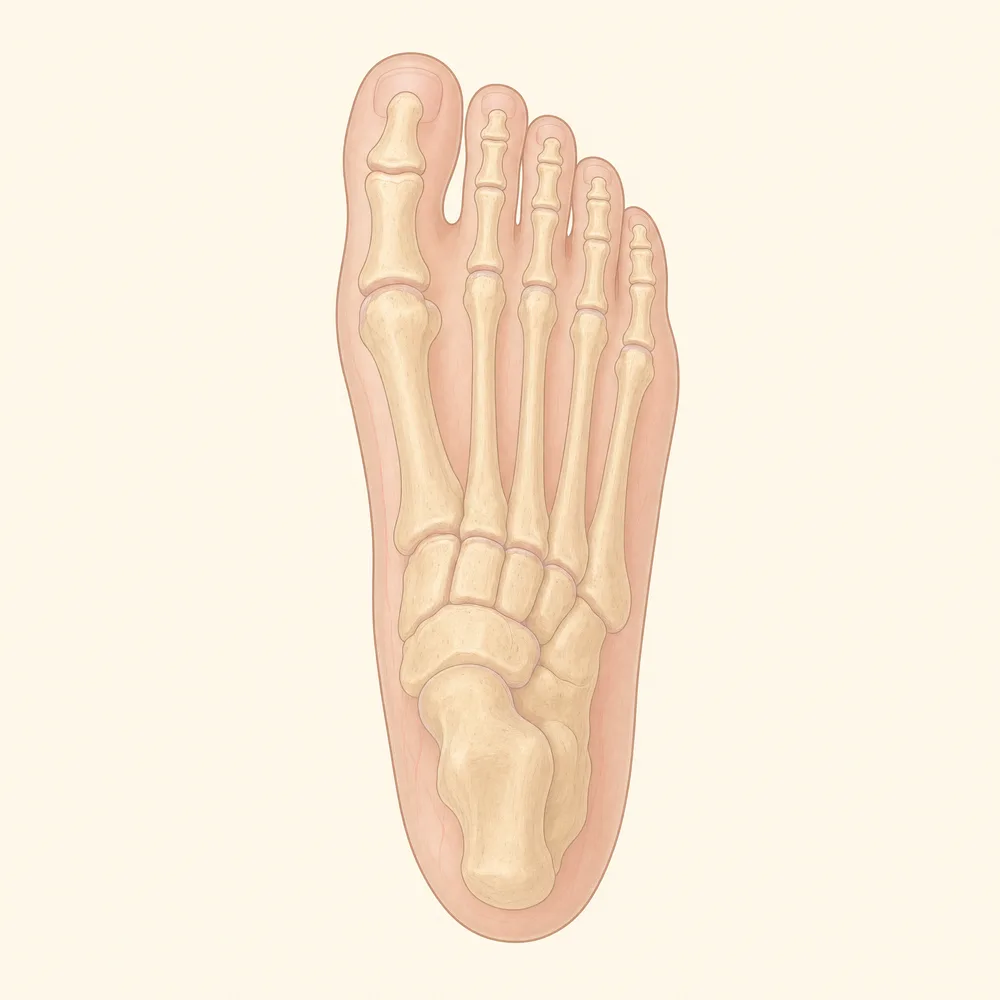 Illustration
People describe both of these as "I broke my pinky toe," and from the outside they can look alike: pain on the outer side of the foot, bruising along the edge, a limp. They are not alike to treat. A pinky toe fracture is forgiving. A fifth metatarsal fracture, and one kind in particular, is not.
| Feature | Broken pinky toe | Fifth metatarsal fracture |
|---|---|---|
| Where it hurts | In the toe itself, from the tip back to where it meets the foot | Outer edge of the midfoot, behind the toe and back toward the bony bump |
| How it usually happens | Stubbing it on furniture or a door frame, or dropping something on it | Rolling the ankle inward, an awkward landing, or repeated stress in runners |
| Bruising | The toe and the side of the forefoot | The outer midfoot, often tracking into the sole |
| Walking | Uncomfortable but usually possible | Often very painful, especially pushing off |
| Typical treatment | Buddy tape and a stiff, wide shoe | Walking boot or cast; some need a screw |
| Healing time | 4 to 6 weeks | 6 to 8 weeks for most; a Jones fracture often 8 to 12 or longer |
The fifth metatarsal breaks in three main places, and they behave very differently:
- At the bony bump (avulsion fracture). A small piece pulled off by a tendon when the ankle rolls. Usually heals well in a boot or stiff shoe over 6 to 8 weeks.
- Just beyond the bump (Jones fracture). This zone has a poor blood supply, and a meaningful share fail to heal if they are walked on. Treatment is usually a period of no weight bearing in a cast or boot, and a screw is often recommended for athletes or a break that is slow to heal.
- Along the shaft. Often a spiral break from twisting on the forefoot. Usually a boot for 6 to 8 weeks, with surgery if the pieces have shifted a lot.
The press test
Starting at the base of the pinky, press firmly along the outer edge of the foot, following the long bone back to the bump halfway toward the heel. Tenderness that stays in the toe is consistent with a toe fracture. Sharp tenderness anywhere along that long bone, or at the bump itself, especially after rolling the ankle, means an X-ray before anything else. So does being unable to take four steps. This is the check that emergency departments use to decide who gets a foot X-ray, and it is a sensible one to apply at home.
Why the Pinky Toe Breaks So Often
The fifth toe is broken more often than any other toe, and the reasons are mostly about where it sits and how small it is.
It sticks out
The pinky sits at the outer corner of the forefoot and angles slightly outward, so it is the first thing to meet a bed leg or door frame as you walk past. The stub drives it sideways, away from the fourth toe, and the bone that usually breaks is the base segment where the toe joins the foot.
It is small and thin
These are the smallest bones in the foot, with very little padding around them. A crush from a dropped object tends to break the tip instead, often with blood under the nail.
It often has one fewer joint
In many people the last two bones of the little toe are fused into one, so the toe has two bones instead of three. It is a normal variation, not an old injury, and worth knowing about if your X-ray report mentions it.
The classic scene is barefoot, at night, on the way to the bathroom or the kitchen. It is common enough that clinicians sometimes call it the night walker's fracture, and it is the reason a night light and a clear path are worth having for the next few weeks: the same corner is waiting for the same toe.
What a Broken Pinky Toe Looks and Feels Like
- Pain pinpointed at one spot on the bone, most often near the base of the toe
- Swelling that makes the toe look fat, often spreading onto the fourth toe
- Bruising that appears over a day or two and spreads along the outer edge of the foot and into the sole
- A toe that sits at a different angle to its neighbor, pointing outward or rotated so the nail faces sideways
- Pain when the side of a shoe presses on it, often worse than the walking itself
- After a crush injury, a dark or purple nail from blood collecting underneath
Broken, bruised, or sprained?
It is genuinely hard to tell without an X-ray, and for a toe that still points straight it matters less than people think, because the care is the same: tape, a stiff wide shoe, and elevation. The difference shows up in the timeline. A bruised or mildly sprained pinky toe is usually much better within 1 to 3 weeks. A broken one is still clearly sore at 3 weeks and takes 4 to 6 to settle. If the toe looks crooked, or nothing has improved after 2 weeks, get the X-ray.
The Healing, Week by Week
Throbbing, Swelling, and the Angle Check
- Swelling and throbbing peak around 48 to 72 hours, and the toe can look fat and purple
- Bruising often spreads along the outer edge of the foot and into the sole; that is gravity moving the blood, not the injury spreading
- Look at the toe from above: a pinky that points outward or sits rotated needs setting, ideally this week
- Elevate above heart level, ice 15 to 20 minutes at a time over a cloth, buddy tape, and wear a stiff, wide shoe
Soft Callus, Still Fragile
- Soft callus starts bridging the break; it holds position but is not yet strong
- Pain shifts from constant to mostly when walking, bumping it, or pulling on a shoe
- Bruising drifts toward the toes and outer foot and turns green, then yellow
- Pressure from the side of the shoe is the main irritant; width matters more than anything else now
The Turning Point
- Most people notice a clear drop in pain somewhere in this window
- Walking in a wide, stiff shoe is usually comfortable for errands and a working day
- This is when people stop taping and go back to regular shoes too early; keep the tape for anything beyond light walking
- Pain that is no better at all by now deserves an X-ray if one has not been taken
Bone Knitted, Toe Still Tender
- Most simple pinky toe fractures are united somewhere in this window
- Pressing directly on the break is mildly tender rather than sharp
- Buddy taping usually stops, and roomy everyday shoes return
- Swelling is still present, especially by evening, and the toe may look slightly bigger than the other side
Back to Full Activity
- Running and impact sport usually return around week 6 to 8 once brisk walking is pain free
- Some stiffness when curling the toe is common and eases with use
- Narrow, pointed, or tight shoes still press on it; that is the soft tissue, not the bone
- Evening swelling keeps fading week by week
The Long Tail
- A slightly thicker toe at the old break is common and harmless
- Occasional aching in cold weather or after long days can linger for months
- A toe that healed crooked may rub and start forming a corn on its outer side
- Pain that is still sharp at 3 months is not the normal tail and should be re-imaged
Where should I be today? Enter the date you broke it
Enter the date and get what is normal for today, what is next, and what to watch for.
How to Buddy Tape a Broken Pinky Toe
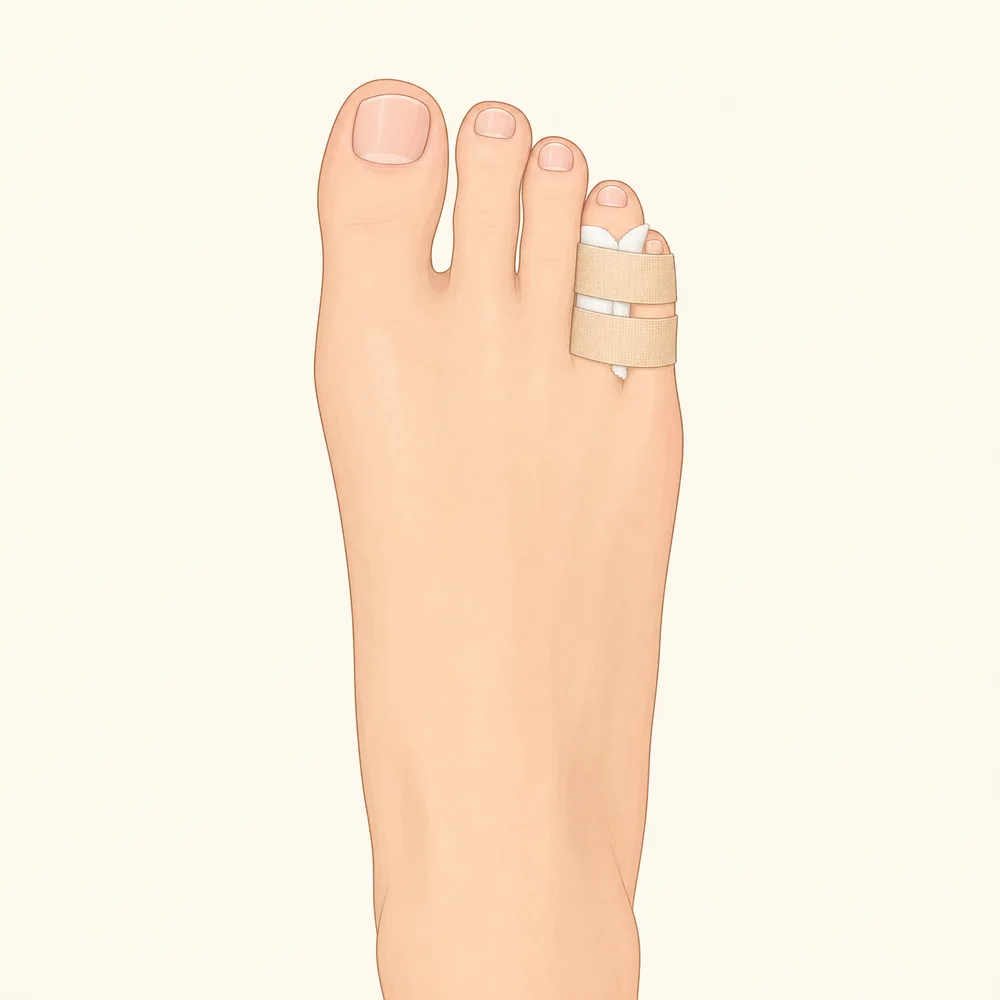 Illustration
Taping the pinky to the fourth toe turns its neighbor into a splint. It holds the broken toe in line, stops it being knocked sideways, and takes a lot of the sting out of walking. Done badly, it causes blisters and soggy skin within days, so the details matter:
- Clean and dry both toes. Moisture trapped under tape is what breaks the skin down.
- Put padding between them. A folded strip of gauze, felt, or a small piece of cotton between the fourth and fifth toes. Never tape skin directly against skin.
- Line the pinky up gently alongside the fourth toe in its natural position. If it will not sit straight, or it is rotated, stop: that toe needs setting first.
- Wrap one or two bands of cloth medical or athletic tape, about half an inch wide, around both toes. Because the pinky is shorter, the bands usually sit around the base and middle of the pinky. Keep them off the nail and the tip.
- Snug, not tight. The toes should stay pink and warm. Throbbing, tingling, numbness, or a pale or blue tip means it is too tight; loosen it.
- Replace it every day and whenever it gets wet, including after a shower, and look at the skin between the toes each time.
How long to keep taping
For most simple pinky fractures, about 3 to 4 weeks. Keeping it on for walks, work, and time in shoes up to about 6 weeks is reasonable if it helps. You are ready to stop when pressing on the break is mildly tender rather than sharp, you can walk in a roomy everyday shoe without limping, and a day without tape does not bring the pain back. Taping at night is optional; if the skin is getting irritated, give it the night off and re-tape in the morning.
Do not buddy tape a toe that is crooked or rotated and has not been set, a toe with an open cut near the break, or if you have diabetes, neuropathy, or poor circulation, unless a podiatrist has shown you how. Tape pressure and trapped moisture cause skin breakdown, and the people it happens to are often the ones who cannot feel it starting. Stop and have the skin checked if you see redness, a blister, or white, waterlogged skin between the toes.
Walking on It, and What to Wear
Walking on a broken pinky toe is usually fine from the first day, and being able to walk is not a sign that it is not broken. What hurts is not the weight. It is the toe bending through the break at the end of each step and the side of the shoe pressing on it. Solve those two things and most of the pain goes with them.
What helps
- A stiff-soled shoe that barely bends at the forefoot, such as a post-op shoe, hiking boot, or work boot
- A wide toe box, so nothing presses on the outside of the pinky
- Loosening the laces over the forefoot, or a size up with a thicker sock, while it is swollen
- Shorter, flatter walks in the first two weeks, with the foot up afterward
- A firm slipper or shoe for night trips to the bathroom
What makes it worse
- Narrow or pointed shoes, including most dress shoes and many work shoes
- Soft, flexible running shoes that fold easily at the forefoot
- Going barefoot on hard floors, which maximizes toe bend and leaves it exposed
- Flip-flops, which make you grip with your toes to keep them on
- Going back to regular shoes at week two because it suddenly feels better
Sleeping, Swelling, and the Evening Ache
The first few nights are often the worst, partly from throbbing and partly because the weight of the bedding presses on a toe that sticks out. A pillow under the lower leg keeps the foot above heart level, which is the single most useful thing for swelling in the first week. Tenting the covers over the foot, with a pillow under the blankets at the end of the bed, keeps them off the toe. If you sleep on your side, a pillow between the knees stops the outer edge of the foot pressing into the mattress.
Swelling that returns by evening and settles overnight is the normal pattern for weeks after the bone has knitted. It is the soft tissue around the break still remodeling, not a sign that the fracture has moved. Over-the-counter pain relief is reasonable for the first days if it is safe for you; check with your doctor or pharmacist if you take blood thinners, have kidney problems, or have been told to avoid anti-inflammatories.
What is not normal is a toe that becomes hotter, redder, and more painful over time rather than less, or swelling that spreads up the foot. Those need to be seen.
The Black Nail After the Injury
A pinky toenail that turns dark purple or black after a stub or a crush is almost always blood trapped under the nail, called a subungual hematoma. It often shows up within hours and can be surprisingly painful, because the blood has nowhere to go.
- Throbbing in the first day or two: a podiatrist can release the blood through a tiny opening in the nail, which usually brings quick relief. Do not do this at home with a heated pin or paperclip, particularly if the toe may be broken underneath.
- Not painful: leave it alone. The dark patch grows out with the nail over months.
- The nail lifts or falls off: common after a larger bleed. Keep the nail bed clean and covered; a small toenail usually regrows in 6 to 12 months.
- A dark spot with no injury, or one that does not move forward as the nail grows, is not a bruise and should be examined.
For the full picture of dark nails, including the causes that are not injury, see why toenails turn black, and for the regrowth timeline, see how long a toenail takes to grow back. If the skin of the toe itself is turning dark rather than just the nail, that is a circulation question and a different page: toe turning black.
If the Toe Is Crooked
A pinky that points outward, tucks under the fourth toe, or has its nail facing sideways has either a displaced fracture or a dislocated joint. Taping it as it lies locks the deformity in, and a toe that heals crooked tends to rub on the shoe and grow a painful corn on its outer side for years afterward.
- •Setting it (reduction). The toe is numbed with a small injection at its base, gently pulled back into line, and buddy taped. It takes minutes in the office, and it is easiest in the first several days, before the break starts to firm up
- •A repeat X-ray about a week or so later confirms it has stayed in position
- •Surgery is uncommon. It is reserved for a break that will not stay in line, a large fragment of a joint surface, or an open fracture, and usually means a small pin for a few weeks
A toe that needed setting typically sits at the longer end of the 4 to 6 week range, and may stay a little stiff. That is a far better trade than a permanent sideways pinky.
Getting Back to Running and Sport
Most people are back to easy running somewhere around week 6 to 8, occasionally a little sooner for a small crack that settled quickly, and later for a toe that had to be set. The calendar matters less than these checks:
- Thirty minutes of brisk walking in your running shoes with no pain during or afterward
- Pressing on the old break gives, at most, mild tenderness
- Ten single-leg hops on the injured foot without pain
- Rising up onto the ball of the foot and toes feels the same on both sides
Start with short, easy runs on flat ground, buddy taped if it helps, in a shoe with enough room at the outer toe. Build over two to three weeks before adding speed, hills, or cutting sports. Pain that appears during a run and lingers the next day means back off for a week, not push through. Outer foot pain that builds up with mileage, rather than from a stub, is a different problem; see stress fractures in the foot.
Not sure it is broken at all? Bruised, jammed and broken toes compared side by side, with how long each takes. Bruised Toe Healing Time →
Broke a different toe? The middle toes follow a similar plan, and the general timeline covers all five. Broken Toe Healing Timeline →
Was it the big toe? It carries far more load and heals on a different schedule. Broken Big Toe Healing Time →
Did the nail go black? Blood under the nail from trauma behaves differently from the other causes of a dark nail. Why Toenails Turn Black →
Rolled the ankle at the same time? Outer foot pain after an ankle roll needs the fifth metatarsal checked, and the ankle has its own timeline. Ankle Sprain Recovery Timeline →
Outer foot pain with no stub or fall? Pain that builds with walking or running points to a stress fracture, which hides from early X-rays. Stress Fracture in the Foot →
Diabetic with a toe injury? Any trauma changes the risk picture, and taping needs supervision. Diabetic Foot Care →
Frequently Asked Questions
How long does a broken pinky toe take to heal?
Most broken pinky toes heal in 4 to 6 weeks. The sharp pain usually eases noticeably by week 2 or 3, which is when walking in a wide, stiff shoe becomes comfortable. The bone is typically knitted by week 4 to 6, but swelling, stiffness, and tenderness in tight shoes commonly linger for another 1 to 3 months, and occasional aching after long days on your feet can last longer than that. A pinky toe that was crooked and had to be set, or a break that runs into a joint, sits at the longer end. If the pain is actually on the outer edge of the midfoot rather than in the toe itself, it may be a fifth metatarsal fracture, which takes 6 to 12 weeks and follows a different plan.
How long does a broken pinky toe hurt?
Expect constant throbbing for the first 2 to 3 days, pain mostly with walking and shoe pressure through the first 2 weeks, and a clear improvement somewhere around week 2 to 3. By week 4 to 6, most people feel it only when the toe is bumped, pressed, or squeezed into a narrow shoe. Mild soreness at the end of a long day on your feet can continue for a couple of months. Pain that is no better at all after 2 weeks, pain that is getting worse, or pain sharp enough to stop you walking is not the normal pattern and should be examined.
Can you walk on a broken pinky toe?
Yes, in most cases, and being able to walk on it does not mean it is not broken. Most people can bear weight from the first day, though it hurts and you will tend to roll onto the inner side of the foot. What you walk in matters more than how much you walk. A shoe with a stiff sole and a wide toe box stops the toe from bending through the break and keeps the side of the shoe off it, which is where most of the pain comes from. Going barefoot, flip-flops, and soft flexible sneakers all make it worse. If you cannot take four steps at all, or the pain is along the outer edge of the foot rather than in the toe, get an X-ray, because that pattern points to a fifth metatarsal fracture.
How long should you buddy tape a broken pinky toe?
For most simple pinky toe fractures, about 3 to 4 weeks, and it is reasonable to keep taping for walks and time in shoes up to about 6 weeks if it makes the toe more comfortable. Change the tape every day and whenever it gets wet, with a fresh strip of gauze or felt between the fourth and fifth toes every time. You are ready to stop when pressing on the break gives mild tenderness rather than sharp pain, you can walk in a normal roomy shoe without limping, and leaving the tape off does not bring the pain back. Stop and have the skin checked if you see redness, blistering, or soggy white skin between the toes.
How do I know if my pinky toe is broken or just bruised?
Often you cannot tell for certain without an X-ray, and for a toe that is still pointing straight the treatment is much the same either way: buddy tape, a stiff wide shoe, and elevation. Signs that lean toward a fracture are a crack felt or heard at the time, pain pinpointed at one spot on the bone, bruising that spreads into the side of the foot over the next day or two, swelling that makes the toe look fat, and a toe that sits at a different angle to its neighbor. A bruised or mildly sprained pinky toe usually feels much better within 1 to 3 weeks; a broken one takes 4 to 6. If the toe looks crooked, or it is no better at all after 2 weeks, an X-ray is worth having.
Do I need to see a doctor for a broken pinky toe?
Not always. A straight, closed pinky toe fracture in a healthy person is usually managed at home with buddy taping and a stiff, wide shoe, which is largely what we would do in the office too. See a podiatrist promptly if the toe is visibly crooked or rotated, if the skin over it is broken, if the toe is numb, cold, or pale, if you cannot walk on the foot, if the pain is on the outer edge of the midfoot rather than in the toe, if you have diabetes, neuropathy, or poor circulation, or if the pain is not clearly improving after 2 weeks. The midfoot one matters most: a fifth metatarsal fracture, and especially a Jones fracture, can fail to heal if it is treated like a broken toe.
Why is my pinky toenail black after stubbing my toe?
Almost always because blood has collected under the nail, which is called a subungual hematoma. The same impact that bruises or breaks the toe bleeds into the tight space between the nail and the nail bed. If it is throbbing with pressure in the first day or two, a podiatrist can release the blood through a tiny opening in the nail, which usually relieves the pain quickly; do not try this at home, especially if the toe may be broken underneath. Otherwise the dark patch simply grows out with the nail, and if the nail loosens and comes off, a small toenail usually regrows in 6 to 12 months. A dark spot or streak that appeared without any injury, or one that does not move forward as the nail grows, is a different matter and should be examined.
What happens if a broken pinky toe heals crooked?
It usually still works, but it can be a long-term nuisance. A pinky toe that heals angled outward or rotated tends to rub against the side of the shoe or tuck under the fourth toe, and that pressure builds painful corns on the outer side of the toe or between the toes. Shoes can become harder to fit. That is why a crooked-looking toe is worth having set in the first several days, when it can be numbed and realigned in the office in a few minutes. Once a toe has healed crooked, the options are wider shoes, padding, and corn care, or for a toe that stays painful, a small corrective procedure.
See a Podiatrist Near You
ASG Foot & Ankle has offices in Homewood, South Chicago Heights and Mokena. Our board-certified podiatrists accept most insurance. Find the office closest to you:
Crooked, Not Improving, or Hurting in the Midfoot?
A pinky toe that needs setting, or a fifth metatarsal fracture mistaken for one, is far easier to deal with in the first week than the sixth. Our board-certified podiatrists can X-ray it, tell you exactly which bone is involved, set it if it needs it, and get you into the right shoe or boot at the same visit.