
Toenail Removal Recovery: A Week-by-Week Healing Timeline
Wondering what's normal 1, 3, or 6 weeks after toenail removal? Here's exactly what to expect at each stage of healing, how to care for the toe, and the warning signs that mean you should call a podiatrist.
You've had a toenail removed, now what? The good news is that toenail removal is one of the most predictable procedures in podiatry. Most patients walk out the same day and are back in normal shoes within a couple of weeks. But because the nail bed heals in stages, it can look alarming if you don't know what's normal.
This guide from the podiatrists at ASG Foot & Ankle walks you through recovery week by week: what the toe should look like, what aftercare to do, and when something is genuinely wrong. If you're trying to decide whether to have a nail removed in the first place, start with our guide on when toenail removal is needed and what the procedure involves.
Medically reviewed by Dr. Timothy Horak and Julia Shauger, board-certified podiatric specialists serving Homewood, South Chicago Heights & Mokena. Last reviewed July 2026.
How long does toenail removal take to heal?
The wound usually heals in 2–6 weeks: about 2–4 weeks for a partial nail removal and 4–6 weeks for a total removal. You can walk the same day and return to normal shoes within 1–3 weeks. If the nail won't grow back (a phenol matrixectomy was done), expect a bit more drainage and a 4–6 week healing window. A regrown nail (one where the matrix was left intact) takes 6–12 months, and up to 18 months for the big toe.
Week-by-Week Recovery Timeline
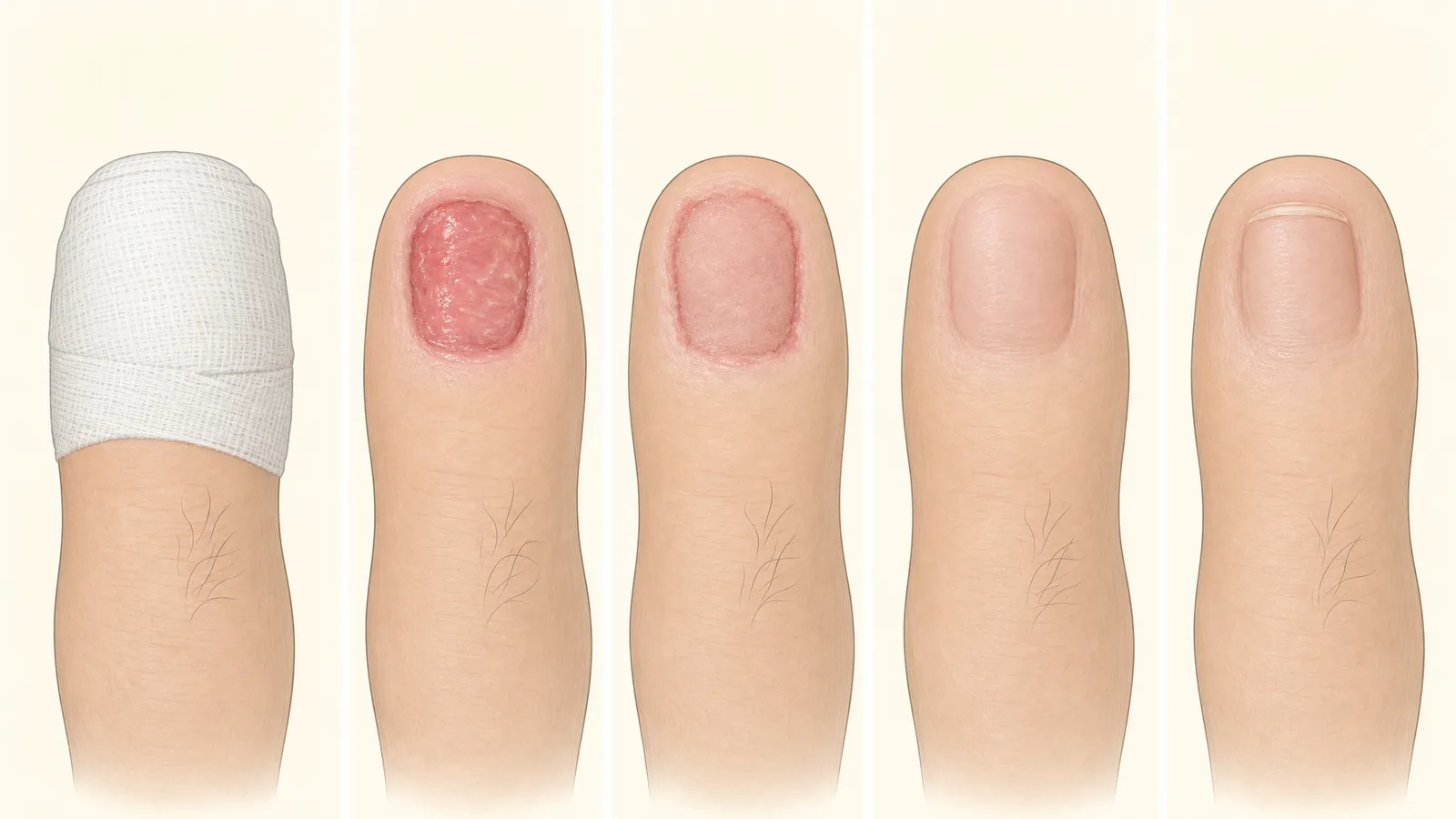 Illustration
Immediately After the Procedure
- Numbness wears off in 2–4 hours; mild-to-moderate throbbing is normal
- Some bleeding or pink spotting on the dressing
- Keep the original dressing on, clean, and dry
- Elevate the foot and take ibuprofen or acetaminophen for soreness
What it looks like: The toe is bandaged. When you change the first dressing (usually after 24–48 hours), the nail bed looks raw, pink-red, and may weep slightly.
Week 1: Early Healing
- Begin daily warm-water soaks (10–15 min), then ointment and a fresh bandage
- Soreness fades quickly; most patients stop needing pain relievers
- Drainage is common, clear or light yellow, especially after a phenol matrixectomy
- Return to desk work and light walking; wear open or wide shoes
What it looks like: The exposed nail bed is moist and pink. A thin yellowish film (not pus) can form. This is normal healing tissue, not infection.
Weeks 2–3: Wound Closing
- Wound edges contract and the surface dries out
- Drainage tapers off (may persist a bit longer with phenol)
- Normal closed shoes become comfortable again
- Light exercise can usually resume once the area is dry
What it looks like: By 3 weeks the nail bed looks pink, dry, and covered by firm, healing skin. Mild edge redness is okay; throbbing pain or pus is not.
Weeks 4–6: Fully Healed Skin
- Wound is closed; skin over the nail bed is intact and toughening
- Full return to sports, running, and normal footwear
- Any phenol drainage has stopped
- The toe may still look slightly different from its neighbor, and that is expected
What it looks like: The nail bed is covered with healthy, slightly shiny new skin. If a matrixectomy was done, the area stays nail-free.
Long-Term: Nail Regrowth
- If the matrix was NOT treated, a new nail begins growing from the cuticle
- Big toenails take the longest, up to 12–18 months for full regrowth
- New nails can look thin or ridged at first, then normalize
- If a matrixectomy was done, no nail (or only the untreated portion) regrows
What it looks like: A thin sliver of new nail appears near the cuticle and slowly advances. Permanent (phenol) removal leaves smooth skin with no nail.
Where should I be today? Enter your procedure date
Enter the date and get what is normal for today, what is next, and what to watch for.
Daily Aftercare: The Routine That Heals Fastest
Soak
Warm water (Epsom salt optional) for 10–15 min once daily, starting day 2.
Dry
Gently pat the toe completely dry. Moisture trapped under a bandage invites infection.
Ointment
Apply a thin layer of antibiotic ointment to keep the nail bed moist and protected.
Cover
Wrap with a fresh, non-stick bandage. Change it daily until the wound is dry.
Protect
Open or roomy shoes, no running for ~2 weeks, elevate the foot when resting.
Print the recovery checklist
Everything on this page condensed to one printable sheet you can tape inside the bathroom cabinet and tick off as you go. Free, and we will email you a copy.
- The daily aftercare routine, in the order you do it
- What the toe should look like at week 1, 3 and 6
- The exact signs that mean stop and call a podiatrist
Free. Unsubscribe anytime. General education only, not medical advice, and not a substitute for being seen by a clinician.
Normal Healing vs. Warning Signs
Normal & Expected
- •Mild soreness for 1–3 days
- •Clear or light-yellow drainage for 1–4 weeks (especially with phenol)
- •Pink, moist nail bed that slowly dries and toughens
- •Slight redness right at the wound edge
- •A toe that looks different from its neighbors
Call Your Podiatrist If…
- •Pain is increasing instead of improving after day 3
- •Thick, green, or foul-smelling pus
- •Redness or warmth spreading up the toe or foot
- •Fever, chills, or red streaking
- •Bleeding that won't stop, or numbness/tingling that persists
Diabetics and anyone with poor circulation should have any concern checked early, because small toe wounds can become serious quickly. Learn about our diabetic wound care →
Go Deeper on One Part of Recovery
How long does it hurt? →
An hour-by-hour and day-by-day pain timeline, what actually helps more than medication, and the one pain pattern that means you should call.
Is my toe infected? →
Yellow drainage and redness are usually normal. A sign-by-sign comparison of real infection against ordinary healing, plus a self-check you can do tonight.
When does the nail grow back? →
A month-by-month regrowth timeline, and why the new nail often comes in thick or ridged before it normalizes.
Had a phenol matrixectomy? →
Why that procedure drains for weeks longer than a plain nail removal, and where the line between normal and infected actually sits.
When can I wear shoes again? →
The activity timetable: closed shoes, socks, walking, work, showering, swimming and the gym, with the timing for each.
Only one side of the nail removed? →
An ingrown toenail procedure heals differently. The border-specific stages, bandage and soaking schedule, and whether the nail comes back.
What am I actually looking at? →
The exposed nail bed, the yellow film people mistake for pus, the dark crust and the shiny red mound, each explained and sorted into normal or call.
Does your paperwork say "avulsion"? →
Partial vs total, with and without a matrixectomy. Four different procedures with four different recoveries, side by side.
Trying to work out what this will cost? How Much Does Toenail Removal Cost? →
Had the nail removed for a recurring ingrown toenail? Make sure it doesn't come back. Learn about permanent ingrown toenail solutions. Ingrown Toenail Treatment →
Removed because of a fungal nail? See how to keep the new nail healthy. Toenail Fungus Treatment →
Frequently Asked Questions
How long does it take to recover from a toenail removal?
Most patients return to light activity within 24–48 hours. The wound itself typically closes and heals in 2–6 weeks: about 2–4 weeks for a partial nail removal and 4–6 weeks for a total nail removal. Full comfort in normal shoes usually returns by week 2–3. If the nail matrix was treated with phenol (matrixectomy), expect more drainage and a slightly longer 4–6 week healing window.
What should the toe look like 3 weeks after toenail removal?
By 3 weeks, the wound bed should look pink and dry with little to no drainage. Mild redness at the very edge and some thickened, healing skin (a firm pad over the nail bed) are normal. You should be able to wear a normal closed shoe with minimal discomfort. Increasing redness, swelling, throbbing pain, or pus at 3 weeks is not normal and should be evaluated.
Is it normal to still have drainage weeks after toenail removal?
After a phenol matrixectomy, clear-to-yellowish drainage for 2–4 weeks is common and expected. Phenol is a chemical that causes a controlled, slow-healing wound. Drainage that is thick, green, foul-smelling, or increasing, or that comes with fever or spreading redness, suggests infection and should be seen by a podiatrist.
When can I exercise or run after toenail removal?
Walking is fine the same day. Avoid running, jumping, and high-impact exercise for about 2 weeks to protect the healing nail bed and limit bleeding. Most patients return to full sports and exercise by weeks 2–4 once the wound is dry and closed and a normal athletic shoe is comfortable.
Will my toenail grow back after removal?
If only the nail was removed (avulsion) without treating the matrix, the nail regrows in roughly 6–12 months, and up to 18 months for the big toe. If a matrixectomy (phenol or surgical) was done to permanently stop regrowth, the nail or treated edge will not grow back. New nail growth first appears as a thin, sometimes ridged sliver near the cuticle.
How do I care for my toe after toenail removal?
Keep the dressing on and dry for the first 24–48 hours. After that, soak the toe in warm water (with or without Epsom salt) for 10–15 minutes daily, pat dry, apply a thin layer of antibiotic ointment, and cover with a clean bandage. Wear open or roomy shoes, elevate the foot when resting, and take over-the-counter pain relievers as needed. Continue daily dressing changes until the wound is fully dry and closed.
Specialized Wound Care at ASG Foot & Ankle
Our board-certified podiatrists treat slow-healing wounds, diabetic foot ulcers, and post-surgical wounds at our three clinics in Homewood, South Chicago Heights, and Mokena.
See a Podiatrist Near You
ASG Foot & Ankle has offices in Homewood, South Chicago Heights and Mokena. Our board-certified podiatrists accept most insurance. Find the office closest to you:
Worried Your Toe Isn't Healing Right?
If your recovery doesn't look like it should, or you just want peace of mind, our board-certified podiatrists can check it at any of our South Chicago suburbs locations. Call us or book online today.