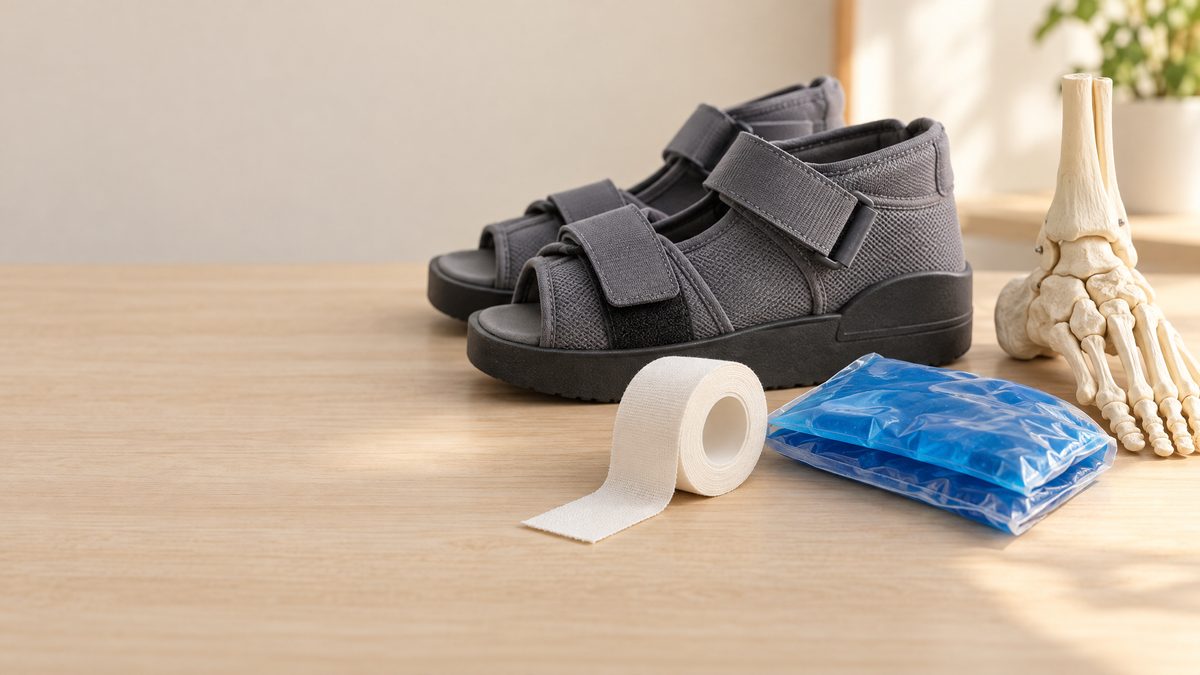
How Do I Know If My Toe Is Broken or Just Bruised? Quick Check
Foot Care Guide from ASG Foot & Ankle
The short answer
How do I know if my toe is broken or just bruised: only an X-ray can confirm a break, and wiggling or walking on it does not rule one out. A straight small toe usually gets the same care either way. A big toe, crooked toe or open wound needs care today. Get checked if not easing by day 5.
- Usually fits a bruiseThe toe lines up straight, the pain keeps easing, and you walk without a limp. Home care, then recheck at day 5.
- Suggests a breakOne sharp spot on the bone, a crack at impact, pain past a day or two, or trouble bearing weight. Straight small toe: same home care. Big toe: X-ray.
- Needs care todayA crooked toe, a big toe injury, a deep cut or visible bone, or a toe that is cold, pale or numb. Get seen now.
ASG Foot & Ankle patient education. Updated November 6, 2026. General information, not a diagnosis.
Is My Toe Broken? A Quick 8-Question Quiz
No quiz can tell you whether the bone is broken. This one tells you what to do next. Yes is always the worrying answer.
- 1. Can you see bone, or is there a deep cut or open wound on the toe?A nail torn loose counts.
- 2. Is the toe cold, pale, blue or gray, or does it feel numb or tingly?Compare it with the same toe on the other foot.
- 3. Was the toe badly crushed, for example by machinery or a very heavy object?A stub against furniture or a light dropped object does not count.
- 4. Is it the big toe?It carries more load, so a break in it is referred far more often.
- 5. Does the toe look crooked, twisted or out of line?Compare both feet from above. A nail facing a different way can mean the toe is rotated.
- 6. Is it too painful to put weight on the foot, or is the worst pain behind the toe?Pain in the ball or outer edge of the foot can be a metatarsal fracture.
- 7. Is this a child, or someone with diabetes, neuropathy or poor circulation?Reduced feeling can hide an injury, and growth plate breaks are usually referred.
- 8. Have 5 or more days passed without the pain and swelling starting to ease?If the injury just happened, answer No.
Answer each question. 0 of 8 done.
General information from published sources. This quiz cannot diagnose a fracture or replace an exam. If you are worried, get the toe seen whatever the result says.
The quiz leaves out a purple color, a sound at impact and one sharp spot. Each can happen with a break (ACFAS), and a bruise can also be sore in one spot (AAFP 2003). None of them changes the next step for a straight small toe.
Already have an answer? Read the broken toe healing timeline or bruised toe healing time.
What to Do Tonight
These steps are for a toe staying home tonight. If it will be seen tomorrow, leave out the tape.
- 1Raise the foot while it is swollen, and limit walking and standing for the first few days. (NHS)
- 2Ice it in a towel for up to 20 minutes every few hours, never on bare skin (NHS). Take care with diabetes or reduced feeling in the foot (Bath NHS).
- 3Take ibuprofen or acetaminophen if safe for you (NHS). Ask a pharmacist first if you have asthma, stomach ulcers or indigestion (Southport NHS).
- 4Wear a stiff-soled, wide, flat shoe when you walk (NHS). Physician guidance puts it at 2 to 6 weeks for most toe fractures (AFP 2024).
- 5Tape it to the next toe only if it is a straight small toe and taping helps. NHS and AAFP advice supports it (NHS) (AAFP 2003), while a Cleveland Clinic orthopedist warns it can pull bone pieces apart (Cleveland Clinic). See how to buddy tape a toe.
The same article also cautions against ice and anti-inflammatory drugs early on (Cleveland Clinic), which differs from NHS advice. No source opened for this page gives toe fracture data that settles it.
Do not do these tonight
- Pull a crooked toe straight. A clinician does this, often with a local anesthetic. (OrthoInfo)
- Strap a big toe or a toe at an odd angle. (NHS)
- Drain blood from under the nail yourself. (Cleveland Clinic)
When to look again
- Day 2 to 3: US and Australian advice sets a recheck around here: see a doctor if pain persists or is not improving. (Cleveland Clinic) (Healthdirect)
- Day 5: Get checked if pain and swelling have not started to ease. (NHS)
- Week 6: Get checked if it still hurts to walk (NHS). See stubbed toe still hurts for what is normal in between.
- Any time: Call a provider for sudden numbness or tingling, a sudden rise in pain or swelling, an open wound or bleeding, fever or chills, red streaks, or a toe that looks more crooked. (MedlinePlus)
How Do You Check for a Broken Toe at Home?
Do these gently and stop if the pain turns sharp. They shift the odds, and none can confirm or rule out a fracture.
Look at both feet from above
Strong if crookedA toe pointing a different way, or a nail facing a different way from the same toe on the other foot, suggests a displaced break or a dislocation. (AAFP 2003) (AFP 2016)
Limit: Breaks that stay in line are usually harder to spot.
Press gently on the bone
Some helpMost people with a toe fracture have a sore spot right over the break. Doctors also press the tip of the toe toward the foot: sharp pain further back suggests a fracture in that bone. (AAFP 2003)
Limit: A bruise can also be sore in one spot, and no accuracy figure is given. Never pull or twist.
Wiggle it and take a few steps
Weak if both workBeing unable to move it or put weight on the foot is a warning sign. (Cleveland Clinic)
Limit: Sources differ when both work. Cleveland Clinic says walking with no limp makes a break unlikely (Cleveland Clinic). US foot surgeons reject the rule "if you can walk on it, it's not broken" (ACFAS). NHS leaflets expect people with a broken toe to keep walking and moving it (Bath NHS) (St Helens NHS).
Watch the color
WeakBruising is common with fractures (AAFP 2003), and a bruised toe with no fracture can look the same (Oxford NHS).
Limit: Bruising may show only by the next day (ACFAS) and is harder to see on brown and black skin (NHS).
Time the pain
Useful over daysPain gone within an hour or two makes a fracture unlikely (Cleveland Clinic). Pain lasting more than a day or two makes a break more likely (Cleveland Clinic).
Limit: A bruise on the bone can feel the same as a break. (Cleveland Clinic)
No source opened for this page gives an accuracy figure for these checks, and X-rays are often needed to separate a fracture from a sprain, bruise or dislocation (AAFP 2003). For how a break feels, see what a broken toe feels like.
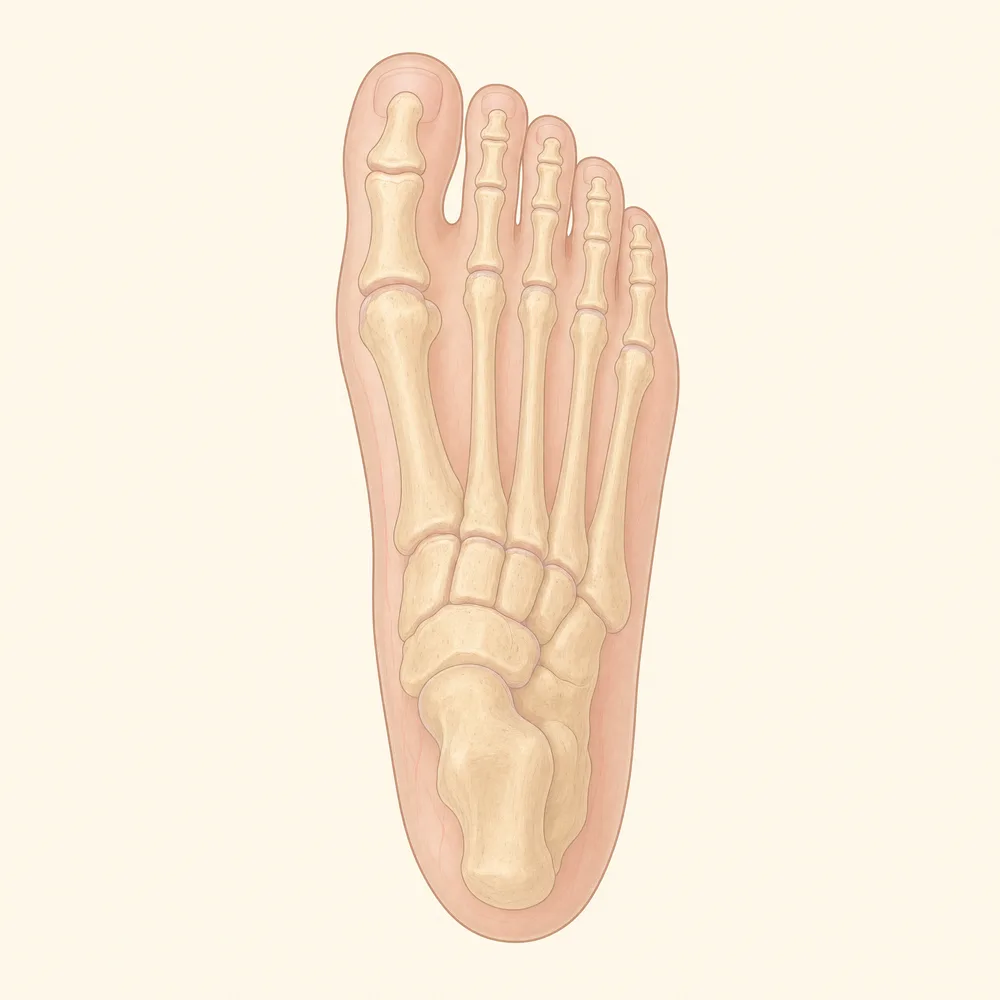 Illustration
When Does an X-Ray Change the Treatment?
A straight small toe with no wound: usually very little
- The NHS says treatment is usually the same for a broken toe and a bruised one. (NHS)
- One NHS emergency department does not X-ray a small toe with no deformity or wound, because the result would not change treatment (Oxford NHS). Others say much the same (Wirral NHS) (Southport NHS).
- Physician guidance treats stable fractures with taping and a rigid-sole shoe, and says small toes rarely need referral. (AAFP 2003)
An X-ray on a straight toe can still add two things:
- A time frame. One NHS leaflet gives 2 to 3 weeks for a soft tissue injury and up to 12 weeks for a fracture (Wirral NHS). The national NHS page says 4 to 6 weeks for a fracture (NHS).
- Whether the break reaches a joint. Physician guidance manages small toe fractures without surgery when there is no rotation and under 25% of the joint is involved (AFP 2024).
Where an exam or X-ray does change the plan
The big toe
Its fractures are referred far more often because it carries load and helps balance (AAFP 2003). Care ranges from a firm-soled shoe for 3 to 4 weeks (Hull NHS) to a walking cast (AFP 2016). See broken big toe healing time.
A crooked or rotated toe
It may need straightening, usually in the office, often with a local anesthetic (OrthoInfo). An X-ray also shows a dislocation (Royal Devon NHS). Physician guidance refers small toes bent over 20 degrees up or down, over 10 degrees sideways, or rotated over 20 degrees (AFP 2016).
An open wound or nail bed injury
Broken skin over a fracture carries a high risk of bone infection (AAFP 2003). Draining blood from under the nail in the first 24 hours may relieve the pain substantially (AAFP 2003), and deeper damage may need repair (Cleveland Clinic). See why toenails turn black.
A crush or several toes
Loss of circulation is rare unless the injury is open or a high-force crush. Breaks in more than one bone are common, so the neighboring toes need a careful look (AAFP 2003).
Diabetes or neuropathy
Lost feeling can hide an injury (CDC), and fractures may heal more slowly (Bath NHS). NHS advice is to see a doctor after any toe injury if you have diabetes (NHS).
A child
NHS advice is not to treat a child's toe at home (NHS). Most breaks through the growth plate are referred to a specialist (AAFP 2003).
Pain behind the toes
Tenderness at the base of the fifth metatarsal, on the outer edge of the foot, is part of the foot X-ray rule (AFP 2016). See fifth metatarsal fracture recovery.
The little toe follows the small toe rules unless it sticks out or tucks under its neighbor. See broken pinky toe healing time.
Where the advice differs
| Who | For a straight small toe |
|---|---|
| NHS (UK) | Treatment is usually the same, so a straight small toe with no wound often gets no X-ray. (NHS) (Oxford NHS) |
| Cleveland Clinic (US) | Get it evaluated if worried. With no crooked toe, visible bone or deep cut, it is safe to wait a day or two. (Cleveland Clinic) |
| AAFP reviews (US family physicians) | X-ray views are part of the evaluation. Small toe fractures rarely need referral, and repeat films rarely change care when the break stays in line. (AAFP 2003) |
| ACFAS and AAOS (US surgeons) | Evaluation is always recommended, and a suspected fracture should be seen as soon as possible. (ACFAS) (OrthoInfo) |
No trial found for this page compares these approaches, and one evidence review found no evidence to show whether any toe fracture treatment improves outcomes (BestBETs). If you want a definite answer, an X-ray is a reasonable choice for any toe. Skipping it on a straight small toe that keeps improving follows NHS advice.
What Happened to 339 People With Broken Toes
A Dutch trauma center reviewed consecutive toe fractures from 2006 to 2008: 339 patients and 368 broken toes (Van Vliet-Koppert 2011). All had X-rays.
Big toes got a cast for about 3 weeks, and small toes got taping and a rigid-sole shoe. Of 264 patients aged 16 to 75 sent a survey, 141 replied a median of 27 months later, with a median foot function score of 100 out of 100 (full paper).
This study cannot show outcomes with no care, because everyone was X-rayed and treated. Nearly half of those surveyed did not reply, and the score was a midfoot scale.
Jammed Toe vs Broken Toe
People say "jammed" for a toe driven straight into something. That force is one of the two most common causes of toe fractures (AAFP 2003), so a jammed toe can be a sprain, a bruise, a dislocation or a break. A straight one usually gets the same care as a simple fracture (Plymouth NHS). A toe bent at a joint may be dislocated and needs an X-ray (Royal Devon NHS). For how long a jam takes, see sprained toe healing time.
The bottom line
- No home test can confirm a broken toe, and wiggling or walking on it does not rule one out.
- A straight small toe with no wound usually gets the same care either way: rest, a raised foot, ice and a stiff-soled shoe.
- An exam or X-ray can change the plan for a big toe, crooked toe, open wound, nail bed injury, crush, several toes, a child, or diabetes and neuropathy.
- Visible bone, or a toe that is cold, pale, numb or tingly, needs emergency care.
- If pain and swelling have not started to ease by day 5, get it checked.
Frequently Asked Questions
Can you still wiggle a broken toe?
Often, yes. Being unable to move a toe is a warning sign, but moving it does not rule out a fracture. One NHS leaflet tells people with a toe fracture to keep moving it within their pain limits to prevent stiffness. If it moves but looks crooked or feels numb, get it seen.
Can I still walk if my toe is broken?
Often, yes. A Bath NHS leaflet says most people with a broken toe can walk in supportive shoes without too much discomfort, and US foot surgeons reject the rule that walking means no break. Limit walking and standing for the first few days. Get it checked if you cannot put weight on the foot.
How fast does a broken toe bruise?
There is no reliable clock. US foot surgeons describe bruising and swelling by the next day, and no source opened for this page gives a timing that separates a fracture from a bruise. A stress fracture can swell with no bruise. A toe that has not turned purple has not been cleared.
If I stub my toe and it turns purple, is it broken?
Not necessarily. A hard stub with no fracture can also turn a toe purple, so color alone cannot separate them. Check the shape of the toe, the feeling in it and whether you can put weight on the foot. Dark color under the nail is often trapped blood. A whole toe that turns dark, cold or numb needs urgent care.
What do doctors do for a broken toe?
A clinician checks the shape, skin, nail, circulation and feeling, and often takes X-rays from three angles. Straight fractures usually get a stiff-soled shoe, taping to the next toe or a boot. A crooked toe may be straightened, often with a local anesthetic. Big toe breaks and open wounds are referred more often. Surgery is uncommon.
How do I know if my pinky toe is broken or just bruised?
The same limits apply: only an X-ray can confirm it. The little toe made up 30% of fractured toes in a Dutch study of 339 patients. If it is straight with no wound, care is usually the same either way. Get it seen if it sticks out sideways, tucks under the next toe, or the worst pain is on the outer edge of the foot.
Sources and further reading
- NHS: Broken toe (reviewed March 2026)
- Hatch RL, Hacking S. Evaluation and Management of Toe Fractures. Am Fam Physician. 2003;68(12):2413-2418
- Bica D, Sprouse RA, Armen J. Diagnosis and Management of Common Foot Fractures. Am Fam Physician. 2016;93(3):183-191
- Silver S, Williams E, Plunkett ML. Common Foot Fractures. Am Fam Physician. 2024;109(2):119-129 (abstract and recommendations)
- Van Vliet-Koppert ST, et al. Demographics and Functional Outcome of Toe Fractures. J Foot Ankle Surg. 2011;50(3):307-310
- Same study, accepted manuscript with full results
- BestBETs: Toe fractures in adults
- Oxford University Hospitals NHS: Lesser toe injury (December 2025)
- Southport and Ormskirk NHS: Toe injuries (2022)
- University Hospitals Plymouth NHS: Toe injuries
- Royal United Hospitals Bath NHS: Advice after breaking your toe
- St Helens and Knowsley NHS: Toe fracture
- Royal Devon NHS: Toe fracture or dislocation (September 2025)
- Wirral Community NHS: Toe injury
- Hull University Teaching Hospitals NHS: Undisplaced great toe fracture
- ACFAS FootHealthFacts: Toe and metatarsal fractures
- AAOS OrthoInfo: Toe and forefoot fractures
- MedlinePlus: Broken toe, self-care
- Cleveland Clinic: Broken toe
- Cleveland Clinic: Stubbed toe
- Cleveland Clinic: Subungual hematoma
- Cleveland Clinic Health Essentials: Suspect a broken toe? (2021)
- Healthdirect Australia: Foot and toe fractures
- CDC: Diabetes and your feet
General patient education. Your examination and individual treatment instructions take priority.
See a Podiatrist Near You
ASG Foot & Ankle has offices in Homewood, South Chicago Heights and Mokena. Our board-certified podiatrists accept most insurance. Find the office closest to you:
Want a Definite Answer?
ASG Foot & Ankle can examine and X-ray the toe, set one that is out of line, and fit a stiff-soled shoe or boot if it needs one.