
Toenail Regrowth After Removal: A Month-by-Month Timeline
How long the nail really takes to come back, what it looks like at each stage, and why the new nail is often thick or ridged at first. Plus the signs that regrowth is not going the way it should.
The wound after a toenail removal heals in a few weeks. The nail is a much longer story, and it is the part nobody warns you about properly. Two months in, with a bare nail bed and no sign of anything growing, it is very easy to conclude that the nail is simply gone for good.
Usually it is not. It is just slow. Toenails grow at roughly half the rate of fingernails, and the tissue that makes the nail needs several weeks to recover before it starts producing again. This guide from the podiatrists at ASG Foot & Ankle lays out regrowth month by month, explains why the first nail to appear often looks worse than the one you lost, and covers when slow or strange regrowth is actually a problem. If your removal was recent and you are still in the wound-healing phase, start with our week-by-week toenail removal recovery timeline instead.
Medically reviewed by Dr. Timothy Horak and Julia Shauger, board-certified podiatric specialists serving Homewood, South Chicago Heights & Mokena. Last reviewed July 2026.
How long does a toenail take to grow back?
A big toenail takes 12 to 18 months to fully regrow. The smaller toenails take 6 to 12 months. Toenails grow about 1 to 1.5 mm per month, and a big toenail is around 20 mm long, which is where those numbers come from. Expect to see nothing at all for the first 4 to 8 weeks, then a thin sliver at the cuticle. One important exception: if you had a matrixectomy, where the nail-producing tissue was deliberately destroyed, that part of the nail is not meant to grow back at all.
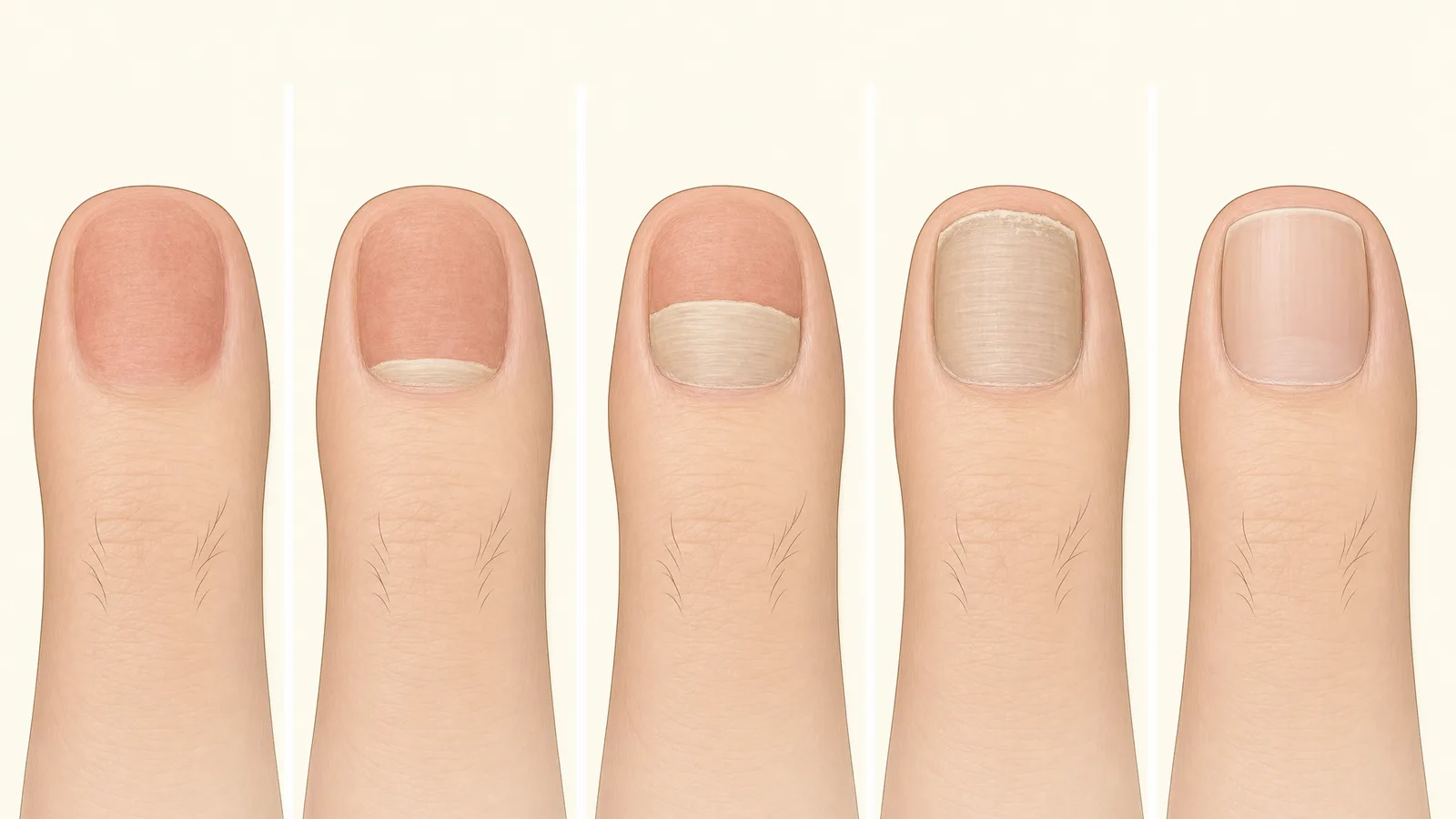
Month-by-Month Regrowth Timeline
 Illustration
Nothing Visible Yet
- The wound closes and skin covers the nail bed, but no nail is being produced yet
- The matrix, the nail factory under the cuticle, is still recovering from inflammation
- The nail bed toughens into a firm pad of skin, which is normal and protective
- This is a wound-healing phase, not a regrowth phase
What it looks like: Smooth pink or slightly shiny skin over the nail bed, with no nail anywhere. Many people assume at this point that the nail is never coming back.
The First Sliver
- A thin band of new nail emerges from under the cuticle
- It can look pale, soft, or slightly wavy at the leading edge
- Do not trim it yet, there is nothing to trim and the edge is fragile
- Growth is roughly 1 to 1.5 millimeters per month from here on
What it looks like: A narrow, often lighter-colored strip of nail at the base of the toe, covering maybe a fifth of the nail bed.
Halfway, and the Awkward Stage
- New nail covers roughly a third to a half of the nail bed
- Ridges running lengthwise are common and usually smooth out over time
- The nail can look thicker than its neighbors during this phase
- First real trim: straight across, corners left alone
What it looks like: A visibly ridged or slightly thickened nail with a clear boundary between new nail and bare nail bed ahead of it.
Most of the Way There
- Smaller toenails are usually fully regrown in this window
- The big toenail is typically two thirds to fully covered
- Texture usually improves as the newer growth comes in
- Normal shoes, sports, and polish are all fine by now
What it looks like: A nail that mostly looks like a nail, often with the older, rougher portion out near the tip and smoother nail behind it.
Fully Regrown (Big Toe)
- The big toenail reaches the end of the toe and is fully replaced
- The rough first-generation nail has been trimmed away entirely by now
- Minor permanent differences in shape or thickness can remain
- If the nail is still thick, crumbly, and discolored, think fungus rather than regrowth
What it looks like: A complete nail. It may not be a perfect match for the other foot, and that is a normal outcome rather than a complication.
Your dates: toenail regrowth calculator
When the nail came off, which toe, and a couple of details. Get the dates.
First, Which Procedure Did You Have?
Everything about your regrowth expectations depends on this one question, and a lot of patients are not sure of the answer. Check your discharge paperwork for the word "phenol" or "matrixectomy."
Avulsion only
The nail plate was lifted off, but the matrix under the cuticle was left alone. This is what gets done for a badly damaged, infected, or fungal nail when the goal is to get the nail out of the way.
The nail grows back, in 6 to 18 months.
Matrixectomy
Phenol or a surgical excision was used to destroy the matrix, permanently, so a problem nail edge cannot come back. This is the standard fix for a recurring ingrown toenail.
That portion does not grow back by design. A partial matrixectomy leaves a permanently narrower nail.
Matrixectomies are not 100 percent effective. Roughly 5 to 10 percent regrow something, usually a thin spike of nail at the treated border that can become painful or ingrown again. That is straightforward to treat, but it does need to be looked at rather than dug at. More on phenol matrixectomy recovery →
Why the New Nail Looks Worse Than the Old One
A very common and very unwelcome surprise: the nail finally starts growing, and it comes in thick, ridged, yellowish, or curved oddly. Patients often assume the procedure went wrong. Usually it did not.
The matrix is delicate tissue, and it was inflamed twice over: once by whatever made the nail a problem in the first place, and again by the removal. An irritated matrix produces irregular nail. Because a toenail is a slow-moving record of what the matrix was doing months ago, the roughest nail is the oldest nail, sitting out near the tip. As the matrix calms down, the nail growing in behind it comes in smoother. So the nail tends to look progressively better from the cuticle outward, and the ugly part gets trimmed off eventually.
The main exception is fungus. If the fully regrown nail stays thick, crumbly, yellow-brown, and separated from the nail bed, that is a fungal infection rather than a regrowth quirk, and it is especially likely if fungus was the reason for the removal in the first place. Toenail fungus treatment →
Caring for the Toe While It Regrows
Keep it dry
Dry between the toes, change damp socks, and rotate shoes. Damp nails are how fungus gets a second chance.
Trim straight
Straight across, corners left visible. Rounding the corners down is what drives a nail into the skin.
Give it room
Shoes that do not press on the tip of the toe. Pressure on a growing nail distorts it.
Do not help
No picking, pulling, or lifting the advancing edge. Damaging new nail sets the clock back months.
Normal Regrowth vs. Warning Signs
Normal & Expected
- •No visible nail at all for the first 1 to 2 months
- •Lengthwise ridges in the new nail that smooth out over time
- •A new nail thicker or paler than its neighbors early on
- •A permanently narrower nail after a partial matrixectomy
- •Slight shape differences that never fully match the other foot
Have It Checked If…
- •No new nail at all by 4 months, when the matrix was left intact
- •A sharp spike of nail at one edge, or new pain at the nail fold
- •The regrown nail is thick, crumbly, and discolored (likely fungal)
- •The nail lifts away from the nail bed as it grows
- •A dark brown or black streak running along the new nail
That last one deserves emphasis. A new pigmented band in a single nail should always be evaluated rather than watched, because although the common causes are harmless, melanoma can present exactly that way. Getting it looked at is quick and worth doing.
If you have diabetes or poor circulation, regrowth is often slower and the toe needs closer monitoring throughout. Learn about our diabetic wound care →
Still in the first few weeks? Here is what the wound itself should be doing. Toenail Removal Recovery Timeline →
Toe still sore? See how long pain should realistically last. Toenail Removal Pain Timeline →
New nail coming in dark? There are several causes, most of them harmless. Why Toenails Turn Black →
Was the nail removed because of fungus? Whether the new nail grows back clear depends on what happens during these regrowth months. Toenail Removal for Fungus →
Frequently Asked Questions
How long does it take for a toenail to grow back after removal?
A big toenail takes about 12 to 18 months to fully grow back. The smaller toenails are shorter and regrow faster, usually in 6 to 12 months. Toenails grow roughly 1 to 1.5 millimeters per month, which is about half the speed of fingernails, and a big toenail is about 20 millimeters long. Nothing visible happens for the first 4 to 8 weeks, because the nail-producing tissue at the base has to recover before it starts making nail again.
Why is my new toenail thick, ridged, or a strange shape?
This is very common and usually temporary. The nail matrix at the base of the toe was inflamed by the original problem and by the removal itself, so the first nail it produces is often thickened, ridged along its length, slightly yellowed, or curved differently than the old one. In most cases it normalizes as it grows out, and the outer half of the nail looks more normal than the first part. If the nail is still thick, crumbly, and discolored once it has fully grown out, the likely cause is a fungal infection rather than the removal.
Will my toenail grow back after a matrixectomy?
That depends on the procedure. If your podiatrist performed a matrixectomy, meaning the nail-producing matrix was deliberately destroyed with phenol or removed surgically, that portion of nail is not supposed to grow back. After a partial matrixectomy, which is the usual treatment for a recurring ingrown nail, you keep a permanently narrower nail with a straight edge where the border used to be. Roughly 5 to 10 percent of matrixectomies see some regrowth anyway, usually as a small spike of nail at the treated edge, which can be treated again.
When will I see the first sign of new nail?
Expect nothing for the first month or two. Somewhere between weeks 6 and 12 a thin, often pale sliver of new nail becomes visible emerging from under the cuticle. It advances slowly and can look fragile or slightly wavy at first. Seeing no new nail at all by 4 months, in a toe where the matrix was left intact, is worth having evaluated.
How do I take care of the toe while the nail grows back?
Once the wound is fully closed, the main jobs are keeping the toe dry, protecting it, and not helping too much. Dry your feet thoroughly between the toes, change out of damp socks, and wear shoes that do not press on the tip of the toe. Do not pick or pull at the advancing nail edge, and do not round the corners down when you trim it, because rounded corners are what drive nails into the skin in the first place. Trim straight across, leaving the corners visible.
Can I paint a toenail that is growing back?
Wait until the nail bed is completely healed and closed with no drainage, which is usually 4 to 6 weeks after the removal, and preferably until there is a reasonable amount of new nail to paint. Polish and especially acrylic or gel applied to a thin new nail traps moisture and makes it harder to spot problems early. If the nail was removed because of a fungal infection, leaving it unpolished while it grows out is a much better idea, since polish creates exactly the warm, damp, dark conditions the fungus prefers.
Specialized Wound Care at ASG Foot & Ankle
Our board-certified podiatrists treat slow-healing wounds, diabetic foot ulcers, and post-surgical wounds at our three clinics in Homewood, South Chicago Heights, and Mokena.
See a Podiatrist Near You
ASG Foot & Ankle has offices in Homewood, South Chicago Heights and Mokena. Our board-certified podiatrists accept most insurance. Find the office closest to you:
Nail Not Growing Back the Way It Should?
A nail spike, a thickened fungal nail, or no regrowth at all are all fixable, and all easier to treat early. Our board-certified podiatrists can take a look at any of our South Chicago suburbs locations.