Black Spot Under Your Toenail: What It Is and When to Worry
Usually a small bruise from your shoes that grows out on its own. Occasionally not. Here is how to tell which one you have.
A black spot under a toenail is most often a small pocket of dried blood, called a subungual hematoma, left by shoe pressure or a knock you may not even remember, and it grows out slowly with the nail over several months. Less often it is dark fungal debris, a splinter hemorrhage, trapped dirt, or a harmless pigment band from the nail's growth center, and rarely it is an early melanoma, which is why a spot that does not move forward as the nail grows deserves a look.
This guide is about a spot, dot, or streak. If the whole nail has gone dark, start with why toenails turn black instead. Below, the podiatrists at ASG Foot & Ankle rank the causes by how often we actually see them, explain the warning signs of nail melanoma in plain terms, and walk through a simple photo test you can do at home that separates a bruise from a pigment band in about a month.
Medically reviewed by Dr. Timothy Horak and Julia Shauger, board-certified podiatric specialists serving Homewood, South Chicago Heights & Mokena. Last reviewed September 2026.
The short answer
Most black spots under a toenail are small bruises from shoe pressure or a minor knock. They are usually painless and they grow out with the nail at about 1 to 2 mm a month. Dark fungal debris, splinter hemorrhages, and dirt account for most of the rest. A brown or black band that starts at the cuticle and runs lengthwise is a different thing: it comes from the nail's growth center, it is usually benign, and it should be examined, sooner rather than later if it is on one nail, 3 mm or wider, getting wider, or spreading onto the skin.
The Causes, Most Likely First
Ranked roughly by how often each one turns out to be the answer when someone comes in about a dark spot under a toenail.
A Small Bruise Under the Nail (Subungual Hematoma)
A few drops of blood trapped between the nail and the nail bed. Shoe pressure is the usual cause, not a memorable injury: a toe box that is slightly short, a shoe loose enough to let the foot slide forward, a long downhill hike, or a run in new shoes can bleed a little under the nail without ever hurting. A dropped object or a stubbed toe does it faster, and that kind usually does hurt.
- Maroon, purple, or black; round, oval, or irregular, often fading to reddish brown at the edges
- Usually painless when it builds up slowly, which is why so many people discover one by surprise
- Big toe and second toe most often, the ones that meet the front of the shoe first
- Moves forward with the nail at roughly 1 to 2 mm a month, leaving a strip of normal pink nail behind it
Dark Fungal Debris or a Dark Fungal Infection
Most toenail fungus turns the nail yellow or white, but some molds and a group of naturally dark fungi stain it brown, gray, or black, and the debris that packs under a thickened nail often looks dark on its own. A nail that has lifted off its bed can also pick up a green-black tint from a bacterium (Pseudomonas) that likes the damp space underneath.
- Usually starts at the tip or a side edge and works back toward the cuticle
- The nail also thickens, dulls, crumbles, or lifts
- Often more than one nail, and often alongside athlete's foot
- Occasionally forms a dark band that mimics pigment, which is why a clipping goes to the lab
Splinter Hemorrhages
Thin, short lines of dried blood, reddish brown to black, running lengthwise under the nail like a wood splinter. The tiny vessels of the nail bed run lengthwise, so when a few of them bleed from a knock or shoe pressure the blood lines up in a streak rather than a blot.
- Usually in the outer half of the nail, and grow out like any bruise
- One or two on a toenail after a hike or a run are ordinary
- New crops on several nails with no injury, especially with fever or feeling unwell, deserve a medical check, as they can accompany psoriasis or, rarely, an infection of a heart valve
Dirt, Debris, or a Surface Stain
Soil, sock fibers, shoe dye, and dead skin collect under the free edge of the nail, especially a thickened one, and can look like a black dot from above. Stains sit on the surface of the nail rather than under it.
- Lifts out with a gentle clean under the nail edge, or buffs off the surface
- Has no defined shape inside the nail itself
- If it cannot be lifted out and stays put, it is not dirt
A Benign Pigment Band (Nail Matrix Nevus or Lentigo)
The nail grows from a matrix hidden under the cuticle. When pigment cells there switch on, or when a small mole or freckle sits in the matrix, melanin is laid into the growing nail and shows as a brown stripe from the cuticle to the tip. Any such stripe is called longitudinal melanonychia. It is common in people with darker skin tones, where it often appears on several nails and has been there for years. It also appears during pregnancy, with some medications including certain chemotherapy drugs, and from friction on the small outer toes that rub inside a shoe.
- Starts at the cuticle and runs to the tip; it does not grow out, because the matrix keeps producing it
- Even light to medium brown, with straight, parallel borders
- Several nails at once is reassuring; a single new band on one nail in an adult is the one to show someone
- Examined once to confirm, then watched for change
A black spot on the big toenail deserves a word of its own. The big toe takes the most shoe pressure, so it is where most of these bruises happen. It is also, along with the thumb, the most common site for nail melanoma. That overlap is exactly why the grow-out test below is so useful on the big toe, and why a spot there with no injury behind it is worth a photo today.
The One Not to Miss: Subungual Melanoma
Melanoma under a nail is uncommon, and most dark spots and bands turn out to be benign. It is on this page because it is the cause where timing matters most, and because the usual reason it is caught late is that it was assumed to be a bruise or fungus for months. It is almost always painless, it usually starts as a brown or black band at the cuticle rather than a round blot, and it does not grow out.
Dermatologists and podiatrists use a simple checklist, the ABCDEF of nail melanoma. One item on its own is not a diagnosis; it is a reason to have the nail examined.
Age
Most often found in adults in their 50s to 70s. It occurs in every skin tone, and because sun-related melanomas are less common in darker skin, nail and sole melanomas make up a larger share of the melanomas seen in Black, Asian, and Hispanic patients.
Band
A brown to black band 3 mm wide or more, or one with blurred, irregular edges, or with several shades of brown and black inside it.
Change
A band that is widening, darkening, or spreading toward the sides of the nail, or a nail that keeps splitting or deforming despite treatment for fungus or injury.
Digit
The big toe and the thumb are the most common sites. A change in a single nail is more concerning than the same change across several.
Extension
Pigment spreading from the nail onto the cuticle or the skin around it, called the Hutchinson sign. It is one of the strongest warning signs on this list.
Family or personal history
A previous melanoma of your own, or melanoma or many unusual moles in the family, lowers the threshold for a biopsy.
Two details catch people out. First, blood does not rule it out. A bruise can sit on top of a pigment band, and a melanoma can bleed. If a spot grows out and leaves a stripe of pigment behind it at the cuticle, that remainder needs to be looked at. Second, not every nail melanoma is dark. Some have little pigment and show up instead as a nail that keeps splitting or lifting, or a pink lump or sore under the nail that bleeds and does not heal.
One reassuring caveat on the Hutchinson sign: on a thin, see-through cuticle, a benign band can show through the skin and look as if it is spreading onto it. A dermoscope tells the two apart in seconds, which is one more reason to let someone look rather than decide from a photo.
Bruise, Fungus, Benign Band, or Warning Sign?
Most spots can be sorted into one of these columns at home. The last column is not a diagnosis, just the features that mean an exam should come first.
| Feature | Bruise (hematoma) | Fungal debris | Benign pigment band | Melanoma warning signs |
|---|---|---|---|---|
| Shape | Round, oval, or irregular patch | Patchy flecks and streaks with debris | Straight stripe, cuticle to tip | Stripe or patch, often widening |
| Color | Maroon, purple, or black, reddish brown at the edges | Brown, gray, or black mixed with yellow | Even light to medium brown | Brown to black, uneven shades, blurred edges |
| Where it starts | Anywhere; moves away from the cuticle | Tip or side edge, spreading back | At the cuticle, always | At the cuticle, sometimes onto the skin |
| After 3 to 4 weeks | Has moved forward with the nail | Slowly spreading, not moving as a unit | Same place, same width | Same place, may be wider or darker |
| The nail itself | Normal; a large one may lift later | Thick, dull, crumbly | Normal | May split, thin, or lift over time |
| How many nails | One or two, big and second toe | Often several | Often several, especially in darker skin | Usually one, most often the big toe |
| Pain | None if slow; throbbing after a sudden injury | None, or pressure from thickness | None | Usually none |
| What to do | Photo test, let it grow out; drain if fresh and painful | Clipping to confirm, then treat | Examine once, then watch for change | See a podiatrist or dermatologist promptly |
The Ruler-and-Photo Test
The single most useful fact about a dark spot under a nail is whether it moves. Blood is stuck to the underside of the nail and travels out with it. Pigment from the matrix is made fresh every day at the cuticle, so a band stays put no matter how long you wait. You can check which one you have in about a month.
- 1
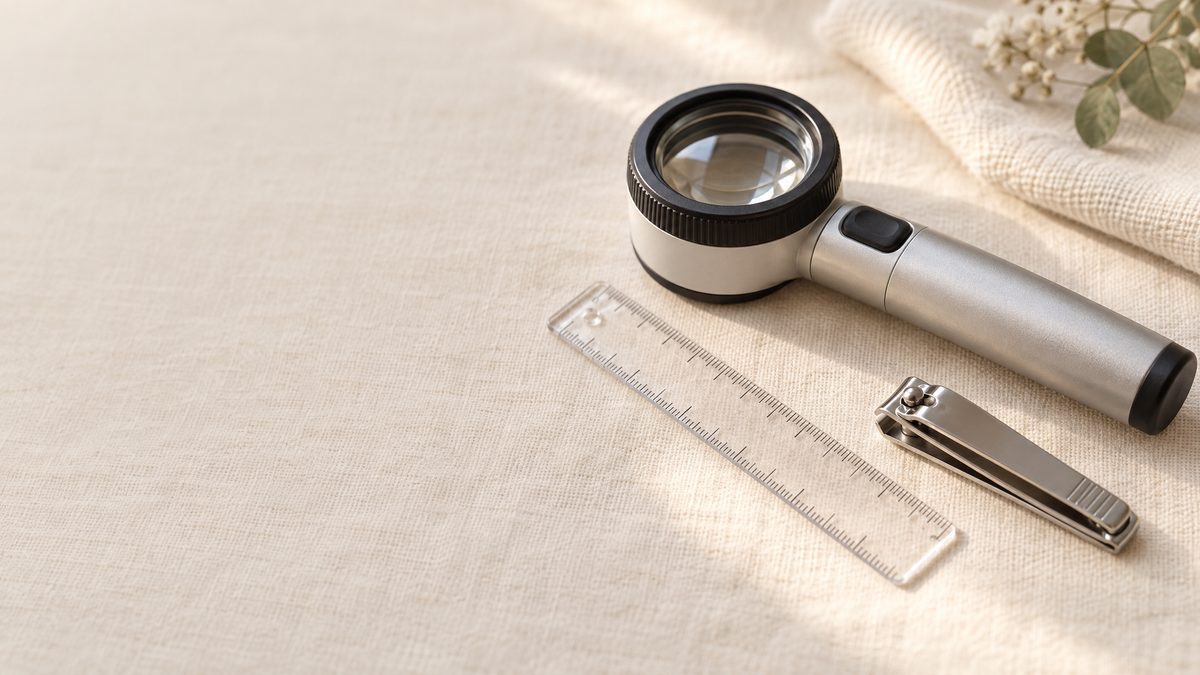
Photograph it today. Daylight, phone held straight above the nail, with a ruler or tape measure showing millimeters laid alongside the toe. Take two or three and keep the sharpest.
- 2
Mark the back edge. Note the gap, in millimeters, between the cuticle and the edge of the spot nearest the cuticle. For a sharper reference, file a tiny shallow notch in the nail surface level with that edge.
- 3
Recheck in 3 to 4 weeks. Same light, same angle, same ruler. Toenails grow slowly, so expect a change of only a millimeter or two, which is why the ruler matters.
It moved: bruise behavior
The gap behind the spot has grown, the spot has traveled forward with the notch, and clear pink nail is appearing between it and the cuticle. Keep trimming it as it grows out; nothing more is needed unless something changes.
It stayed: needs to be seen
It still starts right at the cuticle, or it is the same distance from the cuticle as before, or it is wider or darker. That is matrix behavior, and it should be examined. Bring your photos; they are genuinely useful at the visit.
This test is for reassurance about a likely bruise. It is not a reason to wait a month on a band that is already 3 mm or wider, is visibly widening, has uneven color, or has pigment on the surrounding skin. Those should be seen now.
See a Podiatrist or Dermatologist If
None of these means melanoma. Each one means the spot is not behaving like an ordinary bruise and deserves a proper look:
- •A brown or black band that starts at the cuticle and runs lengthwise, especially a single one in an adult
- •A band or spot that is widening, darkening, or has uneven color or blurred edges
- •Pigment on the cuticle or the skin around the nail
- •No injury you can think of, and the spot has not moved forward after 4 to 8 weeks
- •The nail splitting, thinning, lifting, or deforming along the spot
- •Bleeding, a lump, or a sore under the nail that does not heal
- •A spot that keeps coming back in the same place, especially with the nail pushed up over a firm bump, which can be a small bone spur under the nail (subungual exostosis) that shows on an X-ray
- •Diabetes, neuropathy, or poor circulation, where a new dark spot can mean pressure damage or a hidden sore under a thick nail
- •A fresh, throbbing spot after an injury: draining it within the first day or two relieves the pressure quickly
While You Are Watching It
Worth doing
- Take the ruler photo and put a reminder in your phone for 3 to 4 weeks
- Trim the nail straight across and keep it short so it does not catch the shoe
- Check shoe fit: about a thumb's width in front of the longest toe, and laces snug enough that the foot does not slide forward downhill
- Keep the nail dry and change damp socks, which slows fungus if that turns out to be part of it
- Look at your other toenails and fingernails too, and note whether any have similar marks
Worth avoiding
- Heating a paperclip or drilling into an old, painless spot; once the blood has clotted there is nothing to drain, and it opens a path for infection
- Covering the nail with dark polish while you are trying to watch it
- Digging under the nail with sharp tools to get at a spot that will not lift out
- Months of over-the-counter antifungal on a band that starts at the cuticle
- Deciding from a photo alone when one of the warning signs above is present
What Happens at the Appointment
Most visits for a dark spot under a toenail are short and end with reassurance and a plan. Here is what the evaluation involves, in the order it usually happens.
History and a look at every nail
Shoes, running, recent hikes, injuries, medications, and family history, then a look at all the toenails and fingernails. The pattern across nails is one of the most useful clues: many similar bands are reassuring, one odd nail is not.
Dermoscopy
A handheld magnifying light held against the nail. It is painless and takes a minute. Blood shows as red-purple to black with small round globules and a clean edge; a benign band shows fine brown lines that are regular and evenly spaced; lines that vary in color, thickness, and spacing raise concern. Often this alone is enough to reassure.
A nail clipping to the lab
A piece of the discolored nail is trimmed and sent to pathology. A PAS stain shows whether fungus is present, and the pathologist can also tell whether the dark material is blood or pigment. No numbing needed; it feels like a nail trim.
A nail matrix biopsy, only if needed
Reserved for a band that looks suspicious. The toe is numbed with a toe block, an injection at the base of the toe, after which the procedure itself should not hurt. Part of the nail is lifted and a small sample is taken from the growth center under the cuticle. It is done in the office, the toe is dressed, and most people are back in comfortable shoes within a few days. Depending on where and how much is sampled, the nail may grow back with a thin ridge or split along that line.
Treatment then follows the cause. A fresh, painful bruise is drained through a tiny hole in the nail, which gives almost instant relief. An old, painless one is simply left to grow out and trimmed as it goes. Fungus confirmed by the lab is treated with topical or oral medication or laser therapy, and the shoe fit or running habit that caused a pressure bruise is corrected so it does not come back.
Black Dots in a Callus or Wart
A lot of people searching for a black spot are looking at the bottom of the foot or the tip of a toe rather than the nail. Two very different things cause dark dots there.
Tiny black pinpoints: a plantar wart
The small black specks people call seeds are clotted capillaries, the little blood vessels that feed the wart. Skin lines detour around a wart rather than running through it, and it hurts more when pinched from the sides than when pressed. After freezing or salicylic acid, the dots often look more obvious for a week or two as the treated tissue dies off, which is expected. Dots that come back once the area has fully healed usually mean some wart survived. Plantar Wart Removal Recovery →
One dark patch: bleeding under a callus
A single brown, red, or black area under a thick callus is blood from small vessels crushed by pressure. It is not a wart and not a seed. It can be an early sign that the skin is breaking down beneath the hard cap, and with diabetes or neuropathy it deserves a same-week look rather than a pumice stone. Do not dig it out. Painful Callus Relief →
Is the whole nail black, not just a spot? Blood under the entire nail, runner's toe, and whether the nail will fall off. Why Toenails Turn Black →
Is the dark spot on the skin of the toe rather than the nail? A toe darkening with no injury is a circulation question and should not wait. Toe Turning Black: Causes and Urgency →
Stubbed or crushed the toe recently? How long the bruising and soreness usually last, and when it might be broken. Bruised Toe Healing Time →
Nail thick, yellow, or crumbly as well as dark? How to tell discoloration from a fungal nail. Just Discoloration, or a Fungal Nail? →
Already confirmed as fungus? What the drugstore options can and cannot do. OTC Toenail Fungus Treatments Compared →
Fungus that keeps returning? Why Toenail Fungus Keeps Coming Back → or see all Toenail Fungus Treatment Options →
Frequently Asked Questions
Why do I have a black spot on my toenail?
Most often because a few drops of blood have collected under the nail from shoe pressure or a minor knock, which is called a subungual hematoma. It is usually painless when it builds up slowly, it is most common on the big toe and second toe, and it moves forward with the nail as the nail grows. Other common causes are dark fungal debris in a thickened nail, splinter hemorrhages, dirt under the nail edge, and a harmless brown pigment band from the nail's growth center. Rarely, a dark spot or band is an early subungual melanoma, which is why a spot that does not move forward over a few weeks, or a band that starts at the cuticle, should be examined.
Is a painless black spot under my toenail something to worry about?
Usually not. A slow bruise from shoe pressure is typically painless, and it is the most common reason for a painless black spot. The catch is that nail melanoma is also usually painless, so pain, or the lack of it, does not tell the two apart. What does is movement. Photograph the spot next to a ruler, note or mark where its back edge sits, and recheck in 3 to 4 weeks. A bruise moves out with the nail and leaves clear nail behind it. A spot or band that stays anchored at the cuticle, widens, or spreads onto the surrounding skin should be seen by a podiatrist or dermatologist.
How long does it take for a black spot under a toenail to go away?
A bruise under a nail does not fade the way a skin bruise does, because the blood is trapped under the nail plate and has to grow out with it. Toenails grow roughly 1 to 2 mm a month, a little slower with age or poor circulation, so a spot near the tip can be trimmed away within a couple of months, while one just in front of the cuticle on a big toe can take the better part of a year to clear. The spot often lightens from black to reddish brown as it ages. If the nail lifts and sheds, a new big toenail takes about 12 to 18 months to grow in fully. A spot that has not moved at all after 2 to 3 months is not behaving like a bruise and should be checked.
What does melanoma under a toenail look like?
Most often a brown or black band running lengthwise from the cuticle toward the tip, usually on a single nail, most commonly the big toe or the thumb. Features that raise concern are a band 3 mm wide or wider, blurred or irregular edges, several shades of brown and black within it, a band that is widening or darkening over weeks to months, and pigment spreading onto the cuticle or the skin around the nail, which is called the Hutchinson sign. Later, the nail can split, thin, or lift along the band. Some nail melanomas have little pigment at all and show up as a nail that keeps splitting or a sore under the nail that bleeds. It is uncommon, and most bands turn out to be benign, but only an exam, and sometimes a biopsy, can tell for certain.
What is a light brown spot or brown streak on my nail?
A light brown stripe running the full length of the nail, with even color and straight edges, is usually a benign pigment band called longitudinal melanonychia, made by pigment cells in the nail's growth center. It is very common in people with darker skin tones, often appears on several nails, and can also follow pregnancy, some medications, or friction from shoes on the smaller outer toes. A small brown spot that is not a stripe is more often an old bruise that has lightened as it aged, or a stain on the nail surface. A single new streak on one nail in an adult, or one that is widening or darkening, should be examined once so a baseline can be recorded.
Can toenail fungus cause black spots under the nail?
Yes. Most fungal nails turn yellow or white, but some molds and naturally dark fungi produce brown or black discoloration, and fungal debris packed under a thickened nail often looks dark. A nail lifted off its bed can also harbor a bacterium that gives a green-black tint. Fungal darkening usually starts at the tip or a side edge, comes with a thick, crumbly nail, and often affects more than one nail. Because fungus can occasionally mimic a pigment band, a podiatrist confirms it with a nail clipping sent for a lab stain before starting treatment, which also helps rule out other causes.
What are the black dots in a callus or a plantar wart?
In a plantar wart, the tiny black pinpoints are small clotted blood vessels that supply the wart. They often become more obvious for a week or two after freezing or salicylic acid as the treated tissue dies off, which is expected. Dots that reappear once the area has fully healed usually mean some wart tissue survived. A single darker brown, red, or black area under a callus is different: it is bleeding under the hard skin from pressure, and it can be an early sign that the skin is breaking down underneath, especially with diabetes or neuropathy. That one should be examined rather than filed down at home.
Should I see a podiatrist or a dermatologist for a black spot under my toenail?
Either is appropriate. Podiatrists examine and treat toenails every day, can look at the spot under magnification, send a clipping to the lab, drain a painful fresh bruise, and perform a nail biopsy when one is needed. Dermatologists evaluate pigmented spots everywhere on the body and are a good choice if you also have moles you want checked. What matters most is not waiting months on a band that starts at the cuticle, widens, or spreads onto the skin. If a biopsy ever does show melanoma, treatment is coordinated with dermatology and surgical specialists.
See a Podiatrist Near You
ASG Foot & Ankle has offices in Homewood, South Chicago Heights and Mokena. Our board-certified podiatrists accept most insurance. Find the office closest to you:
A Spot You Are Not Sure About?
Most of the dark spots we examine turn out to be bruises, fungus, or harmless pigment, and a quick look under magnification is often enough to say so. If yours starts at the cuticle, has not moved, or has any of the warning signs above, our board-certified podiatrists can examine it, send a clipping to the lab, and arrange a biopsy if one is needed. Bring your photos.