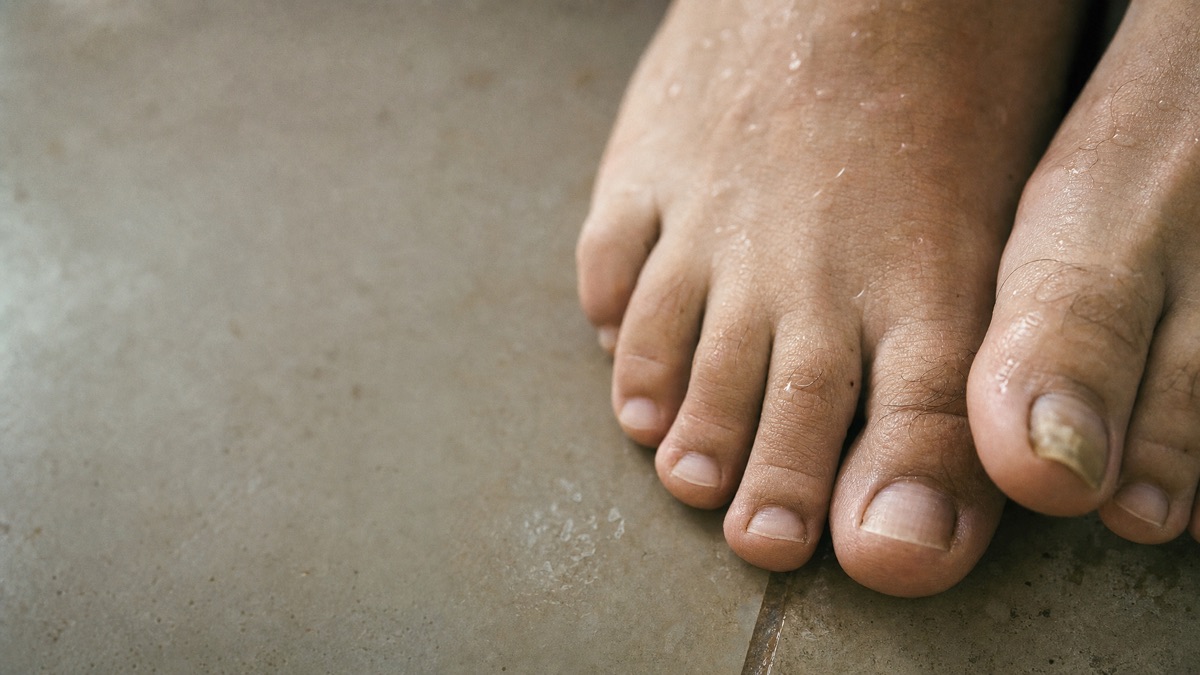
How Toenail Fungus Starts
And what actually clears it, at our Homewood, Mokena and South Chicago Heights offices
Most people notice it the same way. A yellow or white patch at the corner of one big toenail, ignored for a season, then a nail that is thicker than it used to be and harder to cut. By the time it becomes annoying enough to do something about, it has usually been there a year or more.
Fungal nail infection, or onychomycosis, is one of the most common things we see. It is also one of the most frustrating, because the treatments work slowly and the results are hidden behind a nail that takes the better part of a year to grow out. Understanding why it behaves that way makes the whole process much less discouraging.
Medically reviewed by Dr. Timothy Horak and Julia Shauger, board-certified podiatric specialists serving Homewood, South Chicago Heights & Mokena. Last reviewed July 2026.
Where It Comes From
The fungus needs two things: a way in, and a warm damp place to stay. A toenail inside a shoe provides the second one all day. The way in is usually a gap you never noticed, either a small separation between the nail and the nail bed or a crack in the skin at the edge of the nail.
How it gets in
- • A separation between the nail plate and the nail bed, often after a stubbed toe
- • Cracks or splits in the skin around the nail
- • Athlete's foot on the surrounding skin migrating into the nail
- • Damp shared floors: locker rooms, pool decks, gym showers
- • Nail clippers or files shared with someone who already has it
Who tends to get it
- • Anyone with diabetes or reduced circulation in the feet
- • People on medication that suppresses the immune system
- • Feet that sweat heavily or spend the day in work boots
- • Runners and anyone whose toes take repeated impact
- • Older adults, simply because nails grow more slowly with age
How it progresses
A small patch at the tip or corner
Usually white or yellow, easy to mistake for a stain or a bruise. This is the stage where treatment is most likely to work, and the stage almost nobody comes in at.
Spreading back toward the cuticle
The nail thickens, the color deepens, and debris builds up underneath. Cutting the nail gets difficult. Shoes start to feel tight over that toe.
Established, and spreading sideways
The nail becomes crumbly or lifts away from the bed, and the neighboring nails start showing the same changes. At this point the surrounding skin is usually involved too, and treating the nail alone will not hold.
It Is Not Always Fungus
This matters more than it sounds. A discolored, thickened nail can be several other things, and each needs a different answer. Months of antifungal treatment aimed at a nail that never had fungus in it is a common and avoidable waste.
Things that mimic it
- • Old trauma from a stubbed toe or repeated pressure in shoes
- • Nail psoriasis, which can look almost identical
- • A bacterial rather than fungal infection
- • Pigmented streaks, which occasionally need urgent attention
How we sort it out
- • Examining the pattern and where the change started
- • Checking the skin between the toes, which is usually the source
- • Sampling the nail for testing when the picture is unclear
- • Confirming before committing you to months of medication
If oral antifungal medication is being considered, confirming the diagnosis first is not optional. Those medications require blood monitoring, and nobody should be on them for a nail that turned yellow from being stepped on.
Treatment Options
Thinning the nail first
This is the step people skip, and it is why so many treatments fail. The infection sits under and within the nail plate. A thick nail is a barrier that topical medication cannot cross. Reducing the thickness of the nail in the office, and keeping it reduced, gives everything applied afterward a real chance of reaching the fungus.
On its own it does not cure anything. Combined with a topical it changes the odds substantially, and it makes the nail more comfortable in shoes immediately.
Topical and oral medication
Prescription topicals
Applied daily for many months. They are safe and avoid systemic side effects, but they work slowly and depend entirely on consistency. They suit mild infections and patients who cannot take oral medication.
Oral antifungals
Generally the most effective option for extensive infection, taken over a course of several months. They interact with a number of common medications and usually require liver function monitoring, so they are not right for everyone.
Laser treatment
Laser heats the nail plate to target the fungus underneath, in a series of sessions with no medication involved. It is a reasonable option when oral medication is off the table because of other prescriptions or liver concerns, and many patients like that there is nothing to take and nothing to remember daily.
Two honest caveats. It is not usually covered by insurance, so we discuss cost before you commit. And it works best alongside nail thinning and treatment of the skin, not instead of them. You can read more on our laser fungus therapy page.
Removing the nail
Reserved for nails that are painful, badly deformed, or repeatedly getting infected. Taking the nail off does not kill the fungus by itself, so it is done in combination with medication rather than as a cure. It is not a cosmetic solution and we do not offer it as one.
Why It Comes Back, and How to Stop That
The single biggest reason treatment appears to fail is reinfection from the patient's own shoes and skin. The nail gets clear, the treatment stops, and the fungus walks straight back in from the same place it came from originally.
Treat the skin, not just the nail
Athlete's foot between the toes is the usual reservoir. If the skin is not treated at the same time, the nail keeps getting reseeded.
Deal with the shoes
Rotate pairs so each dries fully between wears, use an antifungal powder or spray inside them, and replace the pair you were wearing most while the infection was at its worst.
Keep the feet dry
Dry between the toes after showering, choose socks that move moisture rather than hold it, and wear something on your feet in gym and pool changing areas.
Separate the clippers
Use one set of tools for the infected nail and another for the rest, and do not share clippers within the household. If you use a salon, take your own.
What to Realistically Expect
Nobody honest will promise you a clear nail. What we can tell you is how to read progress properly, because the way people usually judge it is what makes them quit early.
The damaged part of the nail does not heal. It has to grow off the end. A big toenail replaces itself over roughly nine to twelve months, so what you are watching for is a clear band appearing at the base and slowly pushing the discolored nail forward. If that band is there, the treatment is working, even though most of the nail still looks bad.
Some nails never look completely normal again, particularly if the nail bed was damaged before treatment started or the infection had been present for years. We would rather say that up front than have you feel misled at month nine. And if you have diabetes or poor circulation, the goal shifts from appearance to safety: a thick fungal nail can press on the nail bed and start a wound, which is a far more serious problem than a discolored toenail.
Common Questions
Can toenail fungus be cured permanently?
An individual infection can often be cleared, but the nail is not permanently protected afterward. Reinfection is common because the fungus lives in shoes, on shower floors and frequently on the surrounding skin. Clearing the nail and then keeping it clear are two separate jobs, and the second one is ongoing.
Why do drugstore nail fungus treatments not work?
The infection lives underneath and inside the nail plate, and most over-the-counter products cannot get through the nail to reach it. They may improve the surface appearance without touching the fungus. Thinning the nail first and using a prescription-strength product that penetrates gives a much better chance.
How long does it take to treat toenail fungus?
Longer than most people expect, because you are waiting for a healthy nail to grow out rather than watching the existing nail improve. A big toenail replaces itself over roughly nine to twelve months. Treatment often runs several months and the visible result lags behind it.
Is toenail fungus contagious?
It can spread, though not easily through casual contact. It passes on shared damp surfaces such as shower floors, pool decks and locker rooms, through shared nail clippers, and from one of your own nails to the next. Household spread is common enough that we usually suggest separate clippers and not sharing shoes.
Related Reading
Wondering which drugstore treatments are actually worth buying? OTC Toenail Fungus Treatments Compared →
See a Podiatrist Near You
ASG Foot & Ankle has offices in Homewood, South Chicago Heights and Mokena. Our board-certified podiatrists accept most insurance. Find the office closest to you:
Have the Nail Looked At First
Before starting another bottle of something, it is worth confirming the nail is actually infected and finding out how far it has gone. That single visit tends to save people months. We see patients at three offices in Homewood, Mokena and South Chicago Heights, and most major insurance is accepted.