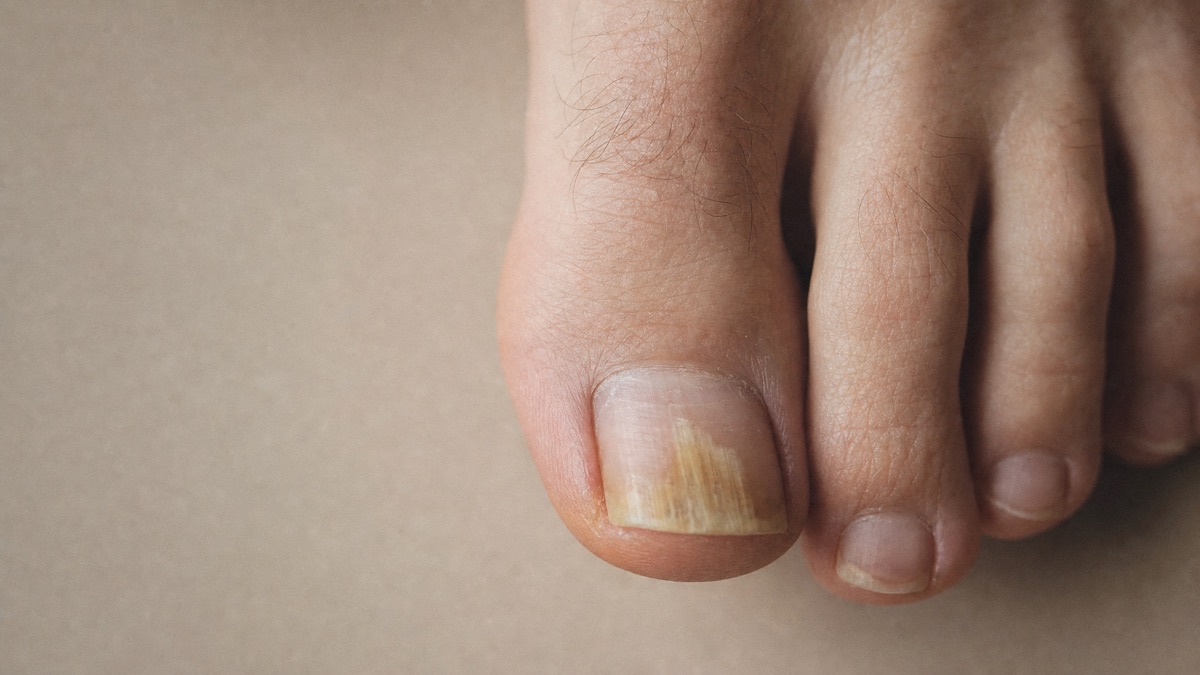
Is It Just Discoloration, or a Fungal Nail?
How to tell the difference before you spend a year treating the wrong thing
A discolored toenail is one of the most common reasons people come to see us, and one of the most commonly self-diagnosed. Almost everyone arrives having already decided it is fungus, usually after months of drugstore treatments that did nothing. A fair number of those nails are not fungal at all. They are bruised, stained, thickened from an old injury, or changed by age.
This matters because the treatments are completely different, and because fungal nail treatment is measured in months. Getting the diagnosis right first is worth the one visit it takes. Here is how we sort it out at our Homewood, Mokena and South Chicago Heights offices, and what you can look at yourself before you come in.
Medically reviewed by Dr. Timothy Horak and Julia Shauger, board-certified podiatric specialists serving Homewood, South Chicago Heights & Mokena. Last reviewed July 2026.
The single most useful thing you can check at home
Watch which direction the discoloration travels. Nails grow forward, so anything sitting in the nail plate travels forward too. A bruise, a stain or a mark left by an old injury slowly migrates toward the tip and eventually gets clipped off. Fungus behaves the opposite way, creeping from the tip back toward the cuticle.
Take a photo today with your phone next to a ruler or a coin for scale, and take another in six to eight weeks. If the discolored area has moved toward the tip, time is fixing it. If the clear portion near the cuticle is shrinking, something is actively growing in the nail and it is worth having looked at.
Discoloration That Usually Is Not Fungus
Shoe pressure
Repeated banging against the front of a shoe, common in runners and anyone in shoes half a size too small, leaves a dull yellow or brown nail. It affects the toes that hit first, usually the big toe and second toe, and improves in better-fitting shoes.
Nail polish staining
Dark polish worn continuously stains the surface of the nail yellow-orange. The giveaway is that it is only on the surface, it is even across the whole nail, and the nail is otherwise normal in thickness. It grows out over a few months if you leave the nails bare.
Bruising under the nail
Stubbing a toe or dropping something on it causes bleeding under the nail plate. It looks purple or black at first, then browns as it ages. It has a defined edge, it does not thicken the nail, and it marches toward the tip as the nail grows.
Medications
Some antibiotics, chemotherapy agents and drugs used for psoriasis change nail color, often across several nails at once and often in bands. Bring your medication list to the visit, since this is easy to miss and easy to confirm.
Age-related change
Toenails naturally become more yellow, more opaque and slightly thicker over the years. When every nail has changed slowly and evenly, and none of them are crumbly or separating, age is usually the answer rather than infection.
Circulation problems
Reduced blood flow gives nails a dusky or bluish cast and slows their growth, usually across several toes with cool skin and thin hair on the foot. This one is worth reporting promptly, because it points to something beyond the nail.
Psoriasis deserves a mention of its own. Nail psoriasis produces pitting, oil-drop colored patches and separation from the nail bed, and it is mistaken for fungus constantly. It will not respond to antifungal treatment, which is one more reason to confirm the diagnosis rather than assume it.
Signs That Point Toward Fungal Infection
No single one of these confirms fungus. Several of them together, especially color change plus texture change, make it likely enough to test for.
It spreads the wrong direction
Most fungal nail infections enter under the front edge of the nail and work backward toward the cuticle. What starts as a small white or yellow patch at one corner of the tip slowly widens across the nail over months.
The pattern to look for
- • Begins at the free edge or a corner, not the middle
- • Advances toward the cuticle rather than away from it
- • White, yellow, brown or occasionally black
- • Involves the full thickness of the nail, not just the surface
The nail changes texture, not just color
This is the most useful distinction on exam. Stains and bruises leave a normal nail that happens to be a different color. Fungus damages the nail structure itself, so the nail thickens, crumbles at the edge, or lifts away from the skin underneath.
Physical changes that matter
- • Thickening, to the point that clipping becomes difficult
- • Crumbly or powdery debris under the front edge
- • A ridged or roughened surface
- • Separation from the nail bed, known as onycholysis
More than one nail is involved
Injury and staining tend to hit one nail. Fungus spreads inside your shoe, so it commonly appears in a second and third nail over time, frequently starting with a big toe. Scaly, itchy skin between the toes at the same time makes fungus considerably more likely, because athlete's foot and fungal nails travel together.
Typical spread
- • Often begins with a big toenail
- • Appears in neighboring nails over months
- • Frequently accompanied by athlete's foot skin changes
- • Can reach fingernails, though that is much less common
Odor, debris and irritation
A thickened nail packed with debris often develops a distinct smell, and the surrounding skin can become irritated as the nail presses into it. Genuine pain is less typical of nail fungus by itself, so a painful, red, swollen toe suggests something else going on, such as an ingrown nail or a bacterial infection.
What tends to accompany it
- • Odor from the affected nail
- • Chalky white or yellow debris beneath the nail
- • Irritated skin at the nail folds
- • Pressure discomfort in closed shoes rather than constant pain
One Pattern That Should Not Wait
A dark brown or black band running lengthwise from the cuticle to the tip is not the same thing as a bruise, and it should be examined promptly. Most of these bands turn out to be benign, and in people with darker skin they can be entirely normal. But melanoma can present under a nail, and it is missed for months when it is assumed to be fungus or an old injury.
Get it looked at sooner rather than later if a dark band is widening, if the pigment extends onto the skin at the base of the nail, if it involves only one nail with no memory of an injury, or if the nail is splitting along the band. Being wrong about this costs you one appointment. Being late about it costs a great deal more.
How We Actually Confirm It
Looking at a nail is a good start and it is not proof. Studies of nail appearance versus laboratory results consistently find that eyeballing it alone gets it wrong in a meaningful share of cases. Since antifungal treatment runs for months, and oral medication requires monitoring, confirming before committing is the sensible order of operations.
In the office
- • Examination of every nail, not only the one that bothers you
- • A look at the skin between the toes for athlete's foot
- • Questions about injuries, polish, medications and family history
- • Reducing the thickness of the nail so it can be assessed
Testing when it changes the plan
- • A painless clipping and debris sample from the affected nail
- • Laboratory staining or culture to confirm fungus and identify it
- • Results guide whether topical, oral or laser treatment makes sense
- • A negative result redirects us to the real cause
Reducing Your Risk and Catching It Early
Habits that help
- Dry between the toes after showering, not just the top of the foot
- Wear something on your feet in locker rooms, pool decks and shared showers
- Rotate shoes so each pair dries out fully between wearings
- Keep your own clippers and files, and do not lend them out
- Treat athlete's foot when it appears, since the skin feeds the nails
Watching your nails sensibly
- Photograph a change when you first notice it, with something for scale
- Note whether you recall an injury, and when
- Go bare-nailed for a couple of months if polish could be the cause
- Check every nail periodically, including the ones you cannot see easily
- If you have diabetes, have nail changes looked at rather than watched
When It Is Worth Coming In
Make an appointment if
- The discoloration has not moved toward the tip after two or three months
- The nail is thickening, crumbling or lifting off the nail bed
- A second or third nail has started to look the same
- There is a dark lengthwise band, or pigment spreading onto surrounding skin
- You have diabetes, neuropathy or circulation problems
What the visit gives you
- A diagnosis based on the nail rather than a guess from a photo
- Testing when the answer would change what we recommend
- A straight discussion of topical, oral and laser options, including what each costs and what each realistically does
- A plan for the skin and the shoes, not only the nail
What to Realistically Expect
If it is fungus, the honest picture is that treatment is slow and no one can promise you a perfectly clear nail. You are not waiting for a color to change, you are waiting for a healthy nail to grow out from the cuticle, and a big toenail takes roughly nine to twelve months to fully replace itself. Progress is judged at the base of the nail, not the tip.
Some nails clear completely, some improve substantially without ever looking untouched, and nails that were already thickened or scarred by an old injury may never look normal regardless of what we do to the fungus. Recurrence is common, which is why treating the skin and dealing with your shoes matters as much as treating the nail.
We will not put a timeline on your nail before we have examined it and, where it matters, tested it. What we will do is tell you honestly whether a given treatment is worth its cost and its monitoring for the nail in front of us.
Common Questions
How do I know if my toenail discoloration is fungus or a bruise?
A bruise moves. Mark where the edge of the discolored area sits and look again in six to eight weeks. Bruising grows out toward the tip and eventually disappears. Fungus goes the other way, spreading from the tip back toward the cuticle, and it usually changes the texture of the nail as well as the color. Color alone does not settle it, which is why nail testing exists.
Does toenail fungus go away on its own?
Generally not. The infection lives inside and underneath the nail plate, where the body clears it poorly and where soap and water do not reach. Left alone it usually spreads across the nail and often to neighboring nails. It is not an emergency, but waiting rarely helps, and treatment is easier while less of the nail is involved.
Is toenail fungus contagious?
Yes, though not dramatically so. It spreads on shared damp surfaces such as locker rooms and pool decks, through shared clippers and files, and inside your own shoes from one nail to the next. Household spread happens but is not inevitable. Keeping your own clippers, covering your feet in public wet areas and treating athlete's foot all lower the risk.
How long does it take to get rid of toenail fungus?
Longer than most people expect, because you are waiting for clear nail to grow out. A big toenail replaces itself over roughly nine to twelve months, so even successful treatment looks like slow improvement from the cuticle forward. Judge progress by the new growth near the cuticle rather than by how the tip looks.
Related Reading
See a Podiatrist Near You
ASG Foot & Ankle has offices in Homewood, South Chicago Heights and Mokena. Our board-certified podiatrists accept most insurance. Find the office closest to you:
Get the Nail Diagnosed Before You Treat It
A single visit can tell you whether you are dealing with fungus, an old injury or something else entirely, which is worth knowing before starting a treatment measured in months. We see patients at three offices in Homewood, Mokena and South Chicago Heights, and most major insurance is accepted.