Plantar Wart Removal Recovery: What to Expect After
Freezing, acid, cantharidin and excision all heal on completely different schedules. Here is each one, and the single sign that tells you the wart is actually gone.
Most of the worry after plantar wart treatment comes from one mismatch: people expect a wart to be removed the way a splinter is removed, and instead they end up with a large blister, a dark crust, or a crater in the bottom of their foot, none of which anyone warned them about.
All three of those are usually normal, and which one you get depends entirely on the treatment used. This guide from the podiatrists at ASG Foot & Ankle covers what recovery looks like after each of the common approaches, what is normal versus what needs a call, why black dots sometimes reappear, and the simple visual test that tells you whether the wart is truly cleared rather than just closed over.
Medically reviewed by Dr. Timothy Horak and Julia Shauger, board-certified podiatric specialists serving Homewood, South Chicago Heights & Mokena. Last reviewed August 2026.
The short answer
After freezing, expect a blister within 24 hours and a healed site in 1 to 2 weeks, with most people needing 3 to 6 sessions in total. Topical acid works over 6 to 12 weeks with no wound at all. Surgical removal leaves an open site that closes over 2 to 4 weeks. In every case, the wart is only truly gone when the fine skin lines grow back straight across the area. Smooth pink skin with no lines through it means wart tissue may still be there.
Why This Is Not Like Removing a Callus
A plantar wart is a viral infection of the skin, not a lump of tissue sitting on top of it. The virus lives inside living skin cells, so treatment is not really about cutting something out. It is about destroying the infected cells and prompting your immune system to recognize and finish off what remains.
That changes what recovery means. There is often no clean before-and-after moment, the treatment usually happens in rounds rather than once, and a wart can look completely gone while infected cells persist in skin that appears normal. It also explains why warts spread if you pick at them, and why recurrence is common even after a technically successful treatment.
The thick, callus-like cap over a plantar wart is your body's response to pressure on the growth, not the wart itself. That is why filing it down gives temporary comfort but never resolves anything, and why plantar warts get confused with calluses constantly. Our guide to telling a painful callus from a wart covers the squeeze test that separates them.
Recovery by Treatment Type
Cryotherapy (freezing)
- Stinging during the freeze and an ache for a few hours after
- A blister within 24 hours, sometimes a dark blood blister, which is expected
- The blister roof dries into a crust and lifts off over the following week
- Tender to walk on for 2 to 4 days; a donut pad around the site helps a lot
Salicylic acid (topical)
- Skin over the wart turns soft, white and macerated, which means it is working
- That white tissue is filed away gently between applications after soaking
- Little to no pain, and no restriction on walking at any stage
- Slowest option, but the least disruptive and safest on weight-bearing skin
Cantharidin (blistering agent)
- Painless when applied; the reaction begins several hours later
- A blister forms over 24 to 48 hours and can be larger than expected
- Washed off at a set time, so follow the timing instructions exactly
- Dead tissue is debrided at the follow-up visit, then the site heals over
Excision or curettage
- Local anesthetic, so the procedure itself is not painful
- Leaves an open crater that heals from the base up rather than being stitched
- Daily dressing changes and limited walking for the first several days
- Used selectively, because scar tissue on a weight-bearing sole can stay tender
Excision sits last on that list for a reason. Cutting a wart out of the sole is effective, but it trades a viral problem for a scar on a surface that carries your entire body weight with every step, and a tender plantar scar can outlast the wart it replaced. Most podiatrists work through the less destructive options first.
 Illustration
How to Tell the Wart Is Actually Gone
This is the part most people get wrong, and it is the reason warts seem to come back weeks after treatment "worked."
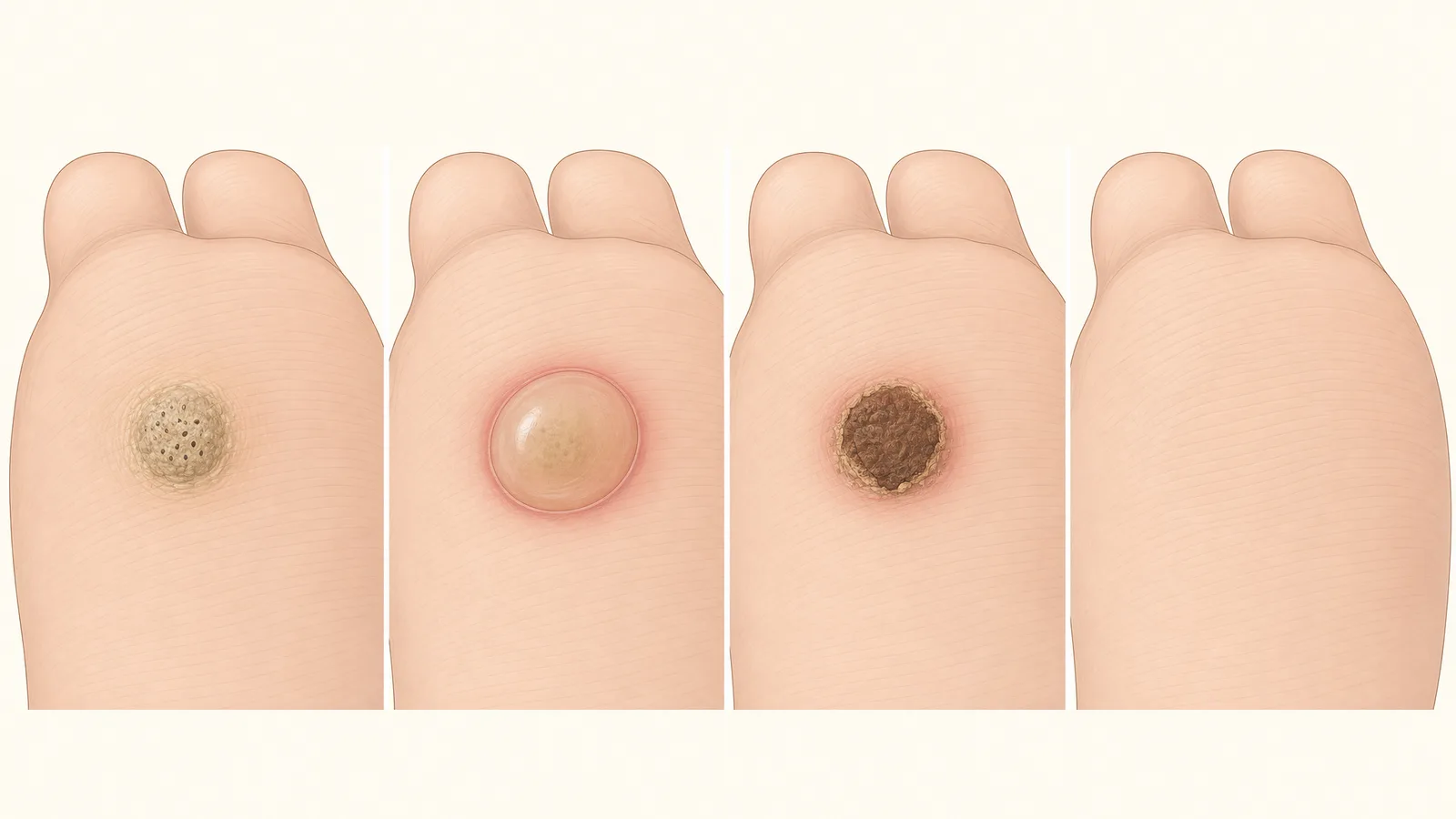
The sole of your foot is covered in fine parallel ridges, the same pattern as a fingerprint. A wart destroys them, which is why the lines stop at its border and travel around it. That gives you a reliable endpoint that does not depend on color, texture, or how the skin feels.
Truly cleared
- •Skin lines run straight across the treated area, uninterrupted
- •No black pinpoints anywhere in or around the site
- •No thickened cap rebuilding over the spot
- •Squeezing the area from the sides is no longer tender
Still active
- •Smooth skin with the lines still detouring around the spot
- •Black dots reappearing as the site heals
- •Thick skin building back up over the same area
- •Side-to-side pinching is still more painful than pressing down
If you are seeing the right-hand column, that is worth a follow-up rather than another round of drugstore acid. A wart that survives a full course of treatment often needs a different mechanism rather than more of the same one, and options such as immunotherapy exist specifically for stubborn cases.
Aftercare, Whatever the Treatment
Keep it covered
A dressing protects the site and stops the virus transferring to other spots on your foot or to other people.
Leave blisters alone
An intact blister roof is a sterile dressing. If it is too painful to walk on, have it drained properly.
Pad around it
A donut or horseshoe pad surrounding the site takes weight off it. Not directly over it.
Finish the course
Stopping when it looks better is the most common reason warts return. Cleared skin is the endpoint, not comfort.
Two habits matter more than the rest for stopping recurrence. First, sandals in locker rooms, shared showers, and around pools, since that is where the virus is picked up and re-picked up. Second, never use a file, pumice stone, or nail clipper on a wart and then on anywhere else, because that is precisely how one wart becomes a cluster.
Where should I be today? Enter your treatment date
Enter the date and get what is normal for today, what is next, and what to watch for.
Normal Healing vs. Call Your Podiatrist
Normal & Expected
- •A blister, including a dark blood blister, within a day of freezing
- •Aching or stinging at the site for a few hours to a couple of days
- •A dark crust forming, then separating over a week or so
- •White, soft, soggy-looking skin during acid treatment
- •Pink, slightly indented skin once the dead tissue comes away
Call If…
- •Increasing pain after day 3 rather than steadily easing
- •Thick, cloudy, or foul-smelling drainage from the site
- •Redness spreading outward, warmth, or red streaks up the foot
- •Fever, or feeling generally unwell
- •A site that has not closed after 4 weeks
- •Any of the above at all, if you have diabetes or poor circulation
If you have diabetes, neuropathy, or reduced circulation, do not treat a plantar wart at home with over-the-counter acid. The same reasoning applies as with corns and calluses: those products cannot distinguish wart tissue from healthy skin, and a chemical burn on a foot that cannot feel it and heals slowly is a far worse problem than the wart was. See our diabetic foot care →
Not sure it is a wart at all? The squeeze test separates a wart from a callus in about five seconds. Why Your Callus Hurts →
Had a corn or callus removed instead? Different procedure, different timeline. Corn & Callus Removal Recovery →
Diabetic, or dealing with a slow-healing spot? Get it looked at rather than treated at home. Wound Care Clinic →
Frequently Asked Questions
How long does it take to heal after plantar wart removal?
It depends entirely on the treatment. After cryotherapy the blister forms within a day and the site is usually healed in 7 to 14 days, though most people need 3 to 6 sessions spaced 2 to 3 weeks apart, so the whole course runs a couple of months. Cantharidin follows a similar blister-and-heal pattern over 1 to 2 weeks per application. Salicylic acid is the slowest but gentlest, working over 6 to 12 weeks of daily use. Surgical excision or curettage leaves an open wound that takes 2 to 4 weeks to close and can be tender on a weight-bearing spot for longer. The wart being gone and the skin being healed are two separate milestones, and the second usually arrives first.
Is a blister after wart freezing normal?
Yes, and it is not a side effect so much as the point of the treatment. Liquid nitrogen freezes the tissue and the resulting blister lifts the infected skin away from the healthy layer underneath, taking the wart with it. The blister typically appears within 24 hours and can be surprisingly large, and a blood blister, which looks alarming and dark red or purple, is also within the normal range on the thick skin of the sole. Leave it intact if you can, since the roof is a sterile natural dressing. If it is large and painful enough to interfere with walking, your podiatrist can drain it properly rather than you opening it at home.
What does a plantar wart look like when it's healing?
The sequence is usually blister or soft white tissue first, then a dark crust or scab as that tissue dies off, then the crust separating to reveal pink skin underneath, and finally normal-looking skin over several weeks. The critical thing to watch is not color but pattern. Your sole is covered in fine parallel ridges, like a fingerprint. A wart destroys those lines, so they detour around it. When the wart is truly gone, those skin lines grow back straight across the area. Pink, smooth skin with no lines through it means wart tissue may still be present even though the surface has closed over.
Why did black dots come back after my plantar wart was removed?
Those dots are small clotted blood vessels feeding wart tissue, so their return generally means some of the wart survived and is active again. This is common and is not evidence that anything was done wrong. Plantar warts are caused by a virus living in the skin cells, and a single treatment session often removes the visible growth without clearing every infected cell, especially with a large, deep, or long-standing wart. It is the reason treatment is usually a course rather than a single visit. Let your podiatrist know rather than restarting over-the-counter acid on your own, since a wart that keeps returning may need a different approach.
Can I walk normally after plantar wart removal?
In most cases yes, immediately. Cryotherapy and cantharidin leave the skin surface intact at first, so you can walk out of the appointment, though the site is often tender for 2 to 4 days once the blister develops, and a cushioned shoe with a donut-shaped pad around the spot makes it far more comfortable. Salicylic acid treatment does not restrict walking at all. Surgical removal is the exception: because it leaves an open wound on a surface that takes your whole body weight, expect a few days of limited walking, a protective dressing, and sometimes a surgical shoe. Running and sport generally wait until the site has closed.
How do I stop a plantar wart from coming back?
Recurrence is common because the virus can persist in surrounding skin that looks completely normal, so the goal is to avoid reinfecting yourself while your skin's immune response finishes the job. Wear sandals in locker rooms, shared showers, and around pools. Keep your feet dry and change socks daily, since the virus prefers moist, macerated skin. Do not pick at, file, or shave a wart and then use the same tool elsewhere, because that is how one wart becomes several. Keep it covered while it is active. And do not stop treatment the moment it looks better, since finishing the course is what clears the tissue you cannot see.
See a Podiatrist Near You
ASG Foot & Ankle has offices in Homewood, South Chicago Heights and Mokena. Our board-certified podiatrists accept most insurance. Find the office closest to you:
Plantar Wart That Keeps Coming Back?
Stubborn warts usually need a different mechanism, not another round of the same acid. Our board-certified podiatrists can confirm it is a wart, choose the approach that fits its size and depth, and treat it without leaving a painful scar on a weight-bearing surface.