Corn Removal: How Corns Come Off, and How to Keep Them Off
What a podiatrist actually does, who should never use acid corn plasters, and when surgery is offered for corns that keep coming back.
Corn removal means taking off the small, hard plug of skin that forms where a bone presses against a shoe or a neighboring toe. The removal itself is the easy part. The harder part is choosing a method that is safe for your skin, then changing whatever made the corn so it does not grow straight back.
Already had one removed? The healing timeline is in our corn and callus removal recovery guide.
ASG Foot & Ankle patient education. Updated October 23, 2026. General information, not a diagnosis.
The short answer
Corn removal is usually done in one office visit: a podiatrist pares away the hard skin with a sterile blade and lifts out the core, which is usually painless. Over-the-counter 40% salicylic acid plasters can work for healthy adults, but they are not for anyone with diabetes, poor circulation, numb feet or fragile skin, and you should never cut a corn yourself. Whatever removes it, a corn comes back unless the pressure behind it is fixed with roomier shoes, padding or insoles. Surgery to remove a bony bump or straighten a bent toe is kept for corns that keep returning, and the NHS suggests getting a corn seen if 3 weeks of home care has not helped.
Get It Seen Promptly If
- •You have diabetes, neuropathy, poor circulation or a weakened immune system. Do not treat the corn yourself
- •The corn is red, swollen, more painful, bleeding, or oozing pus or discharge
- •There is a blister or an open sore at the corn. With diabetes, call right away rather than waiting for your next visit
- •The pain is severe or stops you doing your normal activities
- •Home care has not helped after 3 weeks
- •You think a bent toe or a bony bump is causing it
Hard, Soft and Seed Corns: Which Kind Do You Have?
Corns form where pressure or friction is concentrated over a bone. Ill-fitting shoes are the most common cause, and bent toes such as hammertoes rubbing on the shoe are another. Every corn has a central core of hard skin, which is what separates it from a broad, flat callus.
| Type | Where | What it is like | Removal notes |
|---|---|---|---|
| Hard corn | Tops of the toe joints, or the outer side of the little toe | A small patch of concentrated hard skin with a hard core, up to the size of a small pea, often inside a wider callus | Pared and the core lifted out. A bent toe rubbing the shoe is a common cause |
| Soft corn | Between the toes, most often the fourth and fifth | Whitish and rubbery, because sweat keeps the skin moist | Pared, then a toe spacer and dry skin. A bony bump on the next toe is often behind it |
| Seed corn | The sole of the foot, singly or in clusters | Tiny, and usually painless | Often just gentle filing and moisturizer; pared if sore |
| Vascular or fibrous corn | Corns that have been present a long time | Vascular corns contain blood vessels and nerve fibers; fibrous corns are stuck to deeper tissue | Podiatrist only. Can be very painful and bleed heavily if cut |
A broad, flat patch of thick skin is a callus rather than a corn; if yours hurts, see why a callus hurts and how to relieve it. Thick skin can also hide a sore forming underneath, which matters most if you have diabetes: callus or pressure sore, how to tell.
Corn or Plantar Wart?
A corn on the sole is easily confused with a plantar wart. A corn usually hurts most when you press straight down on it; a wart is often more painful when squeezed from the sides. When pared, a wart tends to bleed and show tiny black dots (clotted blood vessels), while a corn does not. Warts are treated differently, so see plantar wart removal and healing.
Corn Removal Methods Compared
Most methods remove the corn you have now; only a few change the pressure that made it.
| Method | Who it suits | What it does | Fixes the cause? |
|---|---|---|---|
| Pumice stone or foot file, plus a urea cream | Healthy skin, with no diabetes or circulation problems | Thins hard skin a little at a time after a 5 to 10 minute soak | No |
| Non-medicated pads, sleeves and toe spacers | Almost everyone | Take pressure and rubbing off the corn while worn | Partly |
| Roomier shoes | Everyone | A wide, deep toe box and low heel stop the rubbing that builds the corn | Yes, when shoes are the cause |
| 40% salicylic acid corn plaster | Adults with healthy skin and good circulation only; never with diabetes, neuropathy or fragile skin | Softens the corn so it can be lifted off | No |
| Podiatrist paring and core removal | Most people, and the safe choice with diabetes | Removes the hard skin and the core in one visit | No |
| Electrosurgery under local anesthetic | Stubborn fibrous corns that have not responded to routine care | Removes deeper corn tissue; the wound takes weeks to heal | No |
| Surgery on the bone or toe | Corns that keep returning over a bony bump or bent toe despite padding and shoes | Removes the bump or straightens the toe | Yes, that is the aim |
Most corns settle with the simpler steps in this table; surgery is only considered when they do not.
How a Podiatrist Removes a Corn
Podiatrists are trained to use sterile blades on corns, and the whole thing is usually done in a single appointment. A typical visit:
- 1A look and a few questions. Where the corn is, your shoes, how you walk, and whether you have diabetes or circulation problems. Usually no tests are needed.
- 2Paring the hard skin. The thickened skin is shaved down with a sterile scalpel blade, the standard first treatment.
- 3Lifting out the core. The hard central core is cut out, a step called enucleation, which takes the pressure off the tissue underneath.
- 4Taking the pressure off. Padding, a toe spacer or insoles, and footwear advice.
- 5A plan if it keeps coming back. Checking whether a bent toe or bony bump is the real cause.
What happens afterward
Simple paring leaves no stitches, so most people walk out normally; a spot where a deep core was lifted out can be tender for a few days. The day-by-day healing timeline and aftercare are in corn and callus removal recovery.
Does Corn Removal Hurt?
For most corns, no. NHS podiatry guidance says a podiatrist can usually remove corns painlessly. The pain when walking comes from the hard core pressing on a nerve, so taking the core out is what brings relief. The exceptions are corns with blood vessels and nerve fibers in them, and old corns stuck to deeper tissue.
Vascular or fibrous corns
Can be very painful. When a deeper procedure is needed, such as electrosurgery for a fibrous corn, it is done under local anesthetic.
Local anesthetic injections
Sting briefly. The numbness usually lasts about 4 to 8 hours, and a simple pain reliever may be needed after.
Corn Plasters and Salicylic Acid: Who Should Not Use Them
Medicated corn plasters hold a disc of acid, such as 40% salicylic acid, against the corn to soften it so it can be lifted away. They do work in the right person. In a UK trial of 202 adults without diabetes, circulation problems or neuropathy, plasters applied and checked weekly by podiatrists for up to 4 weeks cleared 34% of corns by 3 months, against 21% after scalpel paring alone. Four people had skin reactions such as soggy or broken skin, all of which settled within days of stopping.
Note who was left out of that trial. NHS podiatry guidance warns that corn plasters can burn that healthy skin and lead to serious problems such as infection, and a family medicine review recommends avoiding over-the-counter salicylic acid products, especially with numb feet or a weakened immune system. Do not use them if you have:
Diabetes
A small acid burn heals slowly and can become infected.
Poor circulation
Reduced blood flow slows healing of any burn.
Numb feet (neuropathy)
If you cannot feel the acid burning, you will not know to stop.
Fragile or delicate skin
Thin, easily torn skin is easily damaged by acid.
A weakened immune system
Or a tendency to infections. Any break in the skin carries more risk.
A sore, bleeding or infected corn
These need to be examined, not treated with acid.
If none of these apply, the NHS suggests asking a pharmacist. Keep the acid on the corn only, stop if the skin around it becomes sore, soggy or broken, and have it looked at if it is no better after 3 weeks.
Can You Cut a Corn Off Your Foot?
No. The NHS, the CDC and NHS podiatry services all say not to cut corns yourself. Cleveland Clinic advises never cutting, shaving or removing one with a sharp object, and not treating corns yourself at all if you have diabetes, poor circulation or delicate skin. Why:
- You cannot see the depth. The core runs inward, and taking off too much skin can cause bleeding and infection.
- Some corns bleed heavily. Vascular corns contain blood vessels and can bleed profusely if cut.
- You may not feel the damage. About half of people with diabetes have some nerve damage, most often in the feet.
What you can safely do at home
If you do not have diabetes, circulation problems, a weakened immune system or delicate skin:
- Soak the foot in warm water for 5 to 10 minutes
- Gently file the softened skin with a wet pumice stone or foot file, a little at a time
- Rub in a moisturizer containing urea or ammonium lactate every day
- Take the pressure off with a pad, a spacer or a roomier shoe, as below
Padding and Footwear So It Does Not Come Straight Back
NHS podiatry leaflets note corns often return after removal unless the source of pressure is removed, so this matters more than the removal itself.
Shoes with room
Low heels, soft uppers and a roomy toe box, about half an inch longer than your longest toe. Bent toes may need extra depth and little-toe corns extra width. Shop late in the day, when feet are slightly swollen.
Pads with a hole
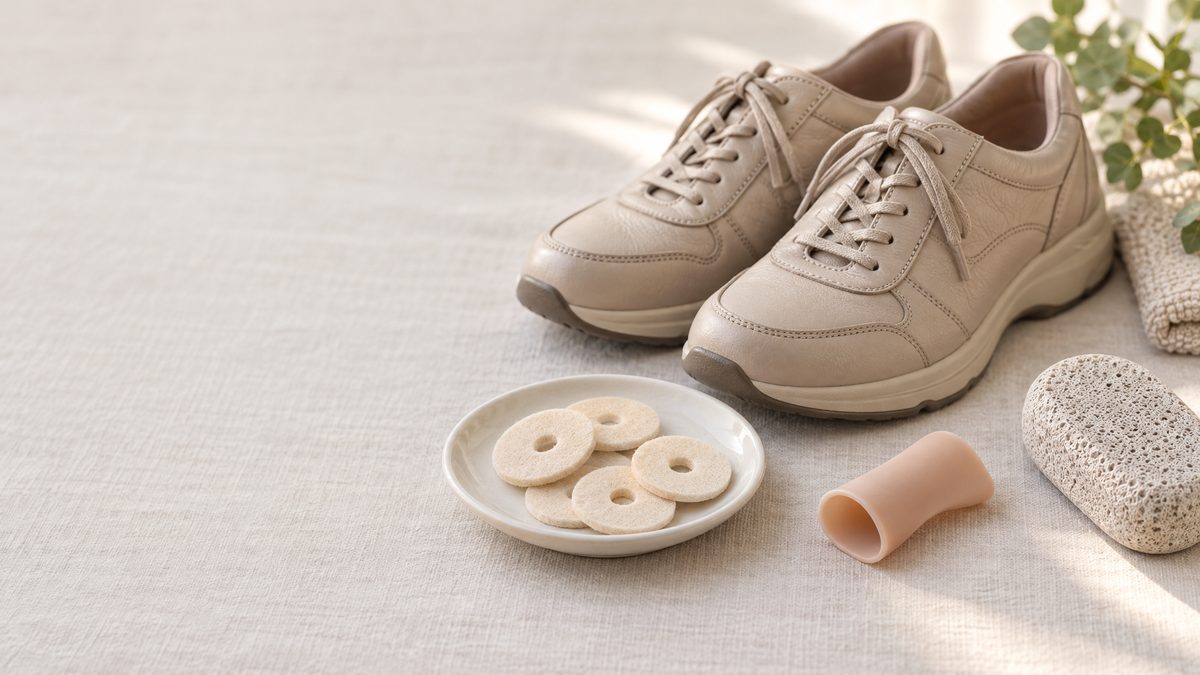
A donut-shaped pad with the corn in the center hole takes pressure off it. Silicone toe sleeves cushion corns on top of the toes.
Spacers for soft corns
A foam or silicone toe spacer stops two toes rubbing. Dry carefully between the toes after washing.
Insoles
Cushioned insoles help corns on the sole. Custom insoles from a podiatrist can help if corns keep coming back.
Socks and nails
Thick, cushioned socks that do not bunch, and toenails trimmed straight across.
Choosing between drugstore and custom insoles? See custom orthotics vs store insoles. If the corn sits on top of a bent toe, the toe is the real problem: hammer toe causes and treatment.
Corn Removal Surgery: When It Is Offered and What It Involves
Surgery does not cut the corn out so much as remove the reason it forms. It is considered when padding, shoes and paring have failed and a bony bump or bent toe keeps making new corns, or when corns are extremely painful, stop you walking normally, or keep causing infections or skin breakdown.
Shaving down the bony bump
For a hard corn on the little toe or a soft corn between the toes, the knob of bone under it is removed (a condylectomy, a type of exostectomy), sometimes through a tiny incision under local anesthetic.
Hammertoe correction
Straightening a bent toe stops it rubbing the shoe. Flexible toes may need a tendon lengthened or moved; rigid toes have a small piece of bone removed and the joint fused, held with a pin, wire or plate.
Little toe reshaping
For corns on the fifth toe, part of the bone at the base of the little toe may be removed (excision arthroplasty).
Electrosurgery for deep corns
For stubborn fibrous corns, deeper corn tissue is removed under local anesthetic. The wound takes about 4 to 6 weeks on average to heal, with no guarantee it works completely.
What the evidence shows
In a study of 59 people with corns between the toes that kept coming back, almost all of whom had an enlarged knob of bone underneath, the corn had returned within 6 months in 82% of the 28 treated without surgery, and in none of the 31 who had the bump shaved down through a tiny incision. Pain scores were 0.5 out of 10 after surgery, against 6.1 with conservative care.
Read that with care: patients chose their own treatment, the study was small, and follow-up was only 6 months. Still, it shows why paring alone rarely ends a corn that sits on a bone.
What to expect. These are usually outpatient procedures under local anesthetic. After toe surgery, swelling, stiffness and redness can last up to 4 to 6 weeks, and a fused toe will no longer bend at that joint and may end up slightly longer or shorter. Risks include infection, slow healing, scarring, the problem returning, and rarely reduced feeling. Hard skin under the ball of the foot is usually best managed without surgery, because operating on the bones there gives unpredictable results.
The full week-by-week recovery after toe straightening is in hammertoe surgery recovery.
How Long Do Corns Last If You Leave Them?
There is no set lifespan. A corn lasts as long as the pressure that built it, and the thickened skin itself adds pressure, a vicious cycle.
Pressure removed
Fades gradually
Once the rubbing stops, most corns settle and the skin returns to normal.
Pressure continues
Can keep growing
Untreated corns may get larger until the cause is fixed.
Pared, cause unchanged
Often returns
In the UK trial, one paring fully cleared the corn by 3 months in only about 1 in 5 people.
Corns and Diabetes: Red Flags
With diabetes, reduced feeling means you may not notice damage, reduced circulation slows healing, and infections are more likely. The CDC advises against removing corns yourself or using over-the-counter removers, which can burn your skin, and recommends checking your feet every day. Contact your doctor or foot specialist right away, without waiting for your next appointment, if you notice:
- •A blister, sore or ulcer at or near the corn
- •A corn that is red, swollen, oozing or looks infected
- •A change in the color or temperature of your feet
- •Tingling, burning or pain in your feet
Have a full foot exam at least once a year, more often with nerve damage. For burning or numb feet, see diabetic neuropathy in the feet, and if a corn has already opened into a sore, see diabetic foot and wound care.
Just had a corn removed? Day-by-day healing and aftercare. Corn and Callus Removal Recovery →
Dark spot under the hard skin? It may be a sore, not a callus. Callus or Pressure Sore? →
Bleeds with black dots when pared? Probably a wart. Plantar Wart Removal Recovery →
Diabetes and a foot deformity? You may qualify for therapeutic shoes. Diabetic Shoes and Medicare Coverage →
Frequently Asked Questions
Does corn removal hurt?
Usually not. The bulk of a corn is thick, compacted skin, and NHS podiatry guidance says a podiatrist can usually remove corns painlessly with a sterile blade, and taking out the core relieves the pressure that made it hurt. The exceptions are vascular corns, which contain tiny blood vessels and nerve fibers, and long-standing fibrous corns, which can be painful; a deeper procedure, such as electrosurgery for a fibrous corn, is done under local anesthetic.
What is deep corn removal surgery?
It usually means one of two things. For a stubborn, deep fibrous corn, some clinics use electrosurgery under local anesthetic to remove the deeper corn tissue, leaving a small wound that takes about 4 to 6 weeks on average to heal. For a corn that keeps returning over a bony bump or a bent toe, surgery removes the bump or straightens the toe so the pressure that builds the corn is gone.
Can you cut a corn off your foot?
No. NHS, CDC and podiatry guidance all advise against cutting corns yourself with a blade, razor or scissors. You cannot see how deep the core goes, some corns contain blood vessels and bleed heavily when cut, and a small nick can become infected. With diabetes, neuropathy or poor circulation, a cut you do not feel can turn into an ulcer. Soak and file with a pumice stone instead, or have it pared.
How long do corns last?
As long as the pressure that made them. A corn is the skin's response to repeated rubbing over a bone, so it usually fades gradually once the rubbing stops and can keep growing if it does not. The NHS suggests getting it checked if 3 weeks of home care has not helped. After paring, a corn tends to return unless the shoe, toe position or bony bump behind it is dealt with.
How do you remove a corn between your toes?
A soft corn between the toes is pared by a podiatrist like any other corn, but the lasting fix is keeping the two toes apart and the skin dry. A foam or silicone toe spacer stops them rubbing, and careful drying between the toes helps. Soft corns are often caused by a bony bump on the toe next door, so ones that keep returning may be treated by shaving that bump down.
Are corn plasters safe if you have diabetes?
No. Medicated corn plasters contain acid, such as salicylic acid, that can burn the healthy skin around the corn. NHS podiatry guidance says people with diabetes, poor circulation or a reduced immune system should not treat corns themselves, and the CDC warns that over-the-counter removers can burn your skin. Have corns treated by a podiatrist instead, and check your feet every day.
Should I see a podiatrist for corn removal?
Yes if the corn is painful, keeps coming back, or you are not sure it is a corn at all, and always if you have diabetes, poor circulation, neuropathy, a weakened immune system or delicate skin. A podiatrist can pare it safely, check whether it is really a wart or a sore under hard skin, and work out which shoe, toe or bone is causing it.
Sources and further reading
- NHS: Corns and calluses
- East Sussex Healthcare NHS Trust: Corns and callus (podiatry leaflet)
- The Dudley Group NHS Foundation Trust: Corns and calluses (podiatry leaflet)
- Kent Community Health NHS Foundation Trust: A guide for patients about electrosurgery
- Freeman DB. Corns and calluses resulting from mechanical hyperkeratosis. American Family Physician (2002)
- Cleveland Clinic: Corns and calluses
- CDC: Diabetes and your feet
- AAOS OrthoInfo: Hammer toe
- Farndon LJ et al. Salicylic acid plasters compared with usual scalpel debridement of corns: a randomised controlled trial. J Foot Ankle Res (2013)
- Marti-Martinez LM et al. Condylectomy with minimally invasive surgery for interdigital corns compared to conservative treatment. J Foot Ankle Res (2021)
General patient education. Your examination and individual treatment instructions take priority.
See a Podiatrist Near You
ASG Foot & Ankle has offices in Homewood, South Chicago Heights and Mokena. Our board-certified podiatrists accept most insurance. Find the office closest to you:
A Corn That Keeps Coming Back?
ASG Foot & Ankle can pare a painful corn safely, check that it is not a wart or a sore, and find the shoe, toe or bone behind it, starting with padding, insoles and footwear before any talk of surgery.