
Phenol Matrixectomy Recovery: Why Yours Drains So Long
Weeks of drainage after this procedure is not a complication. It is how the treatment works. Here is the real timeline, what the drainage should look like, and the point where it stops being normal.
If you had a matrixectomy for a recurring ingrown toenail and you are now three weeks in with a toe that is still soaking through a bandage every day, you are almost certainly fine. You are also almost certainly convinced that you are not.
This is the single most misunderstood recovery in podiatry, and it is misunderstood for a good reason: the healing pattern genuinely does not match what people expect from a minor procedure. Most wounds dry up within a week or two. A phenol matrixectomy site can stay wet for a month or more, and that is by design rather than in spite of it. This guide from the podiatrists at ASG Foot & Ankle explains why that happens, what the drainage should look like, and where the real warning line sits.
Medically reviewed by Dr. Timothy Horak and Julia Shauger, board-certified podiatric specialists serving Homewood, South Chicago Heights & Mokena. Last reviewed July 2026.
How long does a phenol matrixectomy take to heal?
Plan on 4 to 6 weeks for the site to fully dry and close, and occasionally up to 8. Drainage typically peaks in weeks 2 and 3 before tapering off. The pain, though, follows the normal quick schedule and is usually gone within 3 days. That mismatch is what confuses people: the toe feels fine while it is still visibly weeping. Most patients are back to work the next day and back to running at about 2 weeks, long before the site is dry.
Why It Drains: What Phenol Actually Does
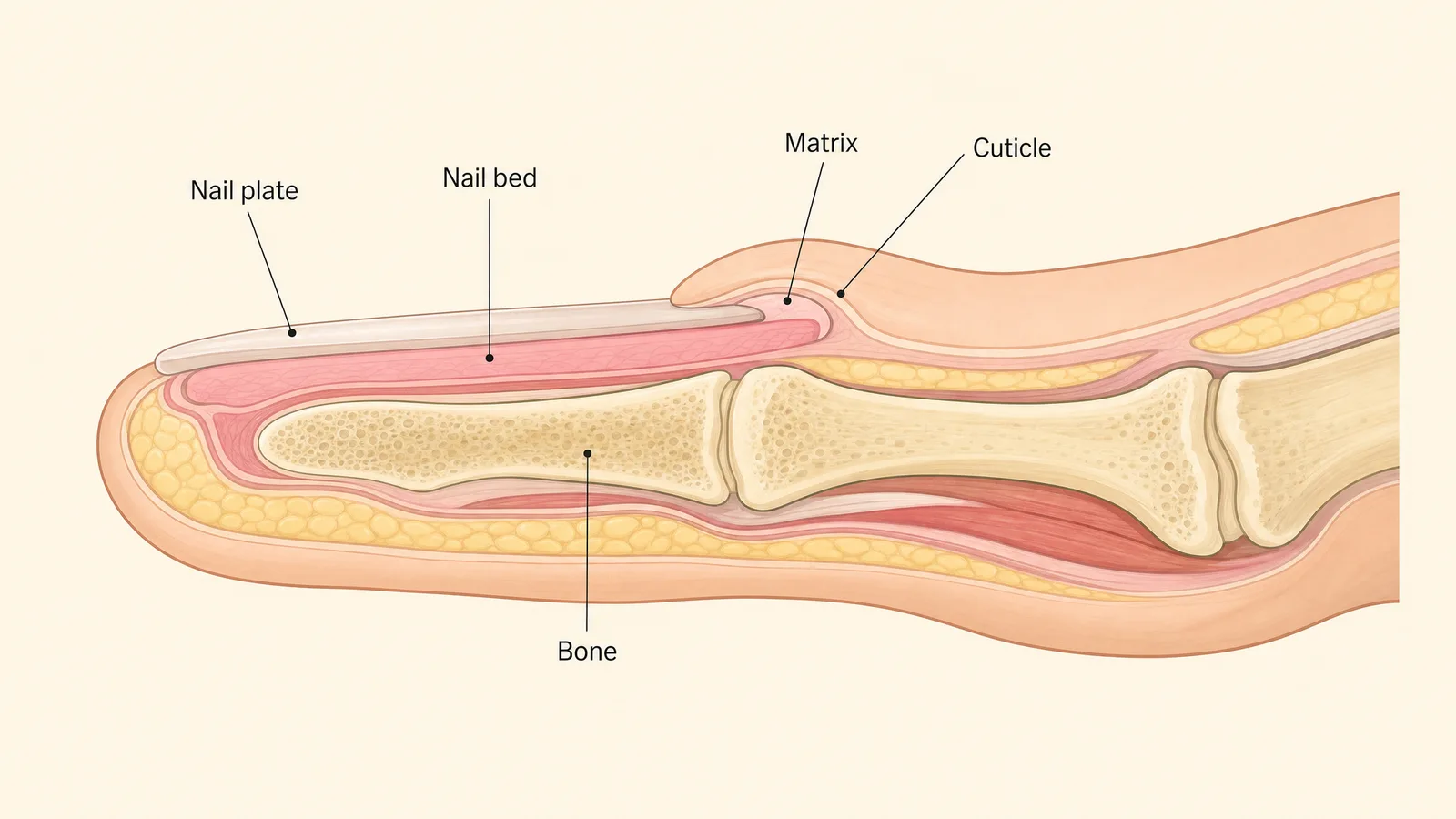 Illustration
A plain nail removal takes the nail off and leaves everything else alone. That is why it heals in two to four weeks like any other surface wound. But a nail that was removed and left alone grows straight back, and if the nail was ingrown, it usually grows back ingrown.
A matrixectomy solves that permanently by destroying the matrix, the strip of tissue tucked under the cuticle that manufactures nail. In a phenol matrixectomy your podiatrist removes the offending nail border and then applies phenol, a strong chemical, to that small area for a short period. It creates a deliberate, controlled chemical burn precisely where nail cells live.
Chemical burns do not heal like cuts. The destroyed tissue has to break down and drain away before new tissue can close over the space, and that clearance process is what produces weeks of fluid. In other words, the drainage is the procedure working. A phenol site that dried up in five days would be a reason to wonder whether enough matrix was treated.
Phenol vs. surgical matrixectomy
The surgical version, in which the matrix is cut out and the site is often closed with stitches, trades a shorter, drier recovery of roughly 2 to 3 weeks for a bit more up-front soreness and a formal incision. Phenol is the more commonly chosen approach in the United States because it is quick, does not require stitches, and has an excellent long-term success rate. Neither is wrong, and they simply front-load the inconvenience differently.
The Real Recovery Timeline
Sore, Not Yet Draining Much
- Numbness fades in 2 to 12 hours depending on the anesthetic used
- Throbbing peaks the first evening, then improves daily
- Keep the original dressing dry and intact for the first 24 to 48 hours
- Drainage is usually light at this stage and picks up later
What it looks like: A bandaged toe with light pink or straw-colored staining on the dressing. The treated border looks raw when the dressing first comes off.
Drainage Ramps Up
- Start daily soaks, then ointment and a fresh dressing
- Expect to change the dressing once or twice a day as it becomes wet
- Pain is usually gone or minimal by now, even as drainage increases
- Back to desk work and normal walking in a roomy shoe
What it looks like: A wet nail fold with clear, milky, or pale yellow fluid. A soft yellowish film over the treated area is healing tissue, not pus.
The Peak, and the Worry Point
- This is when most patients call, convinced it is infected
- Drainage is often at its heaviest and can soak a bandage daily
- The toe should still be comfortable, with no spreading redness
- Keep soaking and changing dressings, and resist picking at the site
What it looks like: A consistently damp, yellowish nail border with a slightly musty smell that clears after a soak. Everything else about the toe looks calm.
Drying Out and Closing
- Drainage tapers and then stops, often quite suddenly
- The nail fold covers over with firm new skin
- Dressings can usually be stopped once the site stays dry all day
- Swimming, hot tubs, and open water are okay again once fully closed
What it looks like: A dry, closed nail border with a clean straight edge where the removed portion used to be. The nail is permanently narrower on that side.
The Permanent Result
- The treated border stays nail-free, which is the intended outcome
- The remaining nail grows normally and can be trimmed straight across
- Roughly 5 to 10 percent of cases see a small spike regrow at the border
- New pain at the treated edge months later means it should be rechecked
What it looks like: A narrower but otherwise normal-looking toenail with smooth skin along the treated side. Most people stop noticing it entirely.
Daily Aftercare That Keeps It On Schedule
Soak
Warm water for 10 to 15 minutes once daily, starting day 2. Epsom salt is optional.
Dry
Pat the toe and the nail fold completely dry. Trapped moisture is the main infection risk here.
Ointment
A thin layer of antibiotic ointment over the treated border.
Cover
Fresh non-stick dressing. Change it whenever it gets wet, which may be twice a day early on.
Protect
Roomy shoes, no running for about 2 weeks, and no pools or hot tubs until fully dry.
The one adjustment specific to phenol is dressing frequency. Standard advice is a daily change, but a site that is draining heavily in weeks 2 and 3 needs a fresh dressing whenever the old one is soaked. A saturated bandage left on all day macerates the surrounding skin and is the most common way an otherwise normal phenol recovery turns into an actual infection.
Normal Phenol Drainage vs. Infection
Normal & Expected
- •Thin, watery, clear to milky or pale yellow fluid
- •Soaking through a bandage daily for 2 to 4 weeks
- •A soft yellow-white film over the treated border
- •A faint musty smell that disappears after soaking
- •A comfortable toe that simply happens to be wet
Call Your Podiatrist If…
- •Drainage turns thick and opaque, green, gray, or brown
- •A foul smell that returns right after cleaning
- •Pain increasing after day 3, or returning after it had stopped
- •Redness spreading out onto the toe or foot, or red streaking
- •Fever or chills, or still actively draining past 8 weeks
Notice that volume of drainage is not on the warning list, and character is. A heavily draining but thin, pale, odorless site with a comfortable toe is a normal phenol recovery. Our full infection vs. normal healing comparison goes deeper on each sign →
If you have diabetes or reduced circulation, healing runs slower and the margin for error is smaller. Have any change looked at early rather than watching it for a week. Learn about our diabetic wound care →
Comparing the cost of the permanent procedure against doing it again later? How Much Does Toenail Removal Cost? →
Not sure which procedure you had? The regrowth guide explains how to tell an avulsion from a matrixectomy, and what each one means long term. Toenail Regrowth Timeline →
Want the general nail removal timeline? Here is the week-by-week version. Toenail Removal Recovery Timeline →
Considering the procedure rather than recovering from it? Ingrown Toenail Treatment →
Frequently Asked Questions
How long does a phenol matrixectomy take to heal?
Expect 4 to 6 weeks for the site to fully close and dry, and up to 8 weeks in some cases. That is noticeably longer than a plain nail removal, which typically heals in 2 to 4 weeks. The pain, by contrast, resolves on the usual quick schedule, within a few days. The long part of a phenol recovery is drainage, not discomfort, and most patients are back in normal shoes and normal activity long before the site is dry.
Why does a phenol matrixectomy drain for so many weeks?
Because phenol works by creating a deliberate, controlled chemical burn of the nail matrix, the tissue that produces nail. Destroying that tissue is the entire point of the procedure, since it is what stops an ingrown nail from coming back. The treated tissue then has to liquefy and drain away before healing can finish, and that process takes weeks. The drainage is evidence the procedure worked, not evidence something went wrong.
What should the drainage look like after a matrixectomy?
Thin and watery, clear to straw-colored, sometimes milky or pale yellow, occasionally with a light pink tinge early on. It can be surprisingly copious. Soaking through a bandage every day for the first two or three weeks is common and normal. Drainage that turns thick and opaque, green or gray-brown, that smells foul, or that increases sharply after it had been settling down is the pattern that suggests infection rather than normal healing.
Does a phenol matrixectomy hurt more than a regular nail removal?
Generally no, and many patients report slightly less pain in the first day or two. Phenol has a numbing effect on the small nerve endings in the treated tissue. The toe is fully anesthetized during the procedure itself, and the usual pattern afterward is a throbbing first evening followed by steady daily improvement, with most people off pain relievers by day 3. Pain that climbs after day 3 is not a normal part of phenol recovery.
Will the ingrown toenail come back after a matrixectomy?
Usually not. Phenol matrixectomy is the most reliable treatment available for a recurring ingrown toenail, with long-term success rates commonly reported in the 90 to 95 percent range. In the small share of cases that do recur, it is typically a thin spike of nail regrowing at the treated border months later, which can be treated again. New pain at that edge months after everything had healed is the sign to have it rechecked.
When can I go back to work, sports, or swimming?
Desk work is usually fine the next day, and a job on your feet is realistic within a few days as long as you can wear a roomy shoe. Hold off on running and other high-impact activity for about 2 weeks. Swimming pools, hot tubs, lakes, and the ocean should wait until the site is completely dry and closed, which is the 4 to 6 week mark, because submerging an open wound in shared or untreated water is a genuine infection risk.
Specialized Wound Care at ASG Foot & Ankle
Our board-certified podiatrists treat slow-healing wounds, diabetic foot ulcers, and post-surgical wounds at our three clinics in Homewood, South Chicago Heights, and Mokena.
See a Podiatrist Near You
ASG Foot & Ankle has offices in Homewood, South Chicago Heights and Mokena. Our board-certified podiatrists accept most insurance. Find the office closest to you:
Still Draining and Not Sure It's Normal?
A two-minute look settles it. Our board-certified podiatrists treat ingrown toenails and perform matrixectomies at all three of our South Chicago suburbs locations. Call us or book online today.