Granulation Tissue After Ingrown Toenail Removal: Will That Red Bump Go Away?
Flat pink tissue is healing. A shiny red bump that bleeds is proud flesh, and it usually shrinks once the nail stops digging in.
Usually, yes: flat, moist, pink to red granulation tissue in the nail groove is normal healing, and new skin covers it in about 2 to 3 weeks after a simple ingrown toenail removal. A raised, shiny, easily bleeding bump (proud flesh) often shrinks once the nail spike or irritation is gone, though some need a quick treatment in the office.
ASG Foot & Ankle patient education. Updated October 18, 2026. General information, not a diagnosis.
The short answer
Flat, moist, pink to red tissue in the groove is healthy granulation, and new skin covers it in about 2 to 3 weeks after a simple removal, several weeks longer after phenol. A raised, shiny, bright red bump that bleeds at a touch is hypergranulation, or proud flesh. It is common with long-standing ingrown nails and after nail procedures, often shrinks once the nail spike or irritation is gone, and sometimes needs a quick office treatment such as silver nitrate. A bump that keeps growing, bleeds daily, or comes with pus, spreading redness or worsening pain needs to be seen.
Get It Seen Promptly If
Most red bumps at the nail fold are a nuisance, not an emergency. These change the picture:
- •Bleeding that will not stop with firm pressure, or soaks a dressing every day
- •Thick, cloudy or smelly pus, or drainage that keeps coming back after you clean it
- •Redness spreading past the nail fold onto the toe or foot, red streaks, fever or chills (same day)
- •A lump that is growing, returns after treatment, or lingers weeks after the nail problem was fixed
- •A lump with no ingrown nail or procedure behind it, or one that is brown, black or breaking down. Rarely, other growths, including skin cancers, mimic proud flesh
- •Diabetes, neuropathy or poor circulation: have any new bump, drainage or color change checked early, because pain is not a reliable warning
Normal Granulation, Proud Flesh or Infection?
Granulation tissue is the mesh of tiny blood vessels and connective tissue a wound builds to fill itself in. When it reaches skin level and stops, skin grows across it. When it keeps going and rises above the skin, it is hypergranulation, or proud flesh. Infection is a separate problem that can sit alongside either.
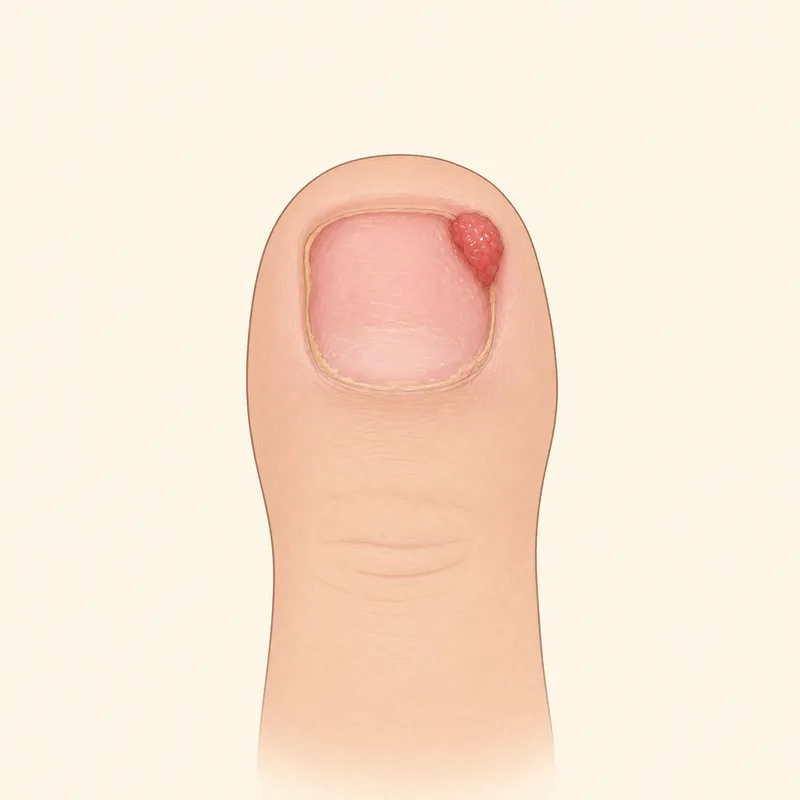 Illustration
| Feature | Healthy granulation | Proud flesh (hypergranulation) | Infection |
|---|---|---|---|
| Height | Fills the groove up to the level of the surrounding skin | Rises above the skin as a mound or berry-like lump at the fold | The whole toe swells; the wound itself may be flat or raised |
| Color and surface | Pink to red, moist, shiny, finely grainy | Bright red and glossy, sometimes darker red; spongy and fragile | Redness spreading beyond the nail fold, warm to the touch |
| Bleeding | Does not bleed easily | Bleeds from light contact, such as a dressing change or a sock | Not the main sign |
| Drainage | A little clear or straw-colored fluid, tapering | Clear or yellowish fluid that can leave nearby skin soggy | Thick, cloudy pus, often smelly, that returns after cleaning |
| Pain trend | Easing day by day | Tender when bumped or squeezed by a shoe | Worse after the first few days, throbbing |
| What to do | Keep following your aftercare | Remove the irritation; see your clinician if it is not shrinking or keeps bleeding | Call promptly; same day for fever, streaks or fast-spreading redness |
What about "pyogenic granuloma"?
Despite the name, it has nothing to do with pus. It is a benign overgrowth of small blood vessels that bleeds easily and can look just like proud flesh. The difference is behavior: proud flesh often settles once the nail spike is gone, while a true pyogenic granuloma rarely goes away on its own and usually needs removing.
Seeing a yellow film, a dark crust or soggy white skin instead? Our guide to what your toe looks like after nail removal walks through each one. For a sign-by-sign infection check, see infection vs. normal healing after toenail removal.
Why Proud Flesh Forms at the Nail Fold
Proud flesh is healing that does not know when to stop, and something is usually keeping it going. Finding that something is most of the treatment.
A nail spike still pressing
The most common driver. A nail edge buried in the fold acts like a splinter, and the body answers with a foreign-body reaction. While the spike stays, the bump usually does too.
A fragment left behind
After a removal, a sliver of nail left in the groove, or early regrowth at the corner, keeps irritating the fold and slows healing.
Moisture that never clears
Wet dressings, long soaks and sweaty socks keep the wound waterlogged. Overgranulation is common under airtight dressings that trap fluid, and some dressings or products irritate the skin.
Friction and pressure
Tight or pointed shoes, a rubbing dressing edge, and repeated knocks keep the fold inflamed.
Bacteria and lingering inflammation
A high bacterial load and inflammation that will not settle are both linked with overgrowth.
No procedure yet? The bump is part of the ingrown nail
Common staging systems put granulation tissue at the severe end of an ingrown nail, usually with a swollen fold and sometimes pus. Trimming the corner at home rarely fixes it, and silver nitrate alone can be slow. A podiatrist will usually remove the offending nail edge and the excess tissue at the same visit, and can treat that edge's root so it does not grow back in.
If you already dug the corner out yourself, read what to do after removing an ingrown toenail at home, or see our ingrown toenail treatment page.
What a Clinician May Do About It
The choice depends on the lump's size, how long it has been there, and what is driving it. These are the usual options, roughly in the order tried.
Find and remove the cause
The fold is checked for a nail spike or fragment, which is removed, and the dressing routine and footwear are reviewed. This alone settles many lumps.
Pressure and a better dressing
A foam dressing applied with light pressure can flatten overgrowth and absorb moisture. Wound care guidance often tries this first because it is gentle.
Silver nitrate cautery
A silver nitrate stick is rubbed on the tissue to cauterize it chemically, and the surface then sloughs away. It can sting, stains tissue and nail gray to black, and often needs repeating a few days to a week apart. The skin around it has to be protected, which is why it belongs in the office.
A short course of topical steroid
Some clinicians prescribe a steroid cream or tape for a limited period and review it after about two weeks. This is an off-label use, so use one only if it was prescribed for this.
Trimming or removal
A large, stubborn or recurring lump can be scraped (curettage), shaved or cut away under local anesthetic, usually with cautery. Excess tissue is often removed during ingrown nail surgery, and anything uncertain is sent for testing.
Antibiotics only for infection
Antibiotics do not shrink proud flesh. They are considered when there is pus or redness spreading beyond the nail fold.
Home Care While It Settles
Your own clinician's dressing instructions come first. Within those, the goal is a clean, dry, pressure-free nail fold.
Worth doing
- Clean the toe as instructed, and keep any soak short
- Pat it completely dry, including between the toes
- Use a non-stick dressing and change it whenever it gets wet
- Wear open-toe sandals or shoes with a roomy toe box
- If it bleeds, press clean gauze on it steadily rather than dabbing
- Photograph it every few days in the same light to track its size
Worth avoiding
- Cutting, burning, tying off or picking at the lump, or digging at the nail corner
- Wart remover, caustic pastes or silver nitrate sticks bought online, which can burn healthy skin
- Leaving a soaked dressing on for hours
- Thick layers of ointment under a tight, airtight cover, unless your clinician asked for that
- Tight or pointed shoes and anything that squeezes the toe
For soreness, over-the-counter acetaminophen or ibuprofen, taken as the label directs if safe for you, is usually enough. Check with your doctor or pharmacist first if you have kidney, stomach or heart problems, are pregnant, or take a blood thinner. The full soak and dressing routine is in our ingrown toenail removal recovery guide.
How Long Until It Goes Away? A Rough Timeline
These stages are approximate. Direction matters more than dates: a bump that is a little smaller each week is heading the right way. If the nail is still ingrown, the bump tends to stay until the nail edge is dealt with.
Raw, Moist, Filling In
- The groove looks raw and pink to red, and weeps a little clear or straw-colored fluid
- Healthy granulation starts filling it from the bottom up and may bleed a little at dressing changes
- Pain should be easing day by day
Level, Then Skinned Over
- Granulation reaches skin level and new skin grows across it, typically closing a simple removal in about 2 to 3 weeks
- A small shiny mound at the fold often appears in this window
- One that has stopped growing and is getting smaller can usually be watched
Phenol Sites Take Longer
- After phenol the site drains for several weeks, and a small mound can linger while it does
- One NHS podiatry service tells patients to expect about seven weeks for full healing after phenol nail surgery
- Drainage that turns thick, cloudy or smelly is not part of this
Repeat Visits Are Normal
- Silver nitrate turns the tissue gray to black, and the surface sloughs over the following days
- More than one application, a few days to a week apart, is common
- A prescribed steroid is usually reviewed after about two weeks
Time for a Check
- Same size or bigger after a week or two of good aftercare, still bleeding, or back after treatment: book a look
- A true pyogenic granuloma rarely goes away on its own and usually needs removal
- With diabetes, neuropathy or poor circulation, do not wait this long
Not sure whether phenol was used? It changes the timeline more than anything else. Our partial vs. total nail avulsion guide explains how to tell, and the phenol matrixectomy recovery guide covers the longer drainage.
When It Is Not Settling: What Gets Checked
A lump that is no smaller after a week or two of careful aftercare, keeps bleeding, or returns after treatment usually has a reason. At a visit, the questions are:
- Is there still nail in the fold? A retained spike, a leftover sliver, or early regrowth is the most common reason proud flesh keeps coming back.
- Is the dressing keeping it wet? Fluid trapped under an airtight dressing drives overgrowth.
- Is there infection? Pus, spreading redness and rising pain change the plan, and a swab may be taken.
- Is it a true pyogenic granuloma? These rarely resolve alone and tend to recur if the cause persists or removal was incomplete.
- Could it be something else? Uncommonly, a lump that looks like proud flesh is a different growth, including a melanoma with little pigment, which is why a lump with no clear cause, or one that keeps returning, is often sent for testing.
With diabetes, neuropathy or poor circulation, do not wait out these timelines: reduced sensation hides warning pain, and reduced blood flow slows healing. Learn about diabetic wound care →
Seeing a yellow film or dark crust too? Every nail bed appearance, explained. What Your Toe Looks Like After Nail Removal →
Want the full aftercare routine? Bandages, soaks and week-by-week healing. Ingrown Toenail Removal Recovery →
Worried it is infected? A sign-by-sign comparison with normal healing. Infection After Toenail Removal →
Had phenol applied? Why that site drains for weeks. Phenol Matrixectomy Recovery →
Pulled the ingrown corner out yourself? What to check next. Removed an Ingrown Toenail at Home →
Frequently Asked Questions
Will granulation tissue on my toe go away?
Usually, yes. Flat, pink to red granulation tissue is how the nail groove fills in, and new skin covers it in about 2 to 3 weeks after a simple ingrown toenail removal, longer after phenol. A raised, bright red, easily bleeding bump (proud flesh) often shrinks once the nail spike or irritation is gone. If it is growing, keeps bleeding, or is no smaller after a week or two of good care, have it checked, because some need treatment.
What is proud flesh on a toe?
Proud flesh is the everyday name for hypergranulation: healing tissue that keeps growing after it has filled the wound, so it sits above the skin. On a toe it is usually a small, shiny, bright red, spongy lump in the corner of the nail fold, often beside a long-standing ingrown nail or after a nail procedure. It bleeds easily because it is full of fragile new blood vessels, but it is not an infection in itself.
Is granulation tissue after ingrown toenail surgery normal?
Yes. Flat, moist, pink to red granulation tissue should fill the groove where the nail edge was removed, with a little clear or straw-colored drainage for the first couple of weeks. A small raised mound at the fold is also common and often settles. A lump that keeps growing, bleeds every day, or comes with pus, spreading redness or worsening pain is not normal.
How do you treat granulation tissue on a toe?
First, remove the cause: a nail spike or fragment pressing on the fold, a dressing that stays wet, or shoe pressure. Many lumps then flatten. If not, a clinician may use a pressure dressing, apply silver nitrate at one or more visits, prescribe a short course of a topical steroid, or trim or remove the tissue, sending it for testing if there is any doubt. Antibiotics are only for signs of infection.
Is there a home remedy for granulation tissue on a toe?
The home care that helps is simple: keep the toe clean and thoroughly dry, change any dressing that gets wet, and wear roomy or open-toe shoes. Do not cut, burn, tie off or pick at the lump, or use wart remover, caustic products or a silver nitrate stick bought online. Those risk chemical burns, bleeding and infection.
Is the red bump by my toenail infected?
Not necessarily. Proud flesh looks angry but is overgrown healing tissue. Infection changes the toe around it: redness spreading past the nail fold, warmth, a swollen toe, thick or smelly pus that returns after cleaning, and pain that is getting worse. Both can happen together. Fever, chills or red streaks need same-day care, and anyone with diabetes, neuropathy or poor circulation should have any change checked promptly.
Why did the bump turn gray or black after it was treated?
If your clinician used silver nitrate, that is the usual reason. It stains treated tissue gray to black, sometimes the nail and nearby skin too, and the treated surface dries and comes away over the following days. Skin staining fades and nail staining grows out. Call if the dark area spreads, the toe gets more painful, swollen or smelly, or the darkening appeared without any treatment.
Sources and further reading
- American Family Physician: Ingrown toenail management (2019)
- bpacnz Best Practice Journal: Ingrown toenails, digging out the facts
- DermNet: Pyogenic granuloma
- NHS Tayside Wound Management Formulary: Management of overgranulation
- Wounds UK: Haelan Tape for the treatment of overgranulation tissue (Johnson, 2007)
- Oxford Health NHS Foundation Trust: Podiatry services and nail surgery
General patient education. Your examination and individual treatment instructions take priority.
See a Podiatrist Near You
ASG Foot & Ankle has offices in Homewood, South Chicago Heights and Mokena. Our board-certified podiatrists accept most insurance. Find the office closest to you:
A Red Bump That Will Not Settle?
A nail spike hiding under the fold, a lump that keeps bleeding, or a toe that is not following the timeline is quick to check in person. Our team can examine the nail fold, remove a retained nail edge, and treat proud flesh in the office when it needs it, at our Homewood, South Chicago Heights and Mokena offices.