
Ingrown Toenail Removal Recovery: Healing Stages & Aftercare
How long to keep the bandage on, when to soak, what the nail border should look like each week, and whether the nail is going to grow back.
An ingrown toenail procedure is quick, and that is exactly why the recovery catches people off guard. You were in the chair for fifteen minutes, you walked out on your own foot, and nobody spent much time explaining what the toe would be doing for the next month. Then day 4 arrives, the nail groove is still weeping, and you start searching for whether that is normal.
Usually it is. Recovery from an ingrown toenail removal is different from a full toenail removal in one important way: only a narrow strip along one side of the nail was taken, so what has to heal is the groove where that strip used to sit, not the whole nail bed. That groove behaves in a predictable pattern. This guide from the podiatrists at ASG Foot & Ankle walks through it week by week, gives you the actual bandage and soaking schedule, and separates the two or three findings that genuinely need a phone call from the many that look alarming and are not.
Medically reviewed by Dr. Timothy Horak and Julia Shauger, board-certified podiatric specialists serving Homewood, South Chicago Heights & Mokena. Last reviewed August 2026.
The short answer
Pain is mostly gone by day 3. The nail border closes over in 2 to 3 weeks after a simple removal. If phenol was applied to stop the edge from growing back, add several weeks: that site drains clear or straw-colored fluid for 3 to 6 weeks, and that drainage is the treatment working, not an infection. Keep the toe covered for as long as it is moist, soak it 10 to 15 minutes daily, and judge your progress by direction rather than by the calendar. Pain and redness should get better every day after day 2.
First, Find Out Which Procedure You Had
Nearly every confusing thing about this recovery traces back to a single question, and most patients do not know the answer to it: was the nail root treated, or just the nail?
Partial nail avulsion (no phenol)
The offending border of nail is lifted out and the root is left alone. Sometimes called a wedge resection or a nail border removal.
- Site closes and dries in about 2 to 3 weeks
- Drainage stops early, usually within the first week
- The nail edge regrows over roughly 3 to 6 months
- Recurrence is common, in the range of 1 in 5 patients
Removal plus phenol matrixectomy
The same strip of nail is removed, then a chemical is applied to the root cells under that border so they stop producing nail there.
- Drains clear or straw-colored fluid for 3 to 6 weeks
- Longer bandaging, but usually less pain than the plain version
- That border stays permanently narrower
- Recurrence drops to roughly 5 percent
If the front desk can tell you which one is on your chart, it is worth the two-minute phone call. The weeks of drainage that would worry you after a plain removal are completely routine after phenol. Our dedicated guide to phenol matrixectomy recovery covers that longer timeline in depth.
The Healing Stages, Week by Week
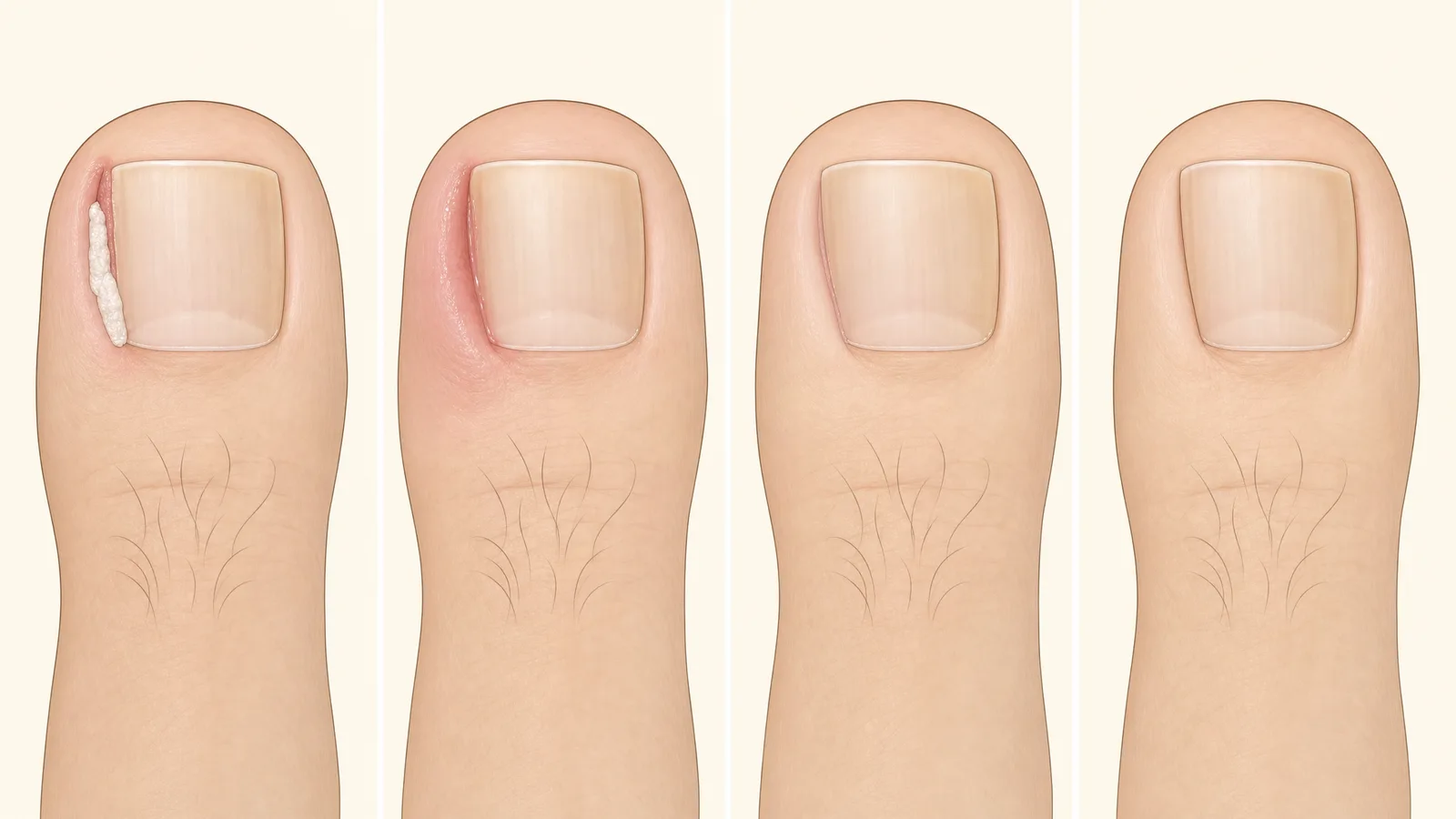 Illustration
Dressing Stays On
- Leave the original bandage dry and untouched for the first 24 hours
- Some pink or red staining through the dressing is expected and is not bleeding
- Keep the foot elevated as much as you can; this controls throbbing better than pills do
- Walk on the heel or the outside of the foot rather than pushing off the big toe
First Soak, First Look
- Remove the dressing in the shower or during a soak so it does not stick and tear
- The nail groove looks raw and pink; that is what a healthy healing border looks like
- Soak 10 to 15 minutes, dry thoroughly, apply a thin layer of ointment, re-cover
- Pain should be clearly lower than day 1 by now, and most patients stop pain relievers
The Groove Starts Filling In
- Daily routine is soak, dry, ointment, fresh bandage, and that is the entire aftercare
- Small amounts of clear or straw-colored drainage are normal, especially after phenol
- Redness should stay confined to the nail fold and not spread across the toe
- Roomy or open shoes are comfortable; tight shoes and safety boots usually are not yet
Skin Closes Over
- After a simple removal the border is typically closed and dry by the end of week 3
- You can usually stop bandaging once the site stays dry through a whole day
- A small shiny red mound of granulation tissue at the edge is common and settles on its own
- Normal shoes, work, and exercise are back on the table for most patients
Phenol Sites Finish Draining
- If phenol was used, this is where the extra weeks of drainage happen, and it is expected
- The chemical creates a controlled burn at the nail root, and burns drain as they heal
- Keep covering and soaking until the site is dry rather than stopping at an arbitrary date
- Drainage that turns thick, yellow-green, or foul smelling is the exception to all of this
What Grows Back
- After a plain removal the nail border regrows across roughly 3 to 6 months
- After phenol the treated edge stays permanently narrower, which is the point of it
- Watch for a sharp point of nail digging back into the fold, which is early recurrence
- New pain at the border months later is worth an appointment before it gets infected
Where should I be today? Enter your procedure date
Enter the date and get what is normal for today, what is next, and what to watch for.
The Daily Aftercare Routine
Soak
10 to 15 minutes in warm water with Epsom or table salt, once or twice a day. Longer is not better.
Dry fully
Pat, do not rub. Trapped moisture between the toes is what turns a clean wound into a problem.
Thin ointment
A small dab of antibiotic ointment at the nail fold keeps the dressing from bonding to the wound.
Fresh bandage
Cover once daily while the site is moist. Stop once it stays dry through a full day.
Two details do most of the work here. First, take the old dressing off during the soak, not before it. Dried blood glues gauze to new skin, and pulling it off dry is both the most painful moment of the week and a genuine setback to healing. Second, do not skip the drying step. Fifteen minutes of soaking followed by a damp bandage is worse for the toe than not soaking at all.
On timing: no submerging the foot in a bath, pool, hot tub, lake, or ocean until the site has closed and stopped draining, which is about 2 weeks for a plain removal and longer after phenol. A quick shower is fine from day 2 as long as you dry and re-dress the toe afterward.
Normal Healing vs. Signs of Infection
Normal & Expected
- •A raw, pink, slightly moist groove where the nail edge was
- •Clear, pink, or straw-colored drainage, especially after phenol
- •A narrow rim of redness right at the nail fold that does not spread
- •A shiny red mound of granulation tissue that bleeds easily
- •Stinging for a few seconds at the start of a soak
Call Your Podiatrist If…
- •Pain is increasing rather than decreasing after day 3
- •Drainage turns thick, yellow-green, or foul smelling
- •Redness spreads down the toe or up the foot, or streaks appear
- •You develop a fever or chills
- •The site is still openly draining past 6 to 8 weeks
The useful test is direction, not appearance. A healing toe gets a little better every day. An infected toe gets worse, and it typically declares itself somewhere between day 3 and day 7 rather than on day 1. For a sign-by-sign comparison, see our guide to telling infection apart from normal healing after a nail procedure.
If you have diabetes, neuropathy, or poor circulation, call much sooner than these thresholds suggest. Reduced sensation means the toe can be significantly infected while feeling only mildly sore, and an ingrown nail is one of the most common starting points for a serious diabetic foot infection. Learn about our diabetic wound care →
Will It Come Back?
This is the question that actually matters six months from now, and the honest answer depends on the procedure and on how you cut your nails from here.
After a plain partial removal, the nail-producing cells under that border are untouched, so the edge grows back. Around one in five patients ends up with the same ingrown nail again, often within the first year. After a phenol matrixectomy the recurrence rate is roughly 5 percent, because that strip of root no longer makes nail. Neither number is a promise, but they explain why podiatrists push the phenol version for a nail that has already been ingrown more than once.
What you control is the regrowth. Cut the nail straight across rather than rounding the corners down into the fold, leave it level with the tip of the toe instead of cutting it short, and stop digging at the corner with clippers or a file. Shoes that pinch across the toe box are the other reliable cause, and they matter more than most patients expect.
A sharp spike of nail poking back into the skin at month 3 or 4 is the classic early recurrence. Getting it trimmed properly at that stage is a minor visit. Waiting until it is red and draining again is not. Ingrown Toenail Treatment →
Deciding between the temporary and the permanent procedure? How Much Does Toenail Removal Cost? →
Wondering how much this is going to hurt? The pain curve peaks once and then falls off fast. Toenail Removal Pain Timeline →
Had the whole nail taken off, not just a border? That is a different timeline. Week-by-Week Toenail Removal Recovery →
Watching for the nail to come back? Here is what month 1 through month 12 look like. Toenail Regrowth Timeline →
Frequently Asked Questions
How long does it take to recover from ingrown toenail removal?
You are back to normal activity within a few days, but the toe is not finished healing for two to six weeks. Expect the pain to be mostly gone by day 3, the skin at the nail border to close over in roughly 2 to 3 weeks after a simple removal, and any tenderness to be gone by week 4. If phenol was used to keep the nail edge from growing back, the site drains clear or straw-colored fluid for 3 to 6 weeks, which is longer than most people expect and is not an infection.
How long do I keep the bandage on after ingrown toenail removal?
Leave the original dressing your podiatrist applied in place for the first 24 hours, keeping it completely dry. After that you change it yourself once a day, usually after a soak: pat the toe dry, apply a thin layer of antibiotic ointment, and cover it with a clean adhesive bandage or gauze. Most patients keep the toe covered for 1 to 2 weeks after a simple removal, and 3 to 6 weeks if the site is still draining after a phenol procedure. Keep it covered as long as it is moist or draining, because a dressing sticks to a dry wound and pulls off new skin.
How long should I soak my toe after ingrown toenail surgery?
Start soaking the day after the procedure, once the original dressing comes off. Ten to fifteen minutes in warm water with Epsom salt or a little table salt, once or twice a day, is the standard instruction. Soaking softens dried blood so the dressing lifts off without tearing the skin, and it keeps the nail fold clean. The first soak often stings for a few seconds. Do not soak longer than about 15 minutes, because waterlogged skin heals more slowly, and always dry the toe thoroughly afterward.
Will the ingrown toenail grow back after removal?
That depends entirely on whether the nail root was treated. A plain partial removal takes out the offending border but leaves the nail-producing cells intact, so the edge regrows over about 3 to 6 months and roughly one in five people has the ingrown nail return. When phenol or another matrixectomy technique is used on that same border, the recurrence rate drops to about 5 percent, and the treated edge stays permanently narrower. Ask which one you had, because it changes what you should expect to see in month 3.
What does normal healing look like at the nail border?
In the first week the exposed groove where the nail edge used to sit looks raw, pink, and slightly moist, and it may weep a small amount of clear or pink fluid. Over week 2 that groove fills in with new skin and flattens out. Some patients develop a small mound of shiny red tissue at the edge, called granulation tissue, which bleeds easily but is not infected and usually settles on its own. Thick yellow or green drainage, spreading redness up the toe, and pain that increases after day 3 are the signs that are not normal.
When can I go back to work after ingrown toenail removal?
Most people go back to a desk job the next day, and many go the same afternoon if they can keep the foot up. A job that keeps you standing or walking all day is usually comfortable by day 2 or 3, and steel-toe or safety boots often need to wait a week until the toe tolerates pressure. Running, sports, and swimming or any other water submersion should wait about 2 weeks, or until the site has stopped draining and the skin has closed.
Specialized Wound Care at ASG Foot & Ankle
Our board-certified podiatrists treat slow-healing wounds, diabetic foot ulcers, and post-surgical wounds at our three clinics in Homewood, South Chicago Heights, and Mokena.
See a Podiatrist Near You
ASG Foot & Ankle has offices in Homewood, South Chicago Heights and Mokena. Our board-certified podiatrists accept most insurance. Find the office closest to you:
Not Sure If Your Toe Is Healing Right?
A nail border that is getting redder, more painful, or draining thick fluid should be looked at the same week. Our board-certified podiatrists can check it at any of our South Chicago suburbs locations. Call us or book online today.