How to Buddy Tape a Toe: Step by Step, and How Long
How to tape it so it helps instead of rubbing, how long to keep it up, and whether it needs to stay on overnight.
For a simple, straight break or sprain of one of the four smaller toes, tape it to the toe beside it with gauze between them, change the tape daily, and keep it up for about 2 to 4 weeks, or until you can walk in a normal shoe without much pain. Taping overnight is optional for most people, unless your clinician told you to keep it on.
Buddy taping, also called buddy or neighbor strapping, turns the healthy toe next door into a splint. Done badly, it rubs, traps moisture, and squeezes a swollen toe. How long the toe itself takes to heal is in our broken toe healing timeline.
ASG Foot & Ankle patient education. Updated October 18, 2026. General information, not a diagnosis.
The short answer
How long: about 2 to 4 weeks for a simple small-toe fracture, a week or two for a sprain, up to about 6 weeks if the bone is still tender. At night: optional for most people. How: dry skin, gauze between the toes, two narrow bands that avoid the creases, snug but not tight, fresh tape daily. Pinky: tape it to the fourth toe. Do not tape the big toe as the main treatment, a crooked toe, an open wound, or, without guidance, a foot affected by diabetes, neuropathy, or poor circulation.
Get It Seen Promptly If
Skip the tape and have the toe examined if:
- •The toe is crooked, rotated, pointing at an odd angle, or overlapping its neighbor
- •It is the big toe
- •There is a cut or wound near the injury, or bleeding from around the nail
- •The toe is numb, tingling, pale, blue, or cold
- •The worst pain is behind the toe, or you cannot walk on the foot at all
- •Pain and swelling have not started to ease about 5 days after the injury
- •You have diabetes, neuropathy, or poor circulation. Have any toe injury checked
What You Need
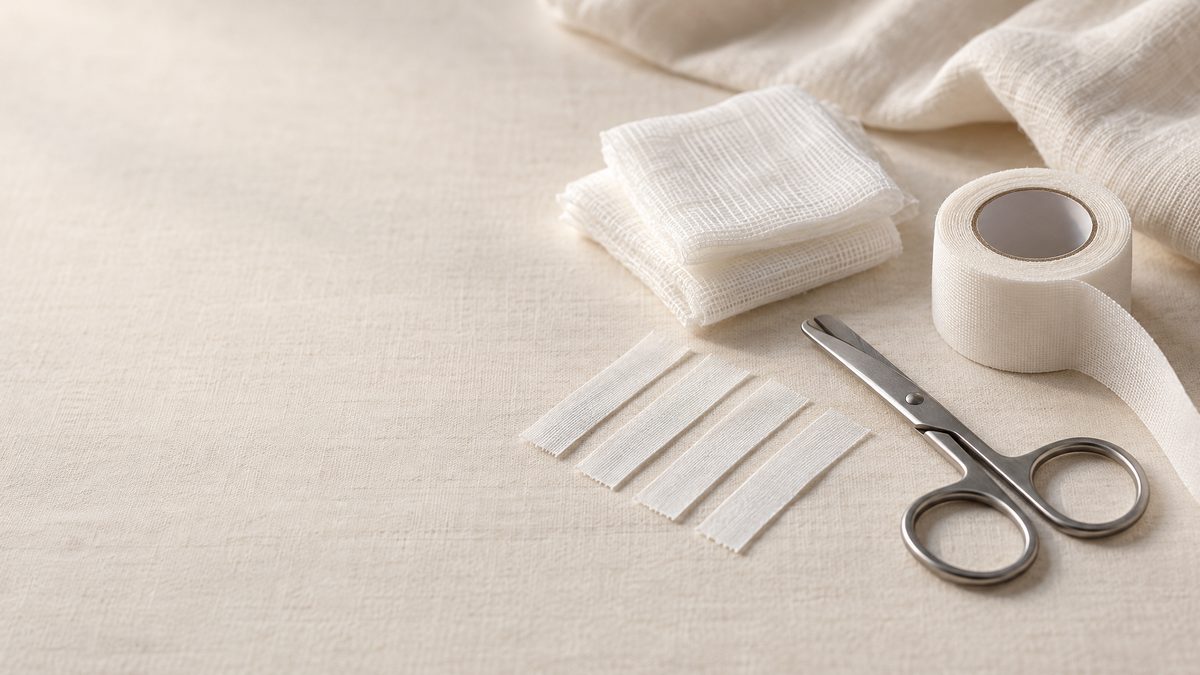
Non-stretch tape
Cloth medical or athletic tape about half an inch wide. Rigid tape holds without being pulled tight.
Padding
A folded gauze square, cotton wool, or thin felt to sit between the toes and protect the skin.
Small scissors
Blunt-ended, for cutting strips and snipping old tape off safely.
A stiff-soled shoe
Wide and flat. Tape keeps the toe in line; the sole stops it bending with every step.
How to Buddy Tape a Toe, Step by Step
It is easiest after a shower, when the skin is clean and can be dried properly.
- 1Check the toe first. Compare it with the same toe on the other foot. It should point the same way, nail facing up. If it is crooked, rotated, or overlapping, stop and get it seen.
- 2Wash and dry both toes, carefully between them. Moisture trapped under tape is what makes skin soggy and sore.
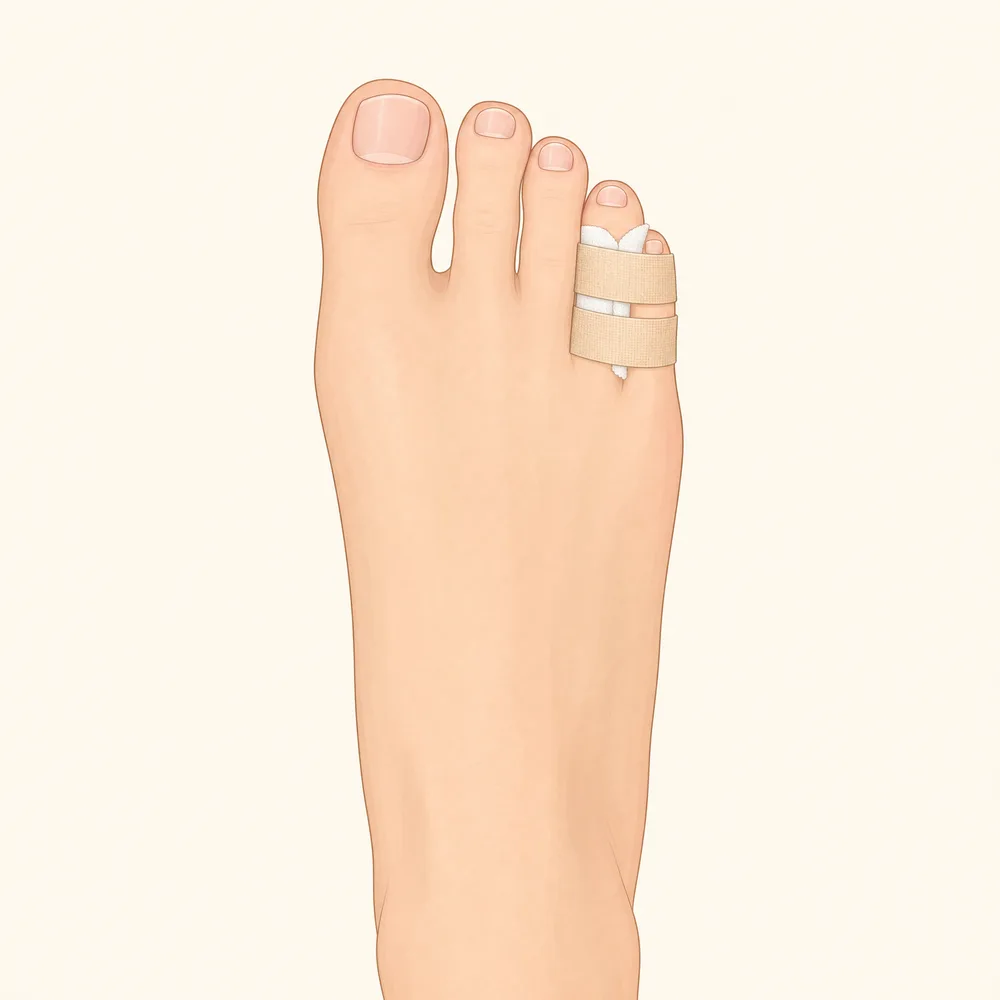
- 3Pad between the toes. A folded strip of gauze or cotton wool that sits flat. Never tape bare skin against bare skin.
- 4Line the toes up gently. Let the injured toe rest in its natural position beside its partner, with no pulling or twisting.
- 5Wrap two narrow bands around both toes: one on the base segments, one on the middle segments. Place them on the bony parts, not over the knuckle creases, so the toes can still bend a little. Keep tape off the nails and tips.
- 6Snug, not tight. Lay each band on rather than pulling it, then check color and feeling a few minutes later.
- 7Re-tape daily, and whenever it gets wet. Fresh gauze each time, and a look at the skin between the toes.
 Illustration
Which toe to tape it to
| Injured toe | Tape it to | Why |
|---|---|---|
| Second toe | The third toe | The big toe is much larger and moves differently at push-off |
| Third toe | The second or fourth, whichever lines up better | Similar length lets both bands land on the bony segments |
| Fourth toe | Usually the third toe | Longer and sturdier than the pinky, so a better splint |
| Pinky (fifth) toe | The fourth toe | Its only neighbor |
| Big toe | Not as the main treatment | Get medical advice; a stiff sole or post-op shoe does the splinting |
Buddy Taping a Pinky Toe
The little toe is the one most often taped, and the fiddliest: it is short and tends to curl in against the fourth toe.
- •Always to the fourth toe, with gauze between them, because the pinky presses into the side of its neighbor.
- •One band is often enough, around the base of the pinky and the matching part of the fourth toe. Add a second only if it fits without covering the nail or a crease.
- •Check the nail afterward. It should face up like the pinky nail on your other foot. If the tape twists the toe or tucks it under, start again more loosely.
- •Width beats tape. Most pinky pain comes from the side of the shoe pressing in, so choose a wide toe box.
- •Outer foot pain is a different injury. Tenderness along the outer edge of the foot behind the toe can be a fifth metatarsal fracture, which needs an X-ray, not tape.
Taping time is the same as for the other small toes. The pinky healing timeline is in broken pinky toe healing time.
How to Tell If the Tape Is Too Tight
An injured toe keeps swelling for the first few days, so tape that fit in the morning can be tight by evening. Compare with the toes on your other foot:
Color
A pale, white, blue, or dusky tip compared with the other toes.
Warmth
A taped toe that feels colder than the toes on the other foot.
Feeling
Numbness, tingling, or pins and needles that start after taping.
More pain with tape on
Throbbing that starts after taping, or a toe that hurts more strapped than unstrapped.
Any of these means remove the tape straight away and re-tape more loosely later. If color and feeling do not come back promptly once it is off, or the toe stays cold or blue, get it seen urgently the same day.
Looking After the Skin Between Changes
Each time the tape comes off, look for white, soggy skin between the toes, raw spots under the tape edges, blisters, or an itchy rash in the shape of the tape. Pat the skin fully dry, skip lotion between the toes, and use fresh gauze every time. Broken skin is an easy way in for infection: if it is breaking down, stop taping, rely on a stiff, roomy shoe, and have it looked at, promptly if you have diabetes.
How Long to Buddy Tape a Broken Toe
The NHS suggests strapping a broken toe for 2 to 3 weeks, and hospital fracture leaflets use 3 weeks, or 2 to 4. A family medicine review advises taping until the bone is no longer tender, usually at least 3 weeks and up to 6 if healing is slow. Put together:
Sprain or bad bruise
1 to 2 weeks
Or until the toe feels comfortable. Some people do not need tape at all.
Simple small-toe fracture
2 to 4 weeks
A straight, closed break of the second to fifth toe.
Slow or still tender
Up to about 6 weeks
If pressing on the break is still sharply sore. Check in with your clinician.
A toe that was set
As instructed
The tape may be holding the corrected position. Follow the plan you were given.
These are taping times, not healing times: a broken small toe usually takes 4 to 6 weeks to knit, and swelling lasts longer. Sprains are covered in sprained toe healing time.
Your Taping Routine, Stage by Stage
Gentle, and Checked Often
- Swelling is still building, so tape lightly and re-check the fit more than once a day
- Keep the foot raised when sitting; walking on the heel can be easier at first
- Wear the stiff-soled shoe for every step outside
The Daily Routine
- Fresh tape and gauze every day, and after showers or a sweaty day
- Tape for time on your feet; overnight is optional
- Walking should be getting easier week on week
Tapering Off
- A sprained toe usually no longer needs tape
- Many simple fractures are ready to come out of tape in this window
- Go without it at home first; keep it for long walks and work
Only If Still Needed
- Taping for comfort is reasonable if the bone is still tender
- The NHS advises seeing a doctor if a broken toe still hurts to walk on at 6 weeks
Should You Tape a Broken Toe at Night?
There is no fixed rule. The leaflets in the sources below focus on protecting the toe while you are walking and agree the tape can come off to wash and be re-applied; none of the adult guidance we found says it must stay on overnight. A children's fracture leaflet we read does ask for strapping to stay on all the time, so follow any instructions you were given.
Leave it on if
- You get up in the night, the classic time to stub it again
- The toe feels better supported
- You were told to, for example after a toe was set
Give it the night off if
- The skin between the toes is soggy, red, or sore
- The tape feels tight or the toe throbs in bed
- You prefer to re-tape fresh each morning
If it is off, wear a firm slipper for bathroom trips in the dark, and rest the foot on a pillow in the first week to help the swelling.
When Not to Buddy Tape
The big toe
The second toe is too small to splint it. Get medical advice; a stiff-soled or post-op shoe does the work.
A crooked or rotated toe
Taping it as it lies holds it crooked while it heals. It needs to be set first.
An open wound
A cut, broken skin, or bleeding from around the nail near the injury needs same-day care, not tape.
Diabetes, neuropathy, or poor circulation
Tape pressure and trapped moisture can break the skin without you feeling it. Tape only if a clinician has shown you how.
Fragile or broken skin
Thin, easily torn skin, eczema or cracks between the toes, or a tape allergy. Rely on a stiff shoe instead.
Pain behind the toe
Tenderness in the ball of the foot or the outer midfoot points to a metatarsal injury, which needs an X-ray.
Hurt the big toe? The broken big toe guide explains what protects it instead. With diabetes, see diabetic foot care.
How to Know When to Stop Taping
Let the toe, not the calendar, decide. You are usually ready when:
- Pressing on the sore spot gives mild tenderness, not sharp pain
- You can walk in a roomy everyday shoe without limping
- A day without tape does not bring the pain back
Most people taper: off around the house first, on for long walks or work for another week or so, then done. Stop sooner if the skin is breaking down or the tape makes the toe hurt more.
When Taping Is Not Helping
Tape should make walking easier, and the toe should improve week by week. The NHS advises seeing a doctor if pain and swelling have not started to ease after 5 days, or if the toe still hurts to walk on at 6 weeks. Get it checked sooner if it looks more crooked, pain or swelling suddenly increases, numbness appears, or you notice red streaks or a fever.
A toe that will not settle may be a different injury, such as a break into a joint or a metatarsal fracture, and more tape will not fix it.
Alternatives and Add-Ons to Tape
Stiff-soled shoe
Wide, flat, and stiff underfoot. It stops the toe bending with every step, and is worth wearing for roughly the first 4 to 6 weeks.
Post-op shoe
A rigid sole with an open, adjustable top that fits over swelling. The usual choice for a broken big toe.
Padding alone
If skin will not tolerate tape, gauze or a soft toe spacer stops rubbing. It cushions but does not splint.
How long until the toe itself heals? The week-by-week timeline. Broken Toe Healing Timeline →
Taping the little toe? Its healing, and the metatarsal mix-up. Broken Pinky Toe Healing Time →
Hurt the big toe? Why it is not taped like the others. Broken Big Toe Healing Time →
Jammed or twisted rather than broken? How long a sprained toe takes. Sprained Toe Healing Time →
Not sure it is broken at all? Bruised versus broken, side by side. Bruised Toe Healing Time →
Big toe bent back during sport? A joint injury with its own recovery. Turf Toe Recovery →
Frequently Asked Questions
Should I tape my broken toe at night?
For most simple injuries of the smaller toes, it is optional. Guidance focuses on supporting the toe while you are walking, and the tape can come off to wash and be re-applied. Take it off at bedtime and re-tape in the morning, or leave it on if that feels better, unless your clinician told you to keep it on, for example after a crooked toe was set.
How long should you buddy tape a broken toe?
Usually about 2 to 4 weeks for a simple, straight fracture of a smaller toe. The NHS suggests 2 to 3 weeks; a family medicine review advises taping until the spot on the bone is no longer tender, usually at least 3 weeks and up to 6 if healing is slow. A sprain often needs only a week or two.
How long should you buddy tape a broken pinky toe?
The same as the other small toes: about 2 to 4 weeks for a simple, straight break, and up to about 6 if it is still tender. Pain along the outer edge of the foot behind the toe needs an X-ray, because it can be a fifth metatarsal fracture, which is not treated with tape.
How do you buddy tape a pinky toe?
Dry both toes, put a folded strip of gauze between the pinky and the fourth toe, line the pinky up gently, and wrap a band of non-stretch tape around both toes at the base of the pinky, with a second band only if it fits without covering a nail or crease. Snug, not tight. Re-tape daily and whenever it gets wet.
When should I stop buddy taping a broken toe?
When pressing on the sore spot gives mild tenderness rather than sharp pain, you can walk in a roomy everyday shoe without limping, and a day without tape does not bring the pain back: usually 2 to 4 weeks for a simple small-toe fracture. Stop sooner if the skin between the toes is breaking down.
Can you buddy tape a broken big toe?
Not as the main treatment. The second toe is too small and flexible to hold it still, and the NHS advises getting medical advice rather than strapping a hurt big toe. It is usually X-rayed and protected with a stiff-soled or post-op shoe, sometimes a boot.
Sources and further reading
- NHS: Broken toe
- MedlinePlus: Broken toe, self-care
- American Family Physician: Evaluation and management of toe fractures
- East Sussex Healthcare NHS Trust: Toe fracture or dislocation
- Wirral Community Health and Care NHS Foundation Trust: Toe fracture
- Townsville Hospital and Health Service: Toe fracture fact sheet
General patient education. Your examination and individual treatment instructions take priority.
See a Podiatrist Near You
ASG Foot & Ankle has offices in Homewood, South Chicago Heights and Mokena. Our board-certified podiatrists accept most insurance. Find the office closest to you:
Not Sure It Should Be Taped?
A crooked toe, a big toe injury, pain behind the toe, or skin that will not tolerate tape all change the plan. ASG Foot & Ankle can examine and X-ray the toe, set one that is out of line, and show you how to tape it or fit a stiff-soled shoe instead.