Sesamoiditis Recovery Time: How Long It Lasts and What Helps
Pain under the big toe joint, explained: how long sesamoiditis takes to settle, how it differs from turf toe and a sesamoid fracture, and what actually takes the pressure off.
Sesamoiditis recovery time depends on what is actually wrong under your big toe joint. Simple irritation of the two small sesamoid bones and the tendons around them usually settles in a few weeks to a few months once the pressure comes off. A cracked sesamoid takes longer, and a few other problems hurt in exactly the same spot.
Below: how to tell sesamoiditis from turf toe, a fracture and a bipartite sesamoid, a recovery timeline for each, and what helps: pads, stiff soles, rocker shoes, and the point at which imaging, injections or surgery come into it.
ASG Foot & Ankle patient education. Updated October 27, 2026. General information, not a diagnosis.
The short answer
Sesamoiditis recovery time is usually a few weeks to a few months: a mild flare that is offloaded early, with a pad, stiff low-heeled shoes and less time on the balls of your feet, can settle within days to weeks. A stubborn case may need a removable walking boot for 4 to 6 weeks and then a gradual return to activity, and flare-ups are common. A sesamoid fracture is slower, often 6 to 8 weeks with no weight on it in a cast or boot, with discomfort that can last several months. Surgery is considered only when months of good non-surgical care have failed.
Get It Seen Promptly If
Do not just pad it and wait. Have the foot examined, and usually X-rayed, if:
- •The pain started with an injury: a fall, a hard landing, or the big toe bent back, especially with a pop or a lot of swelling
- •You cannot put weight on the ball of the foot, or cannot walk normally
- •The pain is severe and there was no injury at all
- •The joint is red, hot and swollen, or you feel feverish or unwell
- •It is not clearly easing after a couple of weeks of padding, stiff shoes and less activity, or it keeps coming back
- •You have diabetes, neuropathy or poor circulation, and there is any pain, callus, blister or broken skin under the ball of the foot
Go the same day if the toe looks out of place, the foot or toes turn cold, pale, blue or numb, or there is a wound with spreading redness.
What the Sesamoids Are, and Why They Get Sore
Most bones meet other bones at joints. Sesamoids are different: they sit inside tendons. Your kneecap is the biggest one. Under each big toe joint, in the ball of the foot, sit two more, each about the size of a corn kernel: one toward the inner side of the foot (the medial or tibial sesamoid) and one toward the outer side (the lateral or fibular sesamoid). They ride in the tendons that bend the big toe down, tied together by ligaments and a tough pad of tissue called the plantar plate.
Pulleys
They give the tendons a smooth surface to glide over and help lift the bones of the big toe.
Shock absorbers
Depending on the movement, the load through them ranges from about half your body weight to three times it.
A thin blood supply
Part of why a broken sesamoid can be slow to heal, and occasionally loses its blood supply altogether.
Sesamoiditis is irritation and inflammation of the sesamoids and the tendons around them, usually from overuse. The inner sesamoid is the one that usually hurts, because it is larger and carries more of the load: in a 2025 review of cases treated without surgery, 82% involved the inner bone. Sesamoid injuries make up about 4% of all foot and ankle injuries.
Who gets it
- •Dancers, runners and baseball catchers, plus basketball, football, golf and tennis players: anyone who spends time on the balls of the feet.
- •People with high arches.
- •Regular high-heel wearers, since heels tip your weight forward onto the ball of the foot.
- •People with bunions that change how they walk.
- •Less often, gout, osteoarthritis or osteoporosis play a part.
Pain Under the Big Toe Joint: Is It Sesamoiditis?
The typical picture of sesamoiditis:
- Pain under the big toe joint, in the ball of the foot
- A dull ache that built up gradually and comes and goes, often with certain shoes or activities
- Pain or difficulty bending and straightening the big toe, and when pushing off or rising onto your toes
- One tender spot under the joint that a fingertip can find
- Swelling or bruising, which may or may not be there
Pain in the ball of the foot under the big toe has a short list of other causes, and each has its own guide:
- A sudden injury with the toe bent back: turf toe, compared side by side below.
- A big toe getting stiffer over months or years, with pain on top of the joint: hallux rigidus, or big toe arthritis.
- A red, hot, swollen joint with no injury: gout in the big toe.
- Pain in the toe itself after stubbing it or dropping something on it: a broken big toe.
- Burning or tingling further across the ball of the foot, toward the smaller toes: a Morton's neuroma is one possibility.
Sesamoiditis vs Turf Toe vs Sesamoid Fracture vs Bipartite Sesamoid
These all hurt in the same place, and they can overlap. How it started and what the X-ray shows usually separate them:
| Condition | How it starts | What it feels like | X-ray |
|---|---|---|---|
| Sesamoiditis | Gradually, with repeated pressure on the ball of the foot | A dull ache under the joint that comes and goes, often with certain shoes or activities | Usually normal |
| Acute sesamoid fracture | One injury: a fall, a hard landing, or the big toe bent back | Immediate pain and swelling over the bone, usually not the whole joint | A break with jagged edges |
| Sesamoid stress fracture | Gradually, from repetitive load | Long-standing pain that comes and goes, worse with activity, better with rest | Can look normal; a bone scan or MRI may show it |
| Turf toe | One sudden event: the big toe forced upward past its normal range | Sharp pain and swelling across the whole joint, sometimes a pop, and a toe that will not bend | X-ray first; advanced imaging in some cases |
| Bipartite sesamoid | Not an injury: the bone formed in two pieces | Nothing, unless the area becomes irritated | Two pieces with smooth, rounded edges, often on both feet |
Sesamoiditis vs turf toe
Turf toe is a sprain of the big toe joint, caused when the toe is forced up beyond its normal range: sudden, sharp pain and swelling across the whole joint, sometimes with a pop. Sesamoiditis creeps up, and the soreness sits on one small spot underneath. Grades, taping and return to sport are in turf toe recovery.
Bipartite sesamoid: not a break
Some people's sesamoid grows in two pieces, a normal variant found in roughly 7 to 30% of people. About 90% involve the inner sesamoid, and 80 to 90% are on both feet, which is why an X-ray of the other foot can settle the question.
Sesamoiditis is often a diagnosis made once the others have been ruled out: the X-ray is usually normal, and the tenderness is on the sesamoid itself.
How Long Does Sesamoiditis Last?
Symptoms usually start to improve soon after the stress comes off the foot. Mild cases can resolve within days; more severe ones can take months to heal fully. Here is how the timeline shifts with the diagnosis:
| Condition | Usual treatment | Typical timeline |
|---|---|---|
| Mild sesamoiditis, offloaded early | Pad, stiff low-heeled shoes, less time on the balls of the feet | Days to a few weeks |
| Sesamoiditis that keeps flaring | A removable short-leg walking boot for 4 to 6 weeks, then a gradual return | Often a few months, and it can come back |
| Acute sesamoid fracture | Non-weight-bearing cast or boot, often 6 to 8 weeks, or a stiff-soled shoe or fracture brace | Bone protected for weeks; discomfort can last several months |
| Sesamoid stress fracture | Stop the sport; 4 to 8 weeks of limited weight in a below-knee cast or boot | Back to sport anywhere from 3 weeks to a year; surgery discussed if still painful at 3 to 6 months |
| Bipartite sesamoid | Nothing if it does not hurt; a sore one is assessed like any other sesamoid pain | Not an injury in itself |
| After sesamoid removal surgery | Protected walking, then lace-up trainers with a thick sole | Sport at about 12 weeks on average; full healing around 6 months |
What the research says about the stubborn cases
A 2025 review pooled 59 people treated without surgery, most of them athletes. About two-thirds got substantial pain relief, but flare-ups and incomplete recovery were common. In one of the included studies, 27 people with sport-related pain under the inner sesamoid followed a structured program of rest, a stiff offloading insole, a boot and injections; about half (48%) improved, and the rest still had pain at follow-up.
That is not a reason for gloom. Most sesamoid problems settle without surgery. It is a reason to take the pressure off properly and early, rather than running through it for months first.
Sesamoiditis Recovery, Stage by Stage
The usual course of treatment for sesamoiditis that came on gradually. If you have a fracture or were told to keep weight off the foot, follow your own plan.
Take the Pressure Off
- Stop or cut right back on the activity that brought it on
- Low-heeled shoes with a stiff sole and a cushioned forefoot; no barefoot walking on hard floors
- A felt or foam pad to take weight off the sore bone
- Ice wrapped in a towel, never straight on the skin, and an anti-inflammatory such as ibuprofen if it is safe for you
It Should Be Calming Down
- Symptoms usually start to ease soon after the stress comes off the foot
- Taping the big toe slightly pointed down can limit how far it bends with each step
- Not easing, or did it start with a sudden injury? Get it examined and X-rayed
Not Settling? Protect It Properly
- A removable short-leg walking boot for 4 to 6 weeks if symptoms persist
- Crutches if walking in the boot still hurts
- Sometimes a steroid injection, once a fracture has been ruled out
A Gradual Return
- Build activity back up gradually, keeping weight off the balls of the feet at first
- Physical therapy to restore big toe motion and strength
- An insole or orthotic that offloads the sesamoids, for the longer term
The Stubborn Minority
- An MRI if X-rays were unclear and treatment is not working
- A second look for a stress fracture, a bone losing its blood supply, or another cause
- Surgery is discussed only for long-standing pain that has not responded
Sesamoid Fracture Healing Time
A sesamoid can break in two ways, and they heal on different clocks.
A break from one injury
A fall, a hard landing, or the big toe bent backward. The pain is immediate.
Treatment is a stiff-soled shoe or a short leg fracture brace, sometimes tape to limit the toe and a J-shaped pad to relieve pressure. Some clinicians start with a non-weight-bearing cast for 6 to 8 weeks. Discomfort can last several months.
A stress fracture
Builds up with repetitive load, often in dancers, gymnasts and sprinters: pain that comes and goes, worse with activity, better with rest.
It counts as a high-risk stress fracture, more likely to heal slowly or not at all. Usual care is stopping the sport and 4 to 8 weeks of limited weight in a below-knee cast or boot. Return to sport ranged from 3 weeks to a year across studies, and surgery is considered if it is still painful after 3 to 6 months.
Stress fractures of the sesamoid can hide on a first X-ray, so pain that will not settle may need a bone scan or MRI. How sesamoid stress fractures compare with the more common metatarsal ones is in stress fracture healing time.
Sesamoiditis Treatment at Home
The aim is simple: take load off the sesamoids long enough for them to settle, then add it back slowly. Nothing here is fancy, and all of it works better together than alone.
Stiff, low-heeled shoes
A firm sole, such as a running or walking trainer with a stiff forefoot, stops the big toe bending as far with each step. High heels tip your weight onto the ball of the foot, so park them.
A rocker sole
A sole that curves up at the front lets you roll over the joint instead of bending through it. A forefoot rocker is among the footwear options podiatrists list for sesamoiditis.
Offloading padding
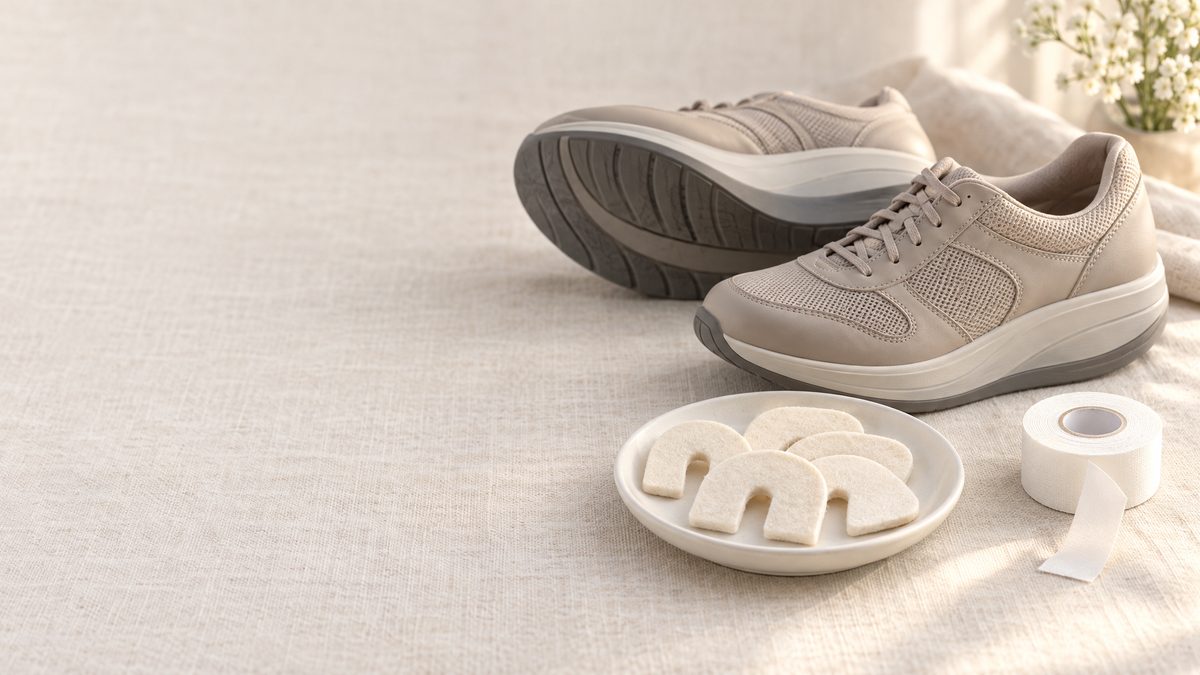
Felt or dense foam that takes pressure off the sore bone: a dancer's pad with a cutout, a U-shaped or winged pad, or a dome or bar just behind the ball of the foot.
Taping
Tape that holds the big toe slightly pointed down limits how far it bends. It works alongside offloading, not instead of it.
Ice and anti-inflammatories
Ice wrapped in a towel on the sore spot, and aspirin or ibuprofen if they are safe for you. They ease symptoms; taking the pressure off is what lets it settle.
An insole that offloads
Once things calm down, an insole or custom orthotic with relief under the sesamoids helps keep pressure off for the long run and may help stop it coming back.
Store-bought insole or custom orthotic? It depends on your foot shape and how stubborn the pain is; the trade-offs are in custom orthotics vs store insoles.
Dancer's Pad: How to Use One
A dancer's pad is a felt or foam pad with a cutout or U-shape that sits under the ball of the foot. The sore sesamoid sits in the gap, and the thicker material around it takes the weight instead. Podiatrists use U-shaped and winged versions of the same idea.
- •Find the sore spot first. Press under the big toe joint to locate the tender bone. The gap goes under that spot, not the felt.
- •Behind and around the joint, not under the toe itself.
- •Test it. After a short walk, the pressure should feel shifted off the sore spot, not onto a new one.
- •Replace it when it flattens. A squashed pad no longer offloads anything.
- •Pair it with a stiff shoe. A pad in a thin, flexible shoe or a high heel is fighting a losing battle.
A pad relieves pressure; it does not rule out a fracture. If the pain began with an injury, get an X-ray first. With diabetes or neuropathy, check the skin under and around the pad every day.
Activity: What to Pause and What to Keep
Pause for now
- Running, jumping and court sports
- Dance on the balls of the feet, and deep squats or lunges on the toes
- High heels, and walking barefoot on hard floors
Keep doing
- Activity that keeps weight off the forefoot, such as swimming or upper-body work
- Everyday walking in a stiff, low-heeled shoe, if it is comfortable
- The exercises your clinician or therapist gives you for big toe motion and strength
Coming back: return gradually, as pain allows. You are usually ready to start when walking in normal shoes is comfortable and pressing on the spot is only mildly tender. If a session leaves it sorer the next morning, drop back a step.
Athletes: a cleat or stud sitting right under the big toe joint may need removing or reducing before you go back to your sport.
X-Ray, Bone Scan or MRI: How It Is Diagnosed
Examination
Pressing on each sesamoid to find the sore spot, moving the big toe up and down, and checking whether bending the toe up makes it worse. Watching you walk and the wear on your shoes can add clues.
X-ray
The standard first step. In sesamoiditis it is usually normal. A fracture tends to have jagged edges, a bipartite sesamoid smooth ones; an X-ray of the other foot can help compare.
Bone scan
Sometimes ordered when X-rays are normal but pain persists. It can show bone irritation even without a visible break.
MRI
Usually not needed. Used when X-rays are inconclusive and treatment is not working: it can show inflammation, subtle stress fractures, and tell a bipartite sesamoid from a break that has not healed.
CT
Gives detailed pictures of the bone, and can help follow whether a sesamoid stress fracture is knitting.
Steroid Injections and Other Treatments
A steroid injection around the sesamoids can calm severe pain and swelling, and it doubles as a test: if the pain eases, the source is likely where the needle went. It is best done with imaging guidance, and it is not used on a fractured sesamoid or one that has lost its blood supply, which is one reason an X-ray comes first. In the 2025 review, offloading with orthotics and steroid injections were the most consistently helpful treatments, though the relief was mostly short-term.
Physical therapy helps once the pain is calmer, with range-of-motion, strengthening and conditioning work to get the big toe moving normally again.
Shockwave therapy and platelet-rich plasma (PRP) show some promise in small studies and single cases, but the evidence for sesamoiditis is still thin.
When Surgery Is Considered
Most sesamoid problems resolve without surgery. An operation comes into the conversation for:
- Long-standing sesamoiditis that has not improved with good non-surgical care
- A fracture whose pieces have shifted out of line
- A fracture that will not heal
- A sesamoid stress fracture still painful after 3 to 6 months of treatment
Fixing the bone
A fracture that has shifted can be repaired, and one that will not heal can be fixed with a screw or bone graft. Keeping the sesamoid is preferred where possible, to protect how the joint works.
Removing one sesamoid
For long-standing pain, removing part or all of one sesamoid is the common operation. Both are not removed: losing both is likely to leave a cocked-up or clawed big toe.
| After sesamoid removal | What a 2026 review of 193 patients found |
|---|---|
| Back to athletic activity | About 12 weeks on average (study averages 8 to 20 weeks) |
| Returned to sport | About 92% |
| Back to their previous level | About 84% |
| Complications | About 12.5% overall (8.5% inner, 18% outer), including numbness, soreness of the remaining sesamoid, the big toe drifting sideways, and stiffness |
Day-to-day recovery depends on the procedure. One NHS podiatric surgery leaflet describes anything from a heel-walking shoe for the first 3 weeks to a non-weight-bearing cast for up to 8 weeks, stitches out at about 3 weeks, lace-up trainers with a thick sole from about 3 weeks, discomfort for up to 10 weeks, high-impact activity from about 10 weeks, and healing complete at around 6 months.
Diabetes, Neuropathy and Pain Under the Big Toe
When nerve damage has dulled the feeling in your feet, pain is a late and unreliable warning. A sore sesamoid, a cracked one, or a pressure spot under the ball of the foot can hurt far less than it should. If you have diabetes or blood vessel disease in your feet, you need special care, so talk to your clinician about any foot problem rather than treating it on your own.
- •Check the skin under the big toe joint every day for callus, blisters, redness or a break, especially under a pad, tape or boot
- •Do not ice a foot you cannot feel well
- •A pad, insole or boot that rubs can break the skin without you noticing
- •A foot that becomes swollen, red or warm needs to be seen promptly, even if it hardly hurts
More in diabetic neuropathy and burning feet and diabetic foot care.
Big toe bent back during sport? Grades and return to play. Turf Toe Recovery →
Stiff big toe with pain on top of the joint? Hallux Rigidus →
Pain built up with training, elsewhere in the foot? Stress Fracture Healing Time →
Hurt the toe itself? Broken Big Toe Healing Time →
Choosing an insole to keep the pressure off? Custom Orthotics vs Store Insoles →
Frequently Asked Questions
How long does sesamoiditis last?
Usually a few weeks to a few months. A mild case that is offloaded early, with a pad, stiff low-heeled shoes and less time on the balls of the feet, can settle within days to weeks. A persistent case may need a removable walking boot for 4 to 6 weeks and then a gradual return to activity, which adds up to a few months. Flare-ups are common, so the shoe and insole changes are worth keeping.
Sesamoiditis vs turf toe: how can I tell the difference?
Mostly by how it started. Turf toe is a sprain of the big toe joint from the toe being bent back too far: sudden, sharp pain and swelling across the whole joint, sometimes with a pop, and a toe that will not bend. Sesamoiditis builds up gradually with repeated pressure, and the soreness sits on one small spot under the joint. The two can overlap, so a sudden injury deserves an examination and an X-ray.
How long does a sesamoid fracture take to heal?
A sesamoid broken in one injury is often protected for 6 to 8 weeks in a non-weight-bearing cast or boot, or in a stiff-soled shoe or fracture brace, and discomfort can last several months. Stress fractures of the sesamoid are slower and less predictable: usually 4 to 8 weeks of limited weight in a cast or boot, with a return to sport anywhere from 3 weeks to a year in published studies.
Can I treat sesamoiditis at home?
Often, if it came on gradually and you do not have diabetes, neuropathy or poor circulation. Cut back the activity that brought it on, wear low-heeled shoes with a stiff sole, use a felt or foam pad to take pressure off the sore bone, ice it wrapped in a towel, and take an anti-inflammatory if it is safe for you. If it is not clearly easing within a couple of weeks, or it started with an injury, get it examined.
Can I keep running with sesamoiditis?
Not while it is sore. Running loads the ball of the foot with every stride, and pushing through usually keeps the irritation going. Switch to activities that keep weight off the forefoot, then build back gradually once walking in normal shoes is comfortable and pressing on the spot is only mildly tender. If a run leaves it sorer the next morning, drop back a step. Pain that keeps returning needs imaging to look for a stress fracture.
Does a dancer's pad help sesamoiditis?
It can. A dancer's pad is a felt or foam pad with a cutout or U-shape, so the sore sesamoid sits in the gap and the surrounding felt takes the weight. Offloading pads are a standard first step, and podiatrists use several versions of the same idea. Put the gap under the tender spot, not the felt, and replace the pad when it flattens. With diabetes or neuropathy, check the skin underneath every day.
Will I need surgery for sesamoiditis?
Probably not. Most sesamoid problems settle without an operation. Surgery is considered for long-standing pain that has not improved with good non-surgical care, a fracture that has shifted or will not heal, or a stress fracture still painful after 3 to 6 months. The usual operation removes all or part of one sesamoid. In a 2026 review, about 92% of active people returned to sport, at around 12 weeks on average.
Sources and further reading
- AAOS OrthoInfo: Sesamoiditis
- ACFAS FootHealthFacts: Sesamoid injuries in the foot
- Cleveland Clinic: Sesamoiditis
- Kent Community Health NHS Foundation Trust: Sesamoiditis (2025)
- Sims AL, Kurup HV. Painful sesamoid of the great toe. World Journal of Orthopedics (2014)
- Robertson GAJ, Wood AM. Lower limb stress fractures in sport: optimising their management and outcome. World Journal of Orthopedics (2017)
- Biz C et al. Conservative treatment of sesamoiditis: a systematic literature review. Medicina (2025)
- Stewart S et al. Recommendations for the assessment and management of sesamoiditis by podiatrists: a Delphi study. Journal of Foot and Ankle Research (2024)
- Bouzid NM et al. Return to athletic activity following sesamoidectomy: a systematic review. Orthopaedic Journal of Sports Medicine (2026)
- American Family Physician: Common foot problems, home treatments (patient handout, 2018)
General patient education. Your examination and individual treatment instructions take priority.
See a Podiatrist Near You
ASG Foot & Ankle has offices in Homewood, South Chicago Heights and Mokena. Our board-certified podiatrists accept most insurance. Find the office closest to you:
Pain Under the Big Toe That Will Not Settle?
ASG Foot & Ankle can examine and X-ray the foot, tell sesamoiditis from a fracture, turf toe or arthritis, and set up offloading that fits your shoes and your sport, from padding and a walking boot to custom orthotics, with extra care when diabetes or neuropathy is part of the picture.