
Sprained Toe Healing Time: Jammed, Big Toe or Pinky
One to three weeks for a mild jam, longer for the big toe, and a stiff, puffy knuckle that usually outlasts the pain.
A mildly sprained or jammed toe usually heals in about 1 to 3 weeks, and a moderate sprain in roughly 3 to 6 weeks. The big toe takes longer than the small toes because you push off through it, and in any toe the stiffness and puffy knuckle commonly last for weeks after the pain has gone.
A jammed toe is a sprained toe: one of its joints was squashed or bent past its range, and the capsule and small ligaments holding that knuckle together were stretched or torn. Still deciding whether a stubbed toe is bruised, jammed, or broken? Our bruised toe guide compares the three in detail.
ASG Foot & Ankle patient education. Updated October 18, 2026. General information, not a diagnosis.
The short answer
Mild sprain or jammed toe (ligaments stretched): about 1 to 3 weeks. Moderate sprain (partial tear): roughly 3 to 6 weeks. Severe sprain or a dislocated joint: around 6 weeks for the tissue to heal, with mild aching and swelling that can come and go for 3 to 6 months. The big toe sits at the longer end of each range, and a big toe bent sharply upward is turf toe, which has its own grades. A toe that looks crooked, will not let you walk, or is not starting to ease after about 5 days should be examined.
Get It Seen Promptly If
Most jammed toes settle with home care. These features mean the toe should be examined, some of them the same day:
- •The toe looks crooked, stepped at a joint, or shortened. Do not pull it straight yourself: it needs an X-ray, since a dislocation can come with a fracture, and a clinician to realign it
- •You cannot put weight on the foot, or the worst pain is in the ball or middle of the foot
- •It is the big toe and you felt a pop, cannot push off, or the whole joint is swollen and bruised
- •Numbness or tingling, or a toe that turns pale, blue, or gray, or feels cold
- •A cut or wound near the injured joint
- •Pain and swelling not starting to ease about 5 days after the injury, or getting worse
- •A child with a hurt toe, which should be assessed rather than managed at home
- •Diabetes, neuropathy, or poor circulation: have any toe injury checked, because pain is not a reliable warning
What a Jammed or Sprained Toe Actually Is
Each small toe has two little joints along its length plus the joint at its base. The big toe has one joint near the nail and the large joint at the ball of the foot. Every knuckle is wrapped in a joint capsule and held by small ligaments. A sprain is a stretch or tear of those ligaments, and in a toe the capsule is usually injured with them.
Jammed: driven end on
The toe hits a bedpost, a wall, or a stair edge straight on. The force runs along the toe and compresses one knuckle, squashing its capsule and straining the ligaments. Bending the toe hurts most.
Sprained: bent too far
The toe is caught and bent sideways, curled under, or forced past its range, often on a rug or in bedding. The ligaments on the stretched side take the strain, so one side of the knuckle is usually sorer.
Big toe bent upward: turf toe
The big toe is forced upward while the heel is off the ground, as when pushing off to sprint, injuring the underside of its base joint. That is turf toe, with its own grades and recovery.
One stub can do both at once, so the label matters less than the grade, the toe, and whether the joint is still lined up. For the hyperextended big toe, see the turf toe recovery guide.
Sprained Toe Healing Time by Grade
Sprains are graded by how much of the ligament was damaged. You cannot grade your own toe with certainty, and a small chip fracture can feel identical, but the grades explain why recovery varies so much.
| Grade | What it means | Small toes | Big toe |
|---|---|---|---|
| Grade 1, mild | Ligament stretched; tender, a little swollen, joint stable | About 1 to 3 weeks | About a week or two |
| Grade 2, moderate | Partial tear; more swelling and bruising, may feel loose | Roughly 3 to 6 weeks | Several weeks, often in a stiff-soled shoe or briefly a walking boot |
| Grade 3, severe | Complete tear; the joint may be unstable or dislocated | About 6 weeks for the tissue; mild symptoms 3 to 6 months | Several weeks in a boot or cast, months before sport, sometimes surgery |
Ranges overlap because injuries do. Time on your feet, your shoes, and conditions such as diabetes all move the number; your own clinician's plan comes first.
The jammed or sprained pinky toe
Most pinky sprains are mild: about 1 to 3 weeks with buddy tape and a wide shoe. A pinky that now sticks out sideways or tucks under its neighbor may be dislocated or broken, and pain on the outer edge of the foot behind it can be a fifth metatarsal injury.
Broken Pinky Toe Healing Time →The jammed or sprained big toe
You push off through the big toe with every step, so a sprain there keeps getting tested and heals more slowly. A stiff sole helps more than tape. If it may be broken, such as one pinpoint sore spot on the bone, do not strap it yourself; get it checked promptly.
Broken Big Toe Healing Time →Sprained, Bruised, Broken or Dislocated?
A quick orientation. The full side-by-side, with the signs of a break, is in the bruised toe guide.
| Feature | Sprained or jammed | Bruised | Broken | Dislocated |
|---|---|---|---|---|
| What is injured | Capsule and ligaments of one joint | Skin and soft tissue | The bone | Joint out of line, ligaments torn |
| Where it hurts | One knuckle; bending hurts most | A broad area where it was struck | One sharply tender spot on the bone | A joint that looks bent or stepped |
| Typical healing | 1 to 3 weeks mild, 3 to 6 moderate | Usually the quickest of the four | 4 to 6 weeks for most toes | About 6 weeks once put back |
| First step | Home care; X-ray if not settling | Home care | X-ray for the big toe, a crooked toe, or a wound | Same-day care; do not pull it |
Walking on it does not tell you which you have; plenty of people walk on a fractured small toe. If an X-ray shows a break, the broken toe healing timeline takes over.
The Healing, Week by Week
The usual course for a mild to moderate small toe sprain. Big toe and severe sprains stretch the later stages. Each week should be a little better than the last.
Swelling and Throbbing
- Swelling builds over the first day or two, and the knuckle looks puffy and sometimes faintly purple
- Rest for the first 24 to 72 hours with the foot raised above hip level, and ice wrapped in a towel
- Compare the toe with the same toe on the other foot: it should point the same way
The Pain Starts to Ease
- Throbbing at rest fades; pain becomes mostly about walking, shoes, and bending the toe
- Start gentle wiggling and bending within comfort so the joint does not set stiff
- Pain and swelling that have not begun to ease by about day 5 are worth having checked
Mild Sprains Settle
- A mild sprain of a small toe is usually close to healed in this window
- Buddy taping can usually stop by about 3 weeks, sooner if the toe is comfortable without it
- The knuckle often still looks a little thicker than its partner, which is expected
Moderate Sprains Catch Up
- A moderate sprain improves week on week, though a long day still brings an evening ache
- Most people move back into normal, roomy shoes during these weeks
- Morning stiffness, rather than pain, becomes the main complaint
Healed, Not Yet Forgotten
- After a severe sprain or a dislocation, the soft tissue has usually healed by about 6 weeks, but mild pain and swelling can come and go for 3 to 6 months
- Heavy tasks and long walks can bring back swelling that settles overnight, and the knuckle may stay slightly thicker
- Still significantly painful or swollen beyond about 12 weeks, or a big toe that will not bend up to push off? Have it reviewed
What to Do at Home
Calm the swelling first, then protect the joint from bending hard with every step while keeping it gently moving.
- 1Rest and raise it. Keep walking to the essentials for the first 24 to 72 hours, with the foot raised above hip level when you sit.
- 2Ice, wrapped. Ice in a towel, up to 20 minutes every few hours for the first few days. Never directly on the skin, and skip it if you have neuropathy or poor circulation.
- 3A stiff-soled, wide shoe. A firm sole stops the toe bending through the injured joint with each step. Avoid tight or pointed shoes, flip-flops, and bare feet on hard floors.
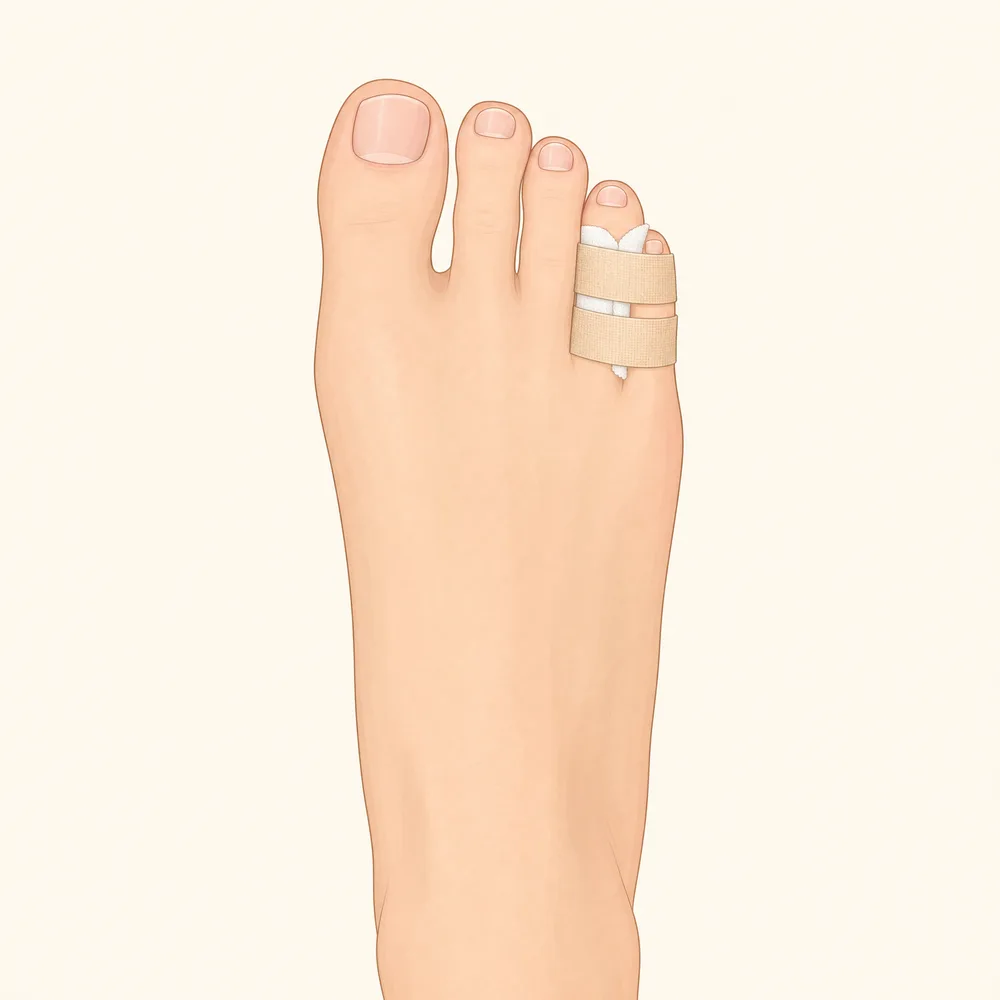
- 4Buddy tape a small toe, not the big toe. Taping a sprained small toe to its neighbor, with gauze or cotton between them, supports it for about 2 to 3 weeks. Do not tape a toe that points at an odd angle. Step-by-step instructions are in our guide to buddy taping a toe.
- 5Gentle movement after the first days. Wiggle and gently bend the toe through a comfortable range a few times a day; a joint kept completely still stiffens.
- 6Pain relief. Over-the-counter acetaminophen or ibuprofen as the label directs, if safe for you. Ask your doctor or pharmacist first if you have kidney, stomach, or heart problems or asthma, are pregnant, or take a blood thinner.
 Illustration
When Can You Run or Play Again?
After a mild jammed small toe, many people run again within the 2 to 3 week healing window. A moderate or big toe sprain, or a contact sport, needs longer: NHS advice after toe injuries is to avoid sports such as football, rugby, or hockey for about 6 weeks or until the pain eases. These checks beat the calendar:
- A long, brisk walk in ordinary shoes with no pain during it or the next morning
- Rising onto your toes on the injured foot alone without a sharp twinge
- Hopping several times on that foot without pain, and no new swelling the next day
Start with short, flat, easy runs. Pain that lingers into the next day means back off, not push through.
Why Is It Still Stiff and Swollen at a Month?
This is the most common worry with a jammed toe, and usually the least worrying finding. The capsule and ligaments heal with new tissue that starts out thicker and stiffer, fluid lingers in the joint lining, and a toe that was protected for weeks has some catching up to do. A slightly puffy, stiff knuckle at a month is normal as long as it is better than it was two weeks ago.
When It Is Not Healing Like a Sprain
Have it examined, and usually X-rayed, if at around a month:
- •It is no better than at two weeks, or it is getting worse
- •The joint looks bent, stepped, or shorter than its partner
- •One spot is sharply tender, which can be a small chip of bone pulled off by the ligament
- •The big toe will not bend up to push off, or the underside of its joint stays swollen
- •The joint turns red and hot without a new injury, which points toward gout or infection
NHS fracture clinics ask people to get back in touch if significant pain, swelling, or trouble walking continues beyond about 12 weeks. A red, hot big toe with no injury is covered in gout in the big toe.
Not sure it is a sprain at all? Bruised, jammed, and broken toes compared side by side. Bruised Toe Healing Time →
Big toe bent sharply upward? Turf Toe Recovery →
One pinpoint sore spot on the big toe bone? Broken Big Toe Healing Time →
Pinky toe sticking out or tucked under? Broken Pinky Toe Healing Time →
X-ray showed a break? Broken Toe Healing Timeline →
Need to tape a small toe? How to Buddy Tape a Toe →
Rolled the ankle at the same time? Rolled Ankle Recovery Time →
Frequently Asked Questions
How long does a sprained toe take to heal?
Most sprained toes heal in 1 to 6 weeks, depending on the grade and the toe. A mild sprain, with the ligaments stretched rather than torn, usually settles in about 1 to 3 weeks. A moderate sprain with a partial tear typically takes 3 to 6 weeks. A severe sprain or a dislocated joint needs around 6 weeks for the soft tissue to heal, and mild aching can come and go for 3 to 6 months. The big toe sits at the longer end of each range.
How long does a jammed toe take to heal?
Most jammed toes heal in about 1 to 3 weeks. The sharp pain eases over the first several days, and a jammed small toe is usually close to healed by 3 weeks. A badly jammed toe or a jammed big toe can take 3 to 6 weeks, and the knuckle often stays stiff and puffy for several weeks after the pain fades. If it is not starting to ease after about 5 days, or it looks bent at the joint, have it examined.
What does a jammed toe feel like?
Usually a deep, sharp ache on one knuckle rather than across the whole toe, with swelling that makes that joint look puffy. Bending the toe and pushing off hurt most, the toe feels stiff, and bruising is often mild. A broken toe more often has one pinpoint sore spot on the bone and may look crooked. A toe that looks bent or shortened at a joint may be dislocated and should be seen the same day, not pulled straight at home.
How long does a sprained or jammed big toe take to heal?
Longer than a small toe. A mild big toe sprain usually settles in a week or two. A moderate one takes several weeks, often in a stiff-soled shoe or briefly a walking boot, and a severe one can mean several weeks in a boot or cast and occasionally surgery. You push off through it with every step, so a stiff sole protects it better than tape. A big toe bent sharply upward is turf toe, and a pinpoint sore spot on the bone or being unable to push off calls for an X-ray.
How long does a sprained pinky toe take to heal?
Most sprained or jammed pinky toes heal in about 1 to 3 weeks with buddy taping to the fourth toe and a wide, stiff-soled shoe, and a worse sprain can take 3 to 6. A fracture takes 4 to 6 weeks, with much the same home care if the toe is straight. Get it checked if the toe sticks out sideways or tucks under the fourth toe, or if the pain sits on the outer edge of the foot behind it, which can be a fifth metatarsal injury.
Why is my sprained toe still stiff and swollen after a month?
Usually because the joint is still remodeling. The healing capsule and ligaments start out thicker and stiffer than before, and fluid lingers in the joint lining. A slightly puffy knuckle that is stiff in the morning is common at a month, especially after a moderate or big toe sprain, as long as it is better than two weeks earlier. Have it examined if it is not improving, looks bent, has one sharply tender spot, or turns red and hot.
Sources and further reading
- NHS: Broken toe (home care, strapping, and when to get help)
- Wirral Community Health and Care NHS Foundation Trust: Toe injury leaflet
- Royal Devon University Healthcare NHS Foundation Trust: Toe fracture or dislocation
- AAOS OrthoInfo: Sprains, strains, and other soft-tissue injuries
- AAOS OrthoInfo: Turf toe
- Merck Manual Consumer Version: Turf toe
General patient education. Your examination and individual treatment instructions take priority.
See a Podiatrist Near You
ASG Foot & Ankle has offices in Homewood, South Chicago Heights and Mokena. Our board-certified podiatrists accept most insurance. Find the office closest to you:
Jammed Toe Not Settling?
A toe that looks bent, will not let you push off, or is still swollen at a month is worth a proper look. ASG Foot & Ankle can examine and X-ray it, tell a sprain from a chip fracture or a joint out of line, put a dislocated toe back in place, and fit the right shoe with a realistic timeline.