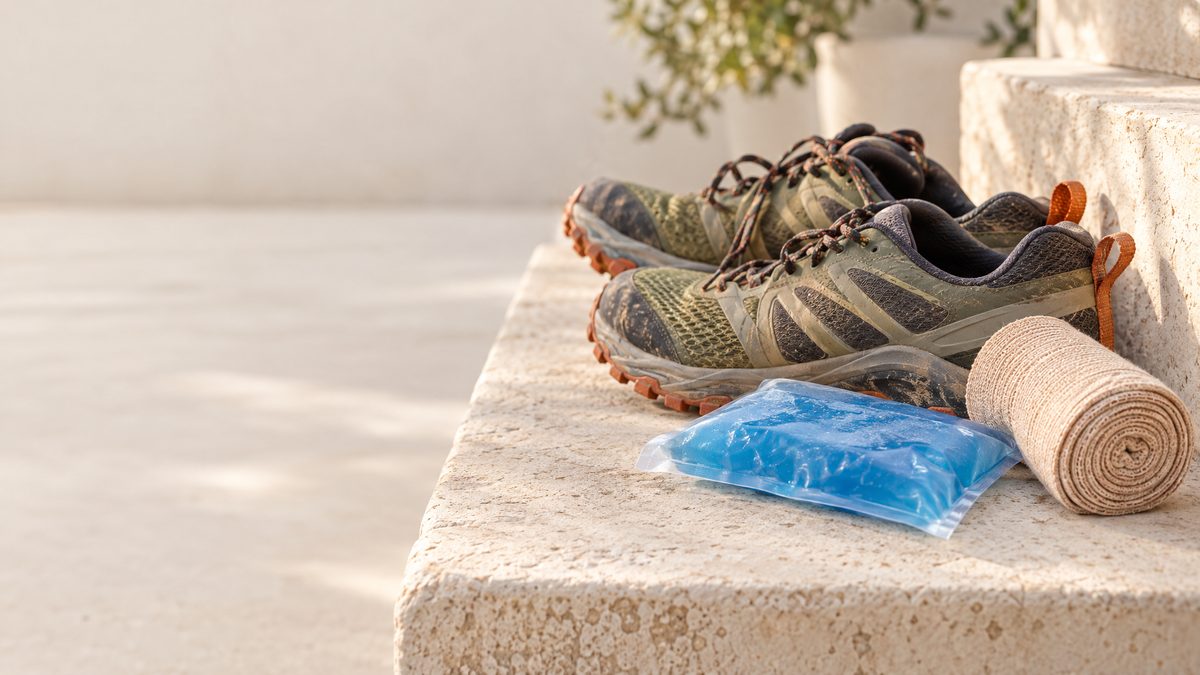
A rolled or twisted ankle that turns out to be a mild sprain usually heals in 1 to 3 weeks, and a minor tweak can feel normal within days. A partly torn ligament takes roughly 3 to 8 weeks, while a complete tear or a broken bone takes months.
ASG Foot & Ankle patient education. Updated October 18, 2026. General information, not a diagnosis.
The short answer
On the first night you rarely know what you did. Use this as a first guess, and let the next few days confirm it.
| What it probably is | How it usually feels | How long |
|---|---|---|
| A tweakLigament stretched, no real damage | A sharp twinge, then little or no swelling. You walk nearly normally within a day. | A few days to about 2 weeks |
| A sprainLigament stretched or torn | Swelling over the outer ankle within hours, bruising over a day or two, sore to walk on. | Grade 1: 1 to 3 weeks. Grade 2: 3 to 8 weeks. Grade 3: 2 to 3 months, longer for sport |
| A fractureA bone broke | Immediate, severe pain, sharp tenderness on the bone itself, often unable to take four steps. | At least 6 weeks for the bone; most back to normal activities in 3 to 4 months |
The best home test is the trend. By day 3 to 5 a sprain should be clearly improving. One that is worse than on day two, or that you still cannot take four steps on, needs an examination.
Get It Seen Promptly If
- •The ankle or foot looks out of shape or sits at an odd angle, or you heard a crack when it happened
- •Numbness, tingling or pins and needles, or the foot looks blue or gray or feels cold
- •An open wound over the injury
- •You cannot put weight on it or walk more than a few steps
- •Sharp tenderness on the ankle bones, or pain in the middle of the foot rather than the ankle
- •Pain above the ankle between the shin bones, or up the outer shin toward the knee
- •Pain that is very severe or getting worse, swelling that keeps growing, or a fever
- •You have diabetes, neuropathy, or poor circulation, where pain is not a reliable guide
The first three mean the emergency room. The rest mean urgent care or a prompt visit with a podiatrist.
Tweak, Sprain or Break: What Did You Actually Do?
When the foot rolls inward, the ligaments on the outside of the ankle take the strain. How far they stretch, and whether a bone gives way first, decides which of these you have.
A tweak
A sharp twinge you walked off, little or no swelling, and merely sore the next morning. It usually feels normal within a few days to about two weeks. The line between a tweak and a mild sprain is blurry, and the care is the same.
A sprain
The ligament fibers were stretched or torn. Swelling usually appears within hours, and the sore spot sits on the soft tissue in front of and below the outer ankle bone rather than on the bone itself. Sprains are graded by how much tore:
Grade 1
1 to 3 weeks
Stretching and microscopic tearing. Mild swelling, stable ankle.
Grade 1 recovery →Grade 2
Roughly 3 to 8 weeks
A partial tear. Moderate swelling, painful to stand on.
Grade 2 recovery →Grade 3
2 to 3 months, longer for sport
A complete tear. Severe pain bearing weight, feels unstable.
Grade 3 recovery →Pain and swelling make grading unreliable on day one. The full grade-by-grade table is in our ankle sprain recovery timeline.
A fracture
Pain is usually immediate and severe, and pressing on the bone hurts sharply at one spot, though a simple break does not always stop you walking. Most ankle fractures take at least 6 weeks for early healing and 10 to 12 weeks for complete healing. See stable ankle fracture recovery or the ankle fracture recovery timeline.
Twisted outward, pain above the ankle?
A planted foot with the leg turning over it suggests a high ankle sprain, which takes considerably longer.
High ankle sprain recovery →Pain and bruising in the arch?
A twist can injure the midfoot joints instead, which needs its own assessment.
Sprained foot recovery →Tonight and the Next 72 Hours
For the first 2 to 3 days, NHS advice is to protect, rest, ice, compress and elevate. The goal is to limit swelling while you watch how the ankle behaves.
- 1Protect. Supportive lace-up shoes or an ankle support; crutches if every step hurts.
- 2Rest. Keep weight off it as much as you can for the first day or two. Short trips around the house are fine.
- 3Ice. A wrapped ice pack or bag of frozen peas, for up to 20 minutes every 2 to 3 hours while awake. Never directly on the skin, and skip it if you have neuropathy or poor circulation.
- 4Compress. An elastic bandage during the day, snug but not tight. Loosen it if the toes tingle, go numb, or change color.
- 5Elevate. The ankle above heart level on pillows as often as you can, especially in the first 48 hours.
- 6Pain relief. Acetaminophen, or ibuprofen as a tablet or gel, as the label directs if it is safe for you. Check with a doctor or pharmacist first if you have kidney disease, stomach ulcers or heart disease, are pregnant, or take a blood thinner.
For the first couple of days, skip heat, hot baths, alcohol and massage, which can all increase swelling. And do not walk it off through sharp pain or finish the game.
Do You Need an X-Ray? A Plain-Language Ottawa Check
Clinicians use a checklist called the Ottawa ankle rules to decide who needs an X-ray. In clinical use it is nearly 100 percent sensitive for significant fractures. For a rough version, press firmly with one fingertip on the bone, not the soft tissue, and compare with your other ankle. An X-ray is worth having if any one of these is sharply tender or true:
The outer ankle bone
The back edge of the bony bump on the outside of the ankle, and its very tip.
The inner ankle bone
The same two spots on the bump on the inside of the ankle.
The fifth metatarsal base
The bony knob about halfway along the outer edge of the foot.
The navicular
The bony bump on the inner side of the midfoot, in front of and below the inner ankle bone.
Four steps
You could not take four steps on your own right after the injury, and still cannot. Limping steps still count.
What the check does not tell you
- •A clear check makes a significant break unlikely. It does not grade the sprain.
- •It was designed for a clinician's hands. With numbness, diabetes or neuropathy, or if you are unsure, get examined instead.
- •Heard a crack, or the ankle looks out of shape? Skip the check and go.
The Day 3 to 5 Trend Test
Every rolled ankle is sore at 48 hours; pain and swelling usually peak in the first 2 to 3 days. MedlinePlus advises contacting a provider if swelling does not start to go down within 2 days. Somewhere between day 3 and day 5, ask:
- Is the swelling smaller first thing in the morning than on day two?
- Can you walk further, with less of a limp?
- Is the pain at rest lower, and waking you less?
Clearly yes: keep going and start building movement. No, or worse than day two: get it examined, because a bigger tear, a fracture, or a high ankle sprain is more likely. Our recovery tracker shows where a typical sprain should be on a given day.
When Can You Walk on a Rolled Ankle?
Sooner than most people expect. For an ankle that passes the four-step check, early movement speeds healing more than prolonged rest, and weight bearing can begin as soon as pain allows.
The first day or two
Short, necessary walks. Crutches if every step is painful.
As pain allows
Walk more in a flat lace-up shoe, with an ankle support if it helps. A mild ache is fine; sharp pain means back off. Point, flex and circle the foot while sitting.
Running and sport
Straight-line first, cutting and jumping last. Ready means pain-free brisk walking, balance on the injured leg close to the other side, and hopping without a sharp twinge.
If you were given a boot or told to keep weight off the ankle, that instruction comes first.
What to Expect, Day by Day
A rough guide for a sprain that passed the X-ray check. A grade 3 tear or a fracture runs on a longer clock, and your clinician's plan comes first.
Swelling Builds
- The bruise may not show until the next day or two
- Start protection, rest, ice, compression and elevation
- Run the four-step and bone checks; if either is positive, plan an X-ray
The Worst of It
- Pain and swelling are usually at their peak in the first 2 to 3 days
- Bruising may spread toward the heel and toes, which looks worse than it is
- Short walks as pain allows, and gentle ankle movement once it is comfortable
The Trend Test
- A sprain should be clearly heading the right way, and a tweak close to normal
- Worse than on day two, or still unable to take four steps? Get it examined
Back on Your Feet
- Many mild sprains heal in 7 to 10 days, and most sprains are clearly better by about 2 weeks
- Start balance work, holding a counter at first
- A grade 2 still aches on long walks and puffs up by evening, which is expected
Rebuilding
- Most ankle sprains resolve in 2 to 6 weeks; a grade 2 commonly needs 3 to 8
- Brisk walking first, then straight-line jogging, then turning and cutting
- NHS guidance is to avoid strenuous exercise such as running for up to 8 weeks, so build back gradually
The Long Tail
- Grade 3 tears and fractures run on this longer clock
- Evening puffiness can linger for months, and occasionally up to a year
- Pain past 4 to 6 weeks, or an ankle that gives way, needs an assessment
When It Is Not Healing
Evening puffiness for weeks is normal; pain is the better guide. Pain lasting more than 4 to 6 weeks may point to a chronic problem. Book a visit if:
- •It is not improving with good home care, or is getting worse
- •The ankle gives way on flat ground, catches, or locks
- •The pain has moved behind the outer ankle bone or into the midfoot
- •Swelling comes with warmth, redness or fever, or the calf turns swollen and painful (same day)
If symptoms continue beyond 6 to 8 weeks, an MRI may be considered. The injuries most often missed at the first visit are covered in our ankle sprain recovery guide.
Why Some People Keep Rolling the Same Ankle
A previous sprain is the biggest risk factor for the next one, and incomplete rehabilitation is the most common cause of chronic ankle instability. A sprain blunts the reflexes that catch your foot on a curb edge, and poor balance often leads to repeat sprains. Balance training has substantial evidence behind it. Start once you can stand on the ankle comfortably, a few minutes most days:
- 1Stand on the injured leg beside a counter until you can balance steadily without your hands.
- 2Do the same with your eyes closed.
- 3Stand on a folded towel, a cushion, or a wobble board.
- 4Add movement: reach, catch a ball, then small hops forward and side to side.
An ankle that keeps giving way despite this work may have chronic instability. It is treated first with structured rehab, and surgery is reserved for instability that does not respond.
Want the full grade-by-grade table? Ankle Sprain Recovery Timeline →
Mild sprain, already walking? Grade 1 Ankle Sprain Recovery →
Swollen, bruised and limping? The partial tear and its rehab. Grade 2 Ankle Sprain Recovery →
Ankle feels unstable? A complete tear, and why most heal without surgery. Grade 3 Ankle Sprain Recovery →
X-ray showed a small, stable break? Stable Ankle Fracture Recovery →
Pain above the ankle, not below the bony bump? High Ankle Sprain Recovery →
Pain in the arch or middle of the foot? Sprained Foot Recovery Time →
Frequently Asked Questions
How long does a rolled ankle take to heal?
A minor tweak often feels normal within a few days to about 2 weeks. A mild (grade 1) sprain usually heals in 1 to 3 weeks, and a partial ligament tear (grade 2) in roughly 3 to 8 weeks. A complete tear takes around 2 to 3 months for daily life and longer for sport, and a fracture needs at least 6 weeks for early bone healing. Any sprain should be clearly better by day 3 to 5.
How long does a twisted ankle take to heal?
Usually the same as a rolled ankle, because it is usually the same injury: the outer ankle ligaments stretch or tear. Expect about 1 to 3 weeks for a mild sprain and 3 to 8 weeks for a partial tear. The exception is a foot that stayed planted while the leg twisted, with pain above the ankle between the shin bones. That suggests a high ankle sprain, which takes considerably longer.
How do I know if my rolled ankle is sprained or broken?
Only an X-ray can say for certain. Clinicians order one, using the Ottawa ankle rules, if you could not take four steps right after the injury and still cannot, or if the bone is sharply tender at the back edge or tip of either ankle bone, the base of the fifth metatarsal, or the navicular. Soft tissue tenderness in front of and below the outer ankle bone is the typical sprain spot. Walking on it does not prove it is not broken.
Can I walk on a rolled ankle?
Usually yes, after a short rest in the first day or two, if you can take four steps without severe pain. Early, protected walking in a supportive shoe or ankle support tends to speed recovery compared with prolonged rest. Use crutches if every step hurts, and back off when the pain turns sharp. If you still cannot take four steps, get an X-ray first.
Why does my ankle still hurt or swell after two weeks?
A mild sprain should be mostly settled at two weeks, but a grade 2 is often only part way through its 3 to 8 week course, so aching on longer walks and evening puffiness are common. Swelling is usually the last thing to go and can linger for months. What matters is that each week is better than the last. Pain beyond 4 to 6 weeks, giving way, or swelling with warmth or fever deserves an examination.
Why do I keep rolling my ankle?
Usually because the first sprain was never fully rehabilitated. A previous sprain is the biggest risk factor for another, and incomplete rehabilitation is the most common cause of chronic ankle instability. Balance training has good evidence for reducing repeat injuries. An ankle that keeps giving way despite that work should be examined.
Sources and further reading
- NHS: Sprains and strains
- AAOS OrthoInfo: Sprained ankle
- American Family Physician: Update on acute ankle sprains
- MedlinePlus: Sprains
- AAOS OrthoInfo: Ankle fractures (broken ankle)
- Northern Lincolnshire and Goole NHS Foundation Trust: Ankle sprain
General patient education. Your examination and individual treatment instructions take priority.
See a Podiatrist Near You
ASG Foot & Ankle has offices in Homewood, South Chicago Heights and Mokena. Our board-certified podiatrists accept most insurance. Find the office closest to you:
Rolled It and Not Sure What You Did?
Cannot take four steps, tender on the bone, or not clearly better by day five? ASG Foot & Ankle can examine the ankle, X-ray it when the findings call for it, tell you whether it is a sprain or a break, and fit the right support with a realistic plan.