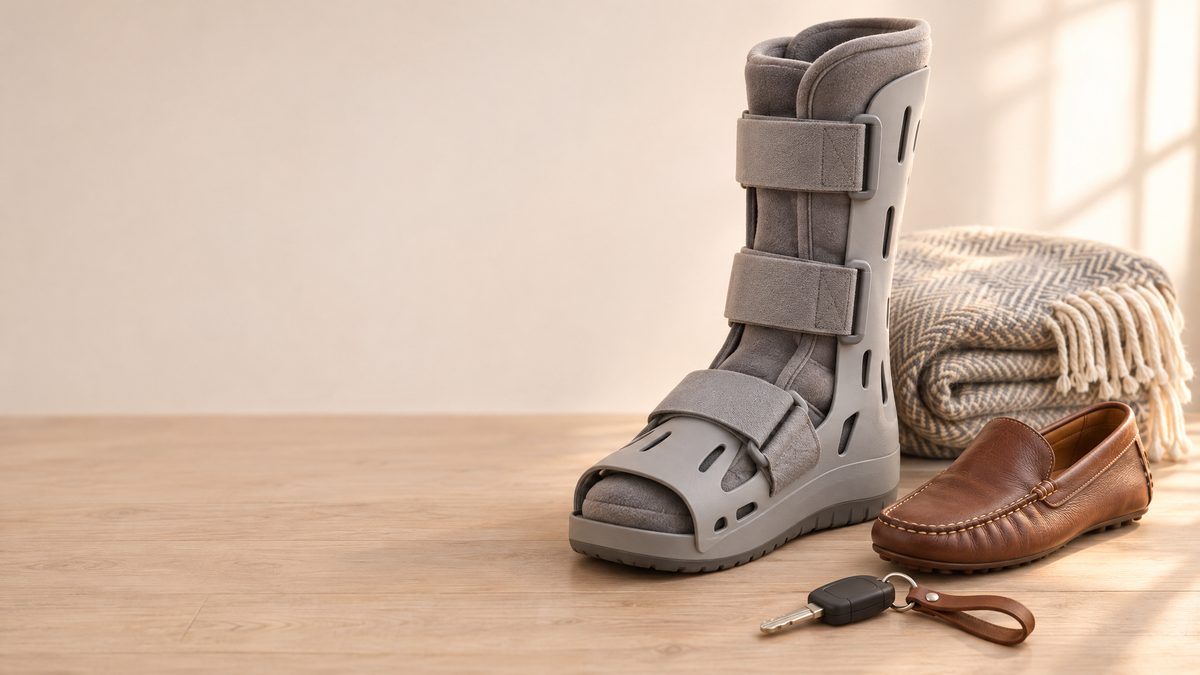
Can You Drive With a Boot on Your Right Foot? What Studies Found
Recovery guide from ASG Foot & Ankle
The short answer
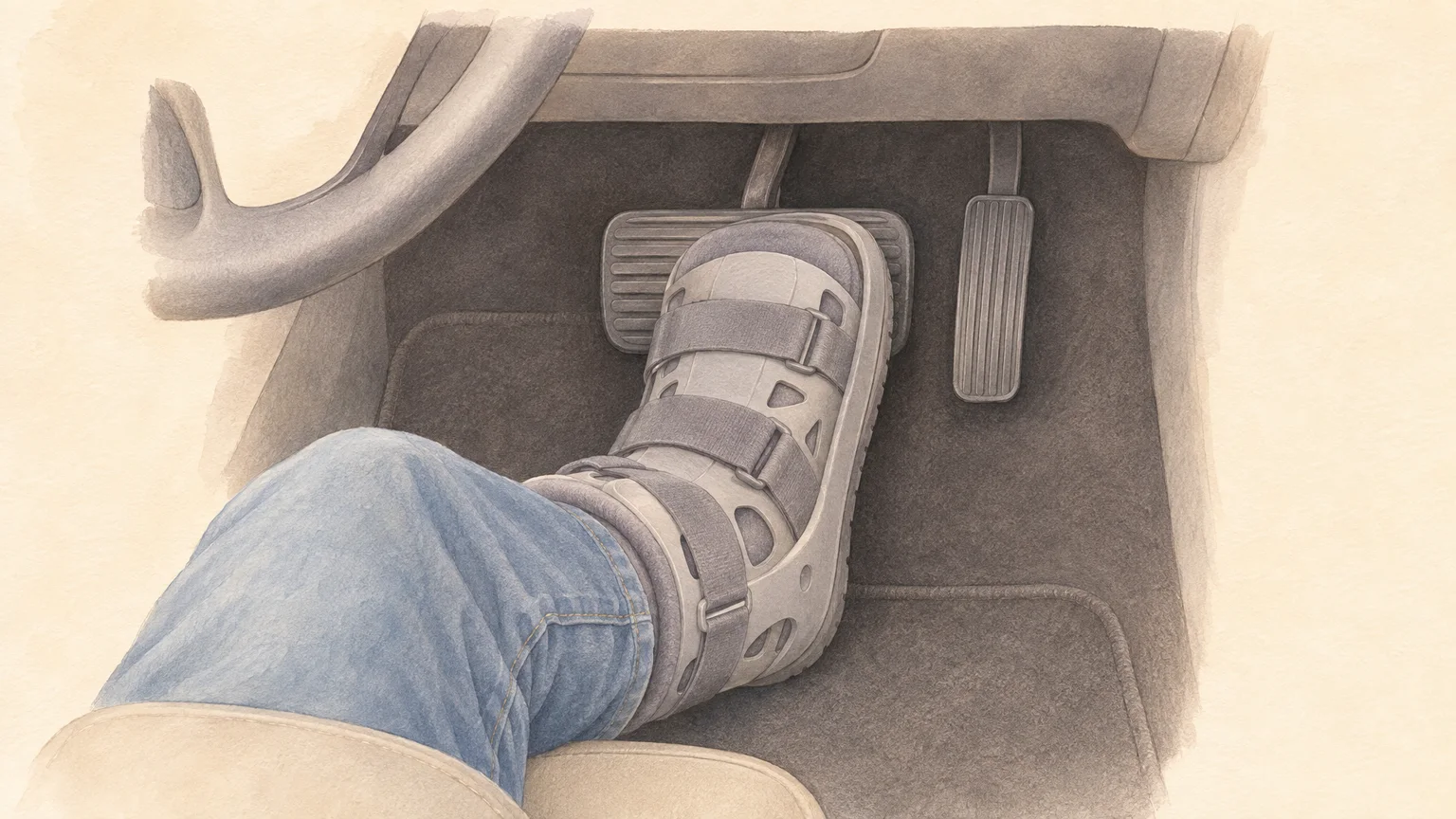
Can you drive with a boot on your right foot? No. US federal guidance is to wait while the foot is immobilized (NHTSA). In one simulator study the boot added 9.2 feet to a 60 mph stop (AAOS). In another, 55.5% of braking responses in a boot were abnormally late (Sansosti 2016). With a left boot in an automatic, ask your clinician and insurer first.
- Boot on the right footIt works the gas and the brake. Do not drive until it is off and you are cleared.
- Boot on the left foot, automaticNo gas or brake for that foot, but sources differ. Wait for a yes from your clinician and insurer.
- Boot on the left foot, manualThat foot works the clutch. Do not drive until it is off and you are cleared.
ASG Foot & Ankle patient education. Updated November 25, 2026. General information, not a diagnosis.
Had an operation? See driving after foot surgery. For how long the boot stays on, see broken foot recovery time.
Which Foot, and Automatic or Manual?
- Right foot, automaticNo, not until you are clearedThis foot works the gas and the brake.
- Right foot, manualNo, not until you are clearedSame gas and brake, same foot.
- Left foot, automaticAsk firstNo gas, brake or clutch for this foot, but sources differ. Wait for your clinician, your insurer and a readiness check.
- Left foot, manualNo, not until you are clearedThis foot works the clutch. A passenger shifting gears is no fix (NHTSA).
What a Boot Does to an Emergency Stop
A full stop from 60 mph, drawn to scale. The 303 feet comes from a table in Virginia law for an average driver in a sound car on a dry, level road (Virginia Code). We added the extra feet from brake studies, so no study measured these totals.
- Normal shoe (Virginia Code)303 feet
- Walking boot, right foot, uninjured people (AAOS)303 + 9.2, about 312 feet
- Six weeks after surgery for a broken right ankle (Egol 2003)303 + 22, about 325 feet
By our arithmetic from that table, if both cars brake equally hard, the booted driver is still moving at about 14 mph where the other has stopped.
The extra feet alone, enlarged
Volunteers with no leg injury
- Right boot, real car on a closed track, 14 people (Murray 2015)about 2.5 feet*
- Right boot, simulator, 35 people (AAOS)9.2 feet
- Right boot, simulator, 25 people (Sansosti 2016)about 14 feet*
- Right short leg cast, 35 people (AAOS)6.1 feet
- Right surgical shoe, 25 people (Sansosti 2016)about 3 feet*
- Left-foot driving adapter, 35 people (AAOS)6.0 feet
31 patients after right ankle fracture surgery, against 11 healthy people
- 6 weeks after surgery (Egol 2003)22 feet
- 9 weeks after surgery (Egol 2003)8 feet
 Illustration
Where the Brake Studies Agree and Disagree
- They agree on slower
- Average braking response rose from 0.575 second in a shoe to 0.736 in a boot (Sansosti 2016). A boot, a cast and a left-foot adapter were all slower than normal shoes (Orr 2010).
- Some responses went wrong
- In the boot, 55.5% of responses were abnormally late and 18.0% were inaccurate. In regular shoes it was 2.5% and 2.0% (Sansosti 2016).
- They disagree on how much it counts
- The real-car team called the delay minimal but urged caution. With a distraction the gaps were not statistically significant (Murray 2015). Another team called the safety effect questionable (Tremblay 2009). The Orr team could not recommend driving with any immobilizing device on the right foot (AAOS).
- The boot volunteers were uninjured
- A review of 48 articles calls the evidence a best-case scenario (DiSilvestro 2016). In 2009 federal reviewers found no study of crashes in drivers with fractures (NHTSA).
Can You Drive an Automatic Car With a Boot on Your Left Foot?
- Federal guidance, 2009
- No driving while an injured limb is immobilized or its joint lacks full movement. It names the right leg for pedal trouble but makes no exception for a left foot (NHTSA).
- Guide for older drivers
- No restriction if the splint or cast does not interfere with driving tasks. If it does, wait until healing or removal, with strength and movement shown (AGS and NHTSA).
- London NHS hospital
- Six weeks off driving, unless only the left leg is hurt, the car is automatic and it is safe. You must feel in full control, including for an emergency stop (Chelsea NHS).
Wait for a yes from your clinician and your insurer. Then check your parked car: the boot does not catch, it rests clear of the brake, the parking brake is not a left foot pedal, your right foot can stamp on the brake, and no medicine is making you drowsy. If anything fails, do not drive. Ask about a professional driving assessment.
Can You Take the Boot Off, or Drive With Your Left Foot?
Boot off for the trip: no, not until you are cleared. A hard stop loads the part the boot protects. Healthy people in running shoes pressed with a peak of 293.8 pounds on average in a simulator (Tremblay 2009).
Left foot on the pedals: no. Federal guidance says this is not a safe alternative to waiting (NHTSA), and New Jersey tells drivers to use the right foot for gas and brake (New Jersey 2026). Studies of speed are mixed. A left-foot adapter was slower than a normal shoe (Orr 2010). In 100 uninjured people, left-foot braking averaged 0.594 second, against 0.713 for a booted right foot (Schick 2019). Those times do not test the gas pedal or real traffic.
Can You Drive With a Cast or Surgical Shoe on Your Right Foot?
- Cast
- Not on the right foot: the federal advice to wait covers any immobilized limb (NHTSA). In a simulator, a cast lowered peak braking force from 293.8 to 275.4 pounds (Tremblay 2009).
- Surgical or post-op shoe
- A smaller delay than a boot, but 18.5% of responses were abnormally late, against 2.5% in regular shoes (Sansosti 2016). After right bunion surgery, 42 people were tested in the shoe. Braking was slower at 2 and 6 weeks, and the authors advise at least 6 weeks without driving (Dammerer 2016).
- Crutches or a knee scooter
- If your right foot has a weight limit, a hard press on the brake can exceed it. Wait for clearance.
- Diabetes with numb feet
- Numb feet may slow braking too. In a simulator, drivers with type 2 diabetes and nerve damage were abnormally late 57.5% of the time, against 3.5% for drivers with neither (Meyr 2017). Tell your clinician.
Is It Illegal to Drive With a Boot on Your Right Foot?
It depends on where you drive, and this page did not check every state. A 2018 medical review, not a legal source, reported that most US states had no rule on casts or walking boots (ACFAS summary). The federal guidance is voluntary advice (NHTSA). A missing rule does not make driving safe, legal or insured. Ask your licensing agency. This is general information, not legal advice.
- Virginia
- Driving a vehicle that is not under proper control on a highway is reckless driving (Va. Code 46.2-853).
- Minnesota
- Every driver must use due care (Minn. Stat. 169.14).
- Maryland
- Drivers must report loss of function in a leg or foot that may affect driving (Maryland MVA). Ask the MVA about a short-term injury.
- Illinois and New Jersey
- In a word search, neither driver manual mentions casts or walking boots (Illinois 2025) (New Jersey 2026). Silence is not permission.
- UK
- Tell DVLA if a broken limb will keep you from driving for more than 3 months. Not reporting a condition that affects your driving can bring a fine of up to £1,000 (GOV.UK).
- Australia
- People with severe pain or reduced movement after injury should be advised not to drive during treatment. The treating doctor decides on return (Austroads).
Insurance. The same review says insurers can refuse to cover a crash that happens while a driver is still recovering (ACFAS summary). In a UK survey, insurers were likely to invalidate a policy after a crash if the doctor had advised against driving (Gandhi 2014). Get your clinician's answer in writing, then ask your own insurer.
How Soon Can You Drive After the Boot Comes Off?
- After any ankle immobilizer
- After 3 to 4 weeks held still, an ankle may need up to 9 weeks for full function. Driving waits until it moves well enough, not just until the cast is off (NHTSA).
- Broken right ankle with surgery
- One study called braking normal by 9 weeks, with an average 8 feet still added (Egol 2003). In a study of 23 patients, 91% passed an on-road test with an instructor at 6 weeks, after screening and before full healing (Ho 2018). See broken ankle surgery recovery.
- Right Achilles repair
- At 6 weeks, 54 of 59 patients passed a simulated brake test and 5 failed (Reb 2020).
Study results are not clearance. They count weeks from surgery, and none tested a boot for a sprain or a break treated without surgery. For those timelines, see fractured fibula recovery time, grade 3 ankle sprain recovery and fifth metatarsal fracture recovery.
Pain Medicine, Work Vehicles and Teen Drivers
Medicine. The FDA lists opioids, muscle relaxants and sleeping pills among drugs that can make driving dangerous, and some effects last into the next day (FDA).
Commercial vehicles. A US commercial driver whose ability to do the job has been impaired by an injury must be medically examined and certified (49 CFR 391.45). Tell your employer, even for a left boot.
Teen drivers. The federal advice gives no separate rule for new drivers.
How to Get Around for Six Weeks
For injuries that need no surgery, one NHS hospital expects the boot to be finished by six weeks unless told otherwise (Chelsea NHS).
- Work and school: ask for a note that says no driving and gives a review date.
- Transit: ADA paratransit can cover a temporary disability that keeps you from using regular buses (49 CFR 37.123).
- Parking for whoever drives you: ask your state about a temporary placard.
First-Drive Checklist, Once You Are Cleared
- Your clinician has cleared this foot for a hard brake press and noted it in your record.
- You are in a normal shoe, finished with the boot or cast.
- Sitting down, you can mimic a fast, hard pedal press and pull your toes back with no hesitation, pain or limit (Wirral NHS).
- You can walk 10 feet, turn and walk back in 9 seconds or less (Wirral NHS).
- No opioid or other drowsy medicine is still in your system.
- Your insurer has confirmed your cover.
- Parked with the engine off, you can move from gas to brake without looking down.
- The first trip is short, dry and in daylight, with another licensed driver beside you.
The Wirral checks are for sprains, strains and other muscle or joint injuries. A home check does not replace clearance.
Call 911, and Do Not Drive Yourself
Leg pain or swelling with chest pain or trouble breathing needs an ambulance: it may be a blood clot. New throbbing pain or swelling in one calf or thigh without those signs needs same-day medical help. Have someone else drive (NHS).
The bottom line
- Do not drive with a boot on the right foot. Wait until it is off, the ankle moves well and your clinician clears you.
- Studies in uninjured people work out to about 2.5 to 14 extra feet at 60 mph in a boot.
- A left boot in an automatic is the one case to ask about. In a manual, wait.
- Rules differ by place, and no named ban is not permission. Ask your insurer before the first drive.
Frequently Asked Questions
Can you drive with a moon boot or CAM boot?
Moon boot, CAM boot, walker boot and orthopedic boot are everyday names for similar devices that hold the ankle still, so the same right-foot and left-foot answers apply. No study here compared short boots with tall ones, so a short boot gets no exception.
Can I drive in a boot if it is only a sprain or a broken toe?
Not with the boot on your right foot. Braking was slower in a boot even in uninjured people, and the pain of a sprain or broken toe comes on top of that. Ask the clinician who fitted the boot when you can drive.
Can you drive with an ankle brace on your right foot?
It depends on the brace. In 70 healthy people, braces that limit how far the ankle moves slowed braking. An elastic bandage and a brace made for unstable ligaments did not. A fresh sprain may slow you more. Ask which kind yours is, and wait for clearance.
Can you drive with a walking boot on your left foot in the UK?
Only with conditions. The London hospital quoted on this page makes an exception for an injury to the left leg alone, in an automatic, when it is safe and you can make an emergency stop. It suggests asking your insurer about cover, and you still need your own clinician to agree.
Sources and further reading
- Orr et al: Immobilization devices, left-foot adapter and brake-response time, J Bone Joint Surg Am 2010
- American Academy of Orthopaedic Surgeons release on the Orr study, with stopping distances (ScienceDaily)
- Sansosti et al: Lower extremity immobilization devices and emergency brake response, J Foot Ankle Surg 2016
- Tremblay et al: Immobilization of the right lower limb and driving performance, J Bone Joint Surg Am 2009
- Murray et al: Right lower limb immobilization and braking, an on-the-road study, J Foot Ankle Surg 2015
- Schick et al: Does Immobilization Affect Braking Time? J Am Podiatr Med Assoc 2019
- Egol et al: Driving after operative treatment of ankle fracture, J Bone Joint Surg Am 2003
- Ho et al: Return to car driving after operative treatment of right ankle fractures, 2018
- Reb et al: Brake response time recovery after Achilles tendon repair, Foot Ankle Spec 2020
- Dammerer et al: Surgical shoes and brake response after first metatarsal osteotomy, 2016
- Dammerer et al: Ankle brace type and braking response time, Injury 2015
- Meyr and Spiess: Brake response time in diabetic drivers with neuropathy, J Foot Ankle Surg 2017
- DiSilvestro et al: When Can I Drive After Orthopaedic Surgery? A systematic review, 2016
- NHTSA with AAMVA: Driver Fitness Medical Guidelines, 2009
- American Geriatrics Society and NHTSA: Clinician's Guide to Assessing and Counseling Older Drivers, 4th edition
- Code of Virginia 46.2-880: Tables of speed and stopping distances
- The Highway Code: Typical stopping distances and average car length
- Code of Virginia 46.2-853: Driving vehicle which is not under control
- Minnesota Statutes 169.14: Duty to drive with due care
- Maryland Motor Vehicle Administration: Medical condition disclosure
- Illinois Secretary of State: Rules of the Road
- New Jersey Motor Vehicle Commission: Driver Manual
- ACFAS summary of Patient Safety: Driving After Foot and Ankle Surgery, Orthop Clin North Am 2018
- GOV.UK: Broken limbs and driving
- Austroads: Assessing Fitness to Drive, short-term musculoskeletal conditions
- Gandhi et al: Can I drive with this plaster cast? Surgeon 2014
- Chelsea and Westminster Hospital NHS: Walker boot care advice
- Wirral Community Health and Care NHS: Assess your own fitness to drive following an injury
- US Food and Drug Administration: Some Medicines and Driving Don't Mix
- 49 CFR 391.45: Commercial drivers who must be medically examined
- 49 CFR 37.123: ADA paratransit eligibility
- NHS: Deep vein thrombosis (DVT)
General patient education, not legal advice. Your examination and individual treatment instructions take priority.
See a Podiatrist Near You
ASG Foot & Ankle has offices in Homewood, South Chicago Heights and Mokena. Our board-certified podiatrists accept most insurance. Find the office closest to you:
Not Sure How Long the Boot Stays On?
ASG Foot & Ankle can check how the injury is healing, how the boot fits and how the ankle moves, and answer your driving questions before you get back behind the wheel.