Grade 1 Achilles Tear Recovery Time: Partial Tears by Grade
Foot Care Guide from ASG Foot & Ankle
The short answer
Grade 1 Achilles tear recovery time is usually about 2 to 8 weeks, based on general strain guidance. A grade 2 partial tear takes about 9 to 12 weeks to heal and often stays sore for months. A grade 3 is a complete rupture, about 4 to 6 months. Partial tears are poorly studied, so these are estimates.
Numbers from (NHS) (Bucks NHS) (Royal Devon NHS) (Cleveland Clinic)
- Grade 12 to 8 weeksMild strain. General strain advice, no Achilles study
- Grade 29 to 12 weeksPartial tear. Running often waits 4 to 5 months
- Grade 34 to 6 monthsComplete rupture. Sports can take up to 1 year
ASG Foot & Ankle patient education. Updated November 6, 2026. General information, not a diagnosis.
If your report says complete or full thickness, use the Achilles tendon rupture recovery timeline. If the pain built up over weeks with no injury, use the Achilles tendonitis recovery guide.
Partial Tear, Rupture or Tendonitis: How to Tell Them Apart
Treat a sudden injury as a complete rupture until someone has examined it, because partial tears are rare (Cambridge NHS).
Get seen the same day if you felt a pop, cannot stand on your toes on that leg, or can feel a gap in the tendon (NHS Lanarkshire) (OrthoInfo).
Strain or partial tear (grades 1 and 2)
- Start
- Usually a sudden, sharp pain (Gatz 2020). Sudden in 14 of 17 people in one series (Alfredson 2011).
- Walking
- Often possible but painful, and you cannot fully load the tendon.
- Touch
- A tender spot, sometimes thickened. A gap is only occasional.
- Squeeze test
- Can look normal (Amlang 2011).
- First step
- Protect the tendon and confirm with a scan (Bucks NHS).
- Typical time
- 2 to 12 weeks to heal (Cedars-Sinai).
Complete rupture (grade 3)
- Start
- Sudden, and you may hear a pop (OrthoInfo).
- Walking
- You may be unable to walk or stand on your toes. Some can still walk (Rossie 2026).
- Touch
- A gap you can feel, in all 66 surgically confirmed ruptures in one study (Garras 2012).
- Squeeze test
- The foot usually does not move (Maffulli 1998).
- First step
- Prompt care. Rupture recovery guide
- Typical time
- 4 to 6 months to heal, up to a year for sports (Cleveland Clinic).
Tendonitis (tendinopathy)
- Start
- Gradual (NHS Lanarkshire).
- Walking
- Usually possible. Stiff and sore on the first steps after rest.
- Touch
- Warm and tender, sometimes swollen or thickened.
- Squeeze test
- The foot should move (Cleveland Clinic).
- First step
- Graded loading. Tendonitis recovery guide
- Typical time
- Most improve within 6 months, some take up to a year (NHS Lanarkshire).
These patterns overlap. A 2020 review says a partial tear "meets the symptom criteria of both" tendinopathy and rupture, and imaging studies of people with tendinopathy report partial tears in 1.6% to 25% of cases (Gatz 2020). If the pain started suddenly, or tendonitis exercises are making it worse, ask whether you need a scan. Pain on the side of the ankle after a twist fits the ankle sprain timeline better.
How a Partial Tear Is Confirmed: Squeeze Test, Then a Scan
In the Thompson test you lie face down and the clinician squeezes your calf while watching your foot (Cleveland Clinic). If the foot does not move, the test is called positive and points to a rupture. In a study of 174 complete tears it caught 96%, and it correctly cleared 93% of 28 people with an intact tendon. Partial tears were not tested (Maffulli 1998).
With a partial tear the calf can still pull on the heel through the remaining fibers, so the test can look normal (Amlang 2011) (Laurent 2020). It can also look like a rupture when only the gastrocnemius part is torn (Douglas 2009). No study was found that measures its accuracy for partial tears. A normal test can even miss a complete rupture, because the toe flexor tendons can move the foot (Park 2020). Ultrasound or MRI is what confirms the injury (Cleveland Clinic).
Ultrasound
- Told full from partial tears with 92% accuracy in 26 cases checked at surgery (Hartgerink 2001).
- Limit: for tears at the upper end of the tendon, sensitivity was only 50% and specificity 81% (Kayser 2005).
MRI
- Rated above ultrasound for finding partial tears (Szaro 2021). Found 10 of 11 mid-tendon tears in one surgical series (Lohrer 2020).
- Limit: found only 6 of 11 tears near the heel in that series. Another study read 4 of 66 surgically confirmed complete ruptures as partial (Garras 2012).
One surgical group warns that the label "partial" is often wrong when the foot still moves well. That is opinion, from authors who studied complete ruptures (Amlang 2011). If your exam suggests a rupture and your report says partial, ask to have the two reviewed together.
Achilles Tear Grades: Why the Numbers Do Not Always Match
A strain means a stretched or torn muscle or tendon (MedlinePlus). Partial Achilles tears have no agreed classification, and studies define them differently (Gatz 2020):
| Source | Grade or type 1 | Grade or type 2 | Grade or type 3 |
|---|---|---|---|
| (Hartford Hospital), Achilles | Mild, a few fibers torn | Fewer than half of the fibers torn | Full rupture |
| (Cleveland Clinic), strains in general | Stretched with minor damage, not torn through | Torn through some or even most of it | Torn all the way through |
| (Kuwada), surgical types | Partial, up to 50% | Complete, gap up to 3 cm | Complete, gap of 3 to 6 cm |
A type 2 on the surgical scale is a complete rupture, while a grade 2 elsewhere is a partial tear. Your report tells you more if it states where the tear is, how much of the thickness is torn, and whether there is a gap.
Recovery Time by Grade, With the Evidence Rated
Research on partial tears is thin. A 2020 review found 38 relevant articles and said there is no evidence-based approach for treating them without surgery (Gatz 2020). A PubMed search that year found 12 case series and case studies covering 213 cases (Lohrer 2020).
Grade 1 strain
About 2 to 8 weeksMost strains feel better after 2 weeks, and running should wait up to 8 weeks (NHS). Mild strains heal within a few weeks (Cleveland Clinic).
How strong: Extrapolated from general strain advice. No Achilles study of grade 1 alone was found.
Grade 2 partial tear
About 9 to 12 weeksLikely painful for several months (Bucks NHS). No running for 4 to 5 months (Royal Devon NHS). On a 3 month heel lift program, 25 of 26 athletes improved on ultrasound and 1 needed surgery (Masci 2013).
How strong: Hospital protocols plus one small series with no comparison group.
Partial tear after surgery
Running at about 5 monthsAverage 4.6 months for mid-tendon tears, 5.2 months near the heel. Excellent results in 29 of 37 (Lohrer 2020).
How strong: 37 people whose long-standing pain had not responded to other care. No nonsurgical comparison.
Grade 3 complete rupture
4 to 6 monthsSports can take up to a year (Cleveland Clinic).
How strong: Much better studied, with randomized trials and meta-analyses.
Can You Walk on a Partial Achilles Tear?
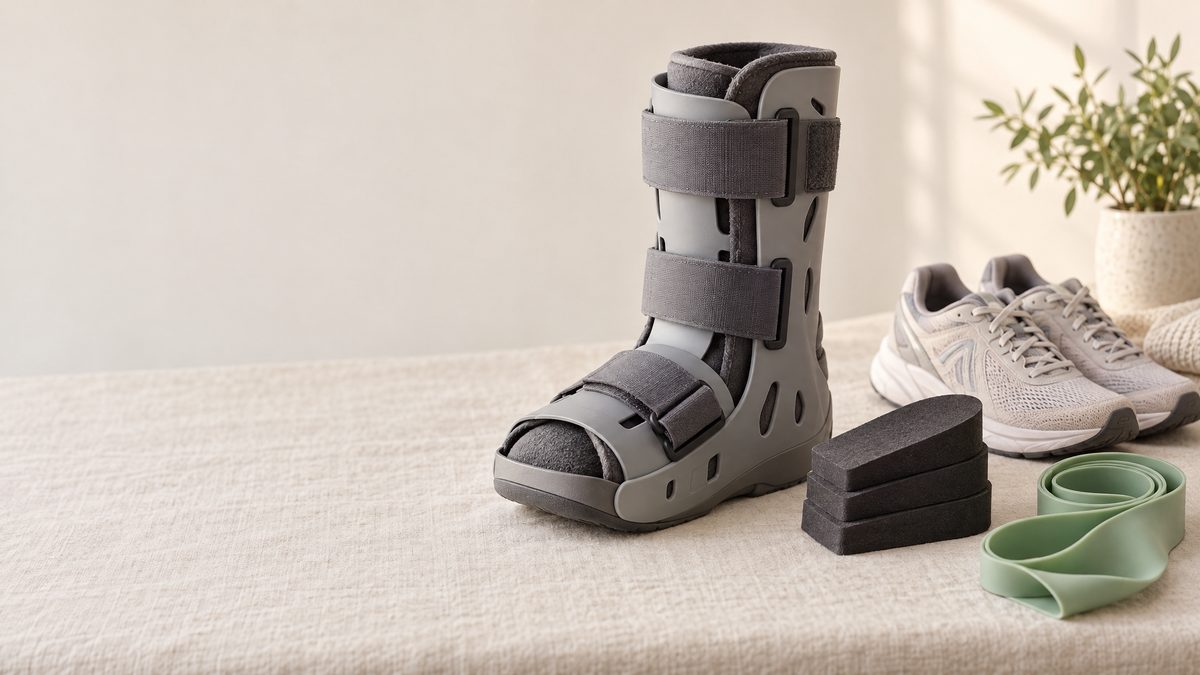
Often yes, but walking does not prove the tear is partial, because people with complete ruptures may still walk (Rossie 2026). Until a scan confirms the injury, one NHS protocol uses a boot with wedges day and night, with no weight on the foot unless the team says otherwise (Bucks NHS).
After that, the plans below disagree on when weight goes back on, from day one to week 2, and trials are still needed (Gatz 2020). Follow the plan you were given. If you are in a boot, do not walk without it, because the tendon may heal longer and weaker (Bucks NHS). Normal walking usually returns in about 3 months (Cedars-Sinai).
What Moves Recovery Forward: Three Published Plans
Heel lift plan
Tested in 26 athletes with mid-tendon tears confirmed by scan (Masci 2013) (Gatz 2020).
- Weeks 0 to 6
- 2 cm heel lifts. Walking and cycling as pain allows. No calf stretching.
- Weeks 7 to 12
- 1 cm lifts. Calf raises, 3 sets of 15 a day: seated, then standing, then on one leg. No stretching.
- After week 12
- If pain free, lifts out. Heel drops, 3 sets of 15, three times a week. Gradual return to sport.
Boot and wedge plan
A hospital protocol for partial tears confirmed by ultrasound (Bucks NHS).
- Weeks 0 to 2
- Boot with 4 wedges, day and night. Crutches, with some weight through the foot.
- Weeks 2 to 6
- One wedge comes out at week 2 and another at week 4. No calf stretching.
- Weeks 6 to 10
- Third wedge out at week 6, the last at week 8. Then the boot alone for 1 to 2 weeks.
- After the boot
- A supportive shoe, with a heel cushion if it helps. Outpatient physical therapy.
Cast then boot plan
A hospital protocol for partial tears and tears where tendon meets muscle (Royal Devon NHS).
- Weeks 0 to 2
- Cast with the toes pointed down. No weight on the foot, using crutches.
- Weeks 2 to 6
- Boot, with weight through it. Crutches reduced as comfortable.
- Weeks 6 to 8
- More ankle movement in the boot. Resistance band exercises and gentle swimming start.
- Week 8 onward
- Boot off, heel pads for 4 to 5 weeks. Specific exercises from week 10. No running until 4 to 5 months.
- When a boot is used. The NHS protocols use one for fresh injuries and while the diagnosis is being confirmed. Heel lifts alone were tested in athletes with confirmed tears. The 2020 review prefers heel lifts, based on few studies and its authors' experience, so that is expert opinion (Gatz 2020).
- Heel drops carry a caution. Another paper warns that this eccentric training may raise the risk of a complete rupture (Lohrer 2020). Ask before starting them.
- Time in a boot raises blood clot risk (Bucks NHS). Putting weight through the boot when you walk and staying hydrated help (Royal Devon NHS).
Signs a Partial Tear Has Become a Complete Tear
No study was found that reports how often this happens (Gatz 2020). The first two signs come from complete rupture guidance (OrthoInfo) (Garras 2012) and are extrapolated to partial tears.
- A new pop or snap, with a jump in pain or swellingThe tendon may have torn further. Get seen the same day.
- You can no longer stand on your toes, or there is a new gap above the heelBoth point to a complete tear. Get seen the same day.
- Throbbing pain in one calf, with swelling or warm, darkened skinThis can be a blood clot, which can feel like the tendon injury. Get checked urgently. Call 911 for chest pain or shortness of breath.
- Numb feet from diabetes or neuropathyYou may not feel a boot sore or a worsening injury. Check your skin daily and tell your care team before using a boot.
- No better at 3 months, or a weak single-leg heel raiseThese are reasons a tear gets another look. Ask for a repeat exam and scan.
- Sore for months but slowly improvingOne NHS protocol expects several months of pain. Keep following your plan.
Blood clot signs from (NHS) (Royal Devon NHS). Numb feet from (MedlinePlus) (Bucks NHS). Three months and heel raise from (Masci 2013) (Gatz 2020).
Antibiotic and Steroid Injection Risks
Fluoroquinolone antibiotics include ciprofloxacin and levofloxacin (OrthoInfo). Ciprofloxacin carries a warning that rupture can happen during treatment or up to several months afterward, with the highest risk over age 60 (MedlinePlus). In a UK study of 1.35 million adults prescribed antibiotics, current use went with about 3 times the rate of Achilles rupture, and about 19 times with oral steroids. The absolute risk stayed small: about 2.1 extra Achilles ruptures per 10,000 patients per year, or 6.6 in people 60 and over also on oral steroids (Morales 2019).
That study did not separate partial tears. For those, the evidence is a 1996 case report (McGarvey 1996) and a brief statement in the 2020 review (Gatz 2020). If tendon pain starts on ciprofloxacin, stop it, rest and call your doctor immediately. For a pop or trouble bearing weight, get emergency care (MedlinePlus).
Steroid injections for tendinitis have been linked to rupture, and doctors avoid them in or around the Achilles (OrthoInfo). In some older studies, nearly 50% of partial ruptures had followed an injection into the tendon (Gatz 2020). Two recent trials of injections for tendinopathy, with 100 and 192 people, recorded no serious adverse events (Johannsen 2022) (Malliaras 2026). Trials that size could miss a rare rupture, and they did not test partial tears. Tell your clinician about any past injection.
What Changes Your Timeline
- Where the tear is. Tears where the tendon meets the muscle generally heal faster than tears through the tendon (Royal Devon NHS). Pain right at the heel can have other causes, such as a Haglund bump.
- Age and activity. Most people studied were younger, male and athletic (Gatz 2020). These results may not fit older or less active people.
- Diabetes, neuropathy or poor circulation. Nerve damage can hide a sore, and damaged blood vessels can slow healing (MedlinePlus). Ask about a boot made for people with diabetes (Bucks NHS).
- Smoking can slow soft tissue healing (Bucks NHS).
The bottom line
- A grade 1 strain usually settles in about 2 to 8 weeks, going by general strain advice.
- A grade 2 partial tear takes about 9 to 12 weeks to heal, and running often waits 4 to 5 months.
- A grade 3 usually means a complete rupture: 4 to 6 months to heal, up to a year for sports.
- A normal squeeze test does not rule out a tear. Ultrasound or MRI confirms it.
- A new pop, losing the ability to stand on your toes or a new gap means get seen the same day.
Frequently Asked Questions
How long does it take for a partially torn Achilles to heal?
A grade 2 Achilles tear usually means a partial tear. Cedars-Sinai says 2 to 12 weeks without surgery, and one NHS protocol says about 9 to 12 weeks, with pain likely for several months. Another NHS protocol advises against running for 4 to 5 months. No trial has measured this directly.
How long is recovery from a grade 3 Achilles tear?
A grade 3 Achilles tear usually means a complete rupture. Cleveland Clinic says it usually takes 4 to 6 months to heal, and up to a year before sports are safe. Check that your report says complete or full thickness, because some scales number their types differently.
How long does an Achilles strain take to heal?
A mild strain usually feels better in a few weeks. NHS advice for strains in general says most feel better after 2 weeks, and to avoid running for up to 8 weeks. No study was found on grade 1 Achilles strains alone. Get it examined if the pain started suddenly.
Does a partial Achilles tear need surgery?
Usually not at first. Small partial tears respond well to nonsurgical treatment. Surgeons consider an operation for lasting pain with a weak single-leg heel raise and a tear on the scan. Some studies also count a tear of more than half the tendon. There is no agreed rule on timing.
Sources
- Gatz M, et al. Partial Achilles tendon rupture, a neglected entity. J Clin Med, 2020
- Masci L, Alfredson H. Rehabilitation of partial midportion ruptures. J Biomed Graph Comput, 2013
- Lohrer H, et al. Operative treatment of partial tears. J Orthop Surg Res, 2020
- Alfredson H, et al. Partial mid-portion ruptures on ultrasound. Br J Sports Med, 2011
- Kayser R, et al. Partial rupture of the proximal Achilles. Br J Sports Med, 2005
- Hartgerink P, et al. Full versus partial thickness tears. Radiology, 2001
- Szaro P, et al. MRI of the Achilles tendon. Eur J Radiol Open, 2021
- Maffulli N. Clinical diagnosis of Achilles tear. Am J Sports Med, 1998
- Garras DN, et al. MRI and acute Achilles ruptures. Clin Orthop Relat Res, 2012
- Amlang MH, et al. Ultrasonographic classification of ruptures. ISRN Orthop, 2011
- Laurent D, et al. Recovery after Achilles rupture. Sci Rep, 2020
- Douglas J, et al. Simmonds-Thompson test. Can J Surg, 2009
- Park SH, et al. Treatment of acute Achilles rupture. Clin Orthop Surg, 2020
- Rossie D. Acute musculoskeletal injuries in the emergency department. Cureus, 2026
- Morales DR, et al. Fluoroquinolones and tendon rupture. Clin Drug Investig, 2019
- McGarvey WC, et al. Partial ruptures and fluoroquinolones. Foot Ankle Int, 1996
- Johannsen F, et al. Corticosteroid injection for tendinopathy. JAMA Netw Open, 2022
- Malliaras P, et al. High volume injections for tendinopathy. BMJ, 2026
- Buckinghamshire Healthcare NHS Trust: Achilles tendon partial tear
- Royal Devon NHS: Achilles tendon injuries
- Cambridge University Hospitals NHS: Achilles tendon rupture
- NHS Lanarkshire: Achilles tendinopathy
- NHS: Sprains and strains
- NHS: Deep vein thrombosis
- AAOS OrthoInfo: Achilles tendon rupture
- Cleveland Clinic: Muscle strains
- Cleveland Clinic: Achilles tendon rupture
- Cleveland Clinic: Thompson test
- Cedars-Sinai: How to treat an Achilles tendon tear
- Hartford Hospital: Torn Achilles tendon
- MedlinePlus: Sprains and strains
- MedlinePlus: Ciprofloxacin
- MedlinePlus: Diabetic foot
- Radiopaedia: Kuwada classification
See a Podiatrist Near You
ASG Foot & Ankle has offices in Homewood, South Chicago Heights and Mokena. Our board-certified podiatrists accept most insurance. Find the office closest to you:
Not Sure How Badly the Tendon Is Torn?
An exam and a scan can show whether a tear is partial or complete. ASG Foot & Ankle has offices in the south Chicago suburbs.