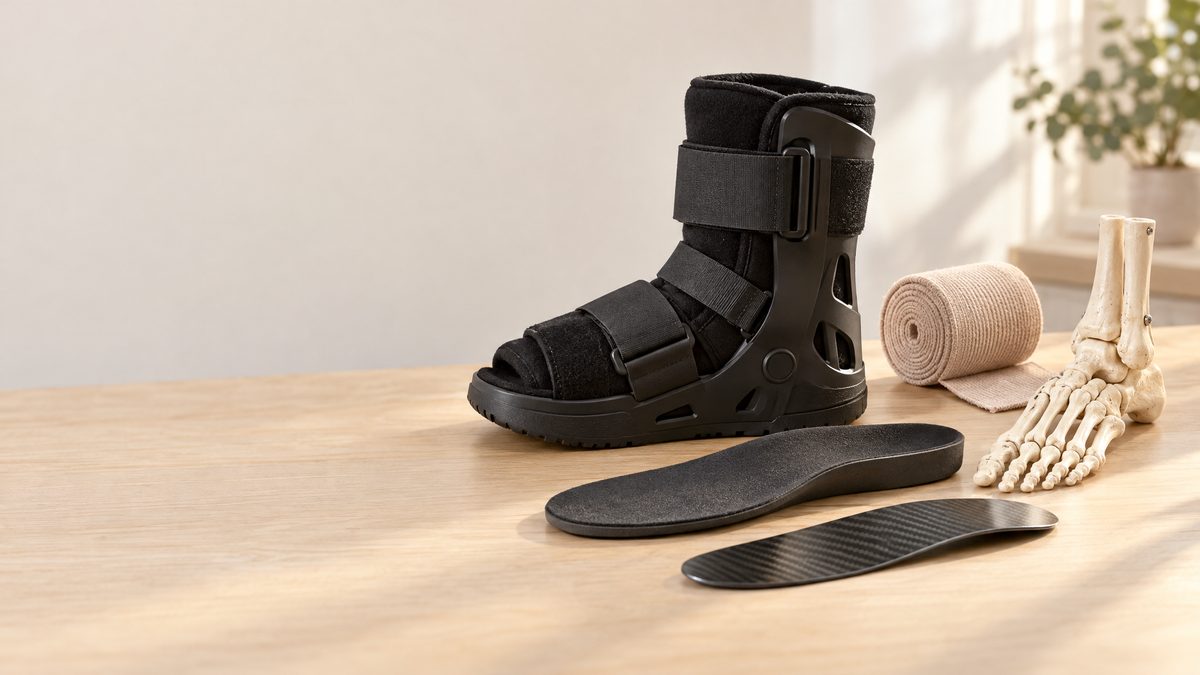
Lisfranc Injury Recovery Time: Sprain vs Fracture, Week by Week
How long a midfoot injury takes with and without surgery, how to tell it from an ordinary sprain, and the long-term risks.
A Lisfranc injury is damage to the joint in the middle of your foot where the long metatarsal bones meet the arch. It ranges from a sprained ligament to bones knocked out of place, it is easy to mistake for an ordinary sprain, and its recovery depends almost entirely on one question: is the joint stable?
ASG Foot & Ankle patient education. Updated October 27, 2026. General information, not a diagnosis.
The short answer
Lisfranc injury recovery time depends on whether the midfoot is stable. A stable sprain with no widening on standing X-rays is usually treated with 6 to 8 weeks in a cast or boot with no weight on the foot, then a gradual return to walking, with running and jumping held off for about 3 months. An unstable injury or fracture-dislocation usually needs surgery (fixation or fusion): 6 to 8 weeks off the foot, weight in a boot from about 6 to 12 weeks, normal shoes by about 3 months, and 6 months to a year for some people to get back to everything. Mild aching and swelling can last 6 to 12 months.
Get It Seen Urgently If
Go to an emergency room or urgent care the same day if, after a twist, fall or crush:
- •There is bruising or blistering on the sole of the foot, under the arch
- •You cannot put weight on the foot, or midfoot pain still stops you standing after simple painkillers
- •The foot looks deformed, wider than the other one, or out of shape
- •The pain is severe and worsening with a tense, very swollen foot, especially after a crush or car crash. This can be compartment syndrome, which needs emergency surgery
- •The toes are cold, pale or blue, or the foot is numb
- •There is a wound over the injured area
- •You have diabetes or neuropathy and the foot is swollen and warm, even if it hardly hurts
Already in a boot or recovering from surgery? Call your clinician if symptoms return or get worse.
What the Lisfranc Joint Is
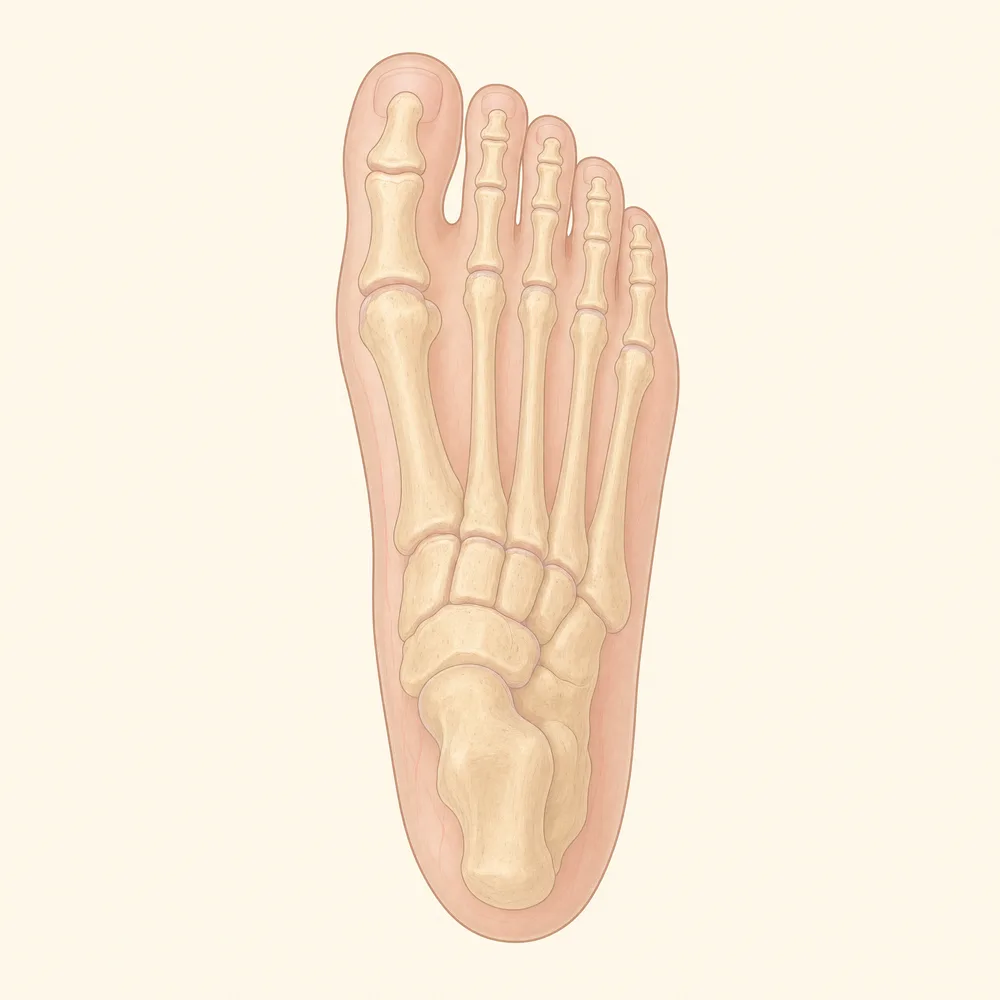
The Lisfranc (tarsometatarsal) joint is the row across the middle of your foot where the five metatarsals meet the small bones of the arch. The inner three joints barely move: they form a stone-arch shape with the base of the second metatarsal locked in like a keystone, which keeps the midfoot arch stable.
The weak point is that the first and second metatarsals have no ligament joining them. Instead, one thick ligament, the Lisfranc ligament, runs underneath from the inner midfoot bone (the medial cuneiform) to the base of the second metatarsal. When it tears, the joint can start to spread apart.
 Illustration
Three kinds of Lisfranc injury
Sprain
Stretched or torn ligaments, no broken bone. Can still be unstable if the ligament is fully torn.
Fracture
A flake of bone pulled off by the ligament, or a break through one or more midfoot bones.
Dislocation
Joint bones forced out of position, often with fractures, after a crash, a fall from height, or a crush.
Low-energy injuries come from a twist and fall, missing a step, or a player landing on your heel while you are on your toes. They are only about 0.2% of fractures, and men are two to four times more likely to have one.
Why Lisfranc Injuries Get Missed (and Called a Sprain)
Reviews estimate that up to 1 in 5 to 1 in 3 Lisfranc injuries are missed or diagnosed late, and one NHS emergency department guideline says up to half of first visits. The reasons:
- It looks like a sprain, often an ankle sprain: pain and swelling, no deformity.
- People can often still walk, and with subtle injuries the pain on standing is often worst at first and then eases.
- Ordinary X-rays can look normal. A torn ligament does not show, and the joint may only open up when you stand on it.
Why it matters
An unstable joint treated like a sprain can drift apart, and delayed treatment is linked with ongoing midfoot pain, a collapsing arch and arthritis. Surgery after about 6 weeks is also harder, because scar tissue makes the bones difficult to line back up. If a "sprained foot" still hurts in the middle when you stand or push off, get a second look.
How Do I Know If I Have a Lisfranc Injury?
You cannot be certain at home, but these clues point to the midfoot rather than the ankle or a simple bruise:
| What you notice | What it can mean |
|---|---|
| Bruising on the sole, under the arch | The classic warning sign, called highly suggestive of a Lisfranc injury. |
| Pain and swelling on top of the midfoot | Right over the joint. Bruising can show on top as well. |
| Pain that worsens standing, walking, or pushing off | With a severe injury you may not be able to bear weight at all. |
| You cannot rise onto tiptoe on that foot | Failing a single-leg heel rise can mean the midfoot is not stable. |
| A pop in the midfoot when it happened | Common with subtle injuries, which then often feel better, so they get missed. |
| A wider foot, or a new gap between the big and second toes | Can mean the bones have spread apart at the joint. |
| Numbness on top of the foot between the big and second toes | A small nerve over the joint can be affected. |
The plantar bruising sign
Bruising on the sole (plantar side) of the midfoot is the sign foot surgeons take most seriously; some reviews call it pathognomonic, meaning it all but confirms the diagnosis. An ankle sprain bruises around the ankle, not under the arch.
The tiptoe test
Rising onto tiptoe on one foot loads the joint hard. Clinicians use it with a "piano key" test of each metatarsal; neither should hurt in an uninjured foot. If you cannot rise up on that foot, stop testing and get it seen.
How it is diagnosed
- 1Standing X-rays, ideally of both feet. Weight opens a gap that a lying-down X-ray can hide. Standing for the X-ray does not make the injury worse.
- 2The 2 mm rule. A gap of more than about 2 mm at the base of the second metatarsal, or a fleck of bone pulled off by the ligament, points to an unstable injury.
- 3CT or MRI when X-rays are unclear. CT shows small fractures and helps plan surgery; MRI shows the ligament, with a sensitivity of up to about 94% for instability.
An NHS emergency guideline advises considering a Lisfranc injury whenever midfoot pain still stops someone bearing weight after simple painkillers, even if the foot X-ray is normal. For the bones further forward, see broken foot recovery time.
Can You Walk With a Lisfranc Injury?
Often, yes, and that is the problem. People with subtle injuries can usually walk, which is why so many are sent home as sprains. Walking tells you nothing about whether the joint is stable.
Before it is assessed
Keep weight off the foot, raise it at or slightly above hip level, and use ice wrapped in a thin towel for about 20 minutes at a time. One NHS emergency guideline splints a suspected Lisfranc injury in a below-knee cast or boot with crutches and no weight until it is reviewed.
After diagnosis
Stable injuries usually stay off the ground for 6 to 8 weeks. Some NHS fracture clinics instead allow weight through the heel only, in a boot with crutches, for 6 weeks. After surgery, expect 6 to 8 weeks with no weight. Follow your own plan.
With neuropathy, the absence of pain is not reassurance: see the diabetes section.
Grade 1, 2 and 3 Lisfranc Sprain Recovery Time
A grade 1, 2 or 3 Lisfranc sprain usually refers to the Nunley and Vertullo stages, designed for lower-energy sports injuries, which grade how far the joint opens on standing X-rays. Every system comes down to the same split: stable injuries can heal in a cast or boot, unstable ones usually need surgery.
| Type | What imaging shows | Usual treatment | Typical recovery |
|---|---|---|---|
| Grade 1 (stage I) | Painful, but no gap between the first and second metatarsals on standing X-rays | Usually no surgery: cast or boot, no weight on the foot | About 6 to 8 weeks protected; impact after about 3 months |
| Grade 2 (stage II) | A 2 to 5 mm gap on standing X-rays, arch height still normal | Usually surgery: a gap over 2 mm means the joint is unstable | Normal shoes by about 3 months; 6 months to a year for everything |
| Grade 3 (stage III) | A gap of more than 5 mm, with the arch starting to flatten | Surgery | The surgical timeline, often toward the longer end |
| Fracture-dislocation | Bones visibly out of place, often several fractures | Surgery, sometimes delayed 10 to 15 days for swelling to settle | Full recovery can take 4 to 6 months or longer |
A grade 1 sprain is not a minor sprain
Even the mildest usually means about 6 weeks with no weight, and "stable" gets rechecked: in a review of injuries first treated without surgery, 12% to 56% of patients across studies later needed an operation. If standing X-rays were normal and a Lisfranc injury has been ruled out, see foot sprain recovery time instead.
Lisfranc Injury Recovery Time, Week by Week
A stable sprain treated without surgery, side by side with an unstable injury treated with fixation or fusion. Plans vary, and yours comes first.
| When | Stable sprain, no surgery | After surgery (fixation or fusion) |
|---|---|---|
| Days 0 to 14 | Cast or boot, crutches, no weight. Foot raised; gentle ankle movements from day one. | After a high-energy injury, surgery may wait 10 to 15 days. Then a splint for about 2 to 3 weeks. |
| Weeks 2 to 6 | Still no weight. Repeat X-rays check the joint has not shifted. | Non-weight-bearing boot or cast. Any wires in the outer midfoot often come out at about 6 weeks. |
| Weeks 6 to 8 | Review at about 6 weeks. If pain-free, weight in a removable boot or with an arch-support insole. | Usually still off the foot until X-rays show it is safe. |
| Weeks 8 to 12 | Out of the boot when your clinician says so. Walk further each week and keep up the exercises. | Weight in a boot, built up step by step from 6 to 12 weeks. Full weight and a shoe with a stiff insert by about 10 to 12 weeks. |
| Months 3 to 4 | Running, jumping and dancing usually return after about 3 months, built up gradually. | Regular shoes by about 3 months. Fixation hardware may come out at 3 to 5 months. Light jogging around 12 to 16 weeks. |
| Months 4 to 12 | Mild aching and end-of-day swelling can last 6 to 12 months. | Sport often at 16 to 28 weeks; some surgeons wait 8 to 12 months. Full recovery 6 months to a year for some. |
The injury itself typically heals in about 6 to 12 weeks; stiffness and swelling take longer. Smoking slows healing, so the weeks in the boot are a good time to stop.
Non-Surgical Recovery: Boot, Crutches and No Weight
Treatment without surgery is usually reserved for injuries with no fracture or dislocation, where the ligaments are not completely torn. The standard plan is 6 to 8 weeks in a cast or boot with no weight on the foot, then building up weight in a removable boot or with an orthotic insole.
What helps
- The foot raised above hip level, especially in the first 24 to 72 hours
- A cold pack in a damp towel for up to 15 minutes every few hours, never directly on skin
- Ankle exercises 3 to 4 times a day: foot up and down, then gentle circles, 10 of each, which also lowers the risk of a blood clot
What to expect at the checks
- Repeat X-rays in the boot. If the bones shift, surgery is needed
- A review at around 6 weeks; if pain-free, a gradual return with an arch-support insole
- Still sore at 6 weeks: about 4 more weeks in a weight-bearing boot in one specialist protocol
Physical therapy usually starts once pain and swelling settle. Running, jumping and dancing are usually avoided for about 3 months.
Lisfranc Fracture Surgery Recovery: Fixation vs Fusion
Surgery is recommended when bones are displaced or the joint is unstable, in practice usually a gap of 2 mm or more. How exactly the joint is lined up is the strongest predictor of how well the foot does. There are two main approaches:
Fixation (ORIF)
The joint is lined up and held with screws or plates while it heals. The hardware may come out at about 3 to 5 months, at the surgeon's discretion. A screw sometimes breaks first, often without spoiling the result.
Fusion (arthrodesis)
The cartilage is removed and the bones are compressed so they knit into one solid block, and the hardware usually stays. Sometimes chosen for purely ligament injuries, and also used later for painful arthritis.
Which is better is still debated. Pooled studies show broadly similar function, with more operations to remove hardware after fixation. In one randomized trial of purely ligament injuries, fusion patients reached about 92% of their previous activity level, versus about 65% after fixation. Either way, expect the timeline in the table above.
Driving waits until you are out of the boot, walk comfortably, and can do a pain-free emergency stop. More in when you can drive after foot surgery.
Return to Sport After a Lisfranc Injury
Most athletes get back. A meta-analysis of 441 athletes and military personnel with lower-energy injuries found 86% returned to play or duty, including 91% of athletes, with no significant difference between surgery and no surgery.
Stable, no surgery
From 6 weeks
A gradual sport-specific build-up once the midfoot is pain-free out of the cast or boot.
Most athlete studies
16 to 28 weeks
Mostly after surgery. Soccer and rugby players averaged about 25 weeks.
Professional football
About 11 months
The average, often with a dip in the first season back.
Return should follow milestones, not the calendar: pain-free drills, and near-equal swelling, hop and balance tests. Some athletes never regain their previous level.
Pain that crept up over weeks of training, with no single injury, is more likely a stress fracture in the foot.
Long-Term Arthritis Risk
A Lisfranc injury can damage the joint cartilage, and arthritis can follow even after successful surgery, usually showing up months later. How often depends on the injury:
| Group studied | Midfoot arthritis reported |
|---|---|
| Lower-energy injuries in athletes and military, no surgery | About 11% |
| Lower-energy injuries in athletes and military, with surgery | About 19% (not a significant difference) |
| Injuries judged stable, treated without surgery, across studies | 5% to 38% |
| Fracture-dislocations (more severe injuries) | Up to about half |
Early diagnosis, an exact alignment, and follow-up X-rays to catch any shift give the best odds; untreated instability can let the arch collapse. Arthritis can cause chronic midfoot pain and stiffness, and when it is disabling it may be treated with a fusion of the affected joints.
Diabetes, Neuropathy and the Midfoot
Reduced feeling in the feet, most often from diabetes, is a risk factor for Lisfranc injuries and hides the pain that would stop you walking on one. It is also the setting for Charcot foot, whose hallmark is a midfoot that collapses into a "rocker-bottom" shape. An international expert task force notes that:
- •Many people recall a minor injury just before it started
- •The foot is typically markedly swollen and warm, often red, with only mild pain
- •It can be mistaken for cellulitis, a blood clot or gout, and early X-rays can look normal
With diabetes or neuropathy, get any midfoot injury checked promptly, ask whether you need a specialist boot, and check the skin under the boot regularly, since you may not feel it rubbing. More in Charcot foot recovery and diabetic foot care.
Standing X-rays normal and the midfoot ruled out? Foot Sprain Recovery Time →
A broken metatarsal rather than the joint? Broken Foot Recovery Time →
Pain on the outer edge of the foot instead? Fifth Metatarsal Fracture Recovery →
Pain that built up over weeks of running? Stress Fracture Healing Time →
Rolled the ankle rather than the midfoot? Ankle Sprain Recovery Timeline →
Wondering when you can drive again? Driving After Foot Surgery →
Frequently Asked Questions
How long does a Lisfranc injury take to heal?
It depends on whether the midfoot is stable. A stable sprain is usually treated with 6 to 8 weeks in a cast or boot with no weight on the foot, then a gradual return to walking, with running and jumping held off for about 3 months. An unstable injury usually needs surgery: 6 to 8 weeks off the foot, normal shoes by about 3 months, and 6 months to a year for some people to get back to everything.
How long does a grade 1 Lisfranc sprain take to heal?
A grade 1 (stage I) sprain, with no gap between the bones on standing X-rays, is usually treated without surgery: about 6 weeks, sometimes 8, in a cast or boot with no weight on the foot. If the midfoot is pain-free by then, activity builds up gradually with an arch-support insole. If it still hurts, one specialist protocol adds about 4 weeks in a weight-bearing boot. Impact activity usually waits about 3 months.
How long does a midfoot sprain take to heal?
A midfoot sprain is often a Lisfranc sprain, the second most common foot injury in athletes after injuries to the joints at the base of the toes. A stable one is usually protected in a cast or boot without weight for about 6 to 8 weeks, impact activity waits around 3 months, and mild swelling can last 6 to 12 months. If standing X-rays show the bones spreading apart, it is treated as unstable, usually with surgery.
Can you walk with a Lisfranc injury?
Often you physically can, especially with a subtle injury, and that is one reason these injuries are missed. Walking on it is not a sign it is minor. Until it has been assessed, keep weight off the foot, raise it, and use ice wrapped in a towel. The one time standing is needed is for standing X-rays, which orthopedic guidance says do not make the injury worse.
How do I know if I have a Lisfranc injury?
Suspect one after a twist, a fall onto a pointed foot, or a crush if the top of the midfoot is painful and swollen and worse when you stand or push off, the sole is bruised under the arch, or you cannot rise onto tiptoe on that foot. Only an examination and standing X-rays, sometimes with CT or MRI, can confirm it, because ordinary X-rays can look normal.
How long is recovery after Lisfranc surgery?
After fixation or fusion, expect 6 to 8 weeks with no weight on the foot in a cast or boot, then weight in a boot from about 6 to 12 weeks once X-rays look right, and regular shoes by about 3 months. Athletes commonly return to sport at about 16 to 28 weeks. Full recovery takes 6 months to a year for some people, and some athletes never regain their previous level.
Will I get arthritis after a Lisfranc injury?
Not always, but the risk is real. In a review of athletes and military personnel with lower-energy injuries, about 1 in 9 treated without surgery and about 1 in 5 treated with surgery developed midfoot arthritis. After major fracture-dislocations it can affect up to half. The factor you can influence most is getting the joint diagnosed early and lined up exactly. Painful arthritis is sometimes treated later with a fusion.
Sources and further reading
- AAOS OrthoInfo: Lisfranc (midfoot) injury
- American College of Foot and Ankle Surgeons, FootHealthFacts: Lisfranc injuries
- Cleveland Clinic: Lisfranc (midfoot) injury
- Whittington Health NHS Trust: Lis Franc injury, fracture clinic patient leaflet (2022)
- Gloucestershire Hospitals NHS Foundation Trust: Guidelines for the management of Lisfranc injuries in ED (2015)
- Moracia-Ochagavia I, Rodriguez-Merchan EC. Lisfranc fracture-dislocations: current management. EFORT Open Reviews (2019)
- Hammad A et al. Lisfranc injuries: latest updates on diagnostics and management. Translational Sports Medicine (2026)
- Attia AK et al. Return to play after low-energy Lisfranc injuries in high-demand individuals: a systematic review and meta-analysis. Orthopaedic Journal of Sports Medicine (2021)
- Guerreiro F et al. Conservative management of Lisfranc injury: a systematic review. Foot & Ankle Orthopaedics (2022)
- Rogers LC et al. The Charcot foot in diabetes. Diabetes Care (2011)
General patient education. Your examination and individual treatment instructions take priority.
See a Podiatrist Near You
ASG Foot & Ankle has offices in Homewood, South Chicago Heights and Mokena. Our board-certified podiatrists accept most insurance. Find the office closest to you:
Midfoot Still Hurting After a "Sprain"?
Bruising on the sole, pain when you push off, or a foot that will not settle all deserve a proper look. ASG Foot & Ankle can examine the midfoot, X-ray it standing, arrange further imaging when needed, and guide the boot and weight-bearing plan, with extra care when diabetes or neuropathy is part of the picture.