Grade 2 Ankle Sprain Recovery Time: A Partial Tear, Week by Week
Three to eight weeks for everyday life, six to twelve for sport. What each stage looks like, and how to tell when it is more than a grade 2.
A grade 2 ankle sprain, a partial tear of a ligament on the outside of the ankle, usually takes about 3 to 8 weeks to get back to normal daily activity and around 6 to 12 weeks before running and sport feel safe. Swelling and some stiffness can linger for months after that, which is normal as long as the trend keeps improving.
The ligament that gives way is usually the anterior talofibular ligament (ATFL) at the front of the outer ankle, and in a harder roll the calcaneofibular ligament (CFL) below it. Expect more swelling and bruising than a mild sprain, a painful limp for the first days, and an ankle slightly looser than the other side.
ASG Foot & Ankle patient education. Updated October 18, 2026. General information, not a diagnosis.
The short answer
Worst pain and swelling: the first 2 to 3 days. Off crutches: usually within about 2 weeks. Normal daily activity: about 3 to 8 weeks. Running and sport: about 6 to 12 weeks, in a brace or tape. Evening swelling: can last 3 to 6 months. Early supported walking beats rest. A grade 2 that is not clearly improving by about 2 weeks, or feels loose, needs a closer look.
Get It Seen Promptly If
These suggest a fracture, a bigger tear or a complication:
- •You heard a crack, or the ankle has changed shape or points at an odd angle: go to the emergency room
- •You could not take four steps right after the injury and still cannot, or the ankle or foot bones are tender to press
- •Numbness, tingling, or a pale, blue or cold foot
- •Pain that is getting worse, or no clear improvement by about 2 weeks
- •Calf pain, warmth or swelling, especially on crutches or in a boot: same-day assessment for a blood clot
- •Diabetes, neuropathy or poor circulation, where pain is not a reliable guide
Grade 1 vs Grade 2 vs Grade 3 Ankle Sprain
The grade describes how much of the ligament is damaged. It is a spectrum, and first-day swelling can hide the difference, so an examination 4 to 7 days after the injury is more accurate.
| Feature | Grade 1 (stretch) | Grade 2 (partial tear) | Grade 3 (complete tear) |
|---|---|---|---|
| What is damaged | Ligament stretched, microscopic tearing | Partial tear, usually the ATFL, sometimes the CFL too | Complete tear of one or more ligaments |
| Swelling and bruising | Mild | Moderate | Significant |
| Walking | Little or no pain | Painful; a limp, sometimes crutches for a few days | Severe pain; often very hard at first |
| Stability when tested | Stable | Slightly looser than the other side | Clearly unstable |
| Usual support | Supportive shoe or brace, briefly | Lace-up or air stirrup brace; occasionally a boot | Boot, brace or cast-brace, then rehab |
| Daily activity | 1 to 3 weeks | About 3 to 8 weeks | Usually months |
| Running and sport | Within a few weeks | About 6 to 12 weeks | Usually months |
Barely swollen and walking the same day? The grade 1 guide fits better. Ballooned within the hour and clearly loose? Read the grade 3 guide. All three grades are compared in our ankle sprain recovery timeline.
Grade 2 Ankle Sprain Recovery, Week by Week
Typical ranges for a first-time grade 2 sprain treated without surgery. Your clinician's plan comes first.
Swelling Builds, Walking Hurts
- Pain, swelling and bruising on the outer ankle, worst over the first 2 to 3 days; bruising often tracks into the foot
- Protect, rest, ice (up to 15 minutes every few hours, wrapped), compress and elevate; skip heat and alcohol
- Put weight on it as pain allows, in a brace; crutches for the first few days are common
- Point the foot up and down and draw circles, about 10 times each, 3 to 4 times a day
Protected Walking
- Walking in the brace gets easier and most people wean off crutches
- An examination at 4 to 7 days grades the sprain more accurately than one on day one
- From about week 2, a towel calf stretch held up to 30 seconds, 3 times
- Most sprains feel better after 2 weeks. Not clearly improving? Get it checked
Out of the Brace, Into Balance Work
- Crutches finished or nearly so; hospital leaflets expect this between 2 and 6 weeks
- Many people wean off the brace for everyday walking after 2 to 3 weeks
- Single-leg balance: holding a chair, then free, then eyes closed, building to 30 seconds
- Calf raises holding a chair, about 12 at a time, three times a day
Walking Close to Normal
- Many grade 2 sprains reach comfortable daily activity here; some take until week 8
- Running usually waits: the NHS advises avoiding it for up to 8 weeks
- Pain lasting beyond 4 to 6 weeks may signal a chronic problem and deserves an examination
Strength, Hopping and Sport
- NHS hospital leaflets describe most sprains as healed between 6 and 12 weeks
- Jumping, then hopping on the spot, then forward, back and side to side
- Still painful, swollen or giving way at 6 to 12 weeks? It needs a reassessment
For pain, over-the-counter acetaminophen or ibuprofen as the label directs, if safe for you. Check with your doctor or pharmacist first if you have kidney disease, stomach ulcers or heart disease, are pregnant, or take a blood thinner.
How Soon Can You Walk on a Grade 2 Sprain?
Sooner than most people expect. Bearing weight as tolerated works better than prolonged rest, starting as soon as pain allows: usually a limp in a brace for the first few days, then steadily longer walks.
The usual choice
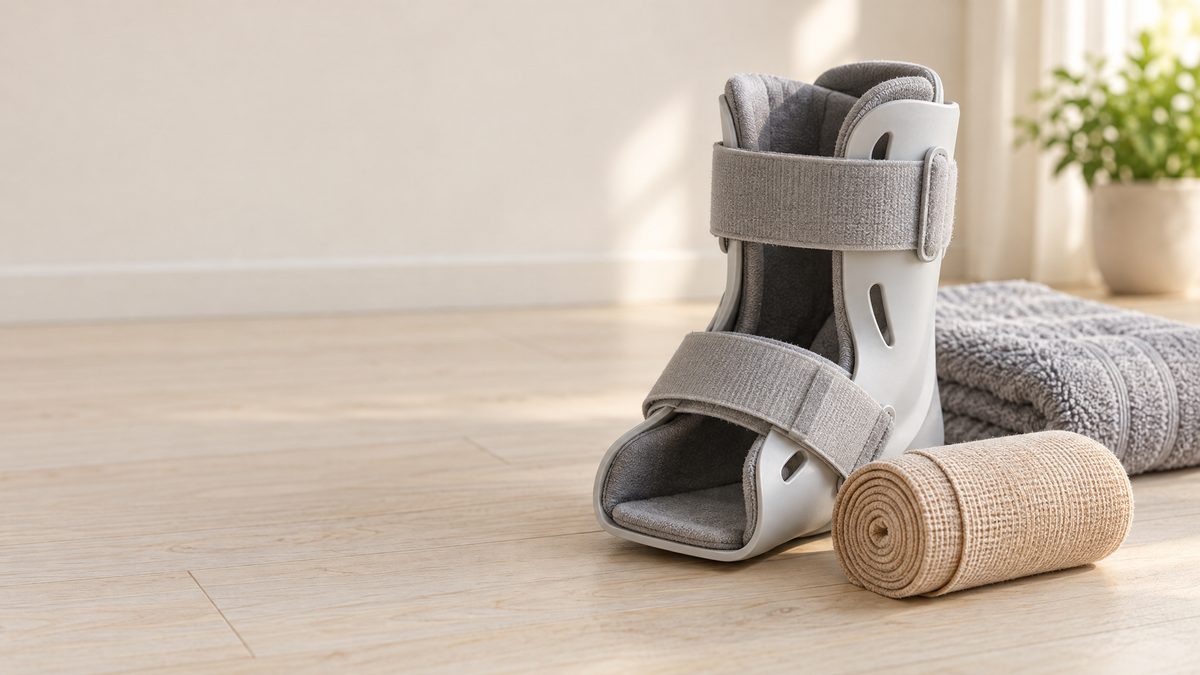
Lace-up or air stirrup brace
Trials reviewed by the AAFP found a lace-up support, or an air stirrup brace with a wrap, better than a wrap alone. A recent AAFP review suggests support for about 5 to 10 days; some NHS leaflets wean it after 2 to 3 weeks.
Sometimes, briefly
Removable walking boot
The AAOS lists a walking boot or air brace as grade 2 options, and some fracture clinics use a boot or supportive shoe for 2 to 6 weeks, mainly when walking is very painful.
First few days
Crutches
Useful while walking is painful. Put weight through the foot as pain allows, and wean off them as the limp settles, usually within about 2 weeks.
Not the main treatment
Elastic wrap or cast
A wrap alone gives less support than a brace. A below-knee cast for about 10 days may ease pain slightly but does not change the long-term result.
Rehab: Motion, Strength, Then Balance
The AAOS describes rehab in three overlapping phases, taking about 2 weeks for a minor sprain and up to 6 to 12 weeks for a more severe one.
Protect and settle
First days
Rest from exercise, ice, elevation and a brace, with early weight bearing as tolerated and gentle foot movement to limit stiffness.
Range of motion, strength and balance
Week 1 to around week 6
Calf stretches, calf raises, resistance band work and single-leg balance. The AAOS stresses ending immobilization in this phase to avoid stiffness.
Advanced strength and return to activity
Around week 4 to 6 onward
Unstable surfaces, single-leg calf raises, jumping and hopping. Straight-line activity before twisting; sharp cuts last.
Phase three is the one most often skipped, because the ankle has stopped hurting. The AAOS names incomplete rehabilitation as the most common cause of chronic ankle instability, and a recent AAFP review describes neuromuscular rehab programs of 8 to 12 weeks.
Back to Work and Driving
Desk job
Often possible well before the ankle has healed, once you can get there safely and keep the foot raised under the desk. Expect more swelling by evening at first.
On your feet all day
Standing, carrying, ladders and uneven ground take longer. Return when you can do your normal duties, and ask about shorter shifts or seated tasks meanwhile.
Driving: not in a walking boot. With the left ankle injured in an automatic car, driving may be possible sooner. With the right, wait until you can brake hard and suddenly without pain or hesitation, and never on drowsy medicine. More in driving after a foot or ankle injury.
The Back-to-Sport Test
Return to sport depends on severity, pain and re-injury risk, not a date; for most grade 2 sprains, around 6 to 12 weeks. First, the ankle should pass all of these:
- Walking, stairs and straight-line jogging without a limp or pain
- Standing on the injured leg for 30 seconds with your eyes closed
- About 12 single-leg calf raises on the injured side without pain
- Hopping for 30 to 60 seconds, then forward, back and side to side, landing softly
- Sharp turns at speed without pain or the ankle feeling like it will give
Once back, wear a lace-up brace, an air stirrup brace or tape. A recent AAFP review recommends a brace during sport for up to 12 months to help prevent a repeat sprain.
Why Swelling and Stiffness Can Outlast Six Weeks
The repaired ligament keeps maturing after it stops hurting. NHS hospital leaflets note pain and swelling can last 3 to 6 months, and stiffness, swelling and weakness can take 6 to 12 months to settle completely. Healing can be slower with diabetes or smoking.
Normal: nearly normal in the morning, puffier by evening, a little better each month. Not normal: increasing swelling, a red or hot ankle, fever, catching or locking, or giving way. The AAOS notes that symptoms persisting beyond 6 to 8 weeks despite treatment may call for an MRI.
Signs It Is More Than a Grade 2
A sprain called grade 2 on day one sometimes turns out to be something else once the swelling settles.
The ankle feels loose or gives way
A grade 2 is only slightly looser than the other side. A clearly unstable ankle may be a complete tear.
Not improving by about 2 weeks
A grade 2 is still sore at 2 weeks but should be improving week by week.
It could be a fracture
The Ottawa ankle rules call for an X-ray if you could not take four steps right after the injury and still cannot, or there is bone tenderness at the back edge or tip of either ankle bone, the base of the fifth metatarsal, or the navicular on the inner arch.
The pain sits above the ankle
Pain just above the joint between the shin bones, after a twist, worse with pushing off and stairs, points to a high ankle sprain.
Pain behind the outer ankle bone, or catching
This can be a tendon injury, cartilage damage or a small fracture, all easily missed early.
Pain above the joint? The high ankle sprain guide covers the grade 2 high ankle sprain, which usually needs a boot and runs longer. A small, stable break on X-ray? See stable ankle fracture recovery.
"Torn Ligament in the Ankle": Partial Is Grade 2, Complete Is Grade 3
A torn ankle ligament is a sprain described in different words. A partial tear, with the ligament weakened but still in one piece, is a grade 2. A complete tear is a grade 3 sprain.
So torn ligament recovery time depends on which: about 3 to 8 weeks to daily activity and 6 to 12 weeks to sport for a partial tear, usually months for a complete one. Nearly all ordinary outer ankle sprains are treated without surgery; the AAOS notes that even a complete tear will heal without repair if it is immobilized. Surgery is mainly for ankles still unstable after months of rehab.
Not sure which grade you have? All three side by side. Ankle Sprain Recovery Timeline →
Barely swollen and walking the same day? Grade 1 Ankle Sprain Recovery →
Ankle clearly loose, or told it is a complete tear? Grade 3 Ankle Sprain Recovery →
Pain above the ankle, between the shin bones? High Ankle Sprain Recovery →
Just rolled it and not sure how bad it is? Rolled Ankle Recovery Time →
Did the X-ray show a small break? Stable Ankle Fracture Recovery →
Frequently Asked Questions
How long does a grade 2 ankle sprain take to heal?
Most grade 2 ankle sprains take about 3 to 8 weeks to get back to normal daily activity and around 6 to 12 weeks before running and sport feel safe. Pain and swelling peak in the first 2 to 3 days, and swelling and stiffness can take months to settle completely.
Can you walk on a grade 2 ankle sprain?
Usually yes, in a brace and with a limp at first, and crutches can help for the first few days. Early weight bearing as pain allows works better than prolonged rest. The exception: if you could not take four steps right after the injury and still cannot, or the ankle or foot bones are tender to press, get an X-ray first.
What is the difference between a grade 1 and a grade 2 ankle sprain?
A grade 1 is a stretched ligament: mild swelling, walking close to comfortable, and a stable ankle. A grade 2 is a partial tear: moderate swelling and bruising, painful walking, and an ankle slightly looser than the other side. A grade 1 usually feels much better in about 2 weeks; a grade 2 takes several weeks.
How long does a torn ligament in the ankle take to heal without surgery?
A partial tear is a grade 2 sprain: about 3 to 8 weeks to daily activity and 6 to 12 weeks to sport. A complete tear is a grade 3 and usually takes months. Nearly all ordinary outer ankle sprains, including complete tears, are treated without surgery.
Why is my ankle still swollen 6 weeks after a grade 2 sprain?
Usually because healing is still finishing. NHS hospital leaflets note that pain and swelling can last 3 to 6 months, typically least in the morning and worst by evening. What matters is the trend. Swelling that is increasing, a red or hot ankle, calf pain, or an ankle that keeps giving way should be examined.
Is a grade 2 high ankle sprain the same injury?
No. An ordinary grade 2 sprain is a partial tear of the ligaments on the outer side of the ankle. A grade 2 high ankle sprain partially tears the ligaments holding the two lower leg bones together just above the joint, usually after a twisting injury. It often needs a boot and takes longer to recover.
Sources and further reading
- NHS: Sprains and strains
- AAOS OrthoInfo: Sprained ankle
- AAFP: Management of acute ankle sprains (2025)
- AAFP: Update on acute ankle sprains (2012)
- King's College Hospital NHS Foundation Trust: Ankle sprain leaflet
- Royal United Hospitals Bath NHS Foundation Trust: Advice after spraining your ankle
General patient education. Your examination and individual treatment instructions take priority.
See a Podiatrist Near You
ASG Foot & Ankle has offices in Homewood, South Chicago Heights and Mokena. Our board-certified podiatrists accept most insurance. Find the office closest to you:
Grade 2 Sprain Not Settling?
If your ankle is still painful to walk on, keeps swelling, or feels loose weeks after the injury, an examination can confirm the grade, X-ray it when a fracture is possible, and set out a brace and rehab plan that fits your work and sport.