Bruise on Top of Foot: Healing Time, Causes, and When to X-Ray
Foot Care Guide from ASG Foot & Ankle
The short answer
Bruise on top of foot: most fade in 2 to 4 weeks (Alberta Health), while a deeper foot injury takes about 6 weeks to heal (Sussex NHS). Get an X-ray if you cannot take four steps or pressing a midfoot bone hurts (ACR 2019), or if the sole is bruised too (OrthoInfo). A crushed, cold or newly numb foot needs emergency care now.
- Usually a simple bruiseYou can take four steps, no one spot on bone is sharply sore, it eases daily, and no row below fits. Home care, check at day 7.
- Needs an X-ray or examFour steps were not possible, one spot on bone is sharply sore, or the sole is bruised. Today or tomorrow.
- No injury you rememberCan be a forgotten twist, thin skin, a medicine or a blood problem. Call a clinician, sooner if more bruises appear.
- Needs care nowCrushed, deep wound, severe pain that keeps building, fever, or a cold, pale or newly numb foot. Emergency department.
ASG Foot & Ankle patient education. Updated November 25, 2026. General information, not a diagnosis.
Already told it is a bone bruise? Read bone bruise healing time. Is only a toe hurt? Use the broken or bruised toe check.
Top of Foot Broken or Bruised? Where to Press
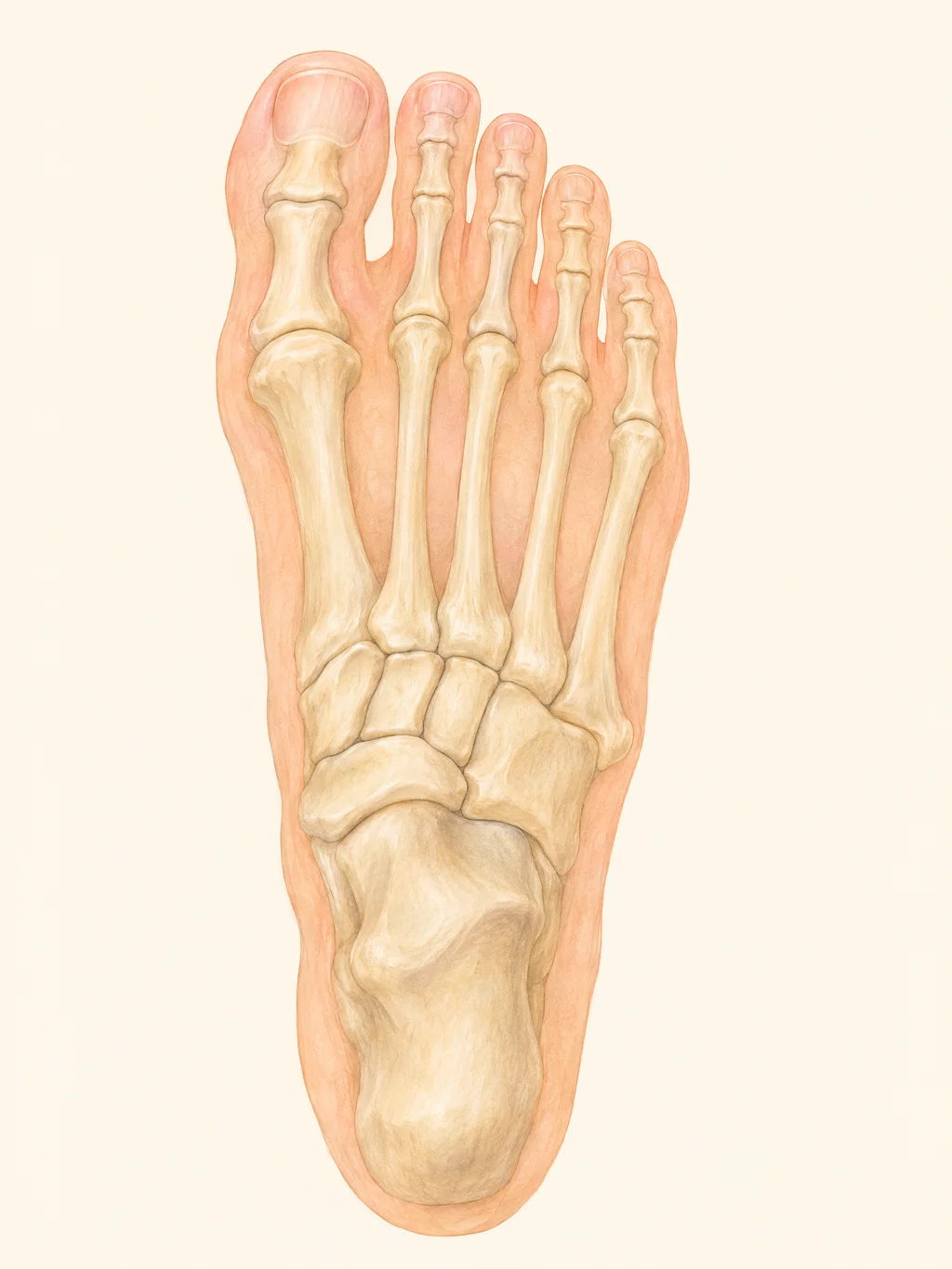
Skip this if the foot is crushed, open, misshapen, cold or numb. Otherwise press the bone with one fingertip, then the same place on the other foot. Spots 1 and 2 come from the Ottawa foot rules, the checklist clinicians use to decide on an X-ray (AFP 2016). Spots 3 and 4 are added for metatarsal and Lisfranc injuries.
 Illustration
- 1Navicular. The bump on the inner side of the midfoot, in front of the ankle.
- 2Base of the fifth metatarsal. The bump halfway along the outer edge.
- 3Metatarsal shafts. The long bones behind each toe.
- 4Lisfranc area. Where the first two metatarsals begin.
Does My Foot Need an X-Ray? An 11-Question Check
For an injured foot. Built on the published Ottawa rules plus red flags. Yes is always the worrying answer.
- 1. Can you see bone, is there a deep or open wound, or has the foot changed shape?
- 2. Is the foot or a toe cold, pale, gray, newly numb or impossible to move, even after loosening shoes and wraps?Bruise color alone does not count.
- 3. Is the pain severe and still building, or does the foot feel tight and hard?
- 4. Was the foot crushed, trapped, run over or hit by a very heavy load?A dropped can or jar does not count by itself.
- 5. Is there spreading redness or heat, a red streak, pus or a fever, or do you feel very ill?
- 6. Were you unable to take four steps right after the injury, or are you unable to now?Ottawa rule. If it hurts too much to try, answer Yes.
- 7. Does it hurt to press the bone at spot 1, at spot 2, or on either side of the ankle?Ottawa foot and ankle rules.
- 8. Is there one sharply sore spot on the bone along spots 3 and 4?Added here. Soreness spread over the whole bruise is a No.
- 9. Is there a bruise under the arch, or midfoot pain when you stand or push off?A warning sign of a Lisfranc injury.
- 10. Did you hear a snap, pop or grinding, or is the pain severe?From NHS advice.
- 11. Does any of these apply: long-term numb feet, diabetes, poor circulation, a blood thinner, pregnancy, bone disease, broken skin, other injuries, being drunk or drowsy, age 5 or under, or an injury over 10 days old?
Answer each question. 0 of 11 done.
The Ottawa rules were made for clinicians examining a foot. This check cannot diagnose or rule out a break. If you are worried, get seen whatever it says.
What the Ottawa Foot Rules Catch and Miss
- The rule
- Midfoot pain plus any one of these: bone tenderness at spot 1 or spot 2, or not managing four steps. One version counts the steps only if you failed both at the time and at the exam (AFP 2016). Another counts either (ACR 2019), as this check does.
- What it catches
- About 99% of breaks in the ankle and midfoot. It also flags many people with no break: only 58% of them were cleared in one review (AFP 2016), and a median of 26% in another (ACR 2019).
- Who it cannot clear
- Anyone with reduced feeling in the foot, a skin wound, pregnancy, bone disease, several injuries or an injury over 10 days old, and children 5 or under. (ACR 2019)
- What it leaves out
- Metatarsals and toes. If a break there is suspected, an X-ray is usually appropriate even when the rule is negative. (ACR 2019)
How to Heal a Bruised Top of Foot: The First 48 Hours
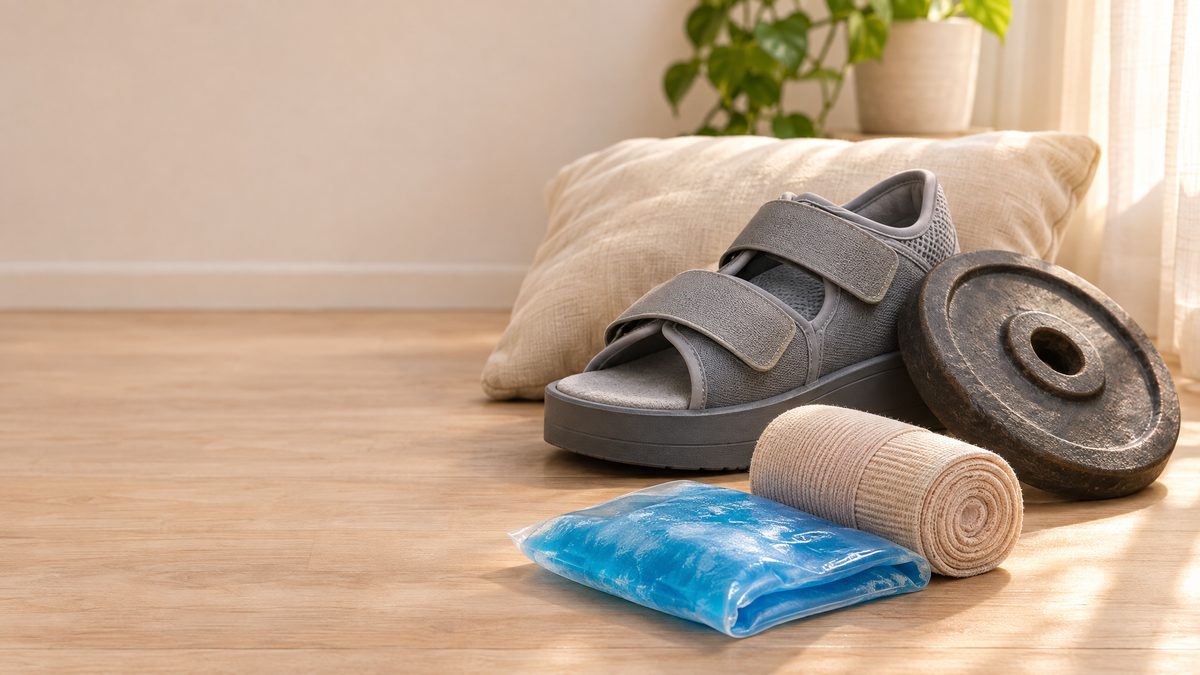
- 1Rest it for 1 to 3 days, and walk only as much as is comfortable. (Sussex NHS)
- 2Raise it above your heart when you can. (MedlinePlus)
- 3Ice it through a cloth for up to 15 minutes each hour (MedlinePlus). Only ice normal skin that can feel hot and cold (Gloucestershire NHS).
- 4Take acetaminophen if you need it (MedlinePlus). Advice on ibuprofen differs: the NHS lists it (NHS), and one NHS hospital says to wait 48 hours (Gloucestershire NHS). Check with your provider first (Cleveland Clinic).
- 5Wrap it lightly, or leave it unwrapped. Alberta suggests an elastic bandage, loosened if the foot goes numb or cool (Alberta Health). Gloucestershire advises against one (Gloucestershire NHS).
For these 48 hours, skip hot showers, heat packs and alcohol, which can add swelling (Alberta Health). After two days a warm compress is fine (Cleveland Clinic). Do not play sport on it (MedlinePlus).
Shoes and laces
Wear a roomy shoe with a low heel (NHS). Tight laces press on the top of the foot (NHS Lanarkshire), so loosen them over the sore spot. A stiff-soled shoe can make walking easier, though it does not speed healing (Sussex NHS).
How Long Does a Bruised Foot Take to Heal?
- Skin color fades2 to 4 weeksSlower on a leg than on the face or arms
- Soft tissue injury of the footAbout 6 weeksIncludes sprains as well as bruises
- Leftover ache and end-of-day swelling3 to 6 monthsPossible, not certain
Foot contusion recovery time depends on what is counted. The bruise itself takes 2 to 4 weeks (Alberta Health), or within two by another source (Cleveland Clinic). Injured tissue in the foot takes about 6, and some ache or swelling can last 3 to 6 months (Sussex NHS). If ligaments were strained, see foot sprain recovery time.
When to get it checked
- Any day: new or worse pain, swelling or numbness. (Alberta Health)
- Day 7: not improving. A break can be missed the first time. (Gloucestershire NHS)
- Week 2: pain no better (NHS), or color still there (Cleveland Clinic), though up to 4 weeks is usual (Alberta Health).
- Week 4: swelling not clearly going down. (Sussex NHS)
Bruise Color Day by Day, on Lighter and Darker Skin
Day 1
Lighter skin: Red
Darker skin: Purple, dark brown or black. Can be hard to see.
Days 2 to 3
Lighter skin: Mixed, leaning blue by day 3
Darker skin: Still dark
Days 4 to 7
Lighter skin: Green, with yellow coming in
Darker skin: Starting to lighten toward your own skin color
Days 7 to 14
Lighter skin: Mostly yellow, some brown
Darker skin: Lighter brown. Yellow may never show.
Weeks 2 to 4
Lighter skin: Fading out
Darker skin: Fading out
Color is a poor clock. In 369 photographs of bruises on 89 people, the only firm conclusion was that a yellow bruise was more than 18 hours old (Langlois 1991). Judge healing by soreness, swelling and walking.
Lighter row: color charts drawn from published studies (Dimitrova 2006). Darker row: Cleveland Clinic's description (Cleveland Clinic) and a study of 18 people of South Indian or Sri Lankan descent, where yellow could not be seen (Thavarajah 2012). No daily chart for darker skin was found.
Why Is There Bruising on Top of My Foot Near the Toes?
A bruise can spread down the body with gravity (Alberta Health), so purple toes after a knock higher up can be settled blood. Press each toe bone too. A sharply sore one needs an exam.
Dropped Something on Top of Your Foot?
After a crush or heavy blow, go to an emergency department for any of these
- Pain far worse than the injury should cause
- A foot that feels tight, full or under extreme pressure
- Numbness, or toes you cannot move. These come late, so do not wait for them.
These can mean compartment syndrome: pressure inside the muscles cuts their blood flow, and it needs emergency surgery. Rarely, a smaller injury causes it. Loosen any tight bandage on the way. (OrthoInfo) (MedlinePlus)
- A broken metatarsal. Pain in one place, swelling, bruising and trouble putting weight on the foot (AFP 2016). See broken foot recovery time.
- A scrape or small cut. Clean it. A tetanus shot is advised if your last was over 5 years ago for a dirty wound, or over 10 for a clean one. (Alberta Health)
Bruise on the Sole Too: The Lisfranc Warning
Turn the foot over and look under the arch. A bruise there strongly suggests a Lisfranc injury, a break or ligament tear in the midfoot. It can follow a simple twist and is easily mistaken for a sprain. The other clue is midfoot pain that worsens when you stand, walk or push off. (OrthoInfo)
Keep weight off and get seen. Ask about standing X-rays, since films taken without weight are not reliable for subtle injuries (ACR 2019). See Lisfranc injury recovery.
Numb on Top of the Foot
Loosen the shoe, laces and any wrap first. After an injury, a foot that stays numb or turns cold or pale is an emergency. With no injury, call a clinician if numbness is new or getting worse (Alberta Health). If your feet were already numb, for example from diabetes, get any suspected break X-rayed: you may feel no sore spot and still walk on a broken foot (ACR 2019).
Bruise on Top of Foot for No Reason
Call a clinician about bruising you cannot explain (MedlinePlus). Some explanations:
- A forgotten injury
- People who bruise easily may not recall the bump (Alberta Health). A twisted ankle can bruise as far down as the toes (Alberta Health).
- A medicine
- Blood thinners, aspirin, ibuprofen-type drugs, steroids, some antidepressants (SSRIs) and fish oil (AFP 2016). Call the prescriber, and do not stop a prescribed drug on your own. A bruise that is spreading fast needs a doctor now (Alberta Health).
- Older, thinner skin
- Vessels break easily, often on the hands, legs and feet. (Alberta Health)
- A vein problem
- Brown color that comes on slowly around the ankles and lower legs. (MedlinePlus)
- A stress fracture
- Pain that builds with activity, with swelling on the top of the foot and sometimes a bruise (OrthoInfo). See stress fracture healing time.
- Poor blood flow
- Skin that turns blue or very pale, feels cold and stays that way needs care now (Alberta Health). For slower changes, see warning signs of poor circulation.
When a doctor checks your blood
Call about unexplained or frequent large bruises, one that keeps returning or lasts more than two weeks, or bruises with nosebleeds or blood in urine or stool (Cleveland Clinic). If a bleeding problem is suspected, the usual tests are a blood count and smear, two clotting tests (PT and PTT), and kidney and liver function (AFP 2016).
Tiny red or purple dots that do not fade when pressed should always be checked (MedlinePlus). With a fever or feeling very ill, go to an emergency department, because sepsis is one cause (Alberta Health).
What Is a Bruised Forefoot?
A bruise over the toes, the ball of the foot or the front ends of the metatarsals. The same home care applies. The Ottawa rules do not cover this area (ACR 2019), so one sharply sore spot still needs an exam.
The bottom line
- Most bruises on the top of the foot fade in 2 to 4 weeks. A deeper injury takes about 6.
- Get an X-ray if you cannot take four steps, a midfoot bone hurts when pressed, or the sole is bruised too.
- A crush, severe pain that keeps building, a deep wound, or a cold, pale or newly numb foot is an emergency.
- With no injury you remember, call a clinician, sooner if more bruises appear or you bleed elsewhere.
Frequently Asked Questions
Can you walk on a bruised foot?
Usually yes, if you can take four steps and it stays comfortable. Sussex NHS advice is to walk as much as is comfortable, with crutches if they help. Walking does not fully rule out a break. Get it examined if you cannot put weight on it.
Is a badly bruised foot broken?
Not always. A large bruise does not prove a break, and a broken metatarsal often looks normal in shape. A snap or pop, severe pain and swelling within 30 minutes, one sharply sore spot on bone, or not managing four steps all call for an exam, usually with an X-ray.
What is a hematoma on top of the foot?
It is blood pooled in one place under the skin, so it feels spongy, rubbery or lumpy, while a plain bruise is more spread out. It is different from a clot in a vein. It can last a month or longer. Call a clinician about a lump, and never drain it with a needle.
What is a foot contusion?
Contusion is the medical word for a bruise: small blood vessels break and leak under skin that stays closed. It can be under the skin, inside a muscle or on bone, and the bone kind is the most severe and painful.
Sources and further reading
- MyHealth Alberta: Bruises and blood spots under the skin
- MyHealth Alberta: Toe, foot and ankle injuries
- Cleveland Clinic: Bruises (ecchymosis)
- MedlinePlus: Bruise
- MedlinePlus: Bleeding into the skin
- MedlinePlus: Stasis dermatitis and ulcers
- NHS: Pain in the top of the foot
- University Hospitals Sussex NHS: Foot soft tissue injury (2025)
- Gloucestershire Hospitals NHS: Soft tissue injuries to the foot and ankle (2024)
- NHS Lanarkshire: Extensor tendinopathy
- Bica D, Sprouse RA, Armen J. Diagnosis and Management of Common Foot Fractures. Am Fam Physician. 2016;93(3):183-191
- Clinical Evaluation of Bleeding and Bruising in Primary Care. Am Fam Physician. 2016;93(4):279-286
- American College of Radiology: Appropriateness Criteria, Acute Trauma to the Foot (revised 2019)
- AAOS OrthoInfo: Lisfranc (midfoot) injury
- AAOS OrthoInfo: Compartment syndrome
- AAOS OrthoInfo: Stress fractures of the foot and ankle
- Langlois NE, Gresham GA. The ageing of bruises. Forensic Sci Int. 1991;50(2):227-238
- Dimitrova T, et al. Bruise age determination: a survey. Conf Proc IEEE Eng Med Biol Soc. 2006:4840-4843
- Thavarajah D, Vanezis P, Perrett D. Bruise age on dark-skinned individuals. Med Sci Law. 2012;52(1):6-11
General patient education. Your examination and individual treatment instructions take priority.
See a Podiatrist Near You
ASG Foot & Ankle has offices in Homewood, South Chicago Heights and Mokena. Our board-certified podiatrists accept most insurance. Find the office closest to you:
Not Sure It Is Only a Bruise?
ASG Foot & Ankle can examine and X-ray the foot, check the midfoot joints, and fit a stiff-soled shoe or boot if it needs one.