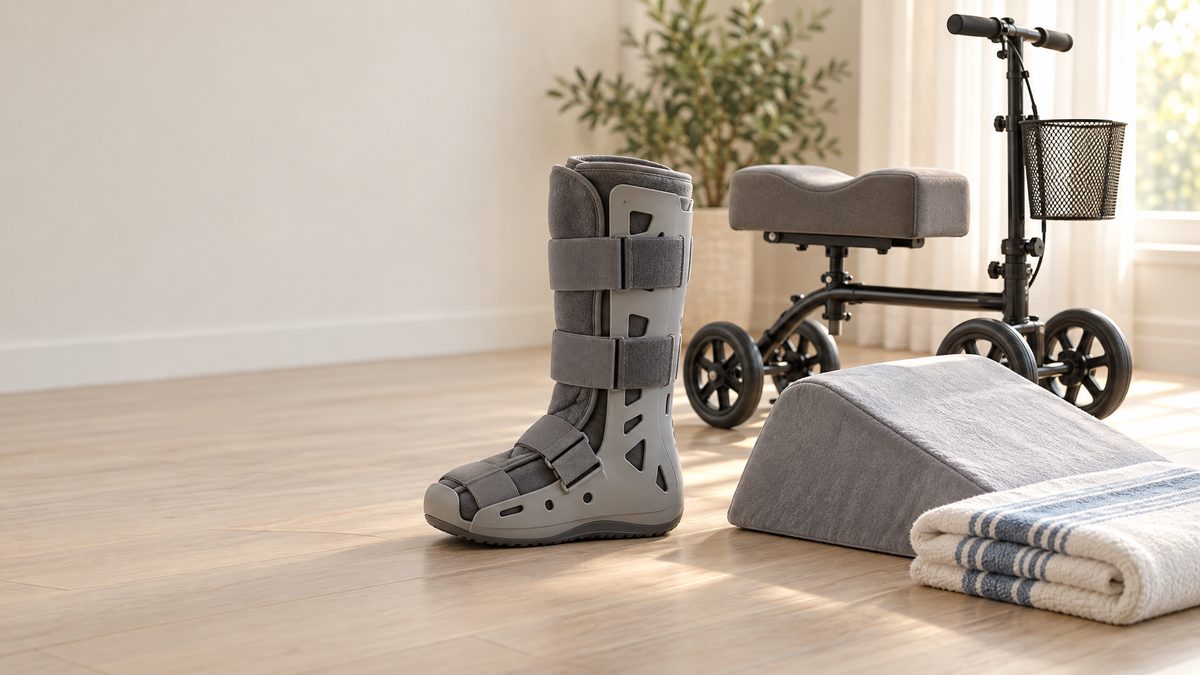
Fractured Fibula and Dislocated Ankle Recovery Time: Week by Week
Foot Care Guide from ASG Foot & Ankle
The short answer
Fractured fibula and dislocated ankle recovery time is usually 3 to 4 months to normal daily activities, with the bone healed by about 10 to 12 weeks (AAOS). Full function often takes a year or longer: in one study, 34% of people with a dislocation were back to usual activities at 1 year, versus 67% without (Ramadi 2022).
- Ankle put back in placeSame dayEmergency room, then a splint
- SurgeryDay 1 to week 2Often in 1 to 2 days, later if swelling delays it
- First weight on the leg2 to 6 weeksSome surgeons allow it sooner, some later
- Boot comes off6 to 12 weeks
- Bone healed10 to 12 weeksEarly healing by about 6 weeks
- Normal daily activities3 to 4 monthsStiffness is still common
- Full function6 to 12 months or longerSome limits can remain
ASG Foot & Ankle patient education. Updated November 6, 2026. General information, not a diagnosis.
This page covers a fibula break with the ankle joint knocked out of place. If the joint stayed in place, read the ankle fracture recovery timeline. For a small break with no surgery, read minor ankle fracture recovery time.
Fracture-Dislocation vs Fracture Alone: What Studies Found
People with a dislocation scored lower in most of these studies. Everyone here had surgery. Scores (FAOS) run from 0 to 100, and higher is better.
| Who was studied | With dislocation | No dislocation |
|---|---|---|
| 47 people with one serious fracture pattern (PER IV), at least 1 year (Warner 2015) | Pain 56, daily activities 61, sport 37 | Pain 82, daily activities 84, sport 59 |
| 62 people, median 37 months (Tantigate 2020) | Pain 76 | Pain 92 |
| 108 people, mean 21 months (Sculco 2016) (Ahmed 2024) | Daily activities 78 | Daily activities 88 |
| 190 people, at least 1 year (Hu 2025) | Sport 32, pain 64 | Sport 46, pain 66 |
| 142 people, share back to usual activities (Ramadi 2022) | 21% at 6 months, 34% at 1 year | 52% at 6 months, 67% at 1 year |
- The results are mixed. In Hu, only the sport score differed clearly. In Ramadi, the 1-year figure rests on 32 people with a dislocation, and the link lost statistical significance after adjustment (P = .13). A review of 15 studies still found worse function with dislocation (Cao 2022).
- Age and health explain part of the gap. In Tantigate, people with a dislocation averaged 53 years old versus 44, and 24% had diabetes versus 7%.
- Joint damage is a likely reason. Cartilage lesions were found in 45% of ankle fractures checked soon after injury (Martijn 2021), so a healed bone on X-ray and a comfortable ankle can be months apart.
How People Are Doing at 6 Weeks, 6 Months, 1 Year and 2 Years
This table follows 142 adults aged 18 to 65 after ankle fracture surgery (Ramadi 2022). Their average age was 43, 36% had a dislocation and 54% had a bimalleolar or trimalleolar fracture. The ankle score (OMAS) runs from 0 to 100.
| Time | Ankle score | Still stiff | Back at work | Back to usual activities |
|---|---|---|---|---|
| 6 weeks | 39 | 89% | 51% | Under 1% |
| 6 months | 69 | 82% | 91% | 39% |
| 1 year | 78 | 73% | 97% | 52% |
Work figures count people with jobs who answered. The 6-week figure can include modified duties.
At 1 year, pain often looks better than stiffness. In 198 people after ankle fracture surgery, 88% had no or mild pain, and 90% had no limits or limits only in recreation (Egol 2006). Younger age, male sex and no diabetes predicted better recovery.
At 2 years, some people still have limits. In 74 people, scores averaged 90 for Weber A, 80 for Weber B and 78 for Weber C, and 21% had a poor or fair result (Lash 2002). After Weber B surgery, 36% of people reported a complete recovery at 2 years (Ponzer 1999). Both studies are older and small, and neither reports dislocation separately.
Week by Week: What Is Usually Allowed
This is a typical course after surgery. Your surgeon's instructions come first, because the plan depends on the fixation, your skin and your health. Sources: (NHS GGC) (NHS) (Chelsea and Westminster).
| When | Weight on the leg | Usually allowed | Not yet, or watch for |
|---|---|---|---|
| Before surgery | None | Leg raised. Toes and knee moving. | Walking on it. Food or drink if surgery may be soon. |
| Weeks 0 to 2 | Cast: usually none. Boot: as pain allows, if approved. | Foot raised when not walking. Clips or stitches out at about 2 weeks. | Driving. Getting a cast wet. |
| Weeks 2 to 6 | Cast: possibly some weight. Boot: as pain allows. Crutches at times. | Desk work if comfortable. X-ray and review at about 6 weeks. | Driving. Lifting work and driving jobs. |
| Weeks 6 to 12 | Rising as advised. Boot may stop. | Normal activity guided by pain. Physical therapy if stiffness limits daily life. Driving once out of the boot and safe to brake hard. | Sport, heavy lifting and manual work. |
| Week 12 onward | As tolerated | Manual work, sport and heavy activity. Pain and swelling may last 6 to 9 months. | Moderate or severe pain, or new swelling: contact the clinic. |
Written instructions differ. UK standards say most people may bear weight as tolerated after fixation unless there is a specific concern (BOAST 2016). MedlinePlus says to keep weight off until told, in most cases at least 6 to 10 weeks (MedlinePlus). Follow your own plan, and ask what it is based on.
Bimalleolar, Trimalleolar and Weber: What Your Paperwork Means
| Term | Meaning, and what it can change |
|---|---|
| Bimalleolar fracture | The lateral malleolus (outer bump, end of the fibula) and medial malleolus (inner bump, end of the tibia) are both broken (AAOS). |
| Trimalleolar fracture | Both bumps plus the back of the tibia. Nearly half of fracture-dislocations in one review (Cao 2022). Later fusion or ankle replacement was about twice as likely (SooHoo 2009). |
| Weber A | A stable break near the end of the fibula that usually heals in about 6 weeks (Hull NHS). See minor ankle fractures. |
| Weber B | A fibula break at the level of the syndesmosis (Ahmed 2024). Alone, it can often be treated in a boot (NLG NHS), but a dislocation marks a highly unstable injury. |
| Weber C | A fibula break above the syndesmosis. In 48 people with trimalleolar fractures, the 1-year score was 70 for Weber C and 79 for Weber B (Testa 2019) (Ahmed 2024). |
| Syndesmosis | The joint between the tibia and fibula, held by ligaments (AAOS). See high ankle sprains for a ligament injury with no break. |
| Bosworth | A fibula piece stuck behind the tibia that may not go back without surgery (Ahmed 2024). In 15 people, delayed surgery and repeated reduction attempts predicted worse results (Cho 2019). |
| SER IV, PER IV | Lauge-Hansen codes for the foot position and twisting force at injury (Hu 2025). |
| ORIF | Open reduction and internal fixation, usually plates and screws. See broken ankle surgery recovery. |
| External fixator | A frame outside the leg that holds the joint while the soft tissues recover before final surgery (Ahmed 2024). |
If the X-ray shows no break and the joint is in place, see grade 3 ankle sprain recovery.
Why the First Night Matters
- Go to the emergency room. An ankle at an odd angle, severe pain, or blue, white or numb toes need emergency care. Do not drive yourself, keep weight off it, and do not eat or drink in case you need surgery (NHS).
- Reduction comes early. Reduction means resetting the joint. UK standards call for it urgently, with X-rays first unless that would cause an unacceptable delay (BOAST 2016). The main aim is to ease the strain on the skin and soft tissues (Cao 2022).
- Nerves and blood supply get checked twice. Circulation and feeling should be recorded on arrival and again after reduction, and a repeat X-ray should confirm the position before you leave (BOAST 2016). The posterior tibial nerve and nearby vessels are at risk (Cao 2022). You can ask what those checks showed.
- Swelling can move the surgery date. UK standards recommend fixation on the day of injury or the next day for most people under 60 with an unstable joint (BOAST 2016). In one US health system, 84% of 354 closed fracture-dislocations had surgery within 48 hours (Wawrose 2020). When surgery is staged to let the soft tissues recover, study averages run from about 6 to 15 days (Suravaram 2026). A 2022 review found no study of the best timing for this injury (Cao 2022).
- The joint can slip in a splint. Across nine studies, 14.6% of splinted ankles lost position versus 3% in an external frame, with similar soft-tissue complications (Suravaram 2026). Single centers range from 2.2% (González-Morgado 2024) to 50% of 28 ankles, where 5 people had skin death from pressure (Wawrose 2020). Keep every recheck visit, and report new pain or tight, pale or blistered skin the same day.
Warning Signs Before and After Surgery
- Blue, white, dark or cold toes, or new numbnessBlood flow or a nerve may be affected. Go to the emergency room now.
- Foot looks out of line again, or a bone is showingThe joint may have slipped, or the fracture may be open. Go to the emergency room now.
- Chest pain or trouble breathingA blood clot may have reached the lungs. Call 911.
- Throbbing pain or swelling in one calf or thighThis can be a deep vein clot. Get seen the same day.
- Fever, rising pain, or a wound that is red or leakingThese can be signs of infection. Call your surgeon the same day.
- Cast or splint too tight, or pain that medicine does not easeThe cast may need changing. Call the same day, or go to the emergency room if pain is severe.
- Some swelling or aching at 6 monthsPain and swelling may last 6 to 9 months. Mention it at your next visit.
Sign lists: (NHS) (NHS DVT) (NHS GGC) (MedlinePlus) (MedlinePlus reduction) (Chelsea and Westminster).
How often: in 57,183 ankle fracture surgeries in California, 0.34% led to readmission for a lung clot and 1.44% for wound infection (SooHoo 2009). Infection estimates run from 1.5% to 16% depending on risk. One review lists fracture-dislocation as a risk factor (Tausendfreund 2025), while another study found no increase (Sculco 2016).
When Can You Walk on It? What the Trials Found
- WAX trial. 561 adults with unstable fractures at 23 UK hospitals started walking at 2 or 6 weeks after surgery. At 4 months, ankle scores were 65.9 and 61.2, and complications were 16% and 14% (WAX 2024).
- Cochrane review. Early walking probably raised the ankle score by 3.56 points in 5 trials and 890 people, which the reviewers did not count as clinically meaningful. Reoperations may be about the same (Cochrane 2024). A second review found no difference at 1 year (Tong 2024).
These results may not fit every fracture-dislocation. WAX excluded people with a hindfoot nail or no protective feeling in the ankle, and surgeons judged that 42% of the 2,218 people assessed needed the full 6 weeks (NIHR). The published summary does not report dislocated ankles separately. A surgeon may delay weight because of the fixation, soft tissues or neuropathy (BOAST 2016).
Return to Work and Driving
Work. NHS guidance suggests 2 to 3 weeks off for desk work, at least 6 weeks for lifting or driving jobs, and about 12 weeks before full manual work (NHS GGC). Early walking made no difference to return to work in a trial of 110 people (Dehghan 2016). In 69 people with bimalleolar or trimalleolar fractures, not randomized, walking in a boot from the day of surgery brought people in non-desk jobs back at 5.7 weeks versus 10.0 (Cunningham 2021).
Driving. For a right ankle, the limit is braking. In 31 people, slower braking added 22 feet of travel at 60 mph at 6 weeks and 8 feet at 9 weeks, and braking time was back to normal by 9 weeks (Egol 2003). In a different test, 91% of 23 people passed an on-road test at 6 weeks (Ho 2018). AAOS suggests 9 to 12 weeks (AAOS). See driving after foot surgery.
Arthritis Risk Years Later
Arthritis on X-ray is common after these injuries. Surgery for it is much less common, at least in the first years.
| Time after injury | What was found |
|---|---|
| About 18 months | Arthritis in 42% with a dislocation and 24% without, in 130 people. The gap was not statistically clear (P = .063) (Park 2026). |
| 5 years | Fusion or ankle replacement in 0.96%, about 2 times higher with trimalleolar fractures and 5 times higher with open fractures (SooHoo 2009). |
| About 6 years | Arthritis in 30% of 169 people with trimalleolar fractures. A step of more than 1 mm left in the joint surface raised the risk (Verhage 2019). |
| About 12 years | X-ray arthritis in 63%: 31% mild, 22% moderate, 10% severe. Dislocation predicted it, yet few people had pain or limits. Only half of eligible people were followed (Regan 2016). |
| 12 to 22 years | Advanced arthritis in 36% of 102 people. With 3 or more risk factors, such as Weber C, dislocation, higher BMI or age 30 or over, the probability was 60% to 70% (Lübbeke 2012). |
In people who reached end-stage arthritis, the average gap after injury was 20.9 years, with a range of 1 to 52 (Horisberger 2009).
Why a Pro Athlete's Return Date Does Not Predict Yours
Many people look up this injury after seeing it happen on TV. A return date tells you when a player was cleared to play. It says little about how the ankle feels months or years later.
- Age and health differ. Athletes in a 2025 review averaged 31 years old (Mazzella 2025). People with a fracture-dislocation in one hospital study averaged 53, and 24% had diabetes (Tantigate 2020).
- The range is wide even for athletes. 87% returned to sport, at an average of about 4.5 months, but bimalleolar and trimalleolar fractures took up to 720 days (Mazzella 2025).
- Being fit does not guarantee a full return. Among 72 service members averaging 29 years old, most with one broken bone, 64% returned to running and 17% left the military because of ongoing pain (Orr 2015).
- Rehab access differs. One case report describes a college running back with 6 months of rehabilitation plus therapy and nutrition staff (Feigenbaum 2016). Cochrane reviewers were still unsure whether specific therapy programs beat usual care (Cochrane 2024).
- The injury may differ too. Public reports often do not say which bones broke or whether cartilage was damaged.
Diabetes, Neuropathy and Poor Circulation
- Diabetes with complications raised the odds of short-term problems after surgery (odds ratio 2.30), and poor leg circulation raised them too (1.65) (SooHoo 2009).
- Compared with diabetes alone, diabetes with neuropathy, kidney disease or artery disease carried 3.8 times the complications and 5 times the revision surgery or fusion. Many people do not know they have neuropathy (Wukich 2011).
- Longer non-weight bearing, then protected weight bearing, is recommended (Wukich and Kline 2008). The early walking results above may not apply, because WAX excluded people without protective feeling.
- Tell every clinician about these conditions, and check both feet daily. Without normal feeling, pain may not warn you about a wound. A foot that is warmer, redder or more swollen than the other can be Charcot foot and needs urgent review (ACFAS).
What the Evidence Cannot Tell You
- No timeline for this exact injury. The sources opened for this page give no week-by-week timeline for fracture-dislocation alone, so the timeline above comes from broader ankle fracture groups. The dislocation groups in the comparison table range from 20 to 69 people, and most studies looked back at records.
- Whether a cast could replace surgery. A 2022 review does not recommend nonsurgical care for fracture-dislocation (Cao 2022), while UK standards allow close contact casting for some people over 60 (BOAST 2016). In 620 adults over 60 with unstable fractures, casting gave similar 6-month function, fewer wound problems (1% vs 10%) and more malunion (15% vs 3%), but the summary does not report dislocated ankles separately (Willett 2016).
The bottom line
- Bone usually heals by about 10 to 12 weeks, and most people reach normal daily activities in 3 to 4 months.
- A dislocation is linked with more pain and a slower return to usual activities, though age and health explain part of that.
- At 1 year most people are back at work, about half are back to usual activities and many are still stiff.
- Arthritis on X-ray is common years later, but fusion or ankle replacement stayed under 1% at 5 years in a large study.
- Numb or discolored toes, chest pain, one-sided calf swelling, fever or a leaking wound need same-day care.
Frequently Asked Questions
How long does a fractured fibula and dislocated ankle take to heal?
Early bone healing takes at least 6 weeks, and complete healing takes about 10 to 12 weeks. Most people with an ankle fracture return to normal activities in 3 to 4 months. A dislocation may slow what comes after, and full function often takes a year or longer.
Can I still walk with a fractured fibula?
Sometimes. A stable break near the end of the fibula, such as a Weber A, is often walked on early. A fibula fracture with a dislocated ankle is unstable, so keep weight off it until a surgeon says otherwise. If it hurts to put weight on your ankle, get it checked.
Is a dislocated ankle as bad as a broken ankle?
It depends on whether a bone also broke. Dislocation with no fracture is rare, about 1 in 200 ankle dislocations in one estimate, and most reported cases did well. Dislocation with a fracture usually does worse than a fracture alone, with more pain and lower sport scores.
Do fibula fractures heal quickly?
A stable fibula fracture usually heals in about 6 weeks, though swelling can last up to 6 months. For ankle fractures in general, AAOS gives 10 to 12 weeks for complete healing. With a dislocation, the bone is often the quickest part to recover.
How long does a dislocated ankle take to heal if nothing is broken?
In a review of 154 reported cases with no fracture, immobilization averaged just over 6 weeks, with a range of 2 to 16 weeks. Most people had good function, and reduced motion was the most common long-term complaint, in 18%. Most of these were case reports.
What is the recovery time for a bimalleolar or trimalleolar fracture?
Expect the same broad timetable, with a slower finish for more severe patterns. In 48 people with trimalleolar fractures, the 1-year ankle score was 79 out of 100 for Weber B and 70 for Weber C. In 169 people followed about 6 years, 30% had arthritis on X-ray.
FAQ sources: (AAOS) (Hull NHS) (NHS) (Wight 2017) (NLG NHS) (Ahmed 2024) (Verhage 2019).
Sources and further reading
- AAOS OrthoInfo: Ankle fractures (broken ankle)
- British Orthopaedic Association: BOAST, the management of ankle fractures (2016)
- NHS: Broken ankle
- NHS: Deep vein thrombosis
- NHS Greater Glasgow and Clyde: Ankle fracture surgery, physiotherapy advice
- Chelsea and Westminster Hospital NHS: Advice following ankle fracture surgery
- MedlinePlus: Ankle fracture, aftercare
- MedlinePlus: Closed reduction of a fractured bone, aftercare
- Hull University Teaching Hospitals NHS: Weber A fracture of the fibula
- Northern Lincolnshire and Goole NHS: Minimally displaced Weber B ankle fracture
- ACFAS FootHealthFacts: Charcot foot
- NIHR Evidence: Walking just 2 weeks after ankle surgery is safe for many
- Warner SJ et al. Fracture-dislocations and poorer outcomes in PER IV ankle fractures. Foot Ankle Int (2015)
- Tantigate D et al. Functional outcomes after fracture-dislocation of the ankle. Foot Ankle Spec (2020)
- Sculco PK et al. Dislocation as a risk factor after SER ankle fractures. Arch Orthop Trauma Surg (2016)
- Hu SY et al. Dislocations and functional outcomes in SER ankle fractures. Chin J Traumatol (2025)
- Park JS et al. Injury characteristics and outcomes of ankle fracture-dislocation. J Clin Med (2026)
- Ramadi A et al. Recovery and return to activity 1 year after ankle fracture surgery. Foot Ankle Orthop (2022)
- Ahmed R et al. Patient-reported outcomes in ankle fracture-dislocation, a systematic review. Trauma (2024)
- Cao MM et al. A systematic review of ankle fracture-dislocations. Front Surg (2022)
- Cho BK et al. Prognostic factors after Bosworth fractures. Foot Ankle Surg (2019)
- Testa G et al. Negative prognostic factors in surgery for trimalleolar fractures. Eur J Orthop Surg Traumatol (2019)
- Wight L et al. Pure ankle dislocation, a systematic review. Injury (2017)
- Martijn HA et al. Osteochondral lesions in ankle fractures. Knee Surg Sports Traumatol Arthrosc (2021)
- Wawrose RA et al. Temporizing external fixation vs splinting. Foot Ankle Int (2020)
- González-Morgado D et al. Temporary immobilization for closed ankle fracture-dislocations. Eur J Orthop Surg Traumatol (2024)
- Suravaram V et al. External fixation vs splinting in ankle fracture-dislocations, a meta-analysis. Arch Orthop Trauma Surg (2026)
- Bretherton CP et al. Early vs delayed weight-bearing after ankle fracture surgery (WAX). Lancet (2024)
- Dehghan N et al. Early weightbearing vs non-weightbearing after ankle fixation. J Orthop Trauma (2016)
- Cunningham BP et al. Immediate weightbearing after bimalleolar and trimalleolar fractures. J Foot Ankle Surg (2021)
- Lewis SR et al. Rehabilitation for ankle fractures in adults. Cochrane Database Syst Rev (2024)
- Tong J et al. Early vs delayed weight bearing after ankle fixation, a meta-analysis. Orthopedics (2024)
- Egol KA et al. Predictors of short-term functional outcome after ankle fracture surgery. JBJS (2006)
- Lash N et al. Ankle fractures: functional and lifestyle outcomes at 2 years. ANZ J Surg (2002)
- Ponzer S et al. Type B ankle fractures, a two-year follow-up. J Orthop Trauma (1999)
- Egol KA et al. Lower-extremity function for driving after ankle fracture surgery. JBJS (2003)
- Ho SWL et al. Return to car driving after right ankle fracture surgery. Arch Orthop Trauma Surg (2018)
- Regan DK et al. Outcomes over a decade after unstable ankle fracture surgery. J Orthop Trauma (2016)
- Verhage SM et al. Posterior malleolus step-off and osteoarthritis in trimalleolar fractures. Arch Orthop Trauma Surg (2019)
- Lübbeke A et al. Risk factors for post-traumatic ankle osteoarthritis, an 18-year follow-up. Int Orthop (2012)
- SooHoo NF et al. Complication rates after ankle fracture fixation. JBJS (2009)
- Horisberger M et al. Posttraumatic ankle osteoarthritis after ankle-related fractures. J Orthop Trauma (2009)
- Mazzella GG et al. Return to sport in athletes after surgical ankle fractures. J Exp Orthop (2025)
- Orr JD et al. Occupational outcomes after ankle fixation in a high-demand population. Foot Ankle Int (2015)
- Feigenbaum LA et al. Rehabilitation of a collegiate football player after ankle fracture. Int J Sports Phys Ther (2016)
- Tausendfreund J et al. Post-operative infection after ankle fracture surgery. Eur J Trauma Emerg Surg (2025)
- Wukich DK et al. Ankle fractures in uncomplicated vs complicated diabetes. Foot Ankle Int (2011)
- Wukich DK, Kline AJ. The management of ankle fractures in patients with diabetes. JBJS (2008)
- Willett K et al. Close contact casting vs surgery in older adults (AIM trial). JAMA (2016)
General patient education. Your surgeon's instructions and your individual treatment plan take priority.
See a Podiatrist Near You
ASG Foot & Ankle has offices in Homewood, South Chicago Heights and Mokena. Our board-certified podiatrists accept most insurance. Find the office closest to you:
Ankle Stiff, Swollen or Slow to Recover?
ASG Foot & Ankle can assess an ankle that is not recovering as expected. If your ankle has just been injured and looks out of line, go to the emergency room first.