Bruised Heel Recovery Time: Fat Pad, Heel Bone, and How to Tell
Recovery Guide from ASG Foot & Ankle
The short answer
Bruised heel recovery time is about 1 to 2 weeks for most heel bruises that spare the bone (Banner Health). A bruised heel bone takes a few weeks if mild, and averaged 12 weeks or more in foot and ankle bone bruises on MRI (Kim 2019). See a provider for a suspected bone bruise (Cleveland Clinic), no improvement after 2 weeks, or today if you cannot walk on it (NHS).
- Fat pad bruise1 to 2 weeksThe cushion is hurt and the bone is spared
- Heel bone bruiseA few weeks to monthsMild ones settle in weeks, a bad one can take months or longer
- Foot or ankle bone bruise on MRI12 to 21 weeksAverage length of pain in 76 people, by type
ASG Foot & Ankle patient education. Updated November 25, 2026. General information, not a diagnosis.
Bruised somewhere else? See bone bruise healing time for the whole foot, or a bruise on the top of the foot.
Get a Hurt Heel Seen Today If
- Pain is severe after any injury, or makes you feel faint or sick.
- You cannot walk, climb stairs or rise onto your toes.
- You felt or heard a snap, pop or grinding.
- The heel has changed shape, or bruising and swelling reach the ankle or calf.
- Emergency department now: a bad fall or crash, a deep wound, bone showing, or a foot that feels extremely tight or turns cold, pale or newly numb. Say so if your back hurts too.
These can mean a broken heel or torn Achilles (NHS). A bad fall or crash needs an emergency room (Cleveland Clinic) and can also break the spine (AAOS). Extreme pressure (MedlinePlus) or a sudden loss of blood supply (Alberta Health) cannot wait. See broken heel recovery time.
Where Exactly Does It Hurt?
The heel bone rests on a thick pad of fat. A hard landing or a lot of running and jumping can hurt the pad (2026 review), the bone, or both. The sorest spot is the first clue to which.
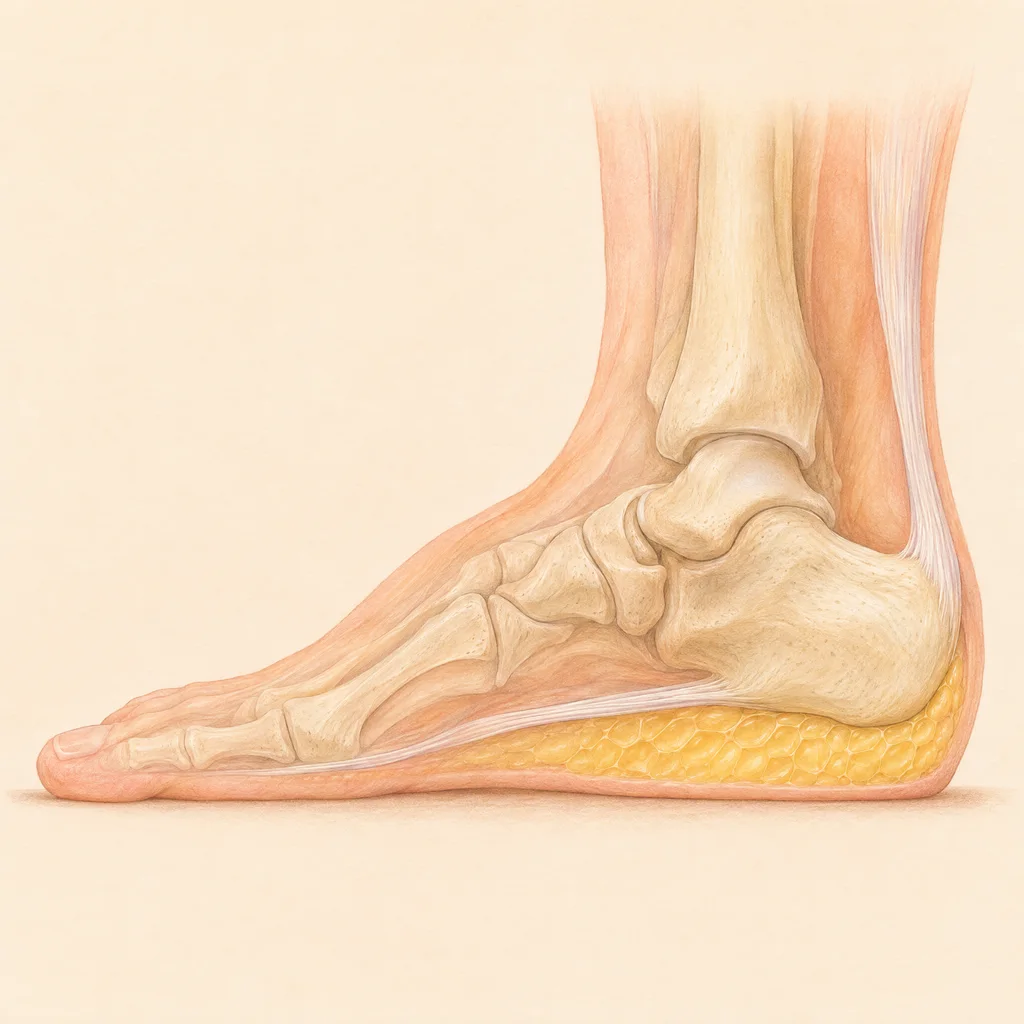 Illustration
- 1Center of the heel pad. Deep, bruise-like pain on pressing: fat pad.
- 2Sides of the heel bone. Pain on squeezing: possible stress fracture.
- 3Inner front edge of the heel. Worst on first steps: plantar fascia.
- 4Back of the heel. Sore with shoes or after exercise: Achilles tendon.
How each one behaves
The numbers match the picture.
First steps after bed or sitting
- 1Fat padOften not the worst moment.
- 2Heel boneUnclear. No study was found on this.
- 3Plantar fasciaThe worst moment. Eases with walking.
- 4AchillesStiff up the back of the heel.
Barefoot on a hard floor
- 1Fat padClearly worse. A soft shoe helps.
- 2Heel boneHurts under weight.
- 3Plantar fasciaCan ache again after long standing.
- 4AchillesHurts more where a shoe presses.
Squeezing the heel from both sides
- 1Fat padPress up into the middle instead.
- 2Heel bonePain suggests a stress fracture. No study was found for bruises.
- 3Plantar fasciaPress the inner front edge instead.
- 4AchillesIn a child of 8 to 12, pain fits Sever's disease.
Resting
- 1Fat padStanding hurts more. A thin pad can ache at night.
- 2Heel bonePain that starts to show up at rest needs a visit.
- 3Plantar fasciaBetter, until the next first steps.
- 4AchillesSwelling can be there all day.
After a run or a day of standing
- 1Fat padA deep ache in the middle.
- 2Heel boneWorse over days of the same activity.
- 3Plantar fasciaLoosens up, then can return.
- 4AchillesCan be severe the next day.
Patterns from (AFP 2025) (AFP 2018) (Cleveland Clinic) (NHS Lanarkshire) (2022 review) (NHS) (AAOS)
Sources disagree on mornings. One says first steps hurt less with fat pad pain than with plantar fasciitis (NHS Lanarkshire). Another says bruised heels often hurt on getting up (Banner Health). If mornings are your main trouble, read the plantar fasciitis healing timeline.
How to check it at home
Skip these if anything in the red box fits or your feet are numb.
- Press. Rest the ankle on your other knee and press a thumb into each numbered spot.
- Squeeze. Press gently on both sides of the heel bone at once. Pain suggests a stress fracture (AFP 2018). No study was found showing that a painless squeeze clears the bone.
Leave out heel raises and hops while walking still hurts (Stanford). No home check can confirm a diagnosis.
Bruised Heel Bone vs Fracture: X-ray or MRI?
How it started helps. One blow fits a bruise or a break. Pain that crept in after more training or harder ground fits a stress fracture (AFP 2025). With a minor break you may still walk, with a limp (AAOS).
- X-ray first after a fall or hard landing. It can show a break, and cannot show a bone bruise. (Cleveland Clinic)
- MRI next if the X-ray is normal and the heel keeps hurting. Of 30 military recruits with heel bone stress injuries on MRI, 15% had one visible on X-ray (JBJS 2006). MRI is the preferred test for a heel stress fracture (AFP 2025).
- It changes the plan. A severely painful heel stress fracture can mean little or no weight for up to 6 weeks (AFP 2018). See stress fracture healing time.
Book a visit this week if
- You think the bone is bruised, or bone pain lasts more than a few days. (Cleveland Clinic)
- It is no better after 2 weeks of home care, or keeps coming back. (NHS)
- Pain is climbing, or now shows up at rest. (AFP 2025)
- The pad snaps or pops when you step, which can mean it is torn. (2026 review)
- There is burning, tingling or numbness. (NHS)
Diabetes, numb feet or poor circulation
Home checks depend on feeling. Nerve damage can hide an injury and damaged blood vessels can slow healing, so call your provider right away about a hurt, red, warm or swollen heel (MedlinePlus). Do not ice numb skin or tape it yourself. In someone who spends long hours in bed or a wheelchair, a dark purple or maroon heel can be a deep pressure injury that worsens quickly. Take the weight off and call right away (MedlinePlus).
If it is a child
In active children, usually 8 to 12, the most common cause is Sever's disease (AFP 2018). Read Sever's disease in kids, unless there was a fall, when the red box applies.
How Long Does a Bruised Heel Take to Heal?
Heel bruise and heel bone bruise research is thin. A 2022 review found only 7 original studies of heel fat pad pain, and none set out to time one injury (2022 review). The figures that exist:
- 1 to 2 weeks
- Most heel bruises. Hospital advice, not a study. (Banner Health)
- 2 weeks or 4 months
- One person, both heel bones, one accident. The right stopped hurting within 2 weeks. The left needed partial weight for 4 months. (Dienst 2000)
- 12 to 21 weeks
- Average length of pain, by bruise type, in 76 people with foot and ankle bone bruises on MRI. Only 12 of 102 bruises were in the heel. (Kim 2019)
- Several months
- Fat pad pain that built up from overuse. Most people improve. (NHS Lanarkshire)
How to Heal a Bruised Heel, Week by Week
First 72 hours
- Stop running and jumping. Raise the heel when you rest. (NHS)
- Ice it in a towel for up to 20 minutes every 2 to 3 hours (NHS), never on numb skin (NHS Lanarkshire).
- Wear soft-soled, low-heeled shoes with a heel pad, indoors too. (NHS)
- Take acetaminophen or ibuprofen if they are safe for you. (NHS)
Day 4 to week 2
- Walk short distances in cushioned shoes. No flip-flops or bare feet. (NHS Lanarkshire)
- Keep fit by swimming or cycling. (Banner Health)
- No better? One hospital says call after a couple of days (Banner Health), the NHS after 2 weeks (NHS). After a hard landing or with deep bone pain, use the shorter limit.
Weeks 3 to 6
- Improving: add walking time, then start the running steps below.
- Told it is a bone bruise: no sport or hard exercise until you are cleared, because loading it too soon can crack it (Cleveland Clinic).
Heel Cups, Shoes and How to Tape a Bruised Heel
Heel cups and shoes. Family medicine guidance lists both, and tape, for heel pad pain (AFP 2025). A 2022 review found no randomized trial of cups. Its one case report followed one man in gel cups, whose pain fell from 10 to 1 out of 10 over 102 days (2022 review).
Tape. A 2026 pilot trial taped 16 people around the edge of the heel to gather the pad under the bone. After 3 days their foot pain score was about 21 points better, out of 100, than with loose tape. The drop in pain right after taping was small and could have been chance. They had hurt for 16 months on average, so a fresh bruise may differ (Loop taping 2026). The method:
- Lie face down while a helper tapes clean, dry skin. In the trial, a physical therapist did it.
- Start 1-inch elastic tape at the front middle of the heel pad.
- Go around the edge, drawing the pad in, and cross the start. Make two or three loops.
Take it off if the skin itches or blisters, or the foot tingles. Skip it with diabetes or nerve problems, which the trial excluded. Have a provider show you first (Cleveland Clinic).
Return to Running After a Bruised Heel
No study was found that tested a running plan for bruised heels. These steps borrow from Oxford and Stanford plans for injured runners and a paper on shin and foot stress injuries. If the bone may be bruised or cracked, get cleared before step 2.
Step 1: Walk without a limp
Impact: lowestEveryday walking in cushioned shoes.
Move up when: 5 days in a row are pain-free. (JOSPT 2021)
Hold if: You limp, or it is sorer the next morning.
Step 2: Walk fast for 30 minutes
Impact: lowEvery other day, build from 15 easy minutes to 30, then speed up. (Stanford)
Move up when: 30 fast minutes are pain-free. (Oxford NHS)
Hold if: It hurts. Rest a day, then repeat the last painless length.
Step 3: Heel raises, jumps, hops
Impact: a short testOn the sore leg, 2 sets of 20 heel raises and 10 squats. Then 20 two-foot jumps, then 10 hops. (Stanford)
Move up when: All 10 hops are painless.
Hold if: Anything hurts. Stop and go back to walking.
Step 4: Walk and jog
Impact: light30 minutes every other day. Jog 1 minute and walk 1 in week one, then 2 and 1, then 4 and 1. (Oxford NHS)
Move up when: A full week at one level is pain-free.
Hold if: It hurts. Drop down one level.
Step 5: Jog for 30 minutes
Impact: moderateJog 9 and walk 1, then 15 and 1, then 30 straight. A week at each. (Oxford NHS)
Move up when: 30 easy minutes are pain-free.
Hold if: It hurts then or the next day. Drop one level.
Step 6: Speed, hills and jumps
Impact: fullAdd no more than 10% a week (Oxford NHS), distance before speed (JOSPT 2021).
Move up when: Normal training is pain-free.
Hold if: Pain comes back. Return to step 5.
The right amount causes no pain during, after, or the next day (JOSPT 2021). If a lower level still hurts, take 3 days off impact and retry. If it hurts again, rest 3 more days and drop two levels. If pain goes on, call your clinician (Stanford).
The bottom line
- Most heel bruises that spare the bone settle in 1 to 2 weeks. A bruised heel bone takes weeks to months.
- Deep bone pain, or no better in 2 weeks: get it examined, even with a normal X-ray. Cannot walk on it: today.
- Run only after 5 pain-free days, a painless 30-minute fast walk and painless hops.
Frequently Asked Questions
Is a heel contusion the same as a bruised heel?
Yes. Contusion is the medical word for a bruise, and it can be in the fat pad, the heel bone, or both. Heel contusion recovery time is usually a week or two, and longer if the bone is bruised. No study was found that timed a fat pad contusion.
What does a bruised heel bone feel like?
Cleveland Clinic describes bone bruise pain as a dull, throbbing ache from deeper inside than a skin bruise, and standing can make it worse. The skin may show no change. It says to see a provider whenever you suspect one. A stress fracture or small break can feel much the same.
Can you walk on a bruised heel?
Short walks in a cushioned shoe are usually reasonable if you do not limp. Avoid long walks, long standing and bare feet. If you cannot walk on it, or cannot rise onto your toes after an injury, get seen the same day. Being able to walk does not rule out a small break.
Why won't my bruised heel heal?
The heel may still be taking the same load, or it may be something else. First-step pain fits plantar fasciitis. Pain that keeps building fits a stress fracture. Both heels sore with long standing or at night fits a thin fat pad. Get it examined if 2 weeks of home care has not helped.
Sources and further reading
- Banner Health: Six common causes of painful heel bruises
- NHS: Heel pain (reviewed October 2025)
- NHS Lanarkshire: Fat pad syndrome
- Cleveland Clinic: Heel fat pad syndrome
- Cleveland Clinic: Bone bruise (bone contusion)
- Morancie NA, et al. Heel Pain: Diagnosis and Management. Am Fam Physician. 2025;112(6):648-656
- Tu P. Heel Pain: Diagnosis and Management. Am Fam Physician. 2018;97(2):86-93
- AAOS OrthoInfo: Calcaneus (heel bone) fractures
- AAOS OrthoInfo: Achilles tendinitis
- Kim HJ, Lee KB. Improvement of pain according to MRI classification in bone contusion around foot and ankle. J Korean Foot Ankle Soc. 2019
- Dienst M, Blauth M. Bone bruise of the calcaneus: a case report. Clin Orthop Relat Res. 2000;378:202-205
- Sormaala MJ, et al. Stress injuries of the calcaneus detected with MRI in military recruits. J Bone Joint Surg Am. 2006;88(10):2237-2242
- Chang AH, et al. Scoping review of heel fat pad syndrome. J Foot Ankle Res. 2022
- Sonographic evaluation of plantar hindfoot pain in athletes (2026 review)
- Chang AH, et al. Loop taping for heel fat pad syndrome: a crossover pilot randomized trial. J Foot Ankle Res. 2026
- Oxford University Hospitals NHS: Return to running programme (September 2024)
- Stanford: Bone stress injury return to sport protocol, patient guideline
- Warden SJ, et al. Optimal load for managing low-risk tibial and metatarsal bone stress injuries in runners. J Orthop Sports Phys Ther. 2021 (abstract)
- MedlinePlus: Diabetes, taking care of your feet
- MedlinePlus: How to care for pressure sores
- MedlinePlus: Bruise
- MyHealth Alberta: Toe, foot and ankle injuries
General patient education. Your examination and individual treatment instructions take priority.
See a Podiatrist Near You
ASG Foot & Ankle has offices in Homewood, South Chicago Heights and Mokena. Our board-certified podiatrists accept most insurance. Find the office closest to you:
Heel Still Sore After Two Weeks?
ASG Foot & Ankle can examine and X-ray the heel, tell you whether an MRI is worth having, and plan your way back to running.