Green Toenail: Why It Happens, How to Clear It, How Long It Takes
Foot Care Guide from ASG Foot & Ankle
The short answer
A green toenail usually means green nail syndrome: Pseudomonas bacteria in the damp gap under a lifted nail. Treatment is trimming the loose nail, keeping the toe dry, and often antibiotic drops. In two published cases the color improved or cleared in 4 to 8 weeks. A whole new toenail takes 8 to 18 months.
- Green patch under a lifted nail, no painUsually bacteria and water, often with fungus as well. Keep it dry and book a routine visit.
- Diabetes, numb feet, poor circulation or a weak immune systemThe same green nail carries more risk. Call this week, even if it does not hurt. No cutting or soaking at home.
- Hot, swollen, spreading redness, pus or feverThe infection may be in the skin, not only under the nail. Get seen the same day.
ASG Foot & Ankle patient education. Updated November 25, 2026. General information, not a diagnosis.
For another color, see what each toenail color means. For a nail that is already loose or off, see toenail falling off.
Why Is My Toenail Green?
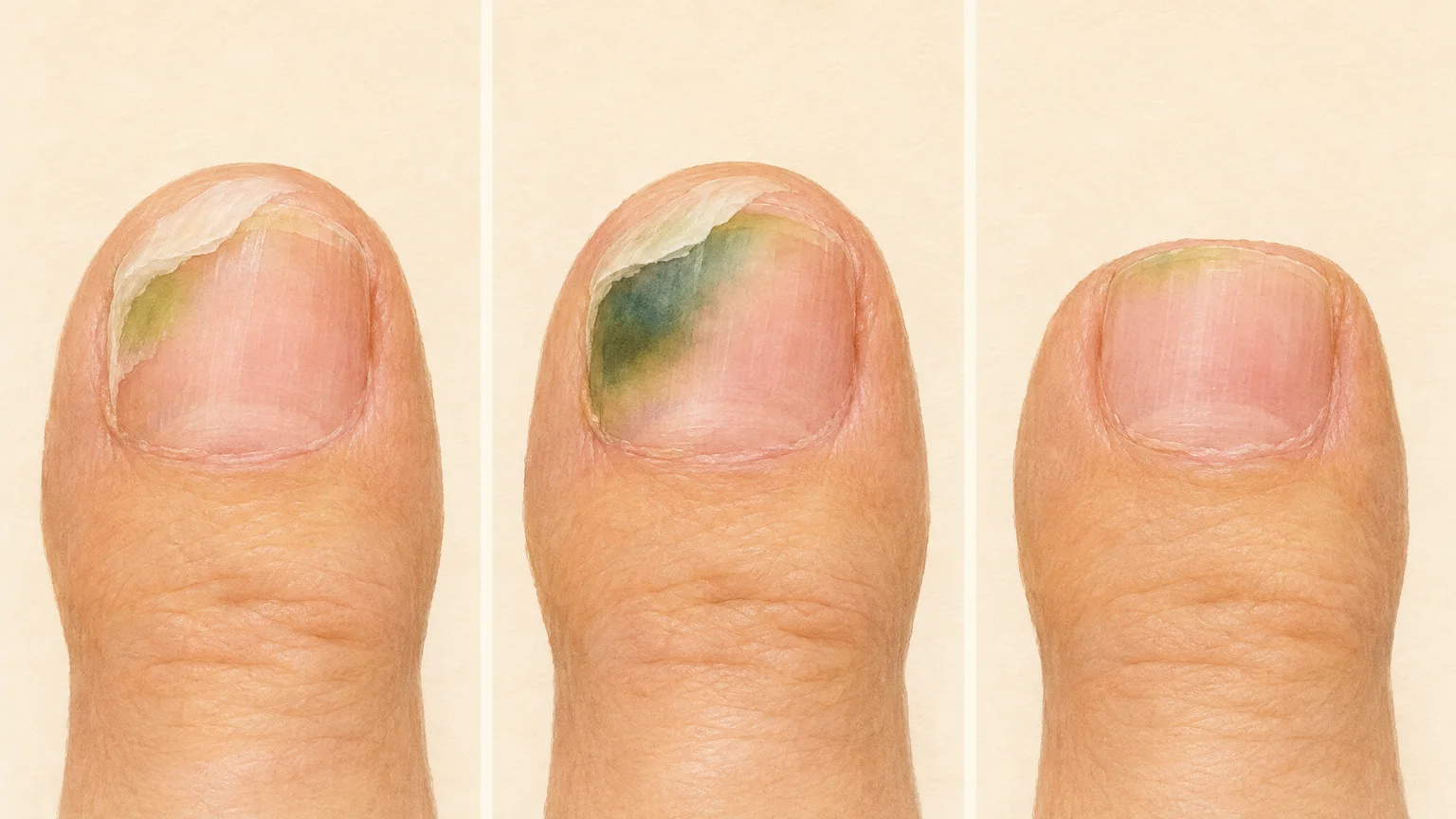
The nail lifts, water collects under it, and bacteria that make green pigment settle in. In a study of 34 patients with green nails, 79% had it on a single digit, and 85% had it on a big toe or thumb. (J Dermatol 2021)
 Illustration
Why it stays green, and how it leaves
The nail lifts
Knocks, tight shoes, fungus or psoriasis separate it from the skin underneath. (DermNet)
To break it: Trim the loose part and wear roomier shoes. A lifted nail will not stick back down, so the new nail has to grow in attached. (DermNet)
Water gets in and stays
Showers, sweat, wet boots and artificial nails all keep it damp. Warm, moist nails are the most prone to infection. (Chiriac 2015)
To break it: Dry the toe and the nail edge after every wash. Change damp socks.
Bacteria move in
Pseudomonas lives in soil and water (CDC). It is not part of the normal germs on healthy skin, which is too dry for it. (2020 review)
To break it: Antibiotic drops or a prescribed antiseptic, once the loose nail is gone.
Pigment soaks into the nail
The bacteria make green and blue-green pigments that spread into the underside of the nail. (2024 case report)
To break it: Time and trimming. The stain can stay after the bacteria are dead, so color alone does not prove a live infection.
When a Green Toenail Needs Care Now
Most green toenails are not urgent. The risk of it spreading through the body is low with a healthy immune system. (AFP 2021)
Same day: skin that is painful, hot and swollen. Redness can be harder to see on brown or black skin (NHS). Also pus, a fever, or redness that is spreading.
Call 911: those signs plus any of these: a very high temperature, shivering, a fast heartbeat or breathing, faintness, confusion, purple patches, or cold, clammy or pale skin. (NHS)
Within days, even with no pain: diabetes, a listed risk factor (2024 case report), numb feet, poor circulation, or a weak immune system, where Pseudomonas can cause serious infections (2020 review). With diabetes, a sore or ulcer on the foot should not wait for your next appointment (CDC).
How to Clear a Green Toenail: What to Do at Home
- 1Take off polish and artificial nails so you can see the whole nail. Leave it bare while it heals.
- 2Clip only the loose part, with clean clippers, and keep it short (DermNet). Stop where the nail is still attached (NHS) or it hurts. Never pull it.
- 3Do not scrape under it. Cleaning beneath the nail with a file can keep it lifting. (DermNet)
- 4Keep it dry and unbumped (AFP 2021), in shoes with room over the toe.
- 5Book a visit, and take a weekly photo in the same light to see whether the green is growing.
With diabetes, numbness, poor circulation or a weak immune system, leave the cutting to a clinician. If you are not sure the nail is loose, leave it.
Does Vinegar or Bleach Help a Green Toenail?
People often try both before a visit, and how well they work at home has not been reported. (AFP 2021)
Vinegar
DermNet lists dilute vinegar soaks for a lifted nail, to lower the chance of infection (DermNet). A review says 1% acetic acid compresses can be effective (2020 review), but acetic acid can irritate the skin next to the nail (2024 case report). No source opened here gives a tested home recipe for a green nail, so ask your clinician for the strength before you try it, and dry the toe fully afterward.
Bleach
One published case series describes brushing a 2% sodium hypochlorite solution on the nail bed twice a day, after the loose nail has been cut off (Chiriac 2015). Most household bleach is 5% to 9% (CDC). Do not put it on your toe. Use a bleach solution only if a clinician tells you the strength and how to apply it.
Skip both if you have diabetes, because the CDC says not to soak your feet (CDC). As a caution, skip them too with numb feet, poor circulation, a weak immune system or broken or sore skin, and on a child.
Green Toenail Treatment at a Clinic
A 2020 review found no controlled double-blind trials, so treatment follows case reports and experience. (2020 review)
- Looking
- The color is usually enough for a diagnosis. A nail sample or biopsy is for when something else is suspected (AFP 2021), such as fungus.
- Trimming
- The detached nail is cut away (Chiriac 2015), so drops can reach the bed.
- Drops or antiseptic
- Often prescription antibiotic eye drops used on the nail. The Merck Manual calls gentamicin drops very effective (Merck). Reported antibiotic courses run from about 4 weeks (AFP 2021) to 4 months (Chiriac 2015).
- Tablets
- For more severe infection (AFP 2021) or when drops do not suit: ciprofloxacin for 2 to 3 weeks; one toenail took 6 weeks (Chiriac 2015). It raises the risk of tendon rupture, most of all after age 60 (MedlinePlus), so ask about the risks first.
- Nail removal
- Occasionally, when the simpler steps fail. (AFP 2021)
How Long a Green Toenail Takes to Go Away
In published cases, treated color had improved at 4 weeks in a big toenail (AFP 2021) and cleared by 8 weeks in a fingernail. That second report adds that full clearing can take several months (2024 case report).
This is one example nail, drawn to scale. The loose half was trimmed off, and the rest grows 1.62 mm a month, the average toenail speed measured in 22 healthy young adults (JEADV 2010). The stain is drawn as if it never fades. Your nail may grow slower.
- Grown since trim day
- Older attached nail
- Green stain
- Bare nail bed
Trim day
Front edge at 8 mm. Last 3 mm stained.The loose nail is gone and the skin under it is showing. A green edge may be left on the part still attached.
Month 1
1.6 mm of new nail. Front edge at 9.6 mm.No new green, and the old green starting to look paler or smaller. If it is spreading, do not wait for month 2.
Month 2
3.2 mm of new nail. Front edge at 11.2 mm.The green gone or clearly smaller. If treatment has not cleared it by 8 weeks, go back. One fingernail case report says nail clippings can then be cultured, and that failing to clear raises concern for melanoma. (2024 case report)
Month 5
8.1 mm of new nail. Front edge back at the tip.Any leftover stain sits at the tip. In the first report, from 1944, a dull green stayed for 6 months after treatment had worked. (2020 review)
Month 7
11.3 mm of new nail. Stain past the tip and clipped off.If it stayed attached, a clear nail along its whole length. If it looks white or hollow underneath, it has lifted again.
All of this nail is new by about month 10. DermNet's figures put a full toenail at 8 to 12 months (DermNet), and the NHS says up to 18 (NHS). The longer a nail has been lifted, the less likely the new one is to attach. (DermNet)
Is It Green Toenail Fungus?
It can be both. Fungus lifts and thickens the nail, and the bacteria add the green.
- Also had a fungal infection67.6%
- Lab culture did not find Pseudomonas64.7%
Both come from the same 34 patients (J Dermatol 2021). People with a negative culture still responded to the usual antibiotics, so a negative result does not rule green nail syndrome out. Pseudomonas can also crowd fungus out of a culture and hide it (Chiriac 2015). If the nail stays thick and crumbly after the green clears, ask for another fungal test.
If a test shows fungus, compare over-the-counter toenail fungus treatments.
Why Is My Toenail Green and Falling Off?
The loosening often came first. A nail lifted by injury, fungus or a skin condition is prone to infection underneath, and that turns it green (DermNet). Trim what is loose, tape down any part that catches, and let the attached part grow out. If an injury tore the nail away, see toenail ripped off.
Dark Green Toenails, Green Toe Skin and Other Lookalikes
- Dark green or green-black patch under a lifted edge
- Still fits green nail syndrome, which runs from green-yellow to green-black (Chiriac 2015). Have it looked at, because old blood or a melanoma can look similar (2024 case report).
- A brown or black stripe, or color spreading onto the skin
- Not typical of bacteria. Nail melanoma can look like a dark patch or a lengthwise band; green is less common. Suspicion needs an urgent dermatology referral (AFP 2021), so do not wait. See brown toenail.
- Green or yellow skin after a knock, normal nail
- Fits a fading bruise, which turns greenish-yellow before the skin returns to normal (MedlinePlus). See bruised toe healing time.
- Wet, sore, smelly skin between the toes with yellow-green fluid
- Points to a toe web infection, which diabetes, nerve damage or poor circulation make more likely and which can turn into a deeper one (2026 guideline). Get it seen soon, and the same day if redness or swelling spreads.
- Green pus from the side of the nail
- A sign of infection in the skin beside the nail. Have it seen the same day, and check the other infected foot symptoms.
Pedicures, Polish and Wet Boots
- Pedicures and polish: wait until the nail is clear and attached, because polish hides the changes you need to watch. DermNet lists nail enamel and remover as irritants to avoid on a lifted nail (DermNet). Bring your own clippers and file.
- Artificial nails: water can get trapped under them, and more than a month of acrylics has been linked to green nails. (2024 case report)
- Wet work: it is common in dishwashers, janitors, barbers, bakers, salon technicians and medical staff (AFP 2021). For feet, carry spare socks and let boots dry fully between shifts.
The bottom line
- A green toenail is usually Pseudomonas in the damp gap under a lifted nail.
- Trim what is loose, keep the toe dry, leave it bare, and ask about a fungus test.
- Use vinegar or bleach only on a clinician's instructions, and never soak your feet if you have diabetes.
- Treated color improved or cleared in 4 to 8 weeks in two published cases. If yours has not cleared by week 8, go back.
- Heat, swelling, spreading redness, pus or fever means care the same day.
Frequently Asked Questions
Is a green toenail contagious?
Spread to healthy skin looks unlikely, because infection of intact skin is rare. The bacteria can travel on contaminated surfaces, equipment and hands, and hospital patients are most at risk. Do not share clippers, files or towels, wash your hands after touching the nail, and keep it away from wounds. If you care for patients, tell your employer: hospital outbreaks have been traced to staff with infected nails.
My toenail is green but doesn't hurt. Do I still need to treat it?
Yes. Book a routine visit, or call this week if you have diabetes, numb feet, poor circulation or a weak immune system. Green nail syndrome is usually painless, so a lack of pain tells you little. A visit is also the chance to test for fungus, which two thirds of patients in one study had.
Does a green toenail go away on its own?
No source opened for this page reports how often that happens. Trimming the loose part and keeping the toe dry are the basic steps in the treatment papers. If the green is spreading, or unchanged after a few weeks of that, get it checked.
Why is my toenail turning green after an injury?
An injury or tight shoes can lift the nail, and the damp space under it lets bacteria in. Green inside the nail, under a loose edge, fits that. Green or yellow on the skin around it can be an old bruise fading. If the toe is getting more painful, hot, red or swollen, leaks pus, or you have a fever, have it seen the same day.
Sources and further reading
- American Family Physician: Green Toenail Discoloration (2021)
- Merck Manual, consumer version: Green Nail Syndrome
- DermNet: Onycholysis
- Lee H et al. Green nail syndrome, 34 cases. J Dermatol (2021), abstract
- Chiriac A et al. Chloronychia in elderly persons. Clin Interv Aging (2015)
- Chloronychia: The Goldman-Fox Syndrome, review. Indian J Dermatol (2020)
- Carhart P et al. Green nail syndrome in the emergency department. Cureus (2024)
- Yaemsiri S et al. Growth rate of fingernails and toenails. JEADV (2010), abstract
- S1 guideline on infected interdigital intertrigo (toe web infection). JDDG (2026)
- NHS: Nail problems
- NHS: Cellulitis
- CDC: Diabetes and your feet
- CDC: About Pseudomonas aeruginosa
- CDC: Cleaning and disinfecting with bleach
- MedlinePlus: Bruise
- MedlinePlus: Ciprofloxacin
General patient education. Your examination and individual treatment instructions take priority.
See a Podiatrist Near You
ASG Foot & Ankle has offices in Homewood, South Chicago Heights and Mokena. Our board-certified podiatrists accept most insurance. Find the office closest to you:
Want That Green Nail Looked At?
ASG Foot & Ankle can trim the lifted nail, test it for fungus and bacteria, and go over which treatment fits.