
Brown Toenail: What Causes It and Which Ones to Get Checked
Foot Care Guide from ASG Foot & Ankle
The short answer
A brown toenail is often caused by fungus, a stain, old blood or natural pigment. Stains and blood move toward the tip, about 1.5 mm in 4 weeks. A cuticle-to-tip stripe stays in place. Get a stripe examined now if it is new, changing, on one nail only, 3 mm or wider, or if color is on the skin.
- A smooth tint where polish was, or a blotch with clear nail behind itFits a stain or old blood. Photograph it and recheck in 4 weeks.
- Thick, crumbly or lifting, brown from the tip or a sideFits fungus, though other problems look similar. Get a sample tested before treating.
- A brown stripe, cuticle to tipOften normal in darker skin, usually on several nails. If new, changing, wide or on one nail, book an exam now.
- Toe newly dark, cold or numb, or red warm skin with diabetesPossible loss of blood flow or infection. Get seen today.
ASG Foot & Ankle patient education. Updated November 25, 2026. General information, not a diagnosis.
Only a small dark dot? Read black spot under a toenail. For a green nail, see green toenail. For other colors, see toenail discoloration by color.
Brown Toenail Discoloration: Read the Pattern
Shade alone cannot name the cause. Look at where the brown sits, whether it moves and how many nails have it.
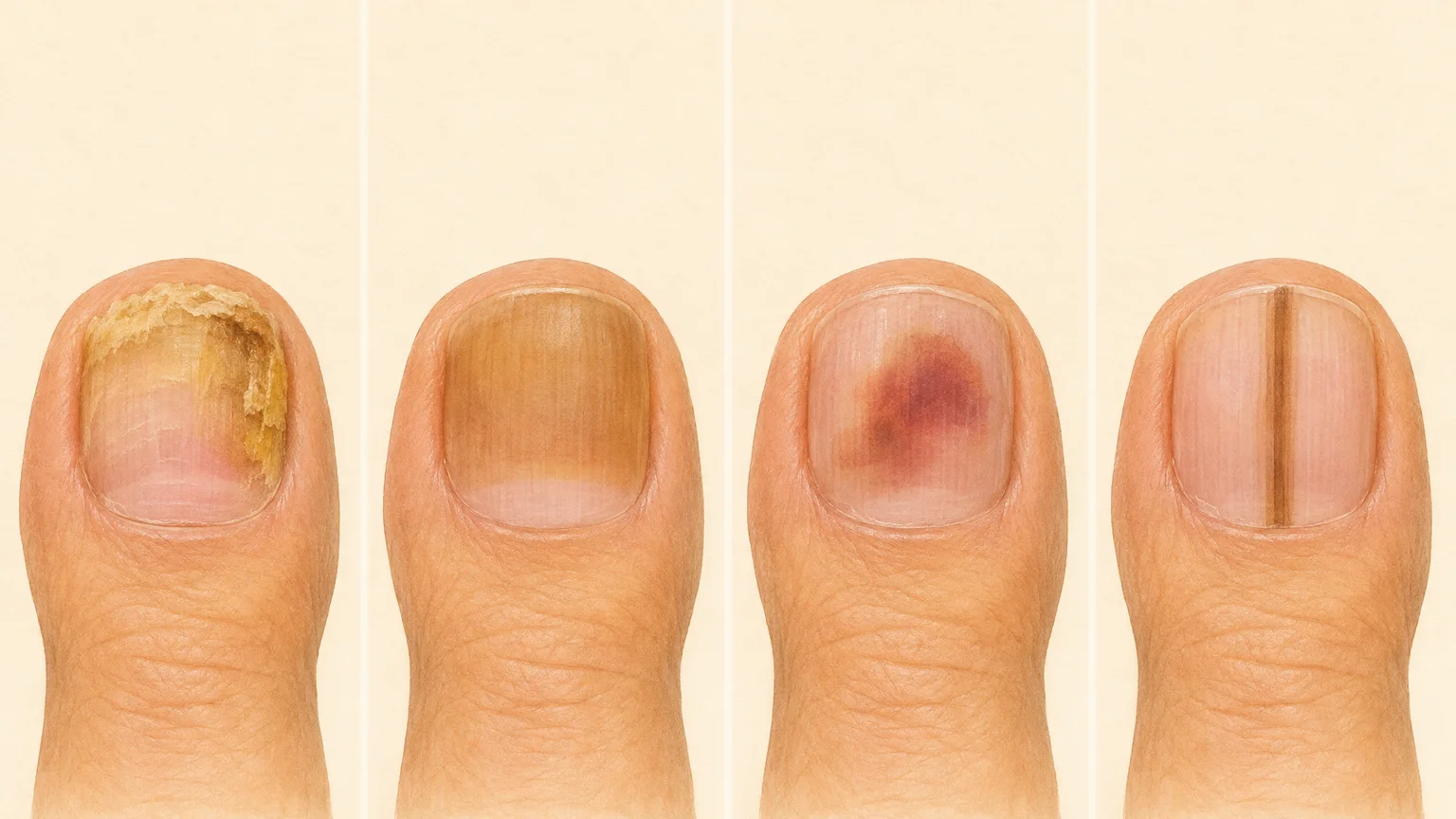 Illustration
Fungus
Get it checked
Where it sitsBegins at the tip or one edge. The nail gets thick, crumbly or lifted. (AAD)
As it growsSpreads back toward the cuticle. (AAD)
How manyOne or several. Big and little toes most often. (AFP 2021)
What to doGet a nail sample tested before you treat it.
Polish stain
Usually fine
Where it sitsOn the surface of a smooth nail. Its back edge curves like the cuticle. (2020 review)
As it growsMoves out with the nail, and some scrapes off. (2012 review)
How manyOften the other nails that wore the polish.
What to doKeep nails bare and compare photos at 4 weeks.
Old bruise
Usually fine
Where it sitsA purple to brown blotch with a rounded back edge. (2012 review)
As it growsA clear edge shows behind it within a few weeks. (DermNet)
How manyUsually one. (DermNet)
What to doPhotograph it and check your shoes. See why toenails turn black.
Stripe
Get it checked
Where it sitsA line running lengthwise, from cuticle to tip. (DermNet)
As it growsStill touches the cuticle, because the nail root keeps making the color. (2020 review)
How manyNormal pigment is often on several. Melanoma is usually on one. (2018 study)
What to doNew, changing, wide, or on one nail only: book an exam now.
Patterns overlap. Old blood, fungus and bacteria can also look like a stripe (2020 review), so let an exam sort them out.
The Grow-Out Test: What to Do at Home for 4 Weeks
Only for a smooth tint or a blotch. Do not wait 4 weeks with a new, changing, wide or single-nail stripe, one whole nail darkening with no explanation, color on the skin, or a nail that is splitting, bleeding or breaking down. See the get-checked list. With diabetes, numb feet or poor circulation, call your clinic before testing at home.
- First photoback edge 2 mm from the cuticle
- 4 weeksmoved about 1.5 mm
- 8 weeksmoved about 3 mm
- 12 weeksmoved about 4.5 mm
- A pigment stripe, every photostill touches the cuticle
- 1Take off all polish. Check every toenail and fingernail for the same color.
- 2Photograph the nail in daylight with a millimeter ruler. Note the gap between the cuticle and the back edge of the brown.
- 3Test the surface. Wipe with polish remover, then file one small area lightly. A surface stain may lighten. Skip this with diabetes, numb feet, poor circulation, or a thin or sore nail.
- 4Remove likely causes. Leave nails bare, wear roomier shoes, keep feet dry and treat athlete's foot (NHS).
- 5Repeat the photo at 4 weeks in the same light and angle, then at 8 and 12 weeks if it is moving.
What the second photo means
- Clear nail behind the brown, and the gap has grownFits a stain or old blood. Keep taking photos until it is gone.
- The brown has spread back toward the cuticleCould be fungus. Book an exam and a nail test.
- No clear movement, new brown behind the old mark, or a stripeCould be a slow nail, repeat bleeding or pigment. Stop the test and book an exam.
The growth study had only 22 healthy young adults, and big toenails grew fastest (Yaemsiri 2010). Expect less on a little toe or after age 60 (AFP 2021). Bleeding that keeps returning needs an exam, because a tumor is a rare cause (DermNet).
When to Get a Brown Toenail Checked
Today
- The toe itself turns purple or black, goes cold or numb, or has a sore leaking smelly fluid. Color change is harder to see on dark skin. Go to an emergency department (NHS).
- You have diabetes and the foot is red, warm or painful, or a bruise is not healing after a few days. Call right away (NIDDK). Do the same with numb feet or poor circulation.
Book now, and do not wait 4 weeks
- A stripe that is new, on one nail only, or getting wider, darker or blurred (AFP 2004)
- A band 3 mm or wider, mixed shades of brown, or a band widest at the cuticle (DermNet)
- Color on the skin around the nail (AAD)
- A nail that splits, lifts, bleeds or breaks down with no clear cause, or has a bump under it, with or without color (AAD) (DermNet)
- Any stripe if you or a relative has had melanoma (DermNet), or one whole nail turning dark brown with no explanation (2018 study)
Otherwise, see a doctor when a nail changes color and you do not know why (AAD), and for a fungal nail if you have diabetes or a weak immune system (NHS).
A Brown Stripe on a Toenail: Normal Pigment or Melanoma
Most stripes are harmless: pigment cells at the nail root switch on and the growing nail carries the color forward (2020 review).
- White peopleAbout 1%
- Japanese and other Asian people10% to 20%
- African American people77% to 100%
Nail melanoma is rare (AAD). It occurs in every skin color, and in dark skin it can be taken for a normal stripe and found late (DermNet). Compare the stripe with your other nails and with old photos.
It most often starts as one narrow band on a thumb or big toenail. Over weeks to months the band may widen, turn uneven or reach the skin, and the nail may crack or lift. Up to half have little or no color (DermNet).
In one Korean hospital, all 13 nail melanomas were on a single nail, while 11 of 13 people with normal pigment had several nails involved. Harmless nail moles were usually on one nail too, in 27 of 29 people, so a single stripe calls for an exam and can still be harmless (2018 study).
Looking alone cannot settle it: in one test, dermatologists telling the earliest nail melanomas from other dark nails were right 46% to 55% of the time (2012 review). A definite diagnosis needs a biopsy, which takes tissue from the nail root and bed (DermNet). Not every stripe needs one: a clinician may watch it closely instead (2012 review). Found early, nail melanoma is highly treatable (AAD).
Toenail Turning Brown Without Injury
Shoe pressure you never felt
Tight shoes can cause small bleeds nobody remembers (DermNet). Repeated rubbing can turn the big, fourth or fifth toenail brown while the nail stays smooth (2020 review).
Fungus
Usually painless. The thick nail is often brown in darker skin and yellowish in lighter skin (AAD).
Polish, tobacco or dye
Long-term polish can leave a yellow or brownish tint (Merck Manual). Tobacco, tar, henna and potassium permanganate also stain (2020 review).
A medicine
Hydroxyurea and other chemotherapy drugs, the HIV drug zidovudine and malaria drugs such as chloroquine can darken nails, often several at once (2020 review). Ask the prescriber before stopping.
Natural pigment or pregnancy
Both tend to give stripes on several nails. Pregnancy stripes may fade or stay after birth (2020 review).
Psoriasis
Yellow-brown patches under the nail, with pits or a lifted edge (Merck Manual).
An illness, which is uncommon
Adrenal disease, an overactive thyroid, HIV and low vitamin B12 can color several nails (2020 review). Dark patches on the skin or in the mouth may come with it (2012 review).
Brown Nail Fungus: Why a Lab Test Comes First
In a US study of 289 toenail clippings, about 1 in 4 nails judged fungal by eye were not confirmed. Podiatrists were right in 80.8%, dermatologists in 75.3% and other physicians in 66.2% (2018 study).
Why treating first can fail:
- Fungi cause only about half of abnormal nails (AFP 2021).
- A mold or yeast is involved. They cause 30% of US fungal nail infections, and mixed infections are harder to diagnose and treat (AFP 2021).
- An antifungal used before the sample can make the culture negative (DermNet).
- Treating a pigment stripe as fungus delays the exam it needs.
The nail may be trimmed back so the sample comes from the affected part nearest the cuticle. A microscope check is quick (AFP 2021), but a negative one does not rule out fungus. A culture can take several weeks (DermNet).
Experts differ. Family physician guidance recommends testing but allows terbinafine without it when cost is a barrier (AFP 2021). The clippings authors questioned routine testing where fungus is common (2018 study).
What Clears a Brown Toenail, and How Long It Takes
Polish stain
Grows out over monthsIt moves out with the nail, and some can be scraped off (2012 review).
Old blood
Months to yearsMost need no treatment (DermNet).
Nail fungus
Up to 18 months to regrowTerbinafine tablets for 12 weeks gave a clear toenail in 38% to 76% of people, and liver disease is the main reason not to take them. Topical treatment runs 48 weeks and works less often. The infection returns in 20% to 25% (AFP 2021). See toenail fungus treatment, drugstore products compared and toenail removal for fungus.
Shoe rubbing or a medicine
Fades slowly, if at allPigment may fade once the rubbing (2020 review) or the medicine (2012 review) stops.
Natural pigment
No treatment neededOnce judged benign, it can be followed (2020 review).
The bottom line
- A stain or old blood should move about 1.5 mm toward the tip in 4 weeks, less on a small or older nail. If it does not, have it examined.
- Test a thick, crumbly brown nail before treating it for fungus.
- Stripes are normal for many people with brown or black skin. A new, changing, wide or single-nail stripe needs an exam now.
- With diabetes, numb feet or poor circulation, call right away if the foot is red, warm or painful.
Frequently Asked Questions
Why is my toenail brown underneath?
Color under the nail will not wipe or file off. Old blood is usually on one nail and moves toward the tip. Fungal debris collects under a thick or lifted nail. If the color touches the cuticle, forms a stripe or has no explanation, have it examined.
Why is my big toenail turning brown?
Fungus favors the big toe, and the big toe gets knocked. A thick, crumbly nail fits fungus, and a blotch with clear nail behind it fits old blood. The big toe is also the most common toe for nail melanoma, which is rare, so have a new lengthwise stripe examined.
Why is my pinky toenail brown?
Shoe rubbing is a well-described reason. Poorly fitting shoes can leave brown color on the outer side of the fourth and fifth toenails, often on both feet. Fungus also favors the little toe and thickens the nail. Try roomier shoes and compare photos. A new or changing stripe needs an exam.
Why is my toenail half brown?
Brown at the tip of a thick or lifting nail fits fungus. A blotch that moves forward fits old blood. If many nails are white near the cuticle and pink or brown toward the tip, kidney disease is one cause, although healthy people can have the same look. Ask a doctor about that pattern.
What does it mean when your toenails turn brown?
Several at once suggests something that reaches all of them: polish, shoe rubbing, fungus, natural pigment, pregnancy or a medicine. Illness is an uncommon reason. A single brown toenail is more often fungus or old blood, and rarely melanoma. See a clinician if you cannot explain it.
Sources and further reading
- Jefferson J, Rich P. Melanonychia. Dermatol Res Pract. 2012
- Singal A, Bisherwal K. Melanonychia: etiology, diagnosis, and treatment. Indian Dermatol Online J. 2020
- DermNet: Melanoma of the nail unit
- DermNet: Subungual haemorrhage
- DermNet: Laboratory tests for fungal infections
- American Academy of Dermatology: How to check your nails for melanoma
- American Academy of Dermatology: Nail fungus, signs and symptoms
- Frazier WT, et al. Onychomycosis: rapid evidence review. Am Fam Physician. 2021
- Fawcett RS, et al. Nail abnormalities: clues to systemic disease. Am Fam Physician. 2004
- Yaemsiri S, et al. Growth rate of human fingernails and toenails. J Eur Acad Dermatol Venereol. 2010
- Li DG, et al. Clinical diagnostic accuracy of onychomycosis: a multispecialty comparison study. Dermatol Res Pract. 2018
- Causes of nail discoloration in 163 patients, South Korea. Acta Derm Venereol. 2018
- Merck Manual Consumer Version: Deformities, dystrophies and discoloration of the nails
- NHS: Fungal nail infection
- NHS: Gangrene
- NIDDK: Diabetes and foot problems
General patient education. Your examination and individual treatment instructions take priority.
See a Podiatrist Near You
ASG Foot & Ankle has offices in Homewood, South Chicago Heights and Mokena. Our board-certified podiatrists accept most insurance. Find the office closest to you:
Not Sure What Turned Your Toenail Brown?
ASG Foot & Ankle can look at the nail, test it for fungus if needed, and tell you whether a stripe needs a closer look.