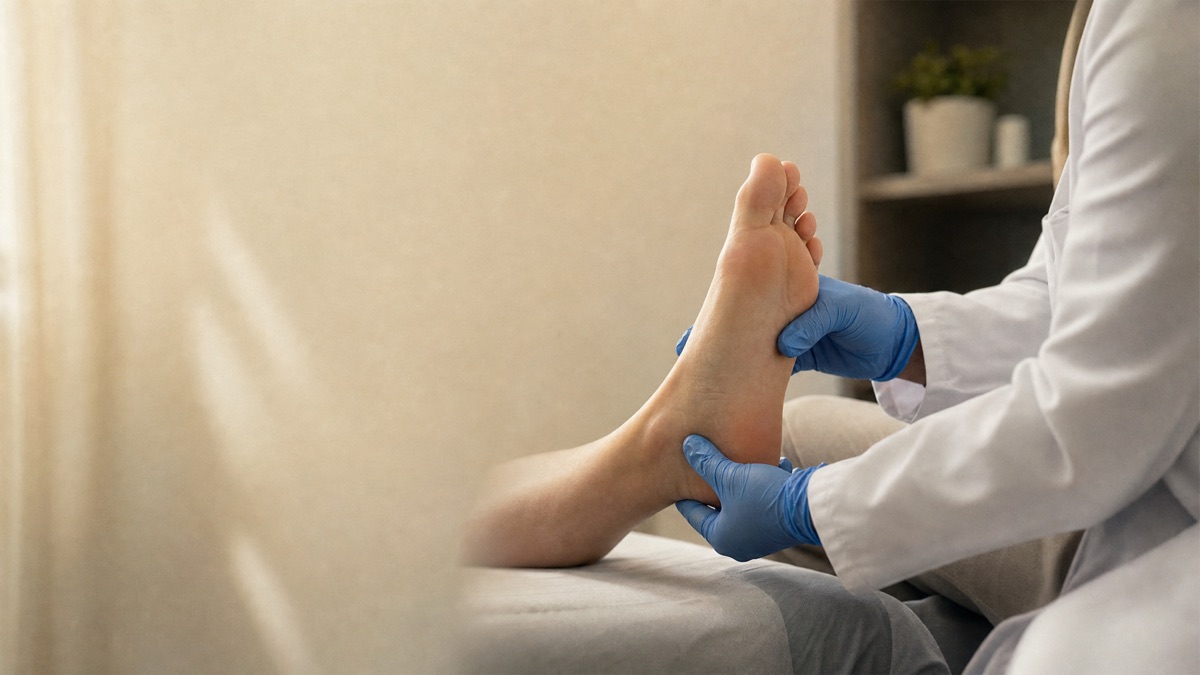
Why Early Wound Care Saves You Time, Money, and Pain
Almost every foot wound that ends badly started as something small that somebody decided to watch for a while.
The wounds that become serious almost never look serious at the start. They are a blister from a new pair of shoes, a callus that got a little sore, a scrape from the corner of a coffee table. What turns one of those into a months-long problem is not usually how bad the injury was. It is how long it sat before anybody trained looked at it.
This page explains what early wound care actually involves, what the delay genuinely costs, and how to decide whether the thing on your foot right now can wait. We see patients for this at our Homewood, Mokena and South Chicago Heights offices, and it is one of the few areas of podiatry where timing matters more than technique.
Medically reviewed by Dr. Timothy Horak and Julia Shauger, board-certified podiatric specialists serving Homewood, South Chicago Heights & Mokena. Last reviewed July 2026.
What Early Actually Means
A fresh wound is still an ordinary injury. The tissue is behaving normally, there is no established bacterial colony on it, the edges are soft, and it responds to simple things: cleaning, a proper dressing, and taking the pressure off. A wound that has been open for two or three months is a different animal. It has stalled in the inflammatory phase, bacteria have organized into biofilm on its surface, and the edges have thickened and rolled inward.
Nothing dramatic happens on any single day of that transition. That is exactly why people miss it.
The practical rule. If you have diabetes, neuropathy or circulation problems, a foot wound gets looked at within the week. If you do not, give it two weeks. A wound that has not visibly shrunk in two weeks is not going to close on its own.
What Waiting Actually Costs
Money
Office visits, dressings and an offloading boot are inexpensive relative to what comes next. The expensive part of wound care is the hospital: intravenous antibiotics, imaging, surgical debridement, and the follow-up that comes after discharge.
Time
A simple wound seen early is often a handful of visits. A wound that has gone chronic is measured in months of weekly appointments, and that is the realistic version, not the pessimistic one.
Living your life
Long-standing wounds mean restricted walking, a boot you cannot drive in comfortably, dressings that have to be kept dry, and cancelled plans. Patients consistently tell us this part is worse than the wound.
What Changes When a Wound Is Seen Early
The wound is still simple
Early wounds respond to early measures, which are the cheap and boring ones.
- • No established biofilm to grind through
- • Soft, healthy wound edges that can still migrate inward
- • Infection contained to the surface rather than tracking deep
- • A dressing plan that does not need weekly sharp debridement
The cause gets found while it is fixable
Most foot wounds are caused by something mechanical, and mechanical problems are correctable.
- • A shoe rubbing in one specific place
- • A bony prominence taking more load than it should
- • A hammertoe pressing the tip of the toe into the insole
- • A callus that has been quietly building pressure underneath it
The serious complications never start
The complications that follow foot wounds mostly follow the ones that stayed open a long time.
- • Infection that reaches bone
- • Hospital admission for intravenous antibiotics
- • Surgery to remove infected tissue
- • Partial amputation, which is where the worst of these end up
What an Early Visit Includes
Working out what caused it
- • Measuring the wound so future visits have a baseline
- • Checking pulses and, when indicated, an ankle-brachial index
- • Testing sensation to see whether protective feeling is intact
- • Looking at your shoes, which tells us more than most tests
- • Asking about blood sugar control if you are diabetic
Treating it and keeping it closed
- • Cleaning back any dead tissue at the edge or base
- • A dressing matched to how wet or dry the wound is
- • Taking pressure off the exact spot, with a boot, pad or insert
- • Deciding whether antibiotics are actually needed, which is less often than people expect
- • Showing you what a worsening wound looks like so you can call early
The Wounds People Wait Too Long On
These are the ones that come in late, over and over:
- • A callus with a dark spot in the middle. That colour is usually old blood, which means there is already a wound under the callus.
- • A blister on a numb foot. No pain does not mean no problem, it means no warning system.
- • A sore under the big toe joint that keeps coming back. Recurrence in the same spot is a pressure problem, and pressure problems do not resolve by waiting.
- • A surgical incision that is oozing longer than expected. Worth a phone call, not a wait-and-see.
- • Any wound with an odor. That is not something to monitor at home.
What to Realistically Expect
Coming in early does not guarantee a fast result, and we will not tell you it does. A shallow wound on a foot with good circulation, seen early and offloaded properly, usually closes in a matter of weeks. A wound on a foot with poor blood flow can take much longer even if you came in the day it appeared, because the blood flow, not the timing, is the limiting factor.
What coming in early reliably does is keep your options open. It is far easier to prevent a chronic wound than to reverse one, and every part of the treatment gets simpler the earlier you start.
Common Questions
How soon should I have a foot wound looked at?
If you have diabetes, neuropathy or known circulation problems, the same week, and sooner if there is any drainage, odor, redness spreading outward, or warmth. If you have none of those risk factors, give a clean, shallow wound about two weeks. If it has not clearly shrunk in that time, it is not going to close on its own and it needs an exam.
Is a small blister or cut really worth an appointment?
On a foot with normal sensation and normal blood flow, usually not. On a foot with diabetes or poor circulation, yes. Those feet do not send the pain signal that tells you something is wrong, so the first sign of trouble is often the wound itself, and by then it has been developing for a while.
Does treating a wound early actually save money?
In practical terms, yes. Office visits, dressings and offloading cost a fraction of what a hospital admission for a deep infection costs, and that comparison does not count the weeks of lost work or the follow-up care afterward. We cannot promise you a number, but the expensive part of wound care is almost always the part that happens in a hospital.
What actually happens if I wait?
A wound that stays open long enough stops behaving like a fresh injury. It stalls in the inflammatory stage, bacteria organize into biofilm on the surface, the edges thicken, and it stops responding to simple treatment. At that point it is a chronic wound and it takes months of structured care rather than weeks.
Related Reading
Specialized Wound Care at ASG Foot & Ankle
Our board-certified podiatrists treat slow-healing wounds, diabetic foot ulcers, and post-surgical wounds at our three clinics in Homewood, South Chicago Heights, and Mokena.
See a Podiatrist Near You
ASG Foot & Ankle has offices in Homewood, South Chicago Heights and Mokena. Our board-certified podiatrists accept most insurance. Find the office closest to you:
Have It Looked At Now, Not in a Month
If there is an open area on your foot that has not improved in two weeks, or you have diabetes and anything at all has opened up, call us. We see wound patients at three offices, in Homewood, Mokena and South Chicago Heights, and most major insurance is accepted.