Foot Wound Care: How to Treat an Open Wound on Your Foot
Step by step, from the first hour to the day it closes, and the signs that mean it needs more than home care.
Foot wound care comes down to a few simple things done every day: clean the wound gently, keep it moist and covered, keep pressure off it, and look at it. Feet make that harder than a cut on your arm: they carry your weight, live in socks and shoes, and with diabetes or poor circulation may have less feeling and blood flow.
This guide covers the first hour, daily dressings, what normal healing looks like, and when slow healing stops being normal. Once the basics are in place, our 5 ways to help a foot wound heal faster covers what speeds things up.
ASG Foot & Ankle patient education. Updated October 23, 2026. General information, not a diagnosis.
The short answer
Foot wound care starts with firm pressure to stop the bleeding and a rinse under clean running water, then a thin layer of petroleum jelly and a clean, non-stick dressing changed daily or whenever it gets wet. Skip hydrogen peroxide, alcohol and iodine, keep weight and shoe pressure off the spot, and look at it every day. A minor wound should be settling within a few days; one that has not started to heal in 2 weeks, or is not closed by 6 weeks, needs a specialist. With diabetes, neuropathy or poor circulation, have any open foot wound checked right away.
Get It Seen Today If
Call 911 or go to the ER for the first three. For the rest, get same-day care rather than treating it at home:
- •Bleeding has not stopped after 10 minutes of firm pressure, or blood is spurting
- •Something is stuck deep in the foot (leave it in place)
- •Redness is spreading with fever or you feel very unwell, or the skin is turning black
- •The wound is deeper than about a quarter inch, or its edges pull apart
- •It came from a nail, a bite, or a rusty or very dirty object
- •It is red, hot, swollen, smells bad, or is draining thick yellow or green fluid
- •You have diabetes, neuropathy or poor circulation and there is any break in the skin
Foot Wound Treatment: The First Hour, Step by Step
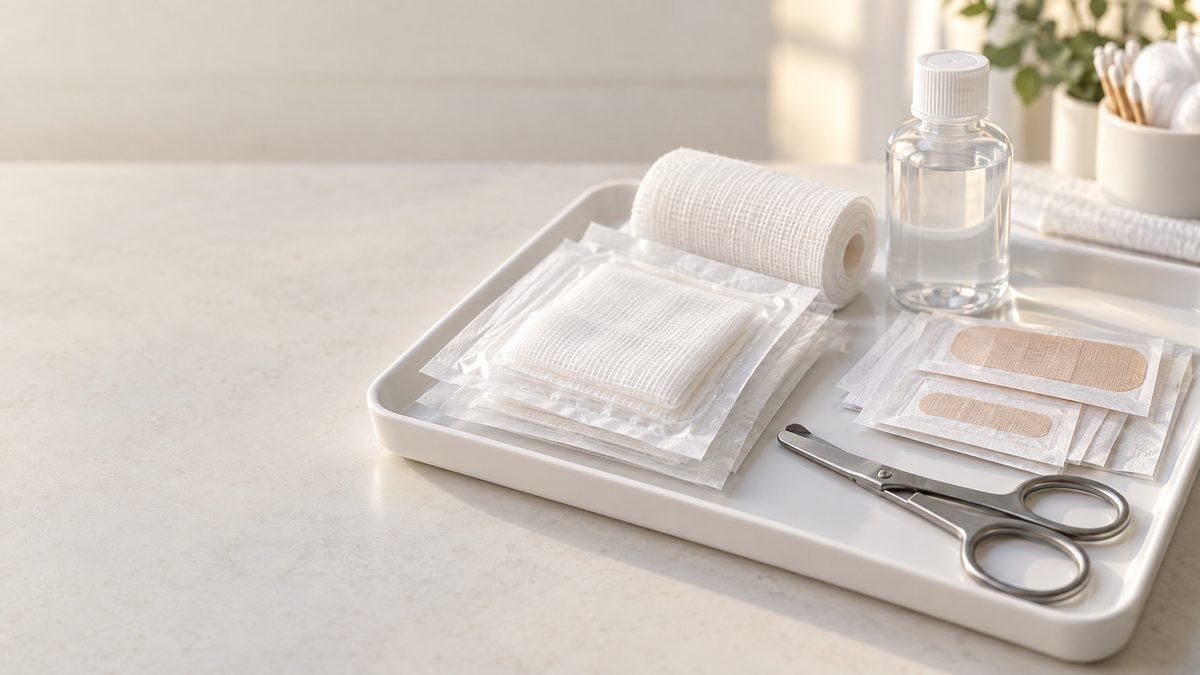
Open wound on foot treatment at home is the same for a minor cut, scrape or small sore. You need clean water, mild soap, gauze, petroleum jelly, non-stick pads and tape.
- 1Stop the bleeding. Sit down, get your weight off the foot, and press firmly with clean gauze or a clean cloth without lifting it to check. If bleeding has not stopped after 10 minutes of firm pressure, call 911 or go to the ER.
- 2Wash your hands, then rinse the wound under clean running tap water (MedlinePlus suggests about 5 minutes for a puncture). Let the water carry grit away; do not dig at debris, and never pull out anything stuck deep.
- 3Clean around it, not inside it. Wash the surrounding skin with mild soap and water, rinse, and pat dry.
- 4Look at it. More than about a quarter inch (0.64 cm) deep, edges that pull apart, or something still inside means it needs to be seen today.
- 5Add a thin layer of petroleum jelly to keep the surface moist so new skin can grow across. On a dirty wound, antibiotic ointment is a reasonable alternative.
- 6Cover it with a non-stick pad over the whole wound, held with tape or a light wrap, and a clean sock on top.
- 7Check your tetanus shot. Call your doctor if your last one was 10 or more years ago or you are not sure. After stepping on a nail or anything dirty or rusty, call either way: you may need a booster sooner.
Tap water is fine
No need for sterile saline. In a trial of 715 people with cuts, infection rates were about 4% with tap water and 3.3% with saline; a review of seven trials found no real difference.
Petroleum jelly is enough
In a trial of 922 patients, plain petroleum jelly did not raise infection rates and healed wounds about as well as antibiotic ointment.
Stitches have a time window
Clean wounds can generally be stitched up to about 18 hours after the injury, so if you are wondering whether it needs stitches, get it looked at today rather than tomorrow evening. Sole cuts and puncture wounds have their own guides: cut on the bottom of the foot and puncture wound in the foot.
What Not to Put on a Foot Wound
Many habits people grew up with do more harm than good. The fizz of peroxide or the sting of alcohol is not a sign that it is working.
Hydrogen peroxide
It kills bacteria but also damages the healthy tissue that does the healing. Cleveland Clinic no longer recommends it for simple open wounds.
Rubbing alcohol and iodine
MedlinePlus lists alcohol, peroxide, iodine, skin cleansers and antibacterial soaps as products that can damage wound tissue and slow healing.
Creams, lotions and home remedies
Nothing on or around the wound beyond petroleum jelly or what a clinician gave you.
Letting it air out
A dry wound forms a scab that new skin has to work its way under. Moist, covered wounds re-cover faster.
Long soaks
Soaking turns the skin around the wound white and soggy (maceration). Diabetic foot guidelines say wash, but do not soak.
Bathroom surgery
No shaving callus, cutting at ingrown nails, or medicated corn plasters. Diabetes foot guidance advises against all three.
Why covered and moist beats open and dry, and how to tell moist from too wet, is explained in moist wound healing vs dry.
Wound Care for Feet: Dressings, Changes and Showers
The goal is a wound that stays moist, clean and covered, with dry, healthy skin around it. For most minor foot wounds, a non-stick pad, petroleum jelly and tape are all you need.
| Situation | What to do |
|---|---|
| A simple cut or scrape under a plain bandage | Change it at least daily (Cleveland Clinic suggests once or twice a day), and whenever it is wet, dirty or leaking through. |
| A dressing a clinic put on (foam, hydrocolloid, silver) | Follow the schedule you were given. Some are meant to stay on for days. |
| Soaked through or came off | Rinse the wound and put on a fresh dressing the same day. If it was a clinic dressing, call the clinic. |
| White, wrinkled skin at the edge | Too wet. Change more often, dry the skin around it, and stop any soaking. |
Can you shower with an open wound on your foot?
Usually, yes. In a trial of 857 patients with stitched wounds, infection rates were 8.9% when wounds were kept dry for 48 hours and 8.4% when they got wet within 12.
- Keep it short, with the dressing on or a waterproof cover over it.
- Let soapy water run off rather than scrubbing the wound.
- Pat dry, especially between the toes, and re-dress straight away.
- No baths, hot tubs, pools or foot soaks until the skin has closed.
- If a clinic dressed it, ask first; some dressings must stay dry.
Keep Weight and Shoe Pressure Off It
The step most people skip. Every step presses on a wound on the sole, and a shoe rubs one on the toes, heel or top of the foot. The American Diabetes Association notes that most diabetic foot ulcers should heal if pressure is removed, circulation is adequate and infection is treated.
Walk less, for now
Cut out walking you do not need, and sit with the foot up when you can.
Pick the right shoe
Roomy enough that nothing presses on the dressing, with no rough seams inside.
Never barefoot
Not even at home. Socks alone do not protect a wound.
For a sole wound or one that keeps getting rubbed, a clinic can unload the spot with padding, a surgical shoe or a walking boot. More in can you walk on a healing foot wound.
Your Daily Foot Wound Checklist
- Look at the wound in good light, using a mirror or a helper for the sole.
- Check the old dressing: how much fluid, what color, any smell.
- Check the skin around it for spreading redness, warmth, swelling or soggy white edges.
- Every few days, photograph it beside a coin or ruler to see whether it is shrinking.
- Clean hands, rinse, thin layer of petroleum jelly, fresh dressing.
- Clean socks daily, and feel inside your shoe before putting it on.
- Feet up when sitting; walk only as much as you need to.
- With diabetes, check your blood sugar: an unexplained high reading can be an early sign of infection.
What Normal Healing Looks Like
Healing happens in overlapping stages. These times are for a minor wound in a healthy person.
Clotting
- Blood clots and seals the wound; left to dry out, the clot forms a scab
Inflammation
- Slightly swollen, pink or red, and tender, with a little clear fluid: the body cleaning up
- Pain should be easing day by day, not building
New Tissue
- The wound fills with red, moist, slightly bumpy new tissue (granulation tissue)
- New skin grows in from the edges, so the wound gets visibly smaller
- Deeper wounds, and feet with poor feeling or circulation, take longer
Scar Remodeling
- The scar can look red, shiny and itchy, then slowly shrinks and fades
- Keep protecting it from rubbing: closed is not the same as fully healed
Normal, or Time to See Someone?
| What you notice | Usually normal | See someone |
|---|---|---|
| Redness | A thin pink or red rim in the first few days that fades | Redness that spreads outward, or a red streak running up the foot or leg |
| Fluid | A little clear or pale fluid in the first days, less each day | Thick yellow, green or tan drainage, more each day, or a bad smell |
| Pain | Tender, easing day by day | Throbbing or worsening pain after the first few days, or pain that pain relievers do not touch |
| Swelling and warmth | Mild swelling early on | Increasing swelling, or the foot feels hot compared with the other one |
| The wound bed | Red, moist, slightly bumpy new tissue filling in | Black or dark edges, or tissue that looks dried out or gray |
| Size | Smaller every week | Larger or deeper, or no smaller after 2 weeks |
| How you feel | Well | Fever of 100°F (37.7°C) or higher, chills, or feeling generally unwell |
With diabetes, neuropathy or poor circulation, any open wound on the foot deserves a professional look, even when it seems to be behaving.
Foot Wound Not Healing? How Long Is Too Long
Some patience is reasonable, especially with a deeper wound. What is not normal is a wound that stops making progress. Three markers are worth knowing:
No sign of healing
2 weeks
A wound that has not started to heal within 2 weeks should be assessed, rather than waiting to see if a new product works.
Less than half the size
4 weeks
For diabetic foot ulcers, ADA guidance uses a 50% reduction after 4 weeks of good care as the point to consider advanced wound therapy.
Still open
6 weeks
A wound that has not completely healed within 6 weeks is generally considered a non-healing (chronic) wound.
Common reasons a foot wound stalls
- Pressure from walking or shoes on the same spot
- Infection, including infection in the bone underneath
- Poor circulation to the foot
- Diabetes, especially with high blood sugar
- Nerve damage that hides injury and pressure
- Smoking and heavy alcohol use
- Poor nutrition or inactivity
- Something left in the wound
- Medicines such as corticosteroids
A stalled wound needs someone to find which of these is in the way. For the week-by-week picture, see is it normal for a foot wound to take weeks to heal. If it closes and then breaks open again, read why a foot wound keeps reopening.
Signs of an Infected Foot Wound
Call for a same-day visit if you notice
- Redness that is spreading, or a red streak running up from the wound
- Warmth, swelling, or throbbing pain that is getting worse
- Thick yellow, green or tan drainage, or a bad smell
- Black edges around the wound, a sign of dead tissue
- Fever, chills, or feeling generally unwell
With diabetes, the signs can be quiet
Nerve damage and poor circulation can blunt redness and pain, and fever is often absent in mild and moderate foot infections. A new smell, more fluid, a warmer foot, unexplained high blood sugar or flu-like symptoms may be the only clues.
Do not wait for an infection to settle on its own. Mild versus serious infection is covered in signs of an infected foot wound, and what treatment involves is in antibiotics for a foot infection.
Foot Wound Care With Diabetes, Neuropathy or Poor Circulation
Everything above still applies, with one big difference: do not wait to see what happens. The American Diabetes Association advises urgent referral to a foot care specialist for any open foot ulcer or unexplained swelling, redness or warmth, and the CDC says not to wait for your next appointment. Here is why.
You may not feel it
About half of people with diabetes have nerve damage, usually in the feet. It played a part in 78% of diabetic foot ulcers in one multicenter study.
Less blood reaches it
Up to half of people with a diabetic foot ulcer also have peripheral artery disease, which slows healing and raises the risk of gangrene.
Infection moves fast
Infection can spread rapidly, often without matching signs, and is usually the final trigger for an amputation. A foot can worsen within hours.
The rules that change
- •Any break in the skin: call a podiatrist or your doctor right away, not at your next routine visit.
- •Keep weight off the foot until it has been seen.
- •Check both feet daily, soles and between the toes included.
- •Shoes and socks at all times, indoors too; socks alone or thin-soled slippers do not protect a numb foot.
- •Wash daily but do not soak. Keep the water below body temperature and test it with your hand, not your foot. No heating pads or hot water bottles.
- •Leave calluses, corns and ingrown nails to a professional.
What to watch for day to day, and what a diabetic foot visit involves, is in foot wounds and diabetes. If burning or numbness is part of the picture, see diabetic neuropathy in the feet; for cramping calves, cold feet or slow-healing toes, see poor circulation warning signs.
Podiatrist, Urgent Care or ER: Where to Go
Urgent care and the ER are built for the first day: stopping bleeding, cleaning, stitching and tetanus shots. A podiatrist or wound care clinic is built for the weeks after: working out why a wound is not healing and fixing it.
| Situation | Where | How soon |
|---|---|---|
| Bleeding not stopped after 10 minutes of firm pressure, or spurting | 911 or the ER | Now |
| Numb toes or foot, toes that will not move, or something stuck deep inside | ER | Now |
| Spreading redness with fever, or skin turning black with a foul smell | ER | Now |
| May need stitches: deeper than about a quarter inch, or gaping | Urgent care or ER | Within hours |
| A nail, bite, rusty or very dirty object, or no tetanus shot in 10 years | Urgent care, your doctor or a podiatrist | Same day |
| Any open wound with diabetes, neuropathy or poor circulation | Podiatrist or diabetes care team | Right away |
| More redness, warmth or drainage, without fever | Podiatrist or your doctor | Same day |
| Not healing at 2 weeks, open at 6 weeks, keeps reopening, or on a callus | Podiatrist or wound specialist | Book now |
What a wound specialist adds
A wound care visit measures the wound, checks blood flow and feeling, and finds why it is stuck. Treatment can include removing dead tissue and callus (debridement), offloading, dressings matched to the drainage, and for stubborn wounds, options such as negative pressure therapy or skin substitute grafts.
Basics in place and want it to heal faster? 5 Ways to Help a Foot Wound Heal Faster →
Cut the sole on glass or a shell? Healing time by depth. Cut on the Bottom of Your Foot →
Stepped on a nail? Tetanus and the infections punctures cause. Puncture Wound in the Foot →
A callus that might be hiding a sore? Callus or Pressure Sore? →
Frequently Asked Questions
How do you treat an open wound on your foot?
For a minor wound: stop the bleeding with firm pressure, rinse it under clean running water, wash the skin around it with mild soap, add a thin layer of petroleum jelly, and cover it with a non-stick dressing. Change the dressing daily or whenever it gets wet, keep weight and tight shoes off it, and look at it every day. Deep, dirty or gaping wounds, and any wound in a person with diabetes, need a clinician.
Should I put hydrogen peroxide on a foot wound?
No. Hydrogen peroxide kills bacteria but also damages the healthy tissue that has to rebuild the wound, which can slow healing, and Cleveland Clinic no longer recommends it for simple open wounds. MedlinePlus wound care instructions give the same warning about rubbing alcohol, iodine, skin cleansers and antibacterial soaps. Clean running water, with mild soap on the surrounding skin, is enough for most wounds.
How long should a foot wound take to heal?
A small, shallow wound in a healthy person usually looks calmer within a few days and fills in with new tissue over about 3 weeks. Deeper wounds, and wounds in people with diabetes, neuropathy or poor circulation, take longer. As a rule of thumb, a wound that has not started to heal within 2 weeks, or has not closed within 6 weeks, counts as non-healing and needs a specialist.
How do I know if a wound on my foot is infected?
Look for redness that spreads instead of fading, warmth, swelling, throbbing or increasing pain, thick yellow, green or tan drainage, a bad smell, a red streak running up the foot, or fever and chills. With diabetes or neuropathy the signs can be muted: there may be little pain, and an unexplained rise in blood sugar can be an early clue. Any of these needs same-day care.
Can I shower with an open wound on my foot?
Usually, yes. Short showers are fine for most minor wounds; in studies of stitched wounds, getting them wet within the first 24 to 48 hours did not raise infection rates. Keep the dressing on or use a waterproof cover, let water run over the foot rather than scrubbing, then pat it dry and put on a fresh dressing. Avoid baths, hot tubs and long foot soaks until the skin has closed.
When should I see a doctor for a wound on my foot?
Go to the ER for bleeding that will not stop after 10 minutes of firm pressure. Get same-day care for a wound that is deep, gaping, very dirty, from a nail, rusty object or bite, or showing signs of infection. See a podiatrist or wound specialist if it has not started healing within 2 weeks, keeps reopening, or you have diabetes, neuropathy or poor circulation.
Sources and further reading
- MedlinePlus: Cuts and puncture wounds
- MedlinePlus: How wounds heal
- MedlinePlus: Surgical wound care, open
- MedlinePlus: Wound care centers
- American Family Physician: Common questions about wound care (2015)
- Cleveland Clinic: Treating wounds, why hydrogen peroxide is not recommended
- CDC: Diabetes and your feet
- American Diabetes Association: Retinopathy, neuropathy, and foot care, Standards of Care in Diabetes 2026
- International Working Group on the Diabetic Foot: Practical guidelines on the prevention and management of diabetes-related foot disease (2023)
- The Queen Elizabeth Hospital King's Lynn NHS Foundation Trust: Diabetes, I'm worried about my foot
General patient education. Your examination and individual treatment instructions take priority.
See a Podiatrist Near You
ASG Foot & Ankle has offices in Homewood, South Chicago Heights and Mokena. Our board-certified podiatrists accept most insurance. Find the office closest to you:
A Foot Wound That Is Not Getting Better?
Wound care is at the center of what ASG Foot & Ankle does. A visit can measure the wound, check circulation and feeling in the foot, clear away dead tissue and callus, take pressure off the spot, and choose a dressing that fits the wound. If you have diabetes, do not wait to see whether it heals on its own.
Learn how the practice approaches chronic and diabetic wounds on the wound care page.