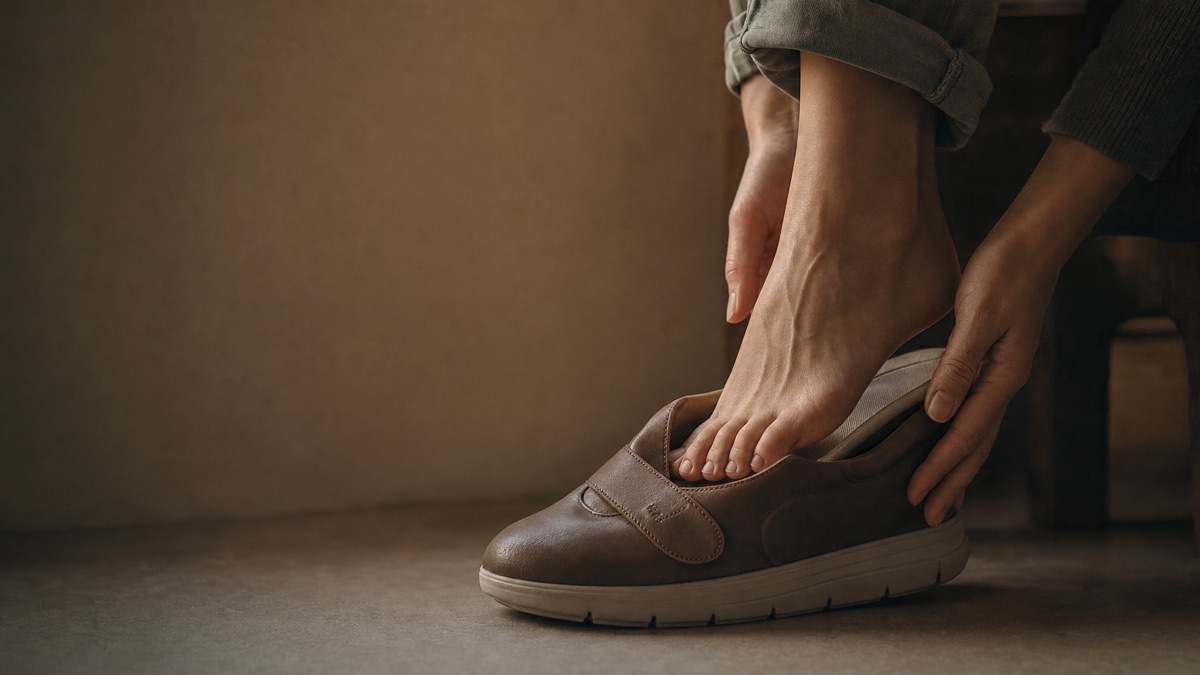
The Best Shoes to Prevent Foot Ulcers and Sores
Choosing footwear that protects an at-risk foot, from our Homewood, Mokena and South Chicago Heights offices
Most diabetic foot ulcers do not start dramatically. They start with a seam rubbing the side of a toe, a shoe half a size too short, a callus that keeps getting pressed on, or a pebble that spent the afternoon under the ball of the foot. If you have neuropathy, none of that hurts at the time. You find out days later when you take your sock off.
That is why footwear is not a comfort question for an at-risk foot. It is the thing standing between normal daily walking and an open wound. This page explains what actually matters in a shoe, what the Medicare diabetic shoe benefit does and does not cover, and what we check when we fit patients at our Homewood, Mokena and South Chicago Heights offices.
Medically reviewed by Dr. Timothy Horak and Julia Shauger, board-certified podiatric specialists serving Homewood, South Chicago Heights & Mokena. Last reviewed July 2026.
Why the Shoe Matters More When You Cannot Feel Your Foot
A healthy foot protects itself. When a shoe presses somewhere it should not, you shift your weight without thinking about it. Neuropathy removes that reflex. The pressure keeps going in the same place, hour after hour, and the tissue underneath gives out before anything hurts.
Pressure
Steady, concentrated load in one spot restricts blood flow to that patch of skin. Under a hammertoe, a bunion or the ball of the foot, that is where callus builds up first and where the skin eventually breaks down underneath it.
Where it usually comes from:
- • A toe box too narrow for the front of the foot
- • Not enough depth for a curled toe to clear the upper
- • A thin or worn-out sole
- • An insole that has flattened and stopped supporting
Friction and shear
If the foot slides inside the shoe with every step, the skin gets dragged back and forth against the tissue underneath it. That is what makes blisters, and on a foot with poor circulation a blister is not a minor thing.
Where it usually comes from:
- • A shoe that is too big or too loosely fastened
- • Internal seams and stitched overlays
- • Socks that bunch, or seams over the toes
- • A heel that lifts out of the shoe when you walk
Do not judge the fit by how it feels. A shoe that feels fine on a neuropathic foot tells you almost nothing. The shoe has to be measured against the foot, and the inside of the shoe has to be checked with a hand.
Four Things That Actually Matter in the Shoe
Depth and width, not just length
Most people buy shoes by length and never think about the other two dimensions. An extra-depth shoe is built with roughly a quarter inch or more of vertical room over a standard shoe, which is what lets a curled toe sit without pressing on the upper and leaves room for an orthotic to go underneath the foot.
What to look for:
- • Extra depth, so an insert does not push the foot up into the upper
- • Wide and extra-wide sizes actually stocked, not just claimed
- • A toe box shaped like a foot rather than tapered to a point
- • A removable factory insole
- • About a thumb width between the longest toe and the end
A sole that spreads the load
The point of cushioning is not softness, it is redistribution. A thick, slightly stiff sole with a rocker at the front keeps the ball of the foot from taking the whole push-off. Hold the shoe at both ends and try to twist it. If it wrings out like a towel, it is not doing much for you.
Cushioning features:
- • A firm midsole that resists twisting
- • Some rocker shape through the forefoot
- • A stable heel counter that does not collapse when squeezed
- • A padded tongue and collar
A smooth inside
Put your hand all the way inside any shoe before you buy it. Run it around the toe box and along both sides. Anything you can feel with your hand is something your foot will be pressed against for the next twelve hours without noticing.
Check for:
- • No internal seams over the toes or the sides
- • A soft lining with no stitched ridges
- • Uppers that flex with the foot instead of creasing into it
- • Nothing stapled, tacked or glued proud of the surface
A closure you can adjust
Feet swell through the day, and swelling changes through the week if you have kidney or circulation problems. A shoe that fits at eight in the morning may be tight by four in the afternoon. An adjustable closure lets you fix that. A slip-on does not.
Closure options:
- • Wide hook-and-loop straps, easiest if reaching your feet is hard
- • Laces, if you can still tie them reliably
- • Elastic or toggle laces as a middle ground
- • Avoid anything you have to force your foot into
Styles That Work, and Styles to Skip
Usually fine
- • Walking and athletic shoes in a wide, deep last
- • Extra-depth oxfords and derbies for work
- • Strapped therapeutic sandals with a closed toe and a heel strap
- • Custom-made boots when a deformity or a healed amputation changes the foot shape
Skip these
- • Pointed or tapered toes, including most dress flats
- • Thong sandals and flip-flops, which press between the toes
- • Backless clogs and mules that let the heel slide
- • Anything a salesperson tells you needs breaking in
- • Going barefoot at home, which is where a lot of injuries happen
Socks matter too, and they are cheap to get right. Seamless, non-binding, light colored so drainage shows up, and changed daily. Do not wear a sock with a hole in it because the ridge around the hole becomes a pressure point.
What a Fitting Visit Involves
What we check
- Both feet measured for length and width, standing, later in the day when they are at their largest
- Sensation testing to establish whether you can feel a pressure point at all
- Callus, deformity and old scar sites, which mark where the load is going
- Circulation, including pulses
- The shoes you walked in with, inside and out
How the Medicare benefit works
Medicare Part B has a therapeutic shoe benefit for people with diabetes who also have a qualifying foot problem, such as a previous ulcer, a foot deformity, poor circulation, neuropathy with callus formation, or a past partial amputation.
- Generally one pair of shoes plus inserts per calendar year
- The doctor treating your diabetes has to certify the need in writing
- The Part B deductible and coinsurance still apply
- Other plans vary, so ask us to check your specific coverage before anything is ordered
Keeping Them Doing Their Job
Every day
- Turn each shoe over and shake it out before putting it on
- Run a hand around the lining for grit, torn fabric or a nail working through
- Check your feet, including between the toes and the heel, with a mirror if needed
- Alternate pairs so each one can dry out
When to replace
- Inserts wear out well before the shoe, often within a few months
- Roughly annually for most people, sooner if you are on your feet all day
- Immediately if the lining tears or the sole wears unevenly
- Immediately if your foot shape changes after surgery, swelling or an injury
What to Realistically Expect
Good shoes lower risk. They do not remove it, and anyone who tells you a particular shoe will prevent ulcers is overselling. Footwear is one part of a plan that also includes blood sugar control, keeping callus trimmed, checking your feet daily, and getting circulation looked at if the pulses are weak.
A new pair should feel right on day one. There is no break-in period for a foot that cannot report pain. Wear them a couple of hours the first day, take them off, and look at your skin. If there is a red mark that has not faded twenty minutes later, that shoe is pressing somewhere and needs adjusting before you wear it again.
The patients who do best are not the ones with the most expensive shoes. They are the ones who actually wear the protective pair indoors as well as out, because a large share of the injuries we treat happened at home, barefoot or in slippers.
Common Questions
Does Medicare pay for diabetic shoes?
Medicare Part B covers therapeutic shoes for people with diabetes who also have a qualifying foot problem such as prior ulceration, deformity, poor circulation, neuropathy with callus, or a past partial amputation. The benefit is generally one pair of shoes plus inserts per calendar year, and the doctor managing your diabetes has to certify the need. Coinsurance and the Part B deductible still apply. Our staff can check your coverage before you order anything.
What kind of shoes should a diabetic wear?
A closed shoe with a wide, deep toe box, a smooth seamless lining, a cushioned sole that does not twist easily, and an adjustable closure such as hook-and-loop straps or laces. The insole should come out so a custom orthotic can go in. Avoid pointed toes, thin flats, thong sandals and anything you have to break in.
Can I wear regular sneakers if I have neuropathy?
Sometimes, if the shoe is genuinely wide enough, deep enough and free of internal seams over pressure points, and if your feet have no deformity or ulcer history. The problem is that most people with neuropathy cannot feel whether a shoe fits, so the shoe has to be measured rather than judged by comfort. Bring the sneakers you wear now to your visit and we will look at the wear pattern and the inside of the shoe.
How often should diabetic shoes be replaced?
Most people need new shoes about once a year, and sooner if they are on their feet all day. Inserts wear out faster than the shoe does and usually need replacing every few months. Replace a shoe immediately if the lining is torn, the sole is worn unevenly, or your foot shape has changed after surgery or swelling.
Related Reading
Specialized Wound Care at ASG Foot & Ankle
Our board-certified podiatrists treat slow-healing wounds, diabetic foot ulcers, and post-surgical wounds at our three clinics in Homewood, South Chicago Heights, and Mokena.
See a Podiatrist Near You
ASG Foot & Ankle has offices in Homewood, South Chicago Heights and Mokena. Our board-certified podiatrists accept most insurance. Find the office closest to you:
Have Your Shoes and Your Feet Checked
If you have diabetes or neuropathy and you are not sure whether your shoes are protecting you, bring them in and we will look at them with your feet. We see patients at three offices in Homewood, Mokena and South Chicago Heights, and most major insurance is accepted.